Introduction
Petrol diesel combustion differences | When you press the accelerator, the engine has to turn fuel into useful mechanical power within a fraction of a second. But petrol and diesel engines don’t accomplish this in the same way. The fuel may serve a similar purpose, but the combustion process, ignition method, compression ratio, fuel injection strategy, temperature, torque delivery, efficiency, and emissions characteristics are significantly different.
Understanding petrol diesel combustion differences is useful whether you’re comparing vehicles, learning how internal combustion engines work, diagnosing an engine problem, or simply trying to understand why a diesel vehicle behaves differently from a petrol car. For drivers who need convenient access to fuel in Dubai, Fuel Delivery Dubai can also be a practical option when traditional refuelling is not convenient.
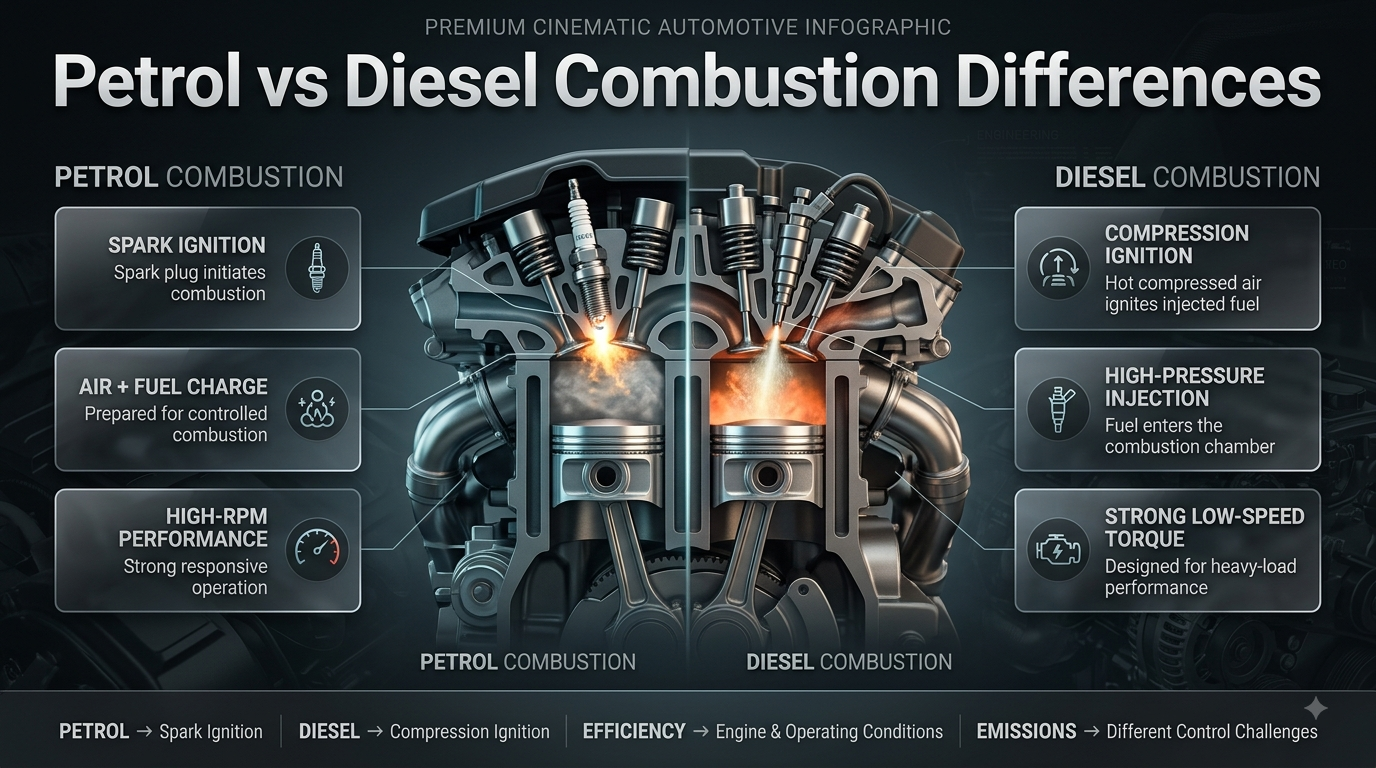
The biggest difference is straightforward: petrol engines normally use spark ignition, while diesel engines normally use compression ignition. A petrol engine prepares an air-fuel charge and uses a spark plug to initiate combustion. A diesel engine compresses air to a high temperature and then injects fuel into that hot compressed air, allowing the fuel to ignite.
But that’s only the beginning.
The way combustion starts affects almost everything else about the engine. It influences how fuel is injected, how much air enters the cylinder, how much compression the engine can use, how torque is produced, how efficiently fuel energy is converted into mechanical work, and what kinds of emissions the engine needs to control.
In this guide, we’ll break down the complete difference between petrol and diesel combustion, explain both processes step by step, compare their efficiency and performance, discuss fuel injection and emissions, cover common misconceptions, and help you understand which type of engine makes more sense for different driving conditions.
For a broader introduction to automotive fuels, you can also explore Fuel Fundamentals before going deeper into the combustion process.
What Is the Main Difference Between Petrol and Diesel Combustion?
The main difference is the method used to start combustion. A petrol engine normally compresses an air-fuel mixture or charge and then uses a spark plug to ignite it. A diesel engine normally compresses air alone to create high pressure and temperature, then injects diesel fuel into that hot air so it can auto-ignite.
This difference is commonly described as:
Petrol = Spark Ignition (SI)
Diesel = Compression Ignition (CI)
Although both engines use a four-stroke cycle in many applications, they manage combustion differently.
| Feature | Petrol Engine | Diesel Engine |
|---|---|---|
| Ignition method | Spark ignition | Compression ignition |
| Fuel | Petrol/gasoline | Diesel |
| Normal spark plug role | Starts combustion | Not used for normal combustion |
| Glow plug | Normally not required | Often used for cold starting |
| Compression ratio | Generally lower | Generally higher |
| Air management | Closely controls air-fuel mixture | Usually operates with excess air |
| Fuel injection | Port or direct injection | High-pressure direct injection |
| Typical torque character | Strong across higher RPM range | Strong low-speed torque |
| Typical efficiency | High, especially in modern engines | Generally high thermal efficiency |
| Common strengths | Smoothness, responsiveness, high RPM | Torque, load carrying, long-distance efficiency |
The important point is that petrol and diesel aren’t simply two different fuels placed into the same engine design.
They are associated with different combustion philosophies.
How Does Petrol Combustion Work?
A petrol engine burns fuel by using a controlled spark to initiate combustion. Air and fuel are brought together in the required proportions, the mixture is compressed, and a spark plug creates a spark at a carefully selected point in the cycle.
The resulting flame spreads through the combustible mixture and produces expanding gases. These gases push the piston downward, creating mechanical work.
The basic four-stroke process is:
- Intake
- Compression
- Power
- Exhaust
Let’s look at what actually happens.
1. Intake Stroke
During the intake stroke, the piston moves downward while the intake valve is open.
Fresh air enters the cylinder. Depending on the engine design, fuel may be introduced into the intake port or directly into the combustion chamber.
Older petrol engines commonly relied on carburetors, but modern engines almost universally use electronic fuel injection.
Modern petrol engines may use:
- Port fuel injection
- Gasoline direct injection
- Turbocharging
- Variable valve timing
- Variable valve lift
- Electronic throttle control
The exact arrangement varies between engines, but the objective is the same: provide the cylinder with the correct conditions for efficient combustion.
2. Compression Stroke
After the intake stroke, the intake valve closes.
The piston moves upward and compresses the charge inside the cylinder.
Unlike a diesel engine, a petrol engine generally doesn’t use extremely high compression ratios because excessive compression and temperature can encourage uncontrolled auto-ignition, commonly associated with engine knock.
The compression process raises pressure and temperature, preparing the mixture for controlled ignition.
3. Spark Ignition
Near the end of the compression stroke, the spark plug creates a high-voltage electrical spark.
This spark provides the initial energy needed to begin combustion.
The spark doesn’t burn the entire mixture instantly. Instead, a flame kernel forms around the spark and develops into a flame front that travels through the mixture.
This is an important distinction when understanding petrol combustion.
The spark initiates combustion; it isn’t responsible for continuously burning every part of the fuel.
4. Power Stroke
As combustion progresses, pressure inside the cylinder rises.
The expanding gases push the piston downward.
The connecting rod transfers this movement to the crankshaft, converting the piston’s reciprocating motion into rotational motion.
That rotational motion is eventually transferred through the transmission and drivetrain to the wheels.
5. Exhaust Stroke
After the useful expansion, the exhaust valve opens.
The piston moves upward and pushes the combustion products out of the cylinder.
The cycle then begins again.
For a deeper explanation of this process, see Petrol Engine Combustion Process.
How Does Diesel Combustion Work?
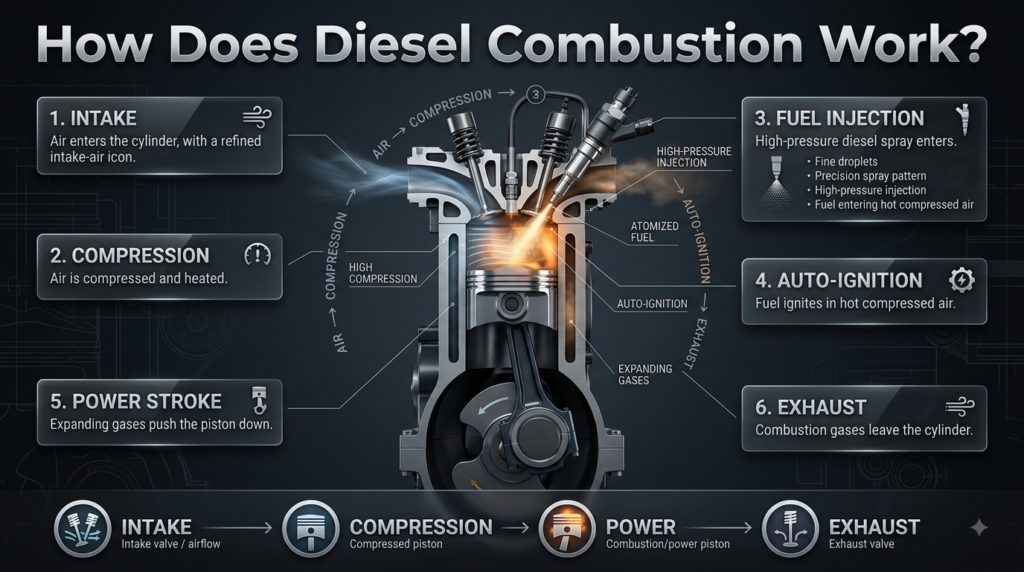
Diesel combustion follows a different sequence.
Instead of bringing a ready-to-burn mixture into the cylinder and then using a spark, a diesel engine normally draws in air, compresses it heavily, and then injects fuel into the hot compressed air.
The high temperature created during compression allows the injected fuel to ignite.
This is why diesel engines are called compression-ignition engines.
The four-stroke cycle is also commonly:
- Intake
- Compression
- Power
- Exhaust
But the combustion event itself is very different from petrol combustion.
1. Intake Stroke
The piston moves downward and the intake valve opens.
Air enters the cylinder.
Unlike a conventional petrol engine, the cylinder generally doesn’t receive a premixed air-fuel charge during the intake stroke.
Instead, the engine primarily takes in air.
2. Compression Stroke
The intake valve closes.
The piston moves upward and compresses the air.
Diesel engines generally use a significantly higher compression ratio than petrol engines.
This compression dramatically increases the temperature of the air.
That high temperature is essential because the diesel fuel will later be injected into this environment.
3. High-Pressure Fuel Injection
Near the end of the compression stroke, the injector sprays diesel fuel into the hot compressed air.
Modern diesel engines use sophisticated high-pressure common-rail injection systems.
The injector has to control:
- Injection timing
- Fuel quantity
- Spray pattern
- Injection pressure
- Number of injection events
The fuel doesn’t simply “drop” into the cylinder.
It is atomized into very small droplets, increasing the surface area available for mixing with air.
4. Auto-Ignition
As the injected fuel mixes with hot compressed air, conditions become suitable for ignition.
The fuel begins to burn without a conventional spark plug initiating the combustion.
This is the defining characteristic of diesel combustion.
5. Expansion and Power
Combustion produces rapidly expanding gases.
These gases push the piston downward.
The crankshaft converts the piston movement into rotational mechanical power.
6. Exhaust
The exhaust valve opens, and the piston pushes combustion products out of the cylinder.
Modern diesel engines then use several emissions-control technologies to treat the exhaust before it reaches the atmosphere.
For a detailed look at this process, see Diesel Engine Combustion Process.
Petrol vs Diesel Combustion Process: Step-by-Step Difference
The easiest way to understand the difference is to compare what happens inside the cylinder.
Petrol Engine
Air + fuel preparation → compression → spark → flame propagation → expansion
Diesel Engine
Air intake → high compression → fuel injection → auto-ignition → expansion
This difference may look simple, but it creates major differences in engine design.
A petrol engine needs an ignition system capable of producing a precisely timed spark.
A diesel engine instead needs a compression system and fuel-injection system capable of producing the correct temperature, pressure, spray pattern, and injection timing.
That’s why diesel fuel systems can operate at extremely high pressures.
Why Does a Petrol Engine Need Spark Plugs?
Petrol engines normally use spark plugs because their combustion strategy is based on controlled spark ignition.
The engine prepares a combustible charge and then starts combustion at a specific crankshaft position.
Spark timing is critical.
If the spark occurs too early, cylinder pressure can rise before the piston reaches the ideal position.
If it occurs too late, the engine may lose efficiency and power because combustion pressure isn’t developed at the most useful point of the cycle.
Modern engine-control systems continuously adjust ignition timing based on operating conditions.
Factors can include:
- Engine speed
- Engine load
- Intake temperature
- Coolant temperature
- Knock detection
- Throttle position
- Fuel characteristics
- Boost pressure
This level of control allows modern petrol engines to achieve much better efficiency and emissions performance than older designs.
Why Doesn’t a Diesel Engine Need Spark Plugs?
A conventional diesel engine doesn’t need spark plugs for normal combustion because the engine creates the required ignition conditions through compression.
When air is compressed strongly, its temperature increases.
The diesel injector then introduces fuel into this hot compressed air.
If the temperature, pressure, fuel properties, and mixture conditions are suitable, the fuel ignites.
This is called auto-ignition or compression ignition.
However, some diesel engines use glow plugs.
Glow plugs are often misunderstood.
They aren’t equivalent to petrol spark plugs.
A glow plug is designed to assist starting and combustion conditions when the engine is cold. Once the engine reaches suitable operating conditions, the diesel combustion process normally doesn’t depend on a spark.
Common Mistake: Saying “diesel engines have no ignition system” is misleading. Diesel engines have an ignition process, but they don’t normally use a spark to initiate combustion.
Glow Plugs vs Spark Plugs
This is one of the most common areas of confusion.
| Feature | Spark Plug | Glow Plug |
|---|---|---|
| Common engine | Petrol | Diesel |
| Main purpose | Initiates combustion | Helps cold starting |
| Creates ignition spark | Yes | No |
| Normal combustion role | Essential | Usually temporary/supportive |
| Works through electrical heating | No | Yes |
A spark plug produces a spark.
A glow plug becomes hot.
Those are two very different functions.
Why Do Diesel Engines Use Higher Compression Ratios?
Compression ratio is one of the most important technical differences between petrol and diesel engines.
A higher compression ratio means the cylinder compresses the charge into a much smaller volume.
In a diesel engine, this high compression is particularly important because it raises the temperature of the intake air.
That temperature provides the environment required for diesel fuel to ignite after injection.
Petrol engines generally use lower compression ratios because excessive compression and temperature can increase the risk of uncontrolled combustion.
However, modern petrol engines have become much better at managing higher compression through:
- Knock sensors
- Precise ignition timing
- Direct injection
- Improved combustion-chamber design
- Variable valve timing
- Advanced engine management
So the old idea that petrol engines always have low compression is no longer accurate.
Does Higher Compression Mean Diesel Is Always More Efficient?
Not automatically.
Higher compression is one reason diesel engines can achieve strong thermal efficiency, but it isn’t the only reason.
Efficiency depends on the entire engine.
Important factors include:
- Compression ratio
- Combustion timing
- Fuel injection
- Air-fuel mixing
- Turbocharging
- Friction
- Heat losses
- Cooling losses
- Exhaust losses
- Engine load
- Operating speed
A modern petrol engine can also achieve excellent efficiency.
For a broader understanding of how different automotive fuels work, see Types of Automotive Fuel.
Petrol vs Diesel Fuel Injection
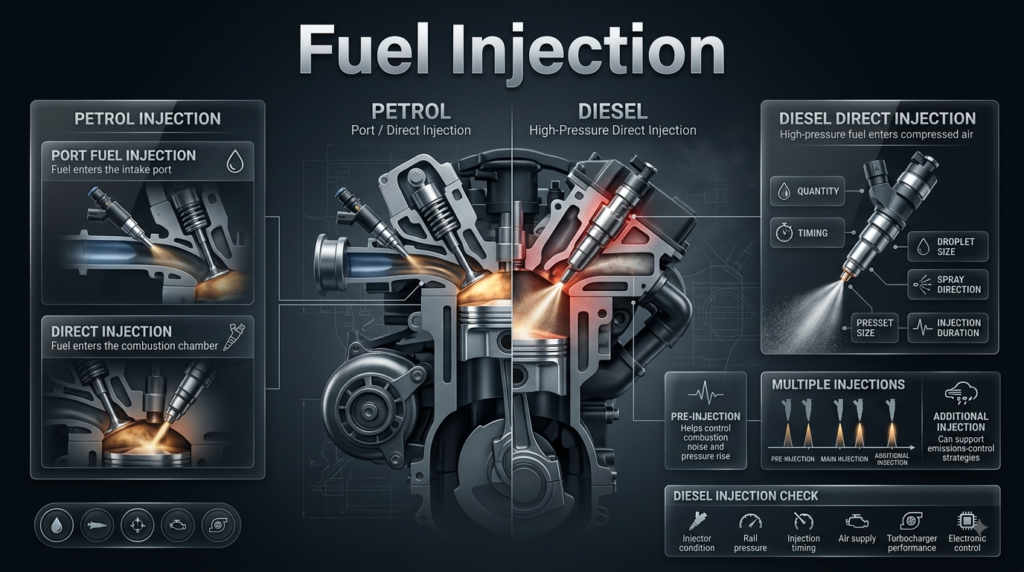
Fuel injection is another major difference between the two combustion systems.
Modern petrol engines may use either:
Port Fuel Injection
Fuel is injected into the intake port before the air enters the combustion chamber.
Direct Injection
Fuel is injected directly into the combustion chamber.
Diesel engines overwhelmingly rely on direct fuel injection.
The fuel is injected directly into highly compressed air inside the cylinder.
This requires extremely precise control.
Why Is Diesel Injection So Important?
Diesel combustion depends heavily on how the fuel spray interacts with the air.
The injector controls the fuel’s:
- Quantity
- Timing
- Pressure
- Droplet size
- Spray direction
- Injection duration
Modern systems can also perform several injections during a single combustion cycle.
For example, an engine may use a small injection before the main injection to help control combustion noise and pressure rise.
Additional injection events may also support emissions-control strategies.
Expert Tip: When diagnosing diesel combustion problems, don’t look only at the fuel filter. Injector condition, rail pressure, injection timing, air supply, turbocharger performance, and electronic control can all influence combustion.
Petrol and Diesel Air-Fuel Mixture Differences
One of the most important differences is how the engines manage air and fuel.
A conventional petrol engine typically aims to control the air-fuel mixture around a specific target for efficient combustion and emissions treatment.
Diesel engines generally operate with excess air over much of their operating range.
The diesel engine controls output primarily by controlling how much fuel is injected.
This is one reason diesel engines can behave differently when you press the accelerator.
The driver is effectively requesting more engine output, and the engine-management system responds by adjusting fuel delivery and air management.
Modern turbocharged engines make the system more sophisticated because the engine can also control boost pressure and airflow.
Petrol vs Diesel Combustion Temperature
It’s tempting to ask which engine burns hotter, but there isn’t one simple answer.
Combustion temperature changes depending on:
- Engine load
- Air-fuel ratio
- Injection timing
- Ignition timing
- Compression ratio
- Engine speed
- Intake temperature
- Combustion chamber design
- Turbocharger boost
Diesel combustion and petrol combustion also distribute heat differently within the cylinder.
This is one reason emission-control strategies differ between the two engine types.
For example, diesel engines have historically required significant attention to NOx and particulate emissions.
Petrol engines have traditionally faced different challenges involving carbon monoxide, hydrocarbons, and NOx, although modern direct-injection petrol engines can also produce particulate matter.
Petrol vs Diesel Efficiency
Diesel engines have traditionally been known for strong fuel efficiency.
There are several reasons.
A diesel engine generally has:
- Higher compression
- High thermal efficiency
- Strong low-speed torque
- Efficient operation under load
- High-pressure direct injection
Diesel vehicles are therefore particularly attractive for drivers who travel long distances.
But this doesn’t mean every diesel vehicle will use less fuel in every situation.
A vehicle’s:
- Weight
- Aerodynamics
- Transmission
- Engine size
- Driving style
- Traffic
- Tire pressure
- Maintenance
- Load
can all affect fuel economy.
A modern petrol hybrid can be exceptionally efficient in urban conditions.
That is why comparing fuel types without considering the vehicle and driving pattern can produce misleading conclusions.
Petrol vs Diesel Torque and Power
Diesel engines are famous for torque.
Petrol engines are often associated with higher-RPM power.
But torque and horsepower aren’t the same thing.
Torque is rotational force.
Power describes how quickly work can be performed.
A diesel engine can produce substantial torque at low RPM, which makes it useful for:
- Towing
- Heavy loads
- Commercial transport
- Climbing hills
- Moving large vehicles
A petrol engine can continue producing useful power at higher RPM, which can make it attractive for performance-oriented applications.
Turbocharging has blurred the distinction, however.
Modern turbocharged petrol engines can produce impressive low-speed torque, while modern turbocharged diesels can deliver strong power across a wide RPM range.
Why Diesel Engines Are Good for Heavy Loads
Diesel engines are commonly used in applications where sustained torque and efficiency matter.
Examples include:
- Trucks
- Buses
- Delivery vehicles
- Construction equipment
- Agricultural machinery
- Heavy SUVs
- Long-distance transport
The combination of high compression, turbocharging, high-pressure injection, and strong low-speed torque makes diesel combustion particularly suitable for these applications.
A diesel engine doesn’t necessarily have to rev extremely high to generate useful pulling force.
That’s a major advantage when the vehicle is carrying substantial weight.
Why Petrol Engines Are Popular for Passenger Cars
Petrol engines have several characteristics that make them attractive for everyday passenger vehicles.
They are often:
- Smooth
- Quiet
- Responsive
- Comfortable at higher RPM
- Well suited to short trips
- Easy to integrate with hybrid systems
Modern petrol engines can also be relatively compact while producing substantial power.
Turbocharging has further improved their flexibility.
A small turbocharged petrol engine can produce performance that would once have required a much larger naturally aspirated engine.
Petrol vs Diesel Emissions

Emissions are another major difference between petrol and diesel combustion.
Both engines produce carbon dioxide because hydrocarbons are being converted into combustion products.
However, the amounts and types of other pollutants can differ.
Diesel Emissions
Diesel engines have historically faced significant challenges with:
- Nitrogen oxides
- Particulate matter
Modern diesel vehicles may therefore use systems such as:
- Diesel particulate filters
- Selective catalytic reduction
- Exhaust gas recirculation
- Diesel oxidation catalysts
- NOx sensors
These systems work together to reduce harmful pollutants.
Petrol Emissions
Petrol engines can produce:
- Carbon monoxide
- Hydrocarbons
- Nitrogen oxides
- Particulate matter, particularly in some direct-injection engines
Modern petrol vehicles commonly use catalytic converters and oxygen sensors to control emissions.
Some modern gasoline direct-injection engines may also use gasoline particulate filters.
Quick Tip: Never judge an engine’s environmental performance from fuel type alone. The vehicle’s emissions standard, technology, maintenance, and real-world operating conditions all matter.
Petrol vs Diesel Fuel Types
Petrol and diesel are both conventional automotive fuels, but their physical and combustion characteristics are different.
Petrol is generally more volatile.
Diesel is less volatile and designed for compression-ignition applications.
Fuel properties influence:
- Ignition behavior
- Injection requirements
- Combustion characteristics
- Storage
- Engine design
- Fuel-system requirements
If you’re comparing fuel categories more broadly, the Petrol and Diesel Fuel Types guide provides useful background before comparing their combustion behavior.
Octane and Cetane: Another Important Difference
Petrol and diesel use different fuel-rating concepts.
Petrol commonly uses octane rating.
Diesel commonly uses cetane rating.
These ratings describe different aspects of fuel behavior.
Octane
Octane rating is primarily related to petrol’s resistance to knock.
A higher-octane petrol isn’t simply “more powerful fuel.”
It is more resistant to uncontrolled auto-ignition under the relevant conditions.
You can learn more about this in Regular vs Premium Petrol Octane.
Cetane
Cetane rating is associated with diesel’s ignition quality.
A higher cetane number generally indicates a shorter ignition delay under standardized testing conditions.
This matters because diesel combustion depends on the fuel igniting after injection into hot compressed air.
So:
Petrol → Octane → resistance to knock
Diesel → Cetane → ignition quality
This is another reason why petrol and diesel shouldn’t be treated as interchangeable fuels.
Why Petrol and Diesel Cannot Simply Use the Same Combustion System
The fuels have different physical and chemical characteristics.
A petrol engine is designed around spark ignition and the characteristics of petrol.
A diesel engine is designed around compression ignition and the characteristics of diesel fuel.
The engine components reflect this.
Diesel engines typically require:
- Stronger internal components
- Higher-pressure fuel systems
- High compression ratios
- Specialized injectors
- Robust engine construction
Petrol engines require:
- Spark plugs
- Ignition coils
- High-voltage ignition systems
- Knock detection
- Precise spark timing
This is why putting the wrong fuel into a vehicle can cause serious problems.
What Happens If Petrol Is Put in a Diesel Engine?
Petrol in a diesel vehicle can be particularly problematic because modern diesel fuel systems depend on diesel fuel for appropriate lubrication and combustion behavior.
Petrol can alter those properties.
The high-pressure pump and injectors may be affected, particularly if the engine is started and the contaminated fuel circulates through the system.
If you realize you’ve put petrol into a diesel vehicle:
- Don’t start the engine.
- Don’t drive the vehicle.
- Contact a qualified recovery or fuel-drain service.
- Have the fuel system assessed before restarting.
The exact consequences depend on the amount of wrong fuel and whether the engine was operated.
What Happens If Diesel Is Put in a Petrol Engine?
Diesel fuel isn’t designed for a conventional petrol engine’s spark-ignition system.
Because diesel is less volatile and has different combustion characteristics, the engine may struggle to start, misfire, smoke, run poorly, or stop.
Again, the safest approach is not to continue driving.
The contaminated fuel should be removed according to the vehicle manufacturer’s recommended procedure.
Common Mistakes People Make About Petrol and Diesel Combustion
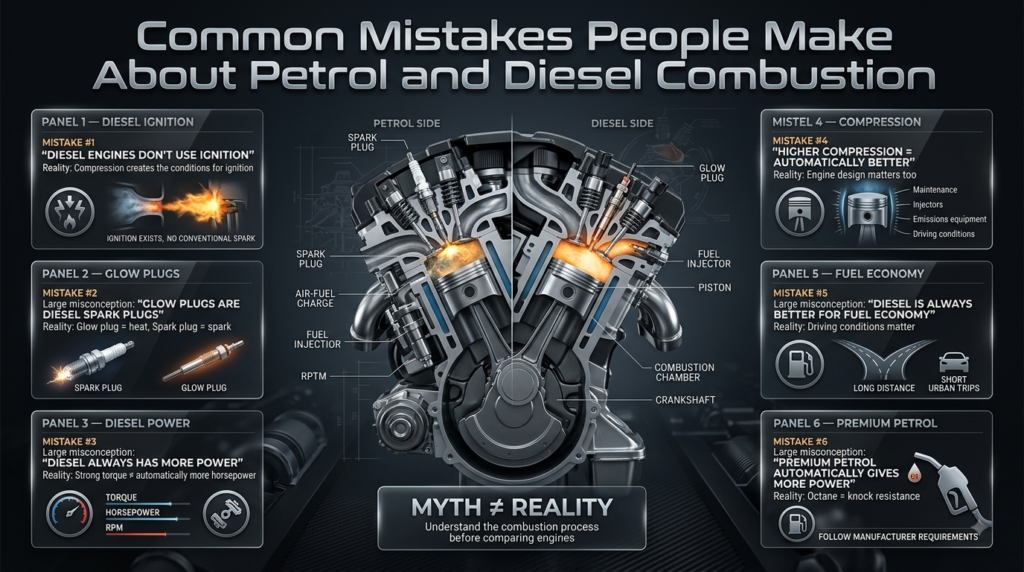
Mistake 1: “Diesel Engines Don’t Use Ignition”
This is technically misleading.
Diesel engines absolutely need fuel to ignite.
The difference is that ignition is achieved through the conditions created by compression rather than a conventional spark.
How to avoid the mistake
Remember:
Spark ignition doesn’t mean “ignition exists.”
It describes how ignition starts.
Mistake 2: “Glow Plugs Are Diesel Spark Plugs”
They’re not.
Glow plugs are heating elements.
Spark plugs create electrical sparks.
They perform completely different jobs.
How to avoid it
Think:
Spark plug = spark
Glow plug = heat
Mistake 3: “Diesel Always Has More Power”
Diesel engines are often strong in torque, but that doesn’t automatically mean they produce more horsepower.
A petrol engine can produce substantially more peak power depending on its design.
How to avoid it
When comparing engines, check:
- Torque
- Horsepower
- RPM
- Vehicle weight
- Gear ratios
- Turbocharging
Mistake 4: “Higher Compression Means Diesel Is Automatically Better”
Higher compression contributes to diesel efficiency, but the entire engine design matters.
A diesel engine with poor maintenance, injector problems, clogged emissions equipment, or unsuitable driving conditions may perform poorly.
Mistake 5: “Diesel Is Always Better for Fuel Economy”
Not necessarily.
Diesel can be excellent for long-distance driving and high annual mileage.
But a driver doing mostly short urban trips may find a petrol or hybrid powertrain more suitable.
Mistake 6: “Premium Petrol Automatically Gives More Power”
Not every engine benefits from higher-octane fuel.
The correct fuel should match the manufacturer’s requirements.
Octane is mainly about resistance to knock, not simply about energy content.
Petrol vs Diesel for City Driving
City driving is one area where the choice deserves careful thought.
Urban driving often involves:
- Frequent starts
- Short trips
- Stop-and-go traffic
- Low average speeds
- Repeated cold starts
Petrol engines can work well in these conditions.
Hybrid petrol systems can be especially effective because they can recover braking energy and reduce engine operation during certain low-speed situations.
Diesel engines can still work perfectly well in cities, but their emissions-control systems may be more demanding.
Drivers who repeatedly take very short trips should understand the requirements of the specific diesel vehicle, particularly if it uses a diesel particulate filter.
Petrol vs Diesel for Highway Driving
Highway driving is traditionally where diesel engines demonstrate many of their strengths.
At steady speeds, a diesel engine can operate efficiently under sustained load.
The combination of high thermal efficiency, strong torque, and favorable gearing can produce excellent long-distance fuel economy.
However, modern petrol engines are also highly capable on highways.
A turbocharged petrol engine can maintain highway speeds efficiently, particularly in a lighter vehicle.
The difference therefore depends on the specific powertrain rather than fuel type alone.
Petrol vs Diesel for Towing
If towing is a major requirement, diesel engines are often attractive because of their strong low-speed torque.
That torque makes it easier to move a heavy combination from a stop and maintain speed under load.
However, towing capability isn’t determined by engine torque alone.
You should also check:
- Maximum towing capacity
- Gross vehicle weight
- Transmission
- Cooling system
- Braking system
- Axle ratings
- Manufacturer’s towing limits
Never exceed the vehicle’s rated capacity simply because the engine has enough torque.
Petrol vs Diesel Maintenance Differences
The combustion system influences maintenance.
Petrol engines typically require attention to:
- Spark plugs
- Ignition coils
- Fuel injectors
- Air filters
- Engine oil
- Sensors
- Catalytic converters
Diesel engines may require attention to:
- Fuel filters
- High-pressure injectors
- Common-rail systems
- Turbochargers
- Glow plugs
- Diesel particulate filters
- EGR systems
- SCR systems
- AdBlue/DEF systems where applicable
This doesn’t mean diesel engines are unreliable.
It means they can have more complex systems because they need to manage high-pressure combustion and modern emissions requirements.
How Maintenance Affects Combustion Quality
Good combustion depends on the engine receiving the right combination of air, fuel, pressure, temperature, and timing.
A dirty air filter can affect airflow.
A poor injector can affect fuel spray.
Incorrect spark timing can affect petrol combustion.
Incorrect injection timing can affect diesel combustion.
A faulty sensor can cause the engine-management system to make incorrect decisions.
That’s why maintenance isn’t just about preventing breakdowns.
It directly affects combustion quality.
Practical Example: Two Drivers, Two Better Choices
Imagine two drivers.
Driver A
They drive 8 km to work each day, mostly through city traffic.
They make short shopping trips and rarely travel long distances.
A modern petrol or hybrid vehicle may be a sensible choice.
Driver B
They travel 100 km every weekday on highways.
They frequently carry equipment and occasionally tow a trailer.
A diesel powertrain may be more appropriate because its efficiency and torque characteristics suit that use.
Neither driver has chosen the “universally better” engine.
They’ve chosen the engine that fits their operating conditions.
That’s the more useful way to think about petrol versus diesel.
How to Choose Between Petrol and Diesel
Before buying a vehicle, ask yourself these questions.
1. How many kilometers do you drive annually?
Low annual mileage may reduce the financial advantage of diesel.
High annual mileage can make diesel’s efficiency more valuable.
2. How much of your driving is highway driving?
Long highway trips generally suit diesel combustion well.
3. Do you tow or carry heavy loads?
If yes, diesel’s strong torque characteristics may be useful.
4. Do you mostly make short trips?
If yes, consider whether petrol or a hybrid system may better fit your driving pattern.
5. How important is smoothness?
If quiet, smooth operation is a major priority, petrol may be attractive.
6. What are the maintenance costs?
Don’t compare fuel prices alone.
Consider:
- Servicing
- Filters
- Injectors
- Emissions systems
- Tires
- Oil
- Repairs
- Vehicle purchase price
The cheapest fuel doesn’t automatically produce the lowest ownership cost.
Expert Advice: Don’t Compare Petrol and Diesel by Fuel Price Alone
One of the most common buying mistakes is calculating only the price of petrol versus diesel.
A professional comparison should include the entire ownership picture.
For example:
Purchase price + fuel cost + maintenance + insurance + expected repairs + resale value + driving pattern
A diesel may use less fuel but cost more to purchase or maintain.
A petrol vehicle may consume slightly more fuel but have lower ownership costs.
The correct answer depends on the vehicle and how long you plan to keep it.
Petrol vs Diesel Combustion: Quick Comparison
| Category | Petrol | Diesel |
|---|---|---|
| Ignition | Spark | Compression |
| Compression | Lower generally | Higher generally |
| Fuel injection | Port/direct | High-pressure direct |
| Low-RPM torque | Usually lower | Usually stronger |
| High-RPM operation | Often strong | Usually lower RPM range |
| Fuel economy | Good to excellent | Often excellent |
| Short trips | Often suitable | Depends on vehicle/use |
| Long-distance driving | Good | Often excellent |
| Heavy towing | Vehicle-dependent | Often strong choice |
| Ignition component | Spark plug | Glow plug for starting on many engines |
| Major emission concerns | CO, HC, NOx, particulates in some designs | NOx and particulates historically significant |
| Typical sound | Smoother/quieter | Traditionally louder, but modern diesels are refined |
| Best application | Passenger/performance/hybrid | Heavy-duty/long-distance/commercial |
What is the main difference between petrol and diesel combustion?
The biggest difference is how combustion starts inside the engine. A petrol engine normally uses a spark plug to ignite a compressed air-fuel charge, while a diesel engine compresses air to a high temperature and then injects diesel fuel into that hot compressed air. The fuel ignites without a conventional spark, which is why petrol engines are called spark-ignition engines and diesel engines are called compression-ignition engines.
This difference isn’t just a technical detail. It determines how the engine manages fuel, air, compression, ignition timing, and combustion. It also helps explain why diesel engines generally use higher compression ratios and why their fuel-injection systems work differently from petrol systems.
Key points to remember:
Petrol: air and fuel are prepared for combustion, then a spark initiates the burn.
Diesel: air is compressed first, then fuel is injected into the hot compressed air.
Petrol engines depend on spark timing.
Diesel engines depend heavily on fuel-injection timing and spray characteristics.
This fundamental difference affects efficiency, torque, emissions, and engine design.
Professional insight: Don’t reduce the comparison to “petrol uses spark and diesel doesn’t.” The real engineering difference is controlled spark ignition versus controlled compression ignition, and that distinction explains most of the other differences between the two engines.
Why are diesel engines generally more fuel efficient than petrol engines?
Diesel engines generally have an efficiency advantage because of their higher compression ratios, lean operation, and combustion strategy. A diesel engine can compress air to a high pressure and temperature before injecting fuel, allowing it to convert a larger share of the fuel’s chemical energy into useful mechanical work. Diesel engines also don’t rely on throttling the intake air in the same way as conventional petrol engines, which can reduce certain pumping losses.
There’s another important point that often gets missed: fuel economy isn’t determined by combustion efficiency alone. Diesel fuel also contains more energy per unit volume than petrol, which can contribute to lower volumetric fuel consumption.
However, don’t assume that every diesel vehicle will automatically use less fuel than every petrol vehicle.
Factors that affect real-world fuel economy include:
Vehicle weight
Engine size
Turbocharger design
Transmission gearing
Driving style
Highway vs city driving
Engine load
Maintenance condition
Aerodynamics
Traffic conditions
Professional insight: Diesel’s efficiency advantage is most meaningful when the engine is used in conditions that suit it. Long-distance driving, sustained loads, and high annual mileage can make the advantage more noticeable. For short urban trips, a modern petrol or hybrid powertrain can be a very competitive alternative.
Why does a diesel engine produce more low-end torque than a petrol engine?
Diesel engines are well known for producing strong torque at relatively low engine speeds because their combustion system is designed around high cylinder pressures, high compression, direct fuel injection, and substantial airflow, often supported by turbocharging.
Torque is essentially the twisting force produced at the crankshaft. When combustion creates high pressure on the piston, that force is transferred through the connecting rod to the crankshaft. A diesel engine’s combustion and mechanical design allow it to produce substantial torque without needing extremely high RPM.
This is particularly useful when a vehicle needs to move a heavy load from a standstill or maintain speed while climbing.
That’s why diesel engines are commonly suited to:
Heavy SUVs
Pickup trucks
Commercial vehicles
Buses
Towing
Long-distance transport
Heavy-duty applications
But there’s an important distinction: more torque doesn’t automatically mean more horsepower.
Horsepower depends on both torque and engine speed. Petrol engines can often operate at higher RPM, allowing them to produce strong peak power even if their low-speed torque isn’t as high.
Professional insight: If you’re choosing an engine for towing or carrying heavy loads, don’t look at horsepower alone. Check the torque curve, the RPM at which peak torque occurs, transmission gearing, and the vehicle’s official towing capacity.
Why does petrol use octane while diesel uses cetane?
Petrol and diesel require different fuel characteristics because their engines use different combustion strategies. Octane rating describes a petrol fuel’s resistance to unwanted auto-ignition or knock. A higher-octane petrol is more resistant to spontaneous combustion under compression and heat.
Diesel fuel is evaluated using cetane, which is related to how readily the fuel ignites under compression. This is important because diesel combustion depends on fuel being injected into hot compressed air and then igniting after a short ignition delay.
So the two ratings shouldn’t be treated as direct equivalents.
Think of them this way:
Petrol → Octane → resistance to unwanted ignition
Diesel → Cetane → ignition quality/readiness
This is also why saying “higher octane means more powerful fuel” is misleading. Octane primarily describes resistance to knock; it isn’t simply a measurement of how much energy the fuel contains.
Important points:
Use the fuel grade recommended by the vehicle manufacturer.
Higher octane isn’t automatically better for every petrol engine.
Diesel fuel quality also matters for proper ignition and injection performance.
Petrol and diesel fuel ratings are designed around different engine requirements.
Professional insight: This is one of the best sections to include in a petrol-vs-diesel combustion article because it explains why the fuels themselves are formulated differently, rather than treating them as interchangeable liquids.
Which is better for combustion efficiency: petrol or diesel?
For traditional internal-combustion powertrains, diesel combustion generally has an efficiency advantage, particularly under operating conditions where its higher compression ratio and lean combustion strategy can be used effectively. The National Academies identifies higher compression ratios, lean mixtures, and reduced throttling losses among the major reasons for the thermodynamic efficiency advantage of compression-ignition diesel engines.
But “diesel is more efficient” doesn’t mean diesel is automatically the better engine for every driver.
A petrol engine can be highly efficient when it uses technologies such as direct injection, turbocharging, variable valve timing, cylinder deactivation, or hybrid assistance. Modern engine development has also blurred the traditional boundary between petrol and diesel combustion. Some advanced petrol engines have experimented with compression-ignition strategies to capture some of the efficiency benefits associated with diesel combustion.
The better question is therefore:
Which engine converts fuel energy efficiently under the conditions where I actually drive?
For example:
Long highway journeys → diesel can be very efficient.
Heavy loads → diesel’s combustion characteristics can be advantageous.
Short urban trips → petrol or hybrid can make more sense.
High-RPM performance → petrol often has an advantage.
High annual mileage → diesel efficiency may become more valuable.
Professional insight: Don’t compare petrol and diesel efficiency using a single fuel-economy number. Compare the engine, vehicle weight, transmission, driving pattern, annual mileage, maintenance requirements, and fuel consumption together. That’s the comparison that actually helps a buyer make a good decision.
Conclusion
Understanding petrol diesel combustion differences makes it much easier to see why these two engine types behave differently on the road. The fundamental distinction is simple: petrol engines normally rely on spark ignition, while diesel engines use compression ignition. From that one difference, many other characteristics follow, including compression ratio, fuel injection, torque delivery, efficiency, emissions, and engine design.
Petrol engines are generally well suited to smooth passenger-car operation, short trips, high-RPM performance, and many modern hybrid applications. Diesel engines are particularly effective where strong low-speed torque, long-distance efficiency, towing, heavy loads, and sustained operation are important.
The important thing is not to assume that one fuel is always better. The best choice depends on how the vehicle is actually used. A diesel can be an excellent option for a driver covering long highway distances, while a petrol or hybrid powertrain may make more sense for someone who mainly drives short urban routes.
Ultimately, knowing how each engine burns fuel helps you make a more informed decision—not only about fuel economy, but also about performance, maintenance, emissions, and long-term ownership. Once you understand the combustion process, the differences between petrol and diesel become much easier to evaluate in practical terms.
Leave a Reply