
Introduction
Diesel Engine Combustion Process | A diesel engine can keep a heavy truck moving for hundreds of kilometres, power construction equipment, run generators, and deliver strong torque without using a conventional spark to ignite its fuel. But how does that actually happen inside the cylinder?
The answer lies in the diesel engine combustion process.
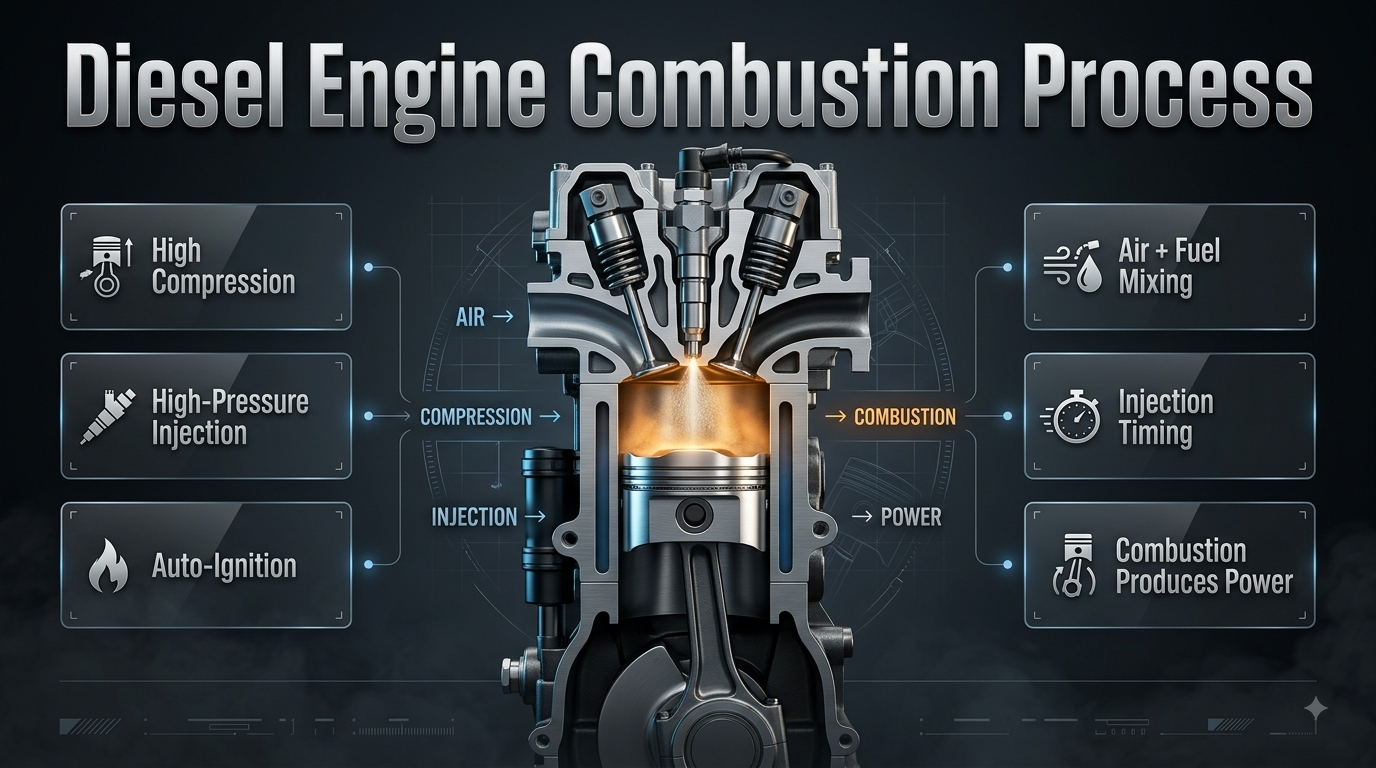
Unlike a traditional petrol engine, a diesel engine first compresses air to create very high temperature and pressure. Diesel fuel is then injected directly into that hot compressed air. Under the right conditions, the fuel auto-ignites and releases energy that pushes the piston downward.
This sounds straightforward, but the actual process is carefully controlled. Fuel injection pressure, injection timing, air supply, compression ratio, fuel quality, injector spray pattern, combustion-chamber design, and engine temperature all influence how efficiently diesel fuel burns.
In this complete guide, you’ll learn exactly how diesel combustion works, what happens during each stage of the four-stroke cycle, how diesel fuel ignites without a spark plug, what ignition delay means, how common-rail injection changes combustion, and what causes smoke, rough running, poor fuel economy, and other combustion problems.
If you want a broader understanding of automotive fuels before going deeper into diesel combustion, you can also read Fuel Fundamentals.
For drivers who car ran out of petrol Dubai 👉 Fuel Delivery Dubai, understanding the correct fuel and combustion requirements can also be useful when arranging emergency fuel delivery.
What Is the Diesel Engine Combustion Process?
The diesel engine combustion process is the controlled sequence in which air is drawn into the cylinder, compressed to a high temperature, diesel fuel is injected into the compressed air, the fuel auto-ignites, and the resulting combustion gases expand to produce mechanical power.
In a conventional diesel engine, there is no spark plug initiating the main combustion event.
Instead, the engine creates the conditions required for ignition through compression.
The simplified process looks like this:
Air intake → Compression → Fuel injection → Ignition delay → Auto-ignition → Combustion → Expansion → Exhaust
Each stage has an important job.
If the engine doesn’t receive enough air, fuel may not burn properly. If compression is too low, the cylinder may not reach the temperature needed for reliable ignition. If injection timing is incorrect, combustion may occur at the wrong point in the cycle.
That’s why diesel combustion should be viewed as a complete system rather than simply “fuel burning inside a cylinder.”
Why Is Diesel Combustion Different From Petrol Combustion?
The biggest difference is the way ignition is initiated.
A conventional petrol engine generally mixes air and fuel and uses a spark plug to start combustion. A diesel engine normally compresses air first and injects diesel fuel into the hot compressed air.
This fundamental difference affects almost everything else, including:
- Compression ratio
- Fuel properties
- Injection strategy
- Ignition timing
- Combustion chamber design
- Engine noise
- Torque characteristics
- Emissions control
Diesel fuel is therefore designed around compression-ignition operation, while petrol is designed around spark-ignition operation.
For a broader comparison, see Petrol and Diesel Fuel Types.
How Does a Diesel Engine Combustion Process Work?
A typical four-stroke diesel engine completes its basic operating cycle through four strokes:
- Intake
- Compression
- Power
- Exhaust
The actual combustion event occurs around the end of the compression stroke and continues into the power stroke.
Let’s look at each stage in practical terms.
1. Intake Stroke: How Does Air Enter a Diesel Engine?
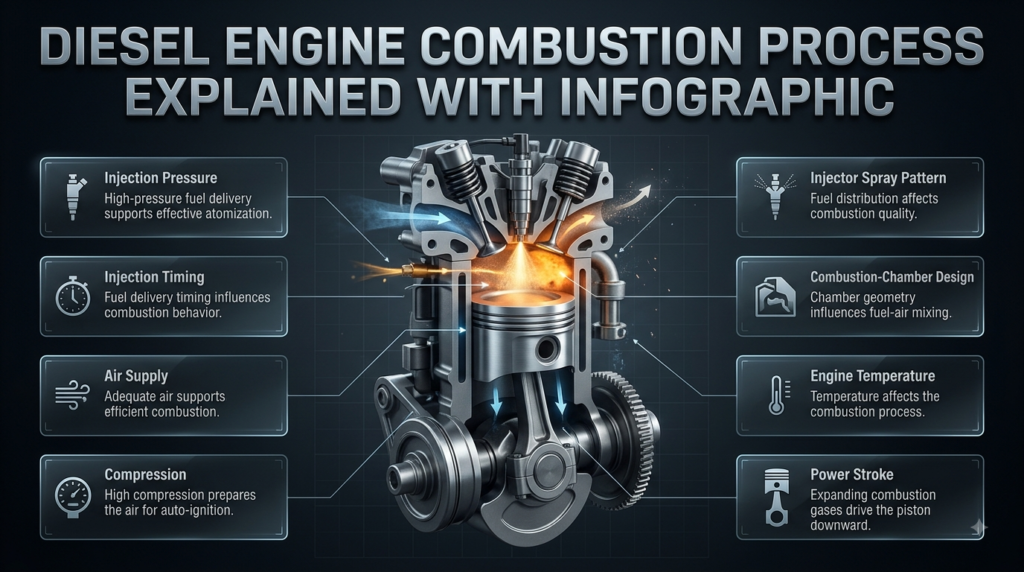
During the intake stroke, the piston moves downward inside the cylinder while the intake valve is open.
Fresh air enters the cylinder.
Unlike a conventional petrol engine, a diesel engine generally doesn’t control engine load by restricting the incoming air with a traditional throttle plate in the same way. Instead, diesel engine output is primarily controlled by changing how much fuel is injected.
This is important because the diesel engine usually has access to a large amount of air, while the fuel quantity determines how much energy is released.
Turbocharged diesel engines can take this further by forcing additional air into the cylinder.
More air means more oxygen is available for combustion.
Why Is Air So Important in Diesel Combustion?
Diesel fuel can’t burn efficiently without sufficient oxygen.
When the engine receives the right amount of air and the injector delivers the correct amount of fuel, combustion can be controlled more effectively.
If air supply is restricted, the engine may produce excessive soot and black smoke.
Potential causes include:
- A heavily restricted air filter
- Turbocharger problems
- Intake restrictions
- Boost leaks
- Faulty sensors
- EGR-related airflow problems
- Problems with the intercooler or intake system
Professional advice: Don’t automatically blame the fuel system when a diesel engine produces black smoke. Air supply should also be investigated.
2. Compression Stroke: How Does a Diesel Engine Create Ignition Temperature?
After the intake stroke, the intake valve closes.
The piston starts moving upward.
The air trapped inside the cylinder is compressed into a much smaller volume.
This compression dramatically increases both pressure and temperature.
This is the foundation of compression ignition.
A diesel engine generally uses a higher compression ratio than a typical petrol engine because it needs to generate the conditions necessary for reliable auto-ignition.
The compression ratio is essentially the relationship between the cylinder’s maximum volume and its minimum volume.
For example, if a cylinder has a compression ratio of 18:1, the air is compressed from its larger volume down to roughly one-eighteenth of that volume.
The exact compression ratio varies between engines, and modern diesel combustion strategies don’t depend on compression ratio alone. Injection pressure, turbocharging, combustion-chamber geometry, and electronic control are also extremely important.
What Happens If Diesel Engine Compression Is Too Low?
Low compression can make diesel combustion difficult because the air may not reach the temperature required for reliable ignition.
Possible symptoms include:
- Difficult starting
- Long cranking
- White smoke
- Rough idle
- Low power
- Poor fuel economy
- Misfire
- Poor cold starting
Low compression can result from mechanical problems such as worn piston rings, valve leakage, cylinder wear, or other internal engine issues.
This is why a diesel engine with a fuel-system problem and one with a compression problem can sometimes show similar symptoms.
A proper diagnosis is more useful than replacing parts based only on symptoms.
3. Fuel Injection: When Is Diesel Fuel Injected?
Near the end of the compression stroke, the fuel injector sprays diesel into the hot compressed air.
This is one of the most important moments in the entire diesel engine combustion process.
The injector must deliver:
- The correct quantity of fuel
- At the correct pressure
- At the correct timing
- With the correct spray pattern
- For the correct duration
Modern diesel engines can perform these tasks with extremely precise electronic control.
Why Is Diesel Fuel Injected at High Pressure?
High injection pressure helps the injector break the fuel into very small droplets.
This process is called atomization.
Smaller droplets generally provide more surface area relative to their volume, helping the fuel evaporate and mix with the surrounding air more effectively.
Better atomization can contribute to:
- More controlled combustion
- Better fuel efficiency
- Reduced soot
- Improved power
- Better emissions performance
Modern common-rail diesel systems can operate at very high pressures compared with older mechanical injection systems.
The exact pressure depends on engine design and operating conditions.
4. What Is Fuel Atomization in a Diesel Engine?
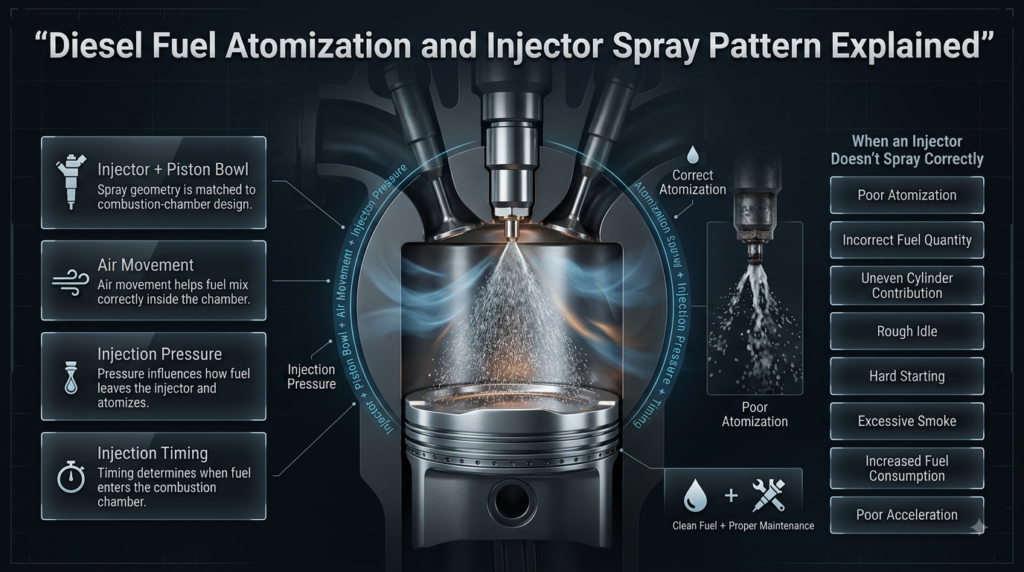
Fuel atomization is the process of breaking liquid diesel fuel into a fine spray of small droplets as it leaves the injector.
The injector nozzle is designed to create a particular spray pattern that matches the combustion chamber.
The spray isn’t random.
Engine designers carefully match:
Injector + piston bowl + air movement + injection pressure + timing
This relationship is critical.
If the spray pattern is poor because of injector wear or contamination, fuel may not mix with air correctly.
That can lead to incomplete combustion and increased soot.
What Happens When an Injector Doesn’t Spray Correctly?
A worn or contaminated injector may produce:
- Poor atomization
- Incorrect fuel quantity
- Uneven cylinder contribution
- Rough idle
- Hard starting
- Excessive smoke
- Increased fuel consumption
- Poor acceleration
This is one reason modern diesel injectors need clean fuel and proper maintenance.
5. What Is Ignition Delay in Diesel Combustion?
After fuel injection begins, combustion doesn’t necessarily start instantly.
The short interval between the beginning of fuel injection and the beginning of noticeable combustion is called ignition delay.
During this period:
- Fuel leaves the injector.
- Fuel droplets break up.
- Fuel begins evaporating.
- Fuel vapour mixes with hot air.
- Chemical reactions begin.
- Auto-ignition starts when suitable conditions are reached.
Ignition delay is extremely important because it affects how much fuel is prepared for combustion before the first part of the mixture ignites.
If too much fuel accumulates during the delay period, combustion can develop very rapidly.
That can create a sharp rise in cylinder pressure and contribute to the characteristic hard diesel combustion sound.
What Factors Affect Ignition Delay?
Ignition delay can be affected by:
- Air temperature
- Compression pressure
- Fuel properties
- Cetane quality
- Injection timing
- Injection pressure
- Fuel spray characteristics
- Engine temperature
- Combustion-chamber conditions
This is where cetane number becomes important.
What Is Cetane Number and Why Does It Matter?
Cetane number is a measure related to the ignition quality of diesel fuel under compression-ignition conditions.
A fuel with better ignition quality generally has a shorter ignition delay under appropriate test conditions.
This can help produce smoother ignition characteristics.
Cetane should not be confused with octane.
Cetane is associated with diesel ignition quality.
Octane is associated with petrol’s resistance to knock.
These are different fuel properties designed around different combustion systems.
For a general introduction to automotive fuel characteristics, see Automotive Fuel Types.
6. How Does Diesel Fuel Auto-Ignite?
Once the injected fuel has mixed sufficiently with the hot compressed air, portions of the mixture reach conditions suitable for auto-ignition.
The fuel begins burning without a spark.
This is the defining feature of compression ignition.
The combustion process then spreads through regions where the fuel and air are in suitable proportions and where temperature conditions support combustion.
However, diesel combustion isn’t simply one perfectly mixed cloud of fuel and air.
The cylinder contains areas with different fuel concentrations.
Some areas may be fuel-rich, while others are closer to lean conditions.
This complex mixing process is one reason diesel combustion is so dependent on injector design and air movement.
7. What Happens During the Power Stroke?
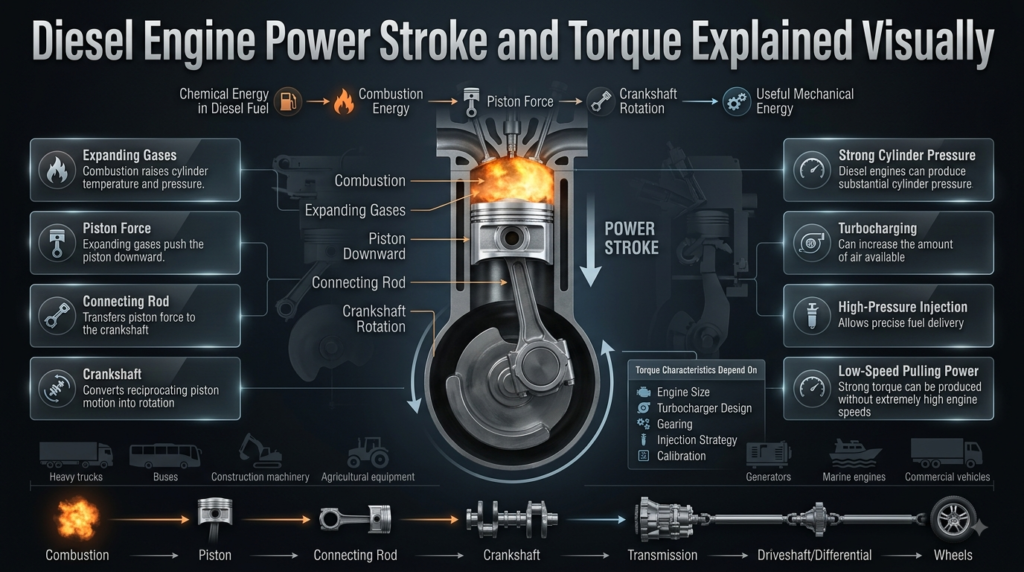
As combustion releases energy, the temperature and pressure inside the cylinder rise sharply.
The expanding gases push the piston downward.
This is the power stroke.
The piston transfers its force through the connecting rod to the crankshaft.
The crankshaft converts the piston’s reciprocating motion into rotation.
That rotational energy eventually drives the vehicle’s wheels or the equipment connected to the engine.
This is the point where the chemical energy stored in diesel fuel becomes useful mechanical energy.
Why Do Diesel Engines Produce Strong Torque?
Diesel engines are commonly designed to produce substantial cylinder pressure and strong torque at relatively low engine speeds.
Turbocharging can increase the amount of air available, while high-pressure fuel injection allows precise fuel delivery.
The result can be strong pulling power without requiring extremely high engine speeds.
That’s one reason diesel engines are widely used in:
- Heavy trucks
- Buses
- Construction machinery
- Agricultural equipment
- Generators
- Marine engines
- Commercial vehicles
The exact torque characteristics still depend on engine size, turbocharger design, gearing, injection strategy, and calibration.
How Does the Crankshaft Convert Combustion Into Power?
The piston moves vertically, but the wheels of a vehicle need rotational motion.
The connecting rod links the piston to the crankshaft.
As combustion pushes the piston downward, the connecting rod transfers that force to the crankshaft.
The crankshaft rotates.
That rotation is then transferred through the drivetrain.
In a vehicle, the power path is broadly:
Combustion → Piston → Connecting Rod → Crankshaft → Transmission → Driveshaft/Differential → Wheels
The engine’s combustion process is therefore only the beginning of the complete power-delivery system.
8. Exhaust Stroke: Where Do the Combustion Gases Go?
After the power stroke, the exhaust valve opens.
The piston travels upward again and pushes the remaining combustion gases out of the cylinder.
The gases then enter the exhaust system.
In a modern diesel vehicle, exhaust gases may pass through several emissions-control components.
These can include:
- Diesel oxidation catalyst
- Diesel particulate filter
- Selective catalytic reduction system
- NOx control systems
- EGR system
The exact system depends on the engine and emissions standard.
This is why modern diesel combustion can’t be considered separately from emissions technology.
Diesel Engine Combustion Process at a Glance
        INTAKE
           ↓
     Fresh air enters
           ↓
      COMPRESSION
           ↓
 Hot, high-pressure air
           ↓
     FUEL INJECTION
           ↓
 Fuel atomization + mixing
           ↓
     IGNITION DELAY
           ↓
      AUTO-IGNITION
           ↓
       COMBUSTION
           ↓
 Expanding gases push piston
           ↓
       POWER OUTPUT
           ↓
        EXHAUST
The important concept is that diesel fuel is injected after the air has already been compressed and heated.
What Is the Difference Between Diesel and Petrol Combustion?
Diesel and petrol engines both convert fuel energy into mechanical power, but they use different approaches to ignition and combustion control.
| Feature | Diesel Engine | Petrol Engine |
|---|---|---|
| Main ignition method | Compression ignition | Spark ignition |
| Main ignition device | Hot compressed air | Spark plug |
| Fuel injection | Often direct injection | Port or direct injection depending on design |
| Compression ratio | Generally higher | Generally lower |
| Fuel quality characteristic | Cetane | Octane |
| Load control | Primarily fuel quantity | Traditionally throttle/airflow |
| Typical torque behavior | Strong low-speed torque | Varies by engine |
| Combustion control | Injection, air and timing | Spark, fuel and airflow |
| Common applications | Heavy-duty and commercial use | Passenger cars and many light-duty applications |
Modern engines are increasingly sophisticated, so these differences shouldn’t be treated as absolute rules for every engine design.
For readers who want to understand the broader fuel comparison, Petrol and Diesel Fuel Types is a useful related resource.
How Does Common-Rail Injection Improve Diesel Combustion?
Common-rail injection is one of the biggest developments in modern diesel technology.
Instead of relying entirely on older mechanical systems, a common-rail system stores fuel under high pressure in a common rail.
Electronic injectors then deliver precisely controlled amounts of fuel into each cylinder.
The engine control unit can adjust injection according to operating conditions.
This allows modern engines to use multiple injection events during a single combustion cycle.
What Is Pilot Injection?
Pilot injection is a small amount of fuel injected before the main fuel delivery.
Its purpose can include helping control the rate of pressure rise and reducing combustion noise.
Instead of allowing a large amount of fuel to accumulate before combustion, the engine can use carefully controlled pilot injection to influence the combustion process.
What Is Main Injection?
Main injection provides most of the fuel responsible for producing useful engine power.
The timing and quantity of the main injection have a major influence on:
- Torque
- Power
- Fuel economy
- Cylinder pressure
- Exhaust emissions
What Is Post Injection?
Post injection occurs after the main combustion event.
Depending on the engine’s strategy, it can help manage exhaust temperature and emissions-control functions, including particulate-filter regeneration strategies.
It isn’t simply “extra fuel for power.”
Its role is often related to emissions management.
Why Is Injection Timing So Important?
Injection timing determines when fuel enters the cylinder relative to piston position.
Even a small timing change can affect combustion behavior.
If Fuel Is Injected Too Early
Early injection can cause combustion to begin while the piston is still approaching top dead center.
This may increase pressure at an undesirable point in the cycle.
Potential results can include:
- Increased combustion noise
- Higher mechanical stress
- Poor efficiency
- Increased NOx under certain conditions
If Fuel Is Injected Too Late
Late injection can cause combustion to occur too far into the expansion stroke.
Potential results include:
- Lower efficiency
- Increased exhaust temperature
- More smoke
- Reduced power
- Poor fuel economy
Modern engines use electronic controls to adjust injection timing based on operating conditions.
Expert Tip: Injection timing is not something to adjust casually on a modern diesel engine. The correct setting depends on the engine’s calibration, sensors, fuel pressure, temperature, load, and emissions strategy.
How Does Turbocharging Affect Diesel Combustion?
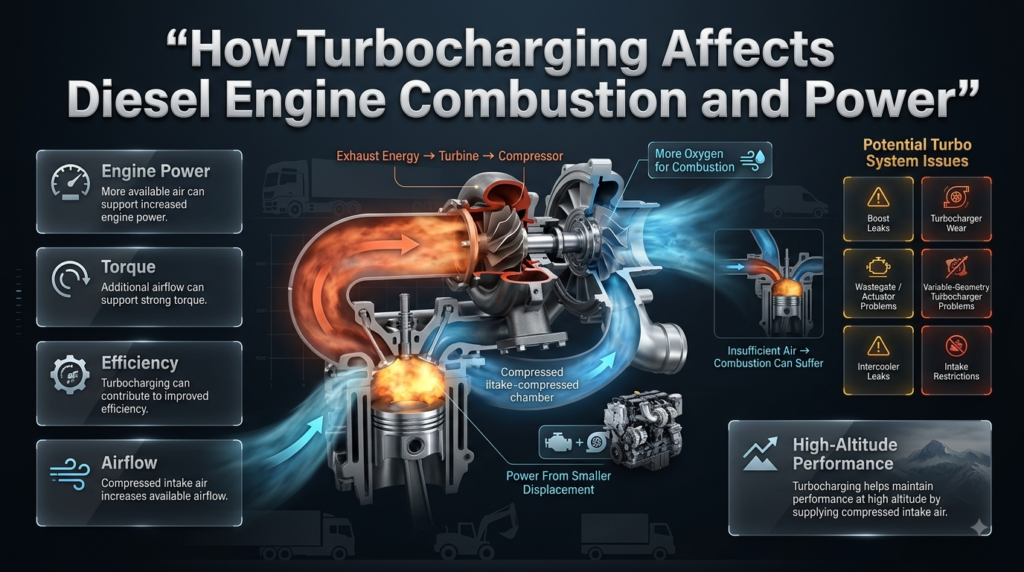
A turbocharger uses exhaust energy to compress incoming air.
The compressed air contains more oxygen than naturally aspirated air at the same intake volume.
This gives the engine more oxygen to support combustion.
Turbocharging can therefore help increase:
- Engine power
- Torque
- Efficiency
- Airflow
- High-altitude performance
A turbocharged diesel engine can produce substantial power from a relatively small displacement.
However, turbocharging also creates additional components that can fail.
Potential issues include:
- Boost leaks
- Turbocharger wear
- Wastegate or actuator problems
- Variable-geometry turbocharger problems
- Intercooler leaks
- Intake restrictions
If the engine isn’t receiving the expected amount of air, combustion can suffer.
What Role Does the Intercooler Play?
When a turbocharger compresses air, the air temperature generally rises.
An intercooler cools the compressed intake air before it enters the engine.
Cooler intake air is denser, meaning a given volume can contain more oxygen.
This supports more effective combustion and helps manage intake temperatures.
A damaged or leaking intercooler system can therefore affect diesel engine performance.
Possible symptoms can include:
- Reduced power
- Poor acceleration
- Excessive smoke
- Boost pressure problems
- Increased fuel consumption
What Role Does EGR Play in Diesel Combustion?
EGR stands for Exhaust Gas Recirculation.
The system routes a controlled amount of exhaust gas back into the intake under selected operating conditions.
The primary purpose is emissions control, particularly reducing nitrogen oxide formation.
Recirculated exhaust gas changes the composition of the intake charge and can reduce combustion temperature.
However, EGR also influences airflow and combustion behavior.
A malfunctioning EGR system can contribute to:
- Poor acceleration
- Rough running
- Excessive deposits
- Increased smoke
- Check-engine warnings
- Reduced efficiency
This is another reason diesel combustion must be considered as part of an integrated engine system.
What Makes Diesel Combustion Efficient?
Efficient diesel combustion happens when the engine can introduce the right amount of fuel into the right amount of air at the right time.
There isn’t one component responsible for efficiency.
Instead, several systems must work together:
- Adequate compression
- Clean intake air
- Correct fuel pressure
- Proper injector spray
- Accurate injection timing
- Suitable fuel quality
- Correct engine temperature
- Effective turbocharging
- Proper combustion-chamber design
- Correct electronic control
If any major part of this chain becomes inefficient, combustion can suffer.
A Simple Example
Imagine an injector delivering the correct quantity of fuel, but the turbocharger isn’t supplying enough air.
The fuel may still enter the cylinder, but the available oxygen may not be sufficient for clean combustion.
The result can be increased soot and black smoke.
Now imagine the air supply is perfect but an injector is delivering an incorrect spray pattern.
Again, combustion quality can decline.
That’s why diagnosing diesel combustion requires looking at the whole system.
What Are the Main Phases of Diesel Combustion?
Diesel combustion is often described using several phases rather than treating it as one instant event.
The exact terminology can vary, but the process can be understood through four broad stages.
1. Ignition Delay Phase
Fuel is injected and begins evaporating and mixing with hot compressed air.
Chemical reactions start before noticeable combustion develops.
2. Rapid Combustion Phase
Some of the fuel prepared during the ignition-delay period ignites.
If significant fuel has accumulated, the rate of combustion can rise rapidly.
This phase has a strong influence on combustion noise and cylinder pressure.
3. Mixing-Controlled Combustion
As injection continues, combustion becomes strongly influenced by how quickly fuel mixes with available oxygen.
The injector spray and air movement become extremely important.
4. Late Combustion
Some remaining fuel and partially oxidized material continue reacting later in the combustion process.
Efficient engine design aims to keep this late combustion under control because combustion occurring too late can reduce efficiency and increase exhaust temperatures.
Why Does Diesel Combustion Produce Soot?
Soot forms when some fuel-rich regions don’t have enough oxygen to completely oxidize the carbon-containing fuel.
Diesel combustion occurs in a complex spray environment where some areas can temporarily be fuel-rich while others contain more oxygen.
Good injection and air management help reduce these rich regions.
Modern diesel engines also use particulate filters to capture soot from the exhaust.
What Increases Soot Production?
Potential contributors include:
- Poor injector atomization
- Excessive fueling
- Restricted airflow
- Turbocharger problems
- Poor combustion
- Incorrect injection timing
- EGR-related issues
- Poor fuel quality
- Engine wear
Soot doesn’t automatically mean the engine needs an injector.
A professional diagnosis should determine whether the problem originates in the fuel system, air system, combustion process, or emissions system.
Why Does a Diesel Engine Produce Black Smoke?
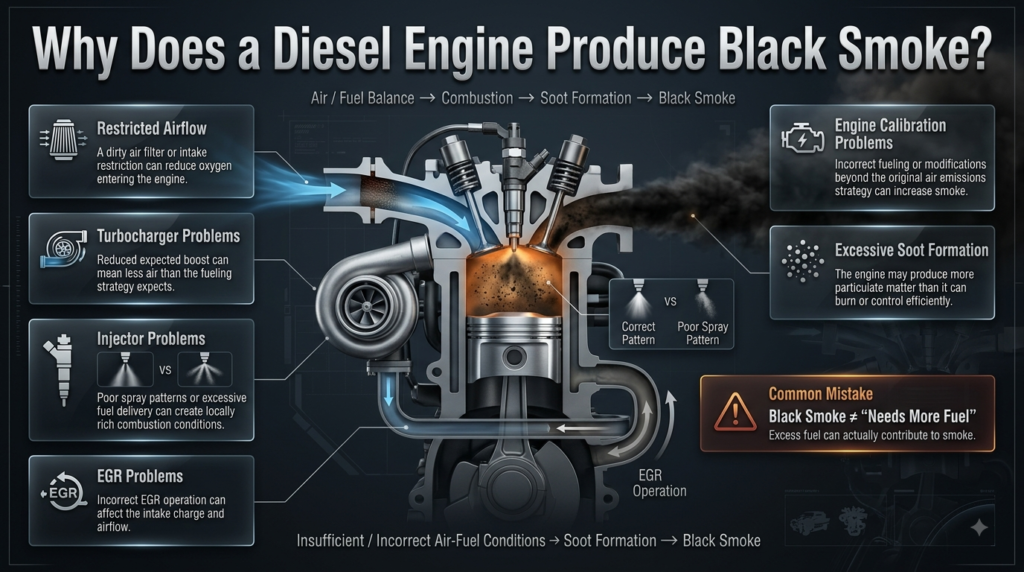
Black smoke is commonly associated with excessive soot formation.
In simple terms, the engine is producing more particulate matter than it can burn or control efficiently.
Possible causes include:
Restricted Airflow
A dirty air filter or intake restriction can reduce the amount of oxygen entering the engine.
Turbocharger Problems
If a turbocharged diesel doesn’t develop the expected boost pressure, the engine may receive less air than the fueling strategy expects.
Injector Problems
Poor spray patterns or excessive fuel delivery can create locally rich combustion conditions.
EGR Problems
Incorrect EGR operation can affect the intake charge and airflow.
Engine Calibration Problems
Incorrect fueling or modifications that exceed the original air and emissions strategy can increase smoke.
Common Mistake: Don’t assume black smoke means “the engine needs more fuel.” Excess fuel can actually be the reason the engine is smoking.
What Does White Smoke Mean on a Diesel Engine?
White smoke can have several causes.
One common situation is incomplete combustion during cold starting.
If the cylinder isn’t reaching suitable combustion conditions, some injected diesel may fail to burn completely.
Possible causes include:
- Low engine temperature
- Glow-plug problems
- Poor atomization
- Incorrect injection timing
- Low compression
- Fuel-system problems
White smoke can also have a different appearance when coolant enters the combustion chamber.
Because different problems can produce similar-looking exhaust, persistent white smoke should be diagnosed rather than identified by colour alone.
What Does Blue Smoke Mean?
Blue or blue-grey smoke is generally associated with engine oil entering the combustion process.
Possible sources include:
- Worn piston rings
- Cylinder wear
- Valve-seal problems
- Turbocharger oil leakage
- Excessive oil entering the intake
This is different from a typical fuel-injection problem.
If a diesel engine is producing persistent blue smoke and consuming engine oil, the lubrication and engine mechanical systems should be investigated.
Can Poor Diesel Fuel Affect Combustion?
Yes.
Diesel engines, particularly modern high-pressure common-rail engines, depend on clean fuel.
Fuel contamination can interfere with injector performance and fuel-system components.
Potential contaminants include:
- Water
- Dirt
- Sediment
- Incorrect fuel
- Degraded fuel
- Other contaminants
Water is particularly undesirable because it doesn’t provide the same lubrication characteristics as diesel fuel and can contribute to corrosion or fuel-system damage.
For general information about fuel categories and characteristics, see Types of Automotive Fuel.
Why Is Fuel Quality Important in Modern Diesel Engines?
Modern injectors use very small clearances and operate at extremely high pressures.
That means contamination that might have been tolerated by an older mechanical system can cause problems in a modern fuel system.
Good fuel quality supports:
- Reliable injection
- Consistent atomization
- Proper injector operation
- Better combustion
- Lower contamination risk
The correct approach isn’t simply buying the most expensive fuel.
The fuel should meet the engine manufacturer’s required specification.
What Happens When a Diesel Injector Becomes Dirty or Worn?
The injector is one of the most important components in diesel combustion.
It determines how fuel enters the cylinder.
A damaged injector can alter:
- Fuel quantity
- Spray pattern
- Droplet size
- Injection timing
- Injection duration
This can affect the entire combustion event.
Common Injector-Related Symptoms
A faulty injector may contribute to:
- Rough idle
- Hard starting
- Excessive smoke
- Knocking or combustion noise
- Poor acceleration
- Increased fuel consumption
- Uneven engine operation
- Higher emissions
However, these symptoms can also come from other systems.
That is why injector replacement shouldn’t be based on symptoms alone.
How Does Low Compression Affect Diesel Combustion?
Compression is critical because diesel ignition depends on the temperature produced by compressing air.
If compression falls too low, the cylinder may not create the conditions required for reliable ignition.
Mechanical causes can include:
- Worn piston rings
- Cylinder wear
- Valve leakage
- Head-gasket problems in certain cases
- Valve-train issues
- Other internal engine damage
A compression test or leak-down testing, where appropriate, can help determine whether the engine has a mechanical compression problem.
What Causes Hard Starting in a Diesel Engine?
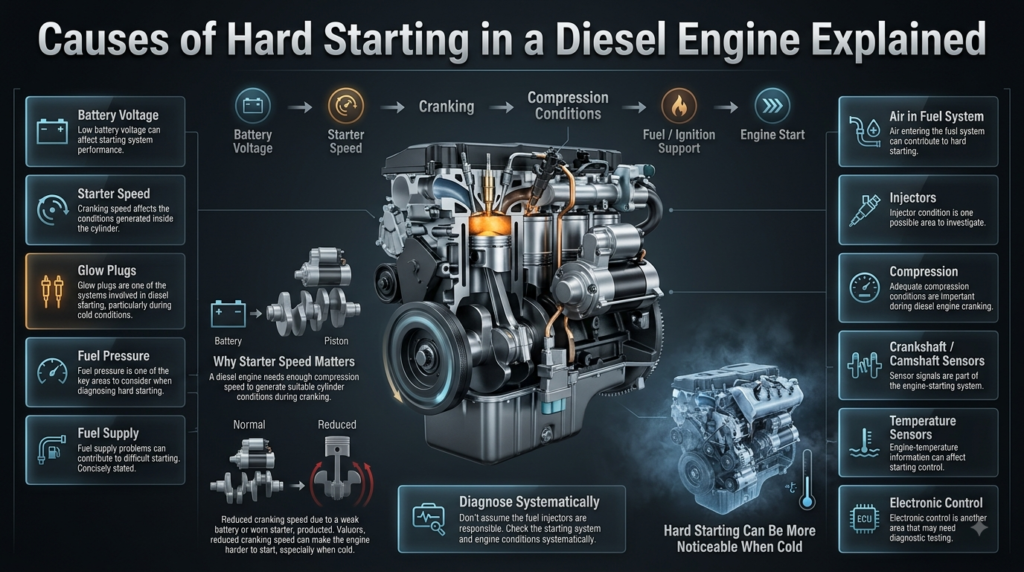
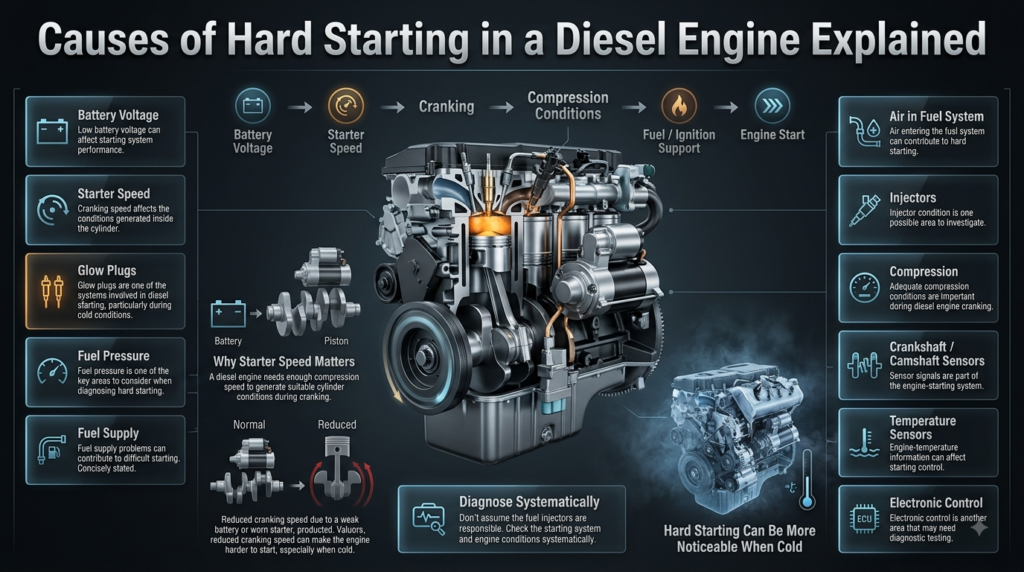
Hard starting doesn’t automatically mean there’s one specific fault.
The cause may be related to:
- Battery voltage
- Starter speed
- Glow plugs
- Fuel pressure
- Fuel supply
- Air entering the fuel system
- Injectors
- Compression
- Crankshaft/camshaft sensors
- Engine temperature sensors
- Electronic control
Why Does Starter Speed Matter?
A diesel engine needs enough compression speed to generate suitable cylinder conditions during cranking.
A weak battery or worn starter can reduce cranking speed.
That can make the engine harder to start, especially when cold.
This is why starting problems should be diagnosed systematically rather than assuming the fuel injectors are responsible.
What Are Glow Plugs and How Do They Help?
Glow plugs are used in many diesel engines to help cold starting.
They are electrically heated components positioned in or near the combustion chamber.
Their purpose is to help create favorable conditions when the engine is cold.
This is important because cold metal surfaces and lower initial temperatures can make diesel combustion more difficult.
Glow plugs are therefore not equivalent to petrol spark plugs.
The diesel engine still relies on compression ignition for its normal combustion process.
Why Do Diesel Engines Sound Different?
Diesel engines can produce a characteristic combustion noise because of the way fuel is injected and ignites.
A rapid pressure rise during early combustion can produce a harder sound.
Modern engines reduce this effect using advanced injection strategies.
Pilot injection is one important method.
By carefully controlling small amounts of fuel before the main injection, the engine can influence the rate of pressure rise.
This is one reason modern common-rail diesel engines can sound significantly smoother than older diesel engines.
What Is Diesel Knock?
Diesel combustion noise is sometimes described as “diesel knock,” although the phenomenon isn’t identical to petrol-engine knock.
In diesel combustion, a significant ignition delay can allow fuel to accumulate before ignition.
When that accumulated fuel burns rapidly, cylinder pressure can rise quickly.
The result can be a sharp combustion sound.
Factors affecting this behavior include:
- Fuel ignition quality
- Injection timing
- Engine temperature
- Injection pressure
- Spray characteristics
- Combustion-chamber design
Modern injection control is designed to manage these effects.
How Does Combustion Affect Diesel Engine Emissions?
Diesel combustion produces several types of emissions that need to be controlled.
Important pollutants include:
- Nitrogen oxides
- Particulate matter
- Carbon monoxide
- Hydrocarbons
The exact emissions profile depends on combustion conditions and engine technology.
One of the major challenges in diesel engine design is balancing different emissions.
For example, combustion conditions that help reduce one pollutant may influence another.
Modern diesel engines therefore use both in-cylinder combustion control and after-treatment systems.
What Is the Diesel Particulate Filter?
A diesel particulate filter, or DPF, is an exhaust component designed to capture particulate matter from diesel exhaust.
The filter collects soot instead of allowing it to pass directly into the atmosphere.
Over time, accumulated soot needs to be burned off through a process called regeneration.
The exact regeneration strategy varies by vehicle.
It may involve raising exhaust temperature so that accumulated soot can oxidize.
What Happens If a DPF Becomes Restricted?
A heavily loaded or malfunctioning DPF can cause:
- Reduced engine performance
- Warning lights
- Increased exhaust backpressure
- Poor fuel economy
- Regeneration problems
A DPF problem doesn’t necessarily mean the DPF itself is the original cause.
Excessive soot can result from an underlying combustion or air-system fault.
This is why replacing the filter without identifying the cause can lead to repeated problems.
What Is Selective Catalytic Reduction in a Diesel Engine?
Selective catalytic reduction, commonly called SCR, is an emissions-control technology used to reduce nitrogen oxides.
Many modern systems use diesel exhaust fluid to support the chemical process.
The fluid is injected into the exhaust system rather than directly into the engine’s combustion chamber.
Inside the SCR system, it helps convert nitrogen oxides into less harmful substances.
The exact technology varies between vehicles and applications.
How Does Diesel Combustion Affect Fuel Economy?
Efficient combustion generally improves how effectively the engine converts fuel energy into useful work.
Poor combustion can waste energy through:
- Incomplete combustion
- Excessive heat loss
- Late combustion
- Increased exhaust temperature
- Poor air-fuel mixing
- Excessive friction
- Incorrect injection
However, fuel economy isn’t determined by combustion alone.
Driving style, vehicle weight, gearing, tyre pressure, aerodynamics, traffic, and engine temperature also matter.
Example
A diesel vehicle that normally achieves good highway fuel economy may consume significantly more fuel during:
- Heavy stop-and-go traffic
- Frequent cold starts
- Aggressive acceleration
- Heavy towing
- Extended idling
- Low tyre pressure
So fuel economy should always be evaluated in context.
What Are the Most Common Diesel Combustion Mistakes?
Mistake 1: Thinking Diesel Engines Use Spark Plugs
Most diesel engines don’t use spark plugs for normal ignition.
They rely on compressed air reaching a suitable temperature before fuel injection.
How to avoid the mistake: Remember the basic principle:
Petrol → spark ignition
Diesel → compression ignition
Mistake 2: Confusing Glow Plugs With Spark Plugs
Glow plugs help with cold starting and combustion conditions.
They don’t create a traditional spark to ignite diesel fuel.
Mistake 3: Assuming More Fuel Means More Power
More fuel only helps when the engine has enough air and the combustion system is designed to handle it.
Excessive fueling can increase:
- Smoke
- Soot
- Exhaust temperature
- Fuel consumption
- Emissions
Mistake 4: Ignoring the Air System
Some diesel owners focus heavily on injectors and fuel quality while overlooking air filters, boost leaks, turbochargers, and intake restrictions.
Air is just as important as fuel.
Mistake 5: Replacing Parts Without Testing
A rough-running diesel engine doesn’t automatically need injectors.
A smoke problem doesn’t automatically mean the DPF is blocked.
Hard starting doesn’t automatically mean the glow plugs are faulty.
Professional diagnosis should identify the cause before parts are replaced.
Mistake 6: Ignoring Small Changes in Engine Behavior
Changes in starting, idle quality, smoke, fuel consumption, or acceleration can provide early warning of developing problems.
Addressing issues early can sometimes prevent more expensive failures.
Expert Advice for Better Diesel Combustion
If you’re responsible for maintaining a diesel vehicle or equipment, focus on the fundamentals.
Keep the Air Supply Clean
Inspect and replace air filters according to the manufacturer’s requirements.
A restricted air filter can affect the amount of oxygen available for combustion.
Use the Correct Fuel Specification
Use fuel that meets the manufacturer’s specification.
Avoid contaminated fuel and be cautious about fuel storage conditions.
Maintain the Fuel System
Fuel filters are important because they protect high-pressure components from contamination.
Don’t ignore scheduled fuel-filter replacement.
Monitor Engine Smoke
A temporary change under unusual conditions isn’t necessarily a major problem.
Persistent smoke is different.
If smoke continues, investigate the cause.
Pay Attention to Starting Behavior
A diesel that suddenly takes longer to start deserves attention.
Early diagnosis can identify fuel-pressure, electrical, compression, glow-plug, or sensor problems before they become more serious.
Don’t Ignore Warning Lights
Modern diesel engines use electronic systems to monitor combustion and emissions.
A warning light may indicate a problem involving:
- Injection
- Airflow
- Turbocharging
- EGR
- DPF
- SCR
- Sensors
- Engine control
Ignoring the warning can allow a relatively manageable problem to develop into a more expensive repair.
How Can You Diagnose a Diesel Combustion Problem?
A professional diagnosis normally begins with the symptoms.
For example:
Hard starting + white smoke
may lead toward investigation of cold-start conditions, fuel delivery, glow plugs, injection timing, or compression.
Black smoke + poor acceleration
may lead toward checking airflow, boost pressure, injectors, EGR operation, and fueling.
Blue smoke + oil consumption
may lead toward checking turbocharger and engine mechanical condition.
The key is to avoid assuming that one symptom automatically identifies one failed component.
A Practical Diagnostic Checklist
- Check warning lights and diagnostic codes.
- Inspect fuel quality and fuel filters.
- Check battery condition and cranking speed.
- Inspect the air filter and intake system.
- Check turbocharger and boost system.
- Evaluate fuel pressure.
- Test injector performance when appropriate.
- Check compression if mechanical problems are suspected.
- Inspect EGR and emissions systems.
- Compare measured values with manufacturer specifications.
This approach is usually more reliable than replacing components based on guesswork.
What Role Does Engine Temperature Play in Diesel Combustion?
Temperature has a major influence on diesel ignition.
Cold engines require different conditions from fully warmed engines.
When the engine is cold:
- Fuel evaporation can be different
- Combustion surfaces are colder
- Ignition may be more difficult
- Glow plugs may become important
- Emissions can temporarily increase
Once the engine reaches normal operating temperature, combustion conditions become more stable.
This is one reason repeated short trips can be harder on some diesel vehicles than longer journeys.
Does Driving Style Affect Diesel Combustion?
Yes.
The engine’s operating conditions constantly change with driving style.
Heavy acceleration increases fuel demand.
Long periods of idling create different combustion and exhaust conditions.
Frequent short trips can prevent the engine and exhaust system from reaching ideal operating temperatures.
A diesel vehicle should generally be operated according to the manufacturer’s recommendations, particularly where emissions-control systems such as DPF and SCR are involved.
Diesel Combustion: What Should You Remember?
The most important concept is that diesel combustion is a controlled interaction between air, fuel, pressure, temperature, and timing.
If one of these elements becomes incorrect, the entire combustion process can be affected.
For example:
Poor air supply → poor fuel-air mixing → increased soot
Poor injector spray → poor atomization → incomplete combustion
Low compression → low ignition temperature → hard starting
Incorrect injection timing → poor combustion timing → reduced efficiency
Poor fuel quality → fuel-system problems → inconsistent injection
This cause-and-effect relationship makes diesel combustion easier to understand and diagnose.
How Does a Diesel Engine Combustion Process Work Without a Spark Plug?
A diesel engine doesn’t normally need a spark plug to start its main combustion process. Instead, it uses compression ignition. During the compression stroke, the piston compresses air to a very high pressure, which raises the air temperature. Near the end of this stroke, the fuel injector sprays finely atomized diesel into the hot compressed air. After a short ignition delay, the fuel-air mixture reaches the conditions required for auto-ignition and combustion begins.
The important point is that the injector doesn’t simply “spray fuel and instantly create power.” The fuel first has to atomize, evaporate, mix with the surrounding air and undergo chemical reactions before combustion becomes established.
Key points to understand:
Diesel engines primarily use compression ignition, not spark ignition.
The piston compresses air before fuel is injected.
High compression creates the temperature required for auto-ignition.
The injector controls fuel quantity, timing and spray pattern.
A short ignition delay occurs between injection and combustion.
The expanding combustion gases then push the piston downward and produce useful power.
Professional insight: This is why compression, injector condition and air supply are so important in diesel engines. If the cylinder can’t generate sufficient temperature, or the injector can’t deliver fuel correctly, the combustion process can become unstable even when the engine has plenty of fuel.
What Is Ignition Delay in a Diesel Engine, and Why Is It Important?
Ignition delay is the short period between the beginning of fuel injection and the actual start of combustion. During this time, the injected diesel breaks into small droplets, evaporates, mixes with hot compressed air and begins the chemical reactions that lead to auto-ignition. The length of this delay has a major influence on combustion noise, cylinder-pressure rise, emissions and overall engine behavior.
Ignition delay isn’t simply wasted time. It’s an essential part of diesel combustion because the fuel needs time to prepare itself for burning. However, if the delay becomes too long, more fuel can accumulate and then burn rapidly once ignition begins. That can create a sharp pressure rise and the characteristic harsh combustion sound associated with some diesel engines.
Factors that can influence ignition delay include:
Diesel fuel ignition quality
Air temperature and pressure
Engine temperature
Injection timing
Injection pressure
Injector design
Fuel atomization
Combustion-chamber design
Air movement and turbulence
Why it matters in real-world driving:
A diesel engine operating correctly should carefully control when combustion begins. Modern electronic injection systems can use multiple injection events to influence the rate of heat release and pressure rise, helping balance power, efficiency, noise and emissions.
Professional insight: If a diesel engine suddenly becomes noticeably louder, rougher or harder to start, don’t automatically assume the engine itself is worn out. Changes in fuel quality, injection behavior, engine temperature or injector performance can alter the combustion process.
How Does Fuel Injection Affect Diesel Engine Combustion?
Fuel injection is one of the most critical parts of diesel combustion because the engine doesn’t premix all of its fuel and air before ignition in the same way a conventional petrol engine does. Instead, diesel fuel is injected directly into hot compressed air, and combustion develops as the fuel spray mixes with the surrounding air. High-pressure injection helps atomize the fuel and strongly influences how quickly and efficiently that mixing occurs.
The injector therefore has several jobs at once. It must deliver the correct amount of fuel, at the correct moment, at the required pressure and with a spray pattern designed for the particular combustion chamber.
Modern common-rail systems take this control much further. They can perform multiple injection events during one engine cycle, such as pilot injection, main injection and post-injection. Pilot injection can help manage combustion noise, while other injection events can support power production and emissions-control strategies.
Important injection factors include:
Injection pressure: Influences atomization and fuel-air mixing.
Injection timing: Determines when fuel enters the cylinder.
Injection quantity: Controls how much chemical energy is released.
Spray pattern: Determines how fuel interacts with the available air.
Injection duration: Influences the amount of fuel delivered.
Multiple injections: Allow combustion to be shaped more precisely.
Professional insight: A diesel injector shouldn’t be judged only by whether fuel is coming out of it. An injector can still deliver fuel while having a poor spray pattern, incorrect quantity or abnormal leakage. That’s why proper injector testing is more reliable than diagnosing an injector problem from smoke or rough running alone.
Why Does a Diesel Engine Produce Black Smoke During Combustion?
Black smoke is generally associated with excessive particulate or soot formation. Diesel combustion occurs in a non-uniform mixture, meaning some regions around the fuel spray can temporarily contain much more fuel than oxygen. If these fuel-rich areas aren’t adequately mixed with oxygen and oxidized, soot can form and leave the engine through the exhaust.
This is why black smoke shouldn’t automatically be blamed on “bad diesel.” The combustion process depends on both fuel delivery and air availability. A diesel engine can have perfectly usable fuel but still produce excessive smoke if the engine isn’t getting enough air or is receiving inappropriate fueling.
Common causes worth checking include:
Restricted air filter
Turbocharger or boost problems
Intake restrictions
Faulty or poorly performing injectors
Excessive fuel delivery
Incorrect injection timing
EGR-related problems
Engine-management faults
Poor combustion caused by mechanical problems
Modern diesel engines also use emissions-control systems to manage particulate matter. Diesel particulate filters, for example, capture soot from the exhaust rather than allowing it to pass directly into the atmosphere.
Professional insight: A particularly useful diagnostic rule is to think about air and fuel together. If black smoke appears during heavy acceleration, investigate whether the engine is receiving enough air to support the additional fuel. Replacing injectors immediately without checking the intake and turbocharging system can result in unnecessary repairs.
What Causes Poor Combustion in a Diesel Engine?
Poor diesel combustion usually occurs when one or more of the conditions required for efficient burning aren’t being met. The engine needs adequate compression, sufficient oxygen, correctly pressurized fuel, proper atomization, accurate injection timing and suitable operating temperatures. A problem in any of these areas can change the way fuel burns inside the cylinder.
For example, low compression can reduce the temperature produced during the compression stroke, making ignition more difficult. A restricted intake or turbocharger problem can reduce the amount of oxygen available. A worn injector can produce an abnormal spray pattern, while incorrect injection timing can cause combustion to occur too early or too late.
Common signs of poor diesel combustion include:
Hard or extended starting
Rough idle
Reduced acceleration
Excessive black, white or blue smoke
Increased fuel consumption
Unusual combustion noise
Engine hesitation
Poor overall performance
Increased exhaust temperature
Warning lights or diagnostic faults
A professional diagnosis should therefore follow the complete combustion chain rather than focusing on one component.
A useful diagnostic approach is:
Check fuel quality and fuel supply.
Inspect the fuel filter and injection system.
Check injector performance when necessary.
Inspect the air filter and intake system.
Check turbocharger and boost operation.
Verify relevant sensors and injection control.
Check compression if a mechanical problem is suspected.
Inspect EGR and emissions-control systems where appropriate.
Professional insight: The most important lesson is that a combustion symptom isn’t the same thing as a failed component. Black smoke doesn’t automatically mean bad injectors, hard starting doesn’t automatically mean bad glow plugs, and poor fuel economy doesn’t automatically mean a fuel-pump problem. Proper testing should identify the actual cause before expensive parts are replaced.
Conclusion
The diesel engine combustion process is a carefully controlled combination of air, compression, fuel injection, ignition, and expansion. Unlike a petrol engine that normally relies on a spark plug, a diesel engine compresses air to create the high temperature needed for the injected fuel to auto-ignite.
From the intake stroke to the final exhaust stroke, every stage has a direct effect on engine performance. Compression pressure, injector condition, fuel quality, injection timing, air supply, turbocharger performance, and combustion temperature all work together to determine how efficiently diesel fuel is converted into useful power.
Understanding this process also makes common diesel problems easier to identify. Black smoke can point toward an air-fuel or combustion imbalance, hard starting may involve compression, fuel delivery, glow plugs, or temperature, while poor fuel economy can result from inefficient injection, restricted airflow, or other engine-related issues.
The biggest takeaway is simple: good diesel combustion depends on getting the right amount of fuel into the right amount of air at the right time and under the right conditions. When these factors are properly controlled, a diesel engine can deliver strong torque, efficient fuel use, reliable performance, and cleaner combustion.
For a broader understanding of the fuel used in modern vehicles, you can also explore Fuel Fundamentals and Petrol and Diesel Fuel Types.
Leave a Reply