Introduction
Octane rating explained | You’ve probably seen numbers like 87, 91, 93, or 95 at a fuel station and wondered what they actually mean. Is higher octane always better? Does premium petrol make your car faster? What happens if you put regular fuel in a car that recommends premium?
This guide provides a complete octane rating explained overview in simple English. You’ll learn what octane numbers mean, how octane prevents engine knocking, the difference between regular and premium petrol, how octane ratings vary by country, and how to choose the right fuel for your vehicle without wasting money.
If you’re trying to understand petrol quality and how different fuels affect an engine, you may also find our guide to Automotive Fuel Types useful. For more information about automotive fuel services and fuel solutions, visit the FuelDeliveryDubai.
What Is an Octane Rating?
Octane rating is a measure of a petrol fuel’s resistance to engine knock or abnormal combustion. A higher octane rating means the fuel can withstand greater pressure and temperature inside a gasoline engine before it self-ignites. It doesn’t simply mean the fuel contains more energy or is automatically better.
In simple terms, octane tells you how well petrol can resist knocking when the engine compresses the air-fuel mixture.
A gasoline engine is designed to burn the air-fuel mixture at a controlled moment. If part of that mixture ignites too early because of pressure and heat, it can create a sharp pressure wave inside the cylinder. This is commonly called engine knock, detonation, or pinging.
Modern engines use sensors and electronic controls to manage combustion, but the fuel still needs an appropriate octane rating.
Why Does Octane Matter?
Octane matters because modern gasoline engines operate under different compression ratios, temperatures, and loads.
A high-performance or turbocharged engine may create considerably more cylinder pressure than a basic naturally aspirated engine. That can increase the risk of knock.
Using the fuel grade recommended by the manufacturer helps the engine operate within its intended combustion conditions.
Quick Tip: Don’t choose fuel simply because the octane number is higher. The correct question is: What octane does your vehicle require or recommend?
How Does Octane Rating Work?

The easiest way to understand octane is to think of it as a fuel’s knock resistance.
During the compression stroke, the piston moves upward and compresses the air-fuel mixture. As pressure and temperature rise, the mixture becomes more likely to ignite.
Ideally, the spark plug initiates combustion at the correct time.
With insufficient knock resistance, parts of the mixture may ignite prematurely or uncontrollably. The resulting pressure waves can produce the characteristic metallic knocking sound associated with abnormal combustion.
Higher-octane petrol is more resistant to this type of unwanted ignition.
A Simple Combustion Diagram
Air + Fuel
    ↓
Compression
    ↓
Spark Plug Ignites Mixture
    ↓
Controlled Combustion
    ↓
Piston Produces Power
With insufficient octane under demanding conditions:
Air + Fuel
    ↓
High Pressure + Heat
    ↓
Unwanted Early/Abnormal Ignition
    ↓
Knock / Detonation
    ↓
Engine Control System May Reduce Performance
The important point is that octane doesn’t cause combustion to become more powerful by itself. Its primary role is allowing the fuel to tolerate the operating conditions of an engine without knocking.
What Does 87, 91, 93, or 95 Octane Mean?
The numbers printed on fuel pumps represent the fuel’s measured anti-knock performance according to a particular octane rating system.
For example, depending on the country and labeling system, you may encounter grades such as:
- 87 octane
- 89 octane
- 91 octane
- 93 octane
- 95 octane
- 97 octane
- 98 octane
However, these numbers aren’t always directly comparable between countries because different measurement and labeling methods are used.
In the United States and Canada, gasoline pumps generally use AKI (Anti-Knock Index), which is calculated from the Research Octane Number and Motor Octane Number.
In many other countries, including markets that commonly label petrol as 95 or 98, the pump generally displays the RON (Research Octane Number).
RON vs AKI
| Rating | Commonly Used In | Typical Pump Numbers |
|---|---|---|
| RON | Europe, Middle East, Asia and many other markets | 91, 95, 98 |
| AKI | United States and Canada | 87, 89, 91, 93 |
| MON | Used as part of fuel testing rather than usually displayed | — |
| AKI | Average of RON and MON | (RON + MON) ÷ 2 |
This distinction is important when comparing fuel specifications internationally.
A fuel labeled 95 RON isn’t equivalent numerically to a pump labeled 95 AKI.
What Is RON?
RON stands for Research Octane Number.
It is one of the standardized methods used to measure gasoline’s resistance to knocking.
RON testing uses a standardized test engine under specified conditions. The resulting number provides an indication of how resistant the fuel is to knock under the test conditions.
That’s why you’ll often see petrol described as:
- 91 RON
- 95 RON
- 98 RON
Many international fuel markets use RON as the primary number displayed to consumers.
What Is AKI?
AKI stands for Anti-Knock Index.
It is commonly displayed on gasoline pumps in the United States and Canada.
The calculation is:
AKI = (RON + MON) ÷ 2
MON stands for Motor Octane Number and is measured under more demanding test conditions than RON.
For example, a gasoline could have:
- RON = 95
- MON = 85
Its AKI would be:
(95 + 85) ÷ 2 = 90 AKI
This is why simply comparing the number printed on a fuel pump in two different countries can sometimes be misleading.
Octane Rating vs Fuel Quality: Are They the Same?
No. Octane rating and overall fuel quality are not the same thing.
Octane specifically describes resistance to knock. Fuel quality can involve many other characteristics, including:
- Cleanliness
- Additive package
- Storage condition
- Contamination
- Sulfur content
- Volatility
- Stability
- Compliance with the relevant fuel standard
A higher-octane fuel isn’t automatically cleaner, more economical, or more powerful.
For example, if an engine is designed for 91 RON, moving to 98 RON doesn’t automatically mean the vehicle will produce more horsepower.
The engine’s design and calibration determine whether higher octane provides a meaningful advantage.
Does Higher Octane Mean More Power?
Not necessarily.
This is one of the biggest misconceptions about premium petrol.
If your vehicle is designed and calibrated to operate normally on regular petrol, switching to a significantly higher octane fuel may provide little or no noticeable performance improvement.
However, some modern high-compression and turbocharged engines are specifically designed to take advantage of higher-octane fuel.
The engine control system may adjust ignition timing, boost pressure, or other parameters depending on operating conditions and the fuel available.
Example
Imagine two vehicles:
Vehicle A: Designed for 91 RON.
Vehicle B: Requires 98 RON.
Putting 98 RON into Vehicle A doesn’t magically transform its engine into Vehicle B’s engine.
Vehicle B has hardware and calibration designed around higher cylinder pressures and more aggressive combustion conditions.
Expert Tip: Higher octane is valuable when the engine is designed to benefit from it—not simply because the number is larger.
Regular vs Premium Gasoline

The terms regular, mid-grade, and premium usually describe different octane levels.
Exact numbers vary by market.
| Fuel Type | Typical Octane Range* | General Use |
| Regular | Lower | Engines designed for standard fuel |
| Mid-grade | Medium | Vehicles requiring or recommending an intermediate grade |
| Premium | Higher | High-compression, turbocharged, or performance engines |
| Super Premium | Very high | Certain performance or specialized applications |
*Exact ratings and names vary by country.
Premium fuel isn’t necessarily “better” for every engine. It is simply more resistant to knock.
The correct fuel is determined by your vehicle manufacturer’s specification.
Why Do Some Engines Need Higher Octane?
Higher octane becomes particularly important when an engine creates conditions that increase the likelihood of knock.
These conditions can include:
- Higher compression ratios
- Turbocharging or supercharging
- High engine loads
- High intake temperatures
- Aggressive ignition timing
- Certain performance-oriented engine designs
A high-performance engine may compress the air-fuel mixture much more aggressively than a basic engine.
If the fuel cannot tolerate those conditions, knock can occur.
Higher-octane fuel gives the engine greater resistance to that unwanted combustion.
What Happens If You Use Lower-Octane Fuel?
The answer depends on the vehicle.
If the manufacturer recommends a certain octane but the engine can safely adapt to a lower grade, modern engine controls may detect knock and adjust combustion timing.
You might experience:
- Reduced performance
- Lower efficiency
- Less responsive acceleration
- Increased engine noise under load
- Reduced boost or ignition timing in some engines
If the vehicle requires premium fuel, repeatedly using lower-octane fuel can be a bad practice, particularly under heavy load or high-temperature conditions.
Common Mistake
Mistake: Assuming that if the engine starts and drives normally, the fuel must be completely suitable.
Why it’s a problem: A vehicle can compensate for suboptimal fuel without immediately showing an obvious warning.
Better approach: Follow the manufacturer’s minimum octane requirement.
What Happens If You Use Higher-Octane Fuel?
Using a higher-octane fuel than the minimum requirement is generally not harmful to a gasoline engine when the fuel itself meets the correct specification.
However, there may be little financial or performance benefit.
For example, if your vehicle is designed to operate normally on 91 RON, consistently buying 98 RON may simply increase your fuel cost without producing a noticeable improvement.
Some engines are different. If the manufacturer specifically recommends premium fuel or states that higher octane can improve performance, the additional octane may have a practical benefit.
Always check the owner’s manual.
Does Higher Octane Improve Fuel Economy?
It can in some vehicles, but higher octane doesn’t automatically improve fuel economy.
If an engine requires premium fuel and performs poorly on lower octane, using the correct premium grade may restore the intended efficiency and performance.
For an engine that doesn’t benefit from higher octane, switching from regular to premium may not produce enough improvement to offset the higher price.
Fuel economy is influenced by many factors:
- Driving style
- Vehicle weight
- Tire pressure
- Traffic
- Engine condition
- Temperature
- Air conditioning use
- Fuel formulation
- Octane requirement
- Engine calibration
So it’s better to follow the manufacturer’s specification rather than choosing fuel based solely on the highest octane number.
Does Octane Affect Diesel Fuel?
Not in the same way.
Octane rating is primarily associated with gasoline engines. Diesel fuel is generally evaluated using cetane-related characteristics instead.
Gasoline engines rely on controlled spark ignition, while diesel engines are designed around compression ignition.
For diesel fuel, cetane number is an important measure of ignition quality.
A simple comparison is:
| Gasoline | Diesel |
| Spark ignition | Compression ignition |
| Octane is important | Cetane is important |
| Higher octane = greater knock resistance | Higher cetane generally relates to easier ignition |
| Spark plug initiates combustion | Fuel ignites from compressed hot air |
If you want to understand the broader differences between gasoline and diesel, see our guide to Petrol and Diesel Fuel Types.
Octane Rating and Compression Ratio
Compression ratio is one of the most important concepts connected to octane.
An engine with a higher compression ratio compresses the air-fuel mixture more strongly before ignition.
Greater compression can improve thermal efficiency, but it can also increase the tendency toward knock.
That’s where higher-octane fuel can become important.
However, compression ratio isn’t the only factor.
Modern engines also use:
- Turbochargers
- Direct fuel injection
- Variable valve timing
- Knock sensors
- Electronic ignition control
- Sophisticated engine management systems
Because of these technologies, you can’t determine an engine’s fuel requirement from compression ratio alone.
Turbocharged Engines and Octane
Turbochargers force more air into the engine.
More air allows the engine to burn more fuel and potentially produce more power. But it also increases pressure and temperature inside the combustion chamber.
This can make knock resistance more important.
That’s why many turbocharged performance engines specify premium gasoline.
However, not every turbocharged engine requires premium fuel. Some are specifically designed to operate on regular gasoline.
Always check the manufacturer’s requirement rather than assuming all turbocharged vehicles need premium.
How to Find the Correct Octane for Your Car
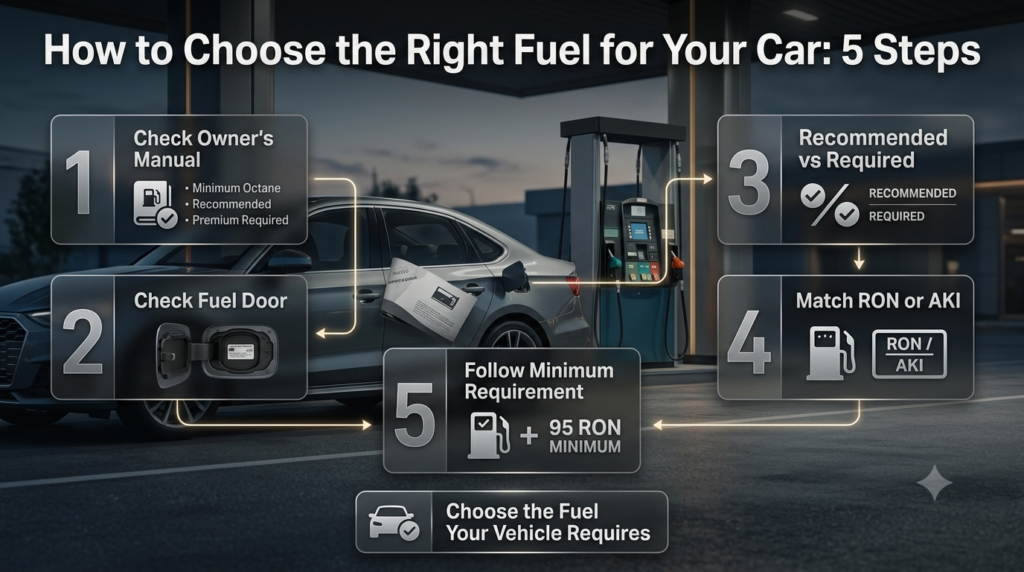
Finding the right fuel doesn’t have to be complicated.
Step 1: Check the Owner’s Manual
Look for the fuel or gasoline specification.
You may see wording such as:
- Minimum octane rating
- Recommended octane
- Premium recommended
- Premium required
- Unleaded gasoline
- 95 RON minimum
Step 2: Check the Fuel Door
Some vehicles display the required fuel specification near the fuel filler.
Step 3: Understand “Recommended” vs “Required”
These words matter.
Required means the manufacturer expects the vehicle to use that minimum fuel specification.
Recommended can mean the vehicle may operate on a lower grade but performs best with the specified fuel.
Don’t assume these terms mean exactly the same thing.
Step 4: Match the Local Rating System
If you’re driving in another country, make sure you understand whether the pump uses RON or AKI.
Step 5: Follow the Minimum Requirement
If your vehicle says 95 RON minimum, don’t intentionally choose a lower grade simply to save money.
How to Choose Between 91, 95, and 98 RON
If your local station offers 91, 95, and 98 RON, the right choice depends on your vehicle.
| Vehicle Requirement | Best Choice |
| 91 RON minimum | 91 RON or higher |
| 95 RON minimum | 95 RON or higher |
| 98 RON required | 98 RON |
| 98 RON recommended | Follow manufacturer guidance |
| Performance engine calibrated for premium | Use recommended premium grade |
Quick Tip: The fuel cap and owner’s manual are more reliable than advice from a friend, social media post, or generic fuel recommendation.
Can Octane Booster Increase Octane?
Octane boosters are aftermarket additives designed to increase a fuel’s knock resistance.
They can sometimes raise octane, but the actual increase depends on:
- Product formulation
- Dosage
- Base fuel
- Fuel volume
- Mixing accuracy
Don’t assume a bottle labeled “octane booster” will turn ordinary petrol into racing fuel.
Some products may also be unsuitable for certain engines or emissions systems.
Expert Tip: If your vehicle regularly requires higher-octane fuel, buying the correct fuel grade is usually a more straightforward approach than depending on aftermarket additives.
Common Octane Rating Mistakes
Understanding octane is easier when you know what not to believe.
Mistake 1: “Higher Octane Always Means Better Fuel”
Not necessarily.
Higher octane means greater resistance to knock. It doesn’t automatically mean better fuel economy, more cleaning additives, or more power.
Mistake 2: “Premium Fuel Makes Every Car Faster”
No.
An engine needs to be designed and calibrated to benefit from higher octane.
Mistake 3: “87 and 95 Are Comparable Numbers Everywhere”
They may use different rating systems.
Always check whether the number is RON or AKI.
Mistake 4: “If the Engine Runs, the Fuel Is Correct”
An engine can continue running while the control system compensates for knock or other combustion issues.
Mistake 5: “Octane Is the Same as Fuel Energy”
Octane measures knock resistance, not simply energy content.
Mistake 6: “Diesel Uses Octane”
Diesel fuel is generally discussed using cetane characteristics rather than gasoline octane ratings.
Pro Tips for Choosing Petrol
Pro Tip: Always start with the vehicle manufacturer’s minimum octane requirement.
Expert Tip: If your car is designed for premium fuel, don’t downgrade simply because the engine appears to run normally.
Quick Tip: When comparing international fuel grades, check whether you’re comparing RON or AKI.
Common Mistake: Don’t assume the most expensive fuel at the station is automatically the best choice for your vehicle.
When Does Premium Fuel Actually Make Sense?

Premium fuel makes sense when:
- Your vehicle requires it.
- Your vehicle manufacturer recommends it for optimal performance.
- Your engine is specifically calibrated to take advantage of higher octane.
- You’re operating a performance engine under demanding conditions and premium fuel is specified.
- The manufacturer provides different performance specifications depending on fuel grade.
For an ordinary vehicle that only requires regular petrol, premium fuel may not deliver enough benefit to justify the extra cost.
This is why vehicle specifications should always come before fuel-station marketing claims.
Octane Rating Explained With a Real-World Example
Imagine you own a turbocharged vehicle that requires 95 RON.
You arrive at a station offering:
- 91 RON
- 95 RON
- 98 RON
The sensible choice is 95 RON because it meets the vehicle’s specified minimum.
Choosing 91 RON because it’s cheaper could cause the engine management system to reduce ignition timing or otherwise compensate for knock risk.
Choosing 98 RON may be acceptable, but whether it provides additional performance or efficiency depends on the engine’s calibration.
The lesson is simple:
The highest number isn’t automatically the correct number. The manufacturer’s specification is the starting point.
Why Modern Engines Can Adapt to Different Octane Fuels
Modern gasoline engines often use knock sensors to monitor combustion.
When the system detects conditions associated with knock, the engine control unit can make adjustments.
Depending on the vehicle, these may include changes to:
- Ignition timing
- Boost pressure
- Fueling
- Other engine operating parameters
This technology gives modern engines a degree of flexibility.
But adaptability doesn’t mean you should ignore the manufacturer’s fuel requirement.
An engine management system can compensate within its designed operating range, but it isn’t a substitute for using the correct fuel.
Octane Rating vs Cetane Number
These two terms are often confused.
| Feature | Octane | Cetane |
| Mainly associated with | Gasoline | Diesel |
| Measures | Resistance to knock | Ignition quality |
| Engine type | Spark ignition | Compression ignition |
| Higher value generally means | Greater knock resistance | Easier/faster ignition characteristics |
| Main purpose | Prevent unwanted combustion | Promote suitable ignition |
Remember:
Gasoline → Octane
Diesel → Cetane
This simple distinction can prevent a lot of confusion when researching automotive fuels.
For a broader overview of fuel fundamentals, visit Fuel Fundamentals.
What Does Octane Rating Actually Mean?
Octane rating tells you how resistant gasoline is to engine knock, also called abnormal combustion or detonation. A higher octane fuel can withstand greater pressure and temperature before it is likely to auto-ignite. This matters because gasoline engines are designed to burn the air-fuel mixture in a controlled sequence, beginning with the spark plug. If the mixture ignites uncontrollably, pressure inside the cylinder can rise sharply and interfere with normal engine operation.
The important point is that octane isn’t a direct measurement of fuel quality, power, or energy content. A 98-octane fuel isn’t automatically “better” for every car than a 91- or 95-octane fuel. Its main advantage is greater resistance to knock, which is particularly useful in engines designed to operate with higher cylinder pressures.
Key points:
Higher octane = greater resistance to knock.
It doesn’t automatically mean more horsepower.
It doesn’t mean the fuel contains proportionally more energy.
The correct octane depends on the engine’s design and manufacturer’s specification.
High-compression and turbocharged engines can have greater octane requirements.
Is Higher Octane Fuel Better for Your Car?
Higher octane is not automatically better for every vehicle. The right fuel is the grade specified or recommended by the vehicle manufacturer. If an engine is designed to run properly on regular gasoline, moving to premium fuel may provide little practical benefit. On the other hand, an engine that requires or is specifically calibrated for premium fuel can benefit from the additional knock resistance.
This is where many drivers misunderstand premium petrol. They see a higher number and assume it means cleaner fuel, better acceleration, or better engine protection in every situation. In reality, the benefit depends on whether the engine can make use of that additional knock resistance.
For example, if a vehicle specifies 95 RON minimum, using 95 RON is the sensible baseline. Moving to 98 RON may be useful if the manufacturer recommends it or the engine is calibrated to take advantage of it, but simply choosing the most expensive fuel isn’t a guarantee of better performance.
Before choosing a higher grade, consider:
Check the owner’s manual.
Look at the fuel-filler label.
Determine whether premium is required or merely recommended.
Check whether the local pump uses RON or AKI.
Don’t pay extra for octane your engine doesn’t need.
Professional advice: Treat octane as an engine requirement, not a simple “higher is better” ranking.
What Happens If You Use Lower-Octane Fuel Than Recommended?
Using gasoline below the manufacturer’s recommended or required octane can increase the likelihood of engine knock, particularly when the engine is under heavy load, operating at high temperature, or producing high cylinder pressure. Modern vehicles commonly use knock sensors and engine-control systems that can detect abnormal combustion and adjust ignition timing to reduce the problem. However, that correction can come with reduced efficiency or performance.
This is especially relevant for turbocharged and high-compression engines. These engines can create operating conditions where knock resistance becomes more important, which is one reason higher-octane fuel is frequently specified for certain performance-oriented vehicles.
An occasional mistake isn’t necessarily the same as routinely ignoring the manufacturer’s fuel requirement. If you accidentally fill with a lower grade, the safest approach is to avoid demanding driving and follow the vehicle manufacturer’s guidance rather than assuming the engine is unaffected simply because it still starts and drives.
Possible effects can include:
Reduced engine performance.
Less responsive acceleration.
Ignition timing being adjusted by the engine computer.
Reduced efficiency in some operating conditions.
Increased risk of knock under demanding conditions.
Common mistake:
Don’t use the argument “The car runs, so the fuel must be fine.” Modern engine-management systems can compensate for certain conditions, but that doesn’t mean an unsuitable fuel grade is the ideal choice.
What Is the Difference Between 91, 95, and 98 Octane?
The difference is primarily their resistance to knock, but you must also consider the rating system used in the country where you’re buying fuel. Many countries use RON (Research Octane Number) at the pump, while North American markets commonly display AKI (Anti-Knock Index), which is calculated from RON and MON. Because these systems are different, a 95 displayed at a pump using RON shouldn’t be treated as the same fuel quality as a 95 displayed using AKI.
In markets using RON, you’ll commonly encounter grades such as 91, 95, and 98 RON. Generally, 98 RON has greater knock resistance than 95 RON, while 95 RON has greater knock resistance than 91 RON.
But the number you should choose isn’t simply the highest one available.
Fuel Grade
General Meaning
Best Approach
91 RON
Lower knock resistance
Use when manufacturer permits/requires it
95 RON
Higher knock resistance
Common requirement for many modern vehicles
98 RON
Higher knock resistance again
Useful where manufacturer recommends or requires it
Important points:
98 RON isn’t automatically necessary.
95 RON isn’t universally equivalent to 95 AKI.
Your owner’s manual should determine the minimum requirement.
Performance engines may specifically benefit from higher octane.
Fuel grades and labeling can vary between countries.
Quick tip: If you’re traveling internationally, don’t compare the pump numbers until you know whether they’re RON or AKI.
Does Higher Octane Increase Horsepower or Improve Fuel Economy?
Higher octane can support better performance in an engine designed to take advantage of it, but simply putting premium fuel into any car doesn’t automatically create more horsepower or improve fuel economy. The benefit comes from the engine’s design and calibration, not from the octane number alone. Higher-octane fuel gives an engine greater resistance to knock, which can allow appropriately designed engines to operate under more demanding combustion conditions.
This is particularly relevant to modern turbocharged and high-compression engines. Manufacturers have increasingly used these technologies to improve efficiency and performance, and some vehicle configurations therefore require or recommend premium gasoline.
For a vehicle designed around regular fuel, however, paying substantially more for premium doesn’t guarantee a measurable improvement. The extra cost can simply become an unnecessary fuel expense.
Higher octane may make sense when:
The manufacturer requires premium fuel.
Premium is recommended for maximum performance.
The engine is specifically calibrated to benefit from higher octane.
You’re driving a high-compression or turbocharged engine designed around premium fuel.
Don’t assume that:
Premium automatically cleans the engine better.
Higher octane always improves mileage.
Every turbocharged car requires premium.
The most expensive fuel is automatically the best fuel for your vehicle.
Bottom line: The best fuel isn’t necessarily the one with the highest number—it’s the fuel that matches your engine’s requirements and operating design.
Conclusion
Understanding octane rating makes it much easier to choose the right fuel for your vehicle without relying on assumptions or simply choosing the highest number at the pump. Octane is primarily about a gasoline fuel’s ability to resist engine knock, not a direct measure of power, cleanliness, or overall fuel quality.
The most important thing is to match the fuel to your engine’s requirements. A vehicle designed for regular petrol may not gain much from premium fuel, while a high-compression or turbocharged engine may require higher-octane gasoline to operate as intended. Using the correct grade can help maintain proper combustion, performance, and efficiency.
Before filling up, check your owner’s manual or fuel-filler label, especially if you’re unsure whether your vehicle requires or recommends premium fuel. Once you understand the difference between octane ratings, RON and AKI, and regular versus premium petrol, choosing the right fuel becomes a simple and informed decision.
Leave a Reply