Introduction
Automotive Fuel Classification | Choosing the right fuel can seem simple until you see different fuel grades, blend percentages, and fuel types at the pump. For some vehicles, choosing the wrong fuel can affect performance, fuel economy, emissions, or even cause serious fuel-system problems.
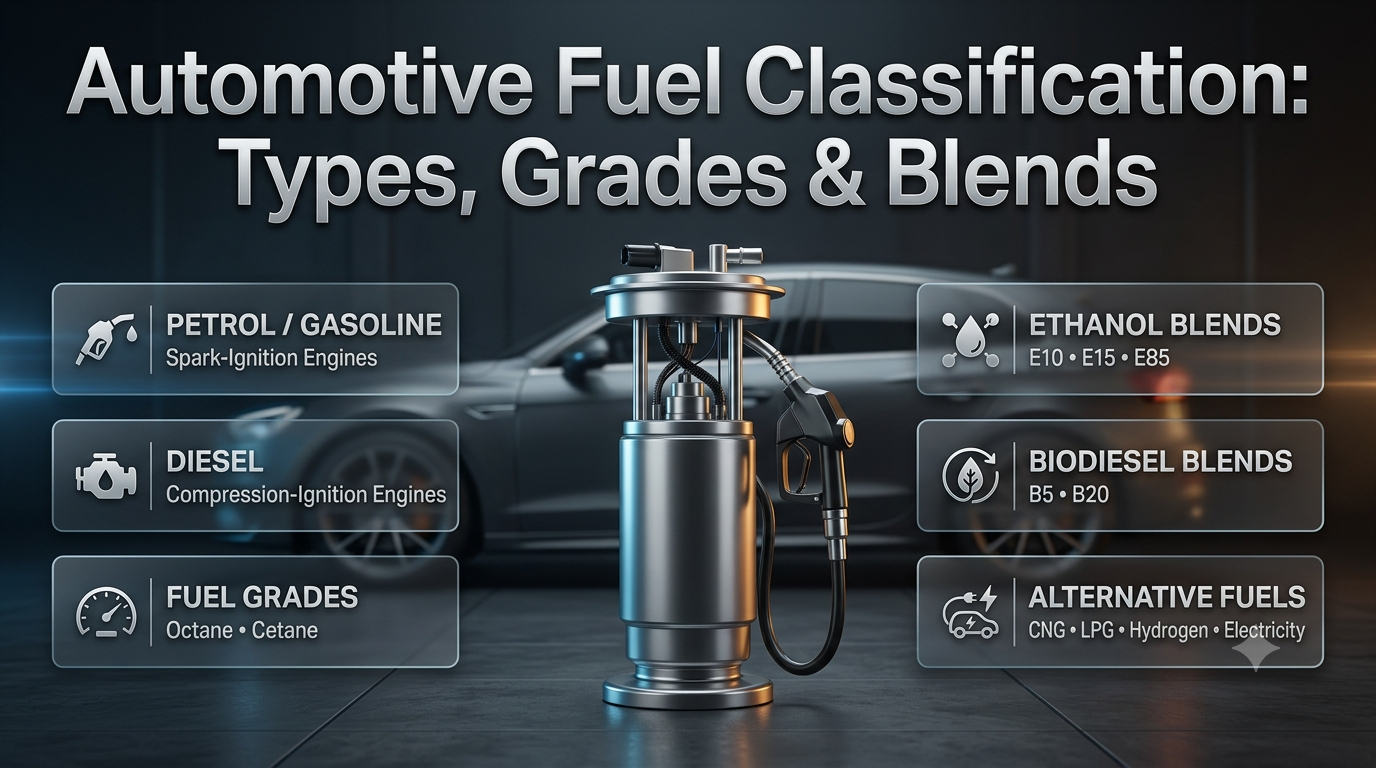
This is why understanding automotive fuel classification is important. Automotive fuel isn’t classified only as petrol or diesel. Fuels can also be grouped according to their engine compatibility, chemical composition, source, octane or cetane rating, blend percentage, and intended use.
In this guide, we’ll explain the major automotive fuel categories, how petrol and diesel differ, what E10 and B20 mean, how alternative fuels fit into the classification system, and how to identify the right fuel for a vehicle.
If you want a broader introduction before going deeper, you can also explore Fuel Fundamentals.
What Is Automotive Fuel Classification?
Automotive fuel classification is the process of grouping vehicle fuels according to their composition, source, engine compatibility, performance characteristics, and blending level. Common categories include gasoline, diesel, ethanol blends, biodiesel blends, renewable diesel, gaseous fuels, hydrogen, and electricity-based propulsion.
Fuel classification matters because different engines are designed to work with different combustion systems.
A gasoline engine generally uses spark ignition, while a conventional diesel engine uses compression ignition. Because these engines operate differently, gasoline and diesel aren’t interchangeable.
Fuel can also be classified by characteristics such as:
- Fuel type
- Engine compatibility
- Octane rating
- Cetane quality
- Ethanol content
- Biodiesel content
- Sulfur content
- Energy source
- Physical state
- Fuel specification
For example, gasoline may be identified by its octane rating and ethanol content, while diesel may be identified by its cetane quality, sulfur level, biodiesel percentage, and other fuel specifications.
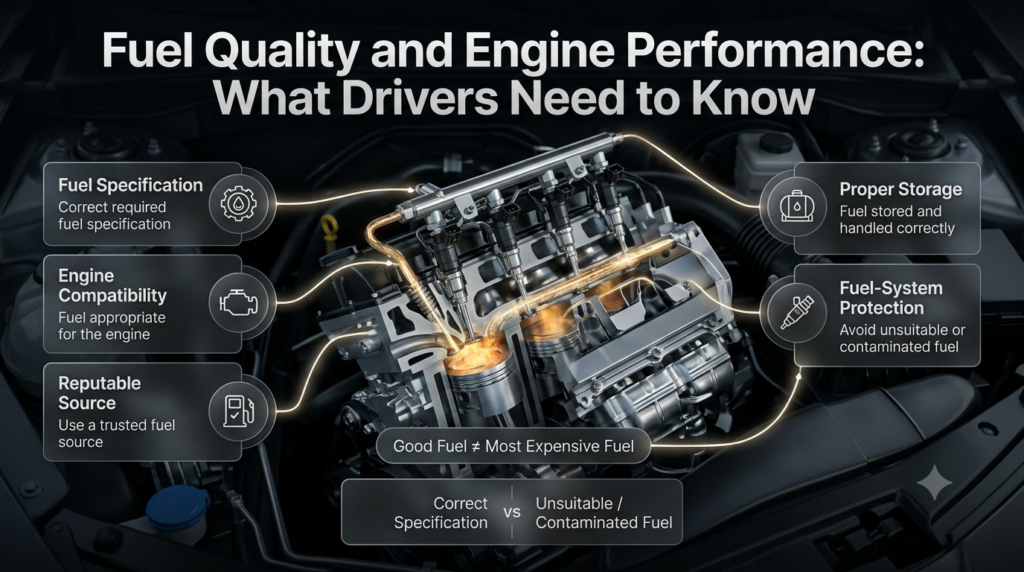
Pro Tip: Don’t assume that the most expensive fuel is automatically the best fuel. The correct fuel is the one that meets your vehicle manufacturer’s requirements.
Why Is Automotive Fuel Classification Important?
Fuel classification helps drivers, mechanics, fleet operators, and fuel suppliers determine which fuel is appropriate for a particular vehicle or piece of equipment.
The most important factor is engine compatibility.
A gasoline engine is designed around the combustion properties of gasoline. A diesel engine is designed around diesel fuel and compression ignition. Using the wrong fuel can create problems such as:
- Poor engine performance
- Difficulty starting
- Reduced fuel economy
- Abnormal combustion
- Fuel-system problems
- Increased emissions
- Expensive repairs
Fuel classification also helps businesses compare operating costs.
Two fuels may both be capable of powering vehicles, but their energy content, price, efficiency, maintenance requirements, and availability can be very different.
For businesses that depend on regular fueling, understanding these differences can make fuel management much easier. If you’re interested in professional fuel services, you can also visit FuelDeliveryDubai.
A Simple Automotive Fuel Classification
Automotive Fuels
│
├── Liquid Fuels
│   ├── Gasoline / Petrol
│   ├── Diesel
│   ├── Ethanol Blends
│   ├── Biodiesel Blends
│   └── Renewable Diesel
│
├── Gaseous Fuels
│   ├── CNG
│   ├── LNG
│   └── LPG
│
└── Alternative Energy
    ├── Hydrogen
    └── Electricity
This is a simplified classification. Exact fuel categories and terminology can vary between countries and fuel standards.
Main Types of Automotive Fuel
The easiest way to understand automotive fuel classification is to start with the major fuel families.
1. Gasoline or Petrol
Gasoline, commonly called petrol in many countries, is mainly used in spark-ignition engines.
It is a refined petroleum product consisting of a complex mixture of hydrocarbons. Depending on the market and fuel formulation, it can also contain additives and ethanol.
Gasoline can be classified according to:
- Octane rating
- Ethanol percentage
- Fuel formulation
- Volatility
- Emission requirements
- Seasonal specifications
For a more detailed comparison of common petrol and diesel products, see Petrol and Diesel Fuel Types.
What Is Octane Rating?
Octane rating describes a gasoline fuel’s resistance to engine knock.
A higher octane number doesn’t simply mean that the fuel contains more energy. Instead, it means the fuel has greater resistance to certain forms of unwanted combustion.
Common gasoline grades include:
| Fuel Grade | General Description |
|---|---|
| Regular | Standard/lower octane grade |
| Mid-grade | Intermediate octane grade |
| Premium | Higher octane grade |
Exact octane numbers depend on the country and rating system.
When Should You Use Premium Gasoline?
Premium gasoline should be used when the vehicle manufacturer recommends or requires a higher octane fuel.
Some turbocharged and high-performance engines are specifically designed around higher-octane fuel because their operating conditions can make them more sensitive to knock.
If the owner’s manual specifies regular gasoline, simply choosing premium doesn’t automatically make the vehicle faster or more efficient.
Common Mistake: Assuming “premium” means that every engine will perform better with it.
The better approach is to follow the manufacturer’s recommended fuel grade.
2. Diesel Fuel
Diesel is primarily used in compression-ignition engines.
Unlike a conventional gasoline engine, a diesel engine doesn’t depend on a spark plug to initiate the main combustion process. Instead, air is compressed to a high temperature and diesel fuel is injected into the compressed air.
Diesel is widely used in:
- Passenger cars
- Pickup trucks
- Heavy-duty trucks
- Buses
- Construction equipment
- Agricultural machinery
- Commercial fleets
- Industrial equipment
Diesel fuel can also be classified by sulfur content, cetane quality, biodiesel percentage, renewable content, and other fuel specifications.
What Is Cetane Rating?
Cetane quality is associated with how readily diesel fuel ignites under compression.
This is different from gasoline’s octane rating.
A simple way to remember the difference is:
Gasoline → Octane → Resistance to knock
Diesel → Cetane → Ignition quality
Octane and cetane therefore shouldn’t be treated as two versions of the same measurement.
Why Is Diesel Common in Heavy Vehicles?
Diesel engines are widely used in heavy-duty applications because they can provide strong pulling performance and good fuel efficiency under many operating conditions.
This makes them particularly useful for trucks, buses, commercial fleets, construction equipment, and other vehicles that regularly operate under heavy loads.
Modern diesel vehicles also use advanced emissions-control systems, making correct fuel quality and regular maintenance increasingly important.
Gasoline vs Diesel: What’s the Difference?
The most important difference is the combustion process.
| Feature | Gasoline / Petrol | Diesel |
|---|---|---|
| Typical engine | Spark ignition | Compression ignition |
| Main fuel rating | Octane | Cetane |
| Ignition method | Spark-assisted | Compression |
| Common applications | Cars, SUVs, motorcycles | Trucks, buses, heavy vehicles |
| Typical advantage | High-speed performance | Torque and efficiency |
| Fuel injection | Common | Common |
| Interchangeable | No | No |
Gasoline and diesel aren’t simply two grades of the same fuel.
They’re different fuels designed around different engine technologies.
Expert Tip: If the wrong fuel is accidentally put into a vehicle, avoid starting the engine and seek appropriate professional assistance.
3. Ethanol-Blended Automotive Fuels
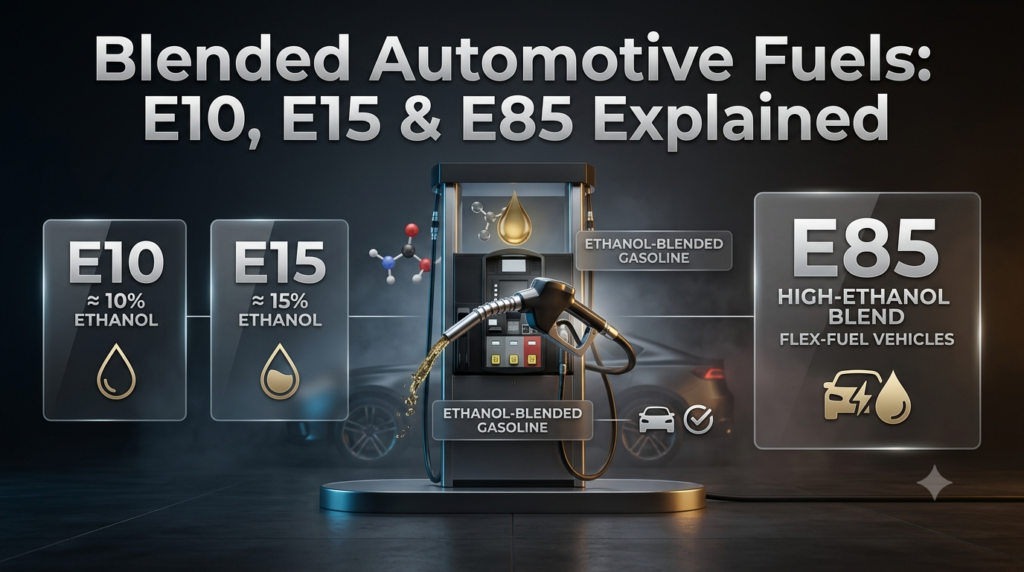
Ethanol is an alcohol-based fuel that can be blended with gasoline.
This creates another important part of automotive fuel classification: blend percentage.
The letter E is commonly used to identify ethanol-containing gasoline blends.
Examples include:
- E10
- E15
- E85
What Does E10 Mean?
E10 generally contains approximately 10% ethanol by volume and is widely used in markets where ethanol blending is common.
It can be suitable for many modern gasoline vehicles, but drivers should still follow the vehicle manufacturer’s requirements.
What Does E15 Mean?
E15 generally contains approximately 15% ethanol.
Compatibility depends on the vehicle and applicable regulations, so drivers shouldn’t assume every gasoline vehicle can use E15.
What Does E85 Mean?
E85 is a high-ethanol gasoline blend intended primarily for flex-fuel vehicles.
An ordinary gasoline vehicle shouldn’t be assumed to be compatible with E85.
Quick Tip: Always check the fuel cap, owner’s manual, and local fuel labeling before using a higher ethanol blend.
4. Biodiesel
Biodiesel is a renewable fuel that can be produced from feedstocks such as vegetable oils, animal fats, and other suitable biological materials.
It’s commonly used in blends with petroleum diesel.
The naming system makes the blend percentage relatively easy to understand.
For example:
B5 = approximately 5% biodiesel
B20 = approximately 20% biodiesel
B100 = biodiesel
The exact fuel specification and permitted use can vary by market.
Why Is Biodiesel Used?
Biodiesel can help:
- Reduce reliance on petroleum
- Use renewable feedstocks
- Support renewable-fuel programs
- Provide an alternative diesel-blending component
- Diversify fuel supplies
However, vehicle compatibility is important.
Not every diesel vehicle is approved for every biodiesel concentration.
Common Mistake: Assuming that because a vehicle is diesel-powered, every biodiesel blend is automatically safe to use.
Always check the manufacturer’s approved fuel specification.
5. Renewable Diesel
Renewable diesel is another important category in modern automotive fuel classification.
Despite the similar name, renewable diesel and biodiesel are not the same fuel.
Renewable diesel can be produced from renewable feedstocks and processed so that its chemical characteristics are similar to conventional petroleum diesel.
This can allow it to function as a drop-in fuel in suitable applications.
Biodiesel vs Renewable Diesel
| Feature | Biodiesel | Renewable Diesel |
|---|---|---|
| Common feedstocks | Vegetable oils, animal fats | Renewable biological feedstocks |
| Production method | Different chemical conversion process | Refining/hydrotreating-type processes |
| Chemical similarity to petroleum diesel | Different | Very similar |
| Typical use | Diesel blends | Drop-in fuel or blends |
| Common labeling | B5, B20, B100 | Renewable diesel |
The key point is that both can be renewable without being chemically identical.
6. Gaseous Automotive Fuels
Automotive fuel isn’t limited to liquid fuels such as petrol and diesel. Some vehicles operate using gaseous fuels, which require specialized storage tanks, fuel systems, and refueling equipment.
The main gaseous automotive fuels include:
- Compressed Natural Gas (CNG)
- Liquefied Natural Gas (LNG)
- Liquefied Petroleum Gas (LPG)
- Hydrogen
Each has different physical properties, storage requirements, applications, and vehicle compatibility.
Understanding these differences is important because the term “gas fuel” doesn’t mean all gaseous fuels work in the same vehicle.
What Is Compressed Natural Gas (CNG)?
Compressed natural gas, or CNG, is natural gas stored under high pressure.
It’s commonly used in certain:
- Commercial vehicles
- Buses
- Fleet vehicles
- Delivery vehicles
- Passenger vehicles
CNG can be attractive for fleet operators because natural gas vehicles can be designed specifically around this fuel.
However, CNG requires specialized high-pressure storage tanks and compatible fueling infrastructure.
Expert Tip: When evaluating CNG for a fleet, don’t compare fuel price alone. Consider vehicle range, refueling availability, tank capacity, maintenance requirements, and local infrastructure.
What Is Liquefied Natural Gas (LNG)?
Liquefied natural gas is natural gas that has been cooled to extremely low temperatures until it becomes a liquid.
This greatly reduces its volume, making it possible to store and transport larger quantities.
LNG is more relevant to certain heavy-duty transportation applications than ordinary passenger cars.
Its storage system is very different from both gasoline and compressed natural gas.
What Is LPG?
Liquefied petroleum gas, commonly called LPG, generally contains propane, butane, or a mixture of these gases depending on the market.
LPG can be used in vehicles designed or converted to operate on the fuel.
It has been used in various passenger and commercial applications where suitable infrastructure is available.
However, LPG vehicle systems require compatible tanks, regulators, injectors, and fuel-control components.
Common Mistake: Treating LPG, CNG, and LNG as interchangeable.
They are different fuels with different chemical characteristics, storage systems, and operating requirements.
7. Hydrogen as an Automotive Fuel

Hydrogen is another category within alternative automotive energy.
One of its most important transportation applications is the fuel-cell electric vehicle.
Instead of burning fuel in a conventional internal-combustion engine, a fuel-cell vehicle uses hydrogen to generate electricity. That electricity then powers an electric motor.
The basic process looks like this:
Hydrogen
   ↓
Fuel Cell
   ↓
Electricity
   ↓
Electric Motor
   ↓
Vehicle Movement
Hydrogen vehicles therefore combine characteristics of fuel and electric propulsion.
How Is Hydrogen Different From Petrol and Diesel?
Petrol and diesel are normally burned inside an internal-combustion engine.
Hydrogen fuel-cell vehicles use an electrochemical process to produce electricity.
This means the vehicle doesn’t need a conventional petrol or diesel combustion process.
Potential advantages include:
- Fast refueling compared with many battery-electric charging situations
- Zero tailpipe carbon dioxide emissions from a fuel-cell vehicle
- Electric motor operation
- Potential suitability for certain transportation applications
Challenges include:
- Limited refueling infrastructure in many markets
- Hydrogen storage requirements
- Production costs
- Distribution infrastructure
- Limited vehicle availability
Hydrogen is therefore an important alternative fuel category, but its practical use depends heavily on local infrastructure.
8. Electricity as an Automotive Energy Source
Electricity is different from conventional automotive fuels because an electric vehicle doesn’t burn petrol or diesel to produce movement.
Instead, electrical energy is stored in a battery and supplied to an electric motor.
A simplified system looks like this:
Electric Grid
     ↓
Charging System
     ↓
Battery
     ↓
Inverter
     ↓
Electric Motor
     ↓
Vehicle Movement
Battery-electric vehicles are therefore often classified separately from internal-combustion vehicles.
What Are the Main Electric Vehicle Types?
The major categories include:
- Battery Electric Vehicles (BEVs)
- Hybrid Electric Vehicles (HEVs)
- Plug-in Hybrid Electric Vehicles (PHEVs)
- Fuel-cell electric vehicles
A BEV uses electricity as its primary energy source.
A hybrid typically combines an internal-combustion engine with an electric motor.
A plug-in hybrid can charge its battery externally and also use an internal-combustion engine.
A hydrogen fuel-cell vehicle uses hydrogen to generate electricity onboard.
This shows why modern automotive energy classification is becoming broader than traditional fuel classification.
How Are Automotive Fuels Classified by Engine Type?
One of the simplest ways to classify automotive fuels is according to the type of engine or propulsion system they support.
Spark-Ignition Fuels
Spark-ignition engines typically use gasoline or petrol.
Other fuels can also be used in appropriately designed spark-ignition systems.
Examples include:
- Gasoline
- Ethanol-gasoline blends
- LPG
- CNG
- Certain alternative fuels
The important point is that the fuel system and engine must be designed for the specific fuel.
Compression-Ignition Fuels
Compression-ignition engines are primarily associated with diesel.
Common fuel categories include:
- Petroleum diesel
- Biodiesel blends
- Renewable diesel
The fuel must meet the engine manufacturer’s requirements.
Electric Propulsion
Electric vehicles don’t rely on conventional fuel combustion.
Instead, they use:
- Battery electricity
- Electric motors
- Power electronics
- Charging systems
This makes electricity an energy source rather than a conventional liquid automotive fuel.
How Are Automotive Fuels Classified by Source?
Fuel source is another useful classification method.
Fossil Fuels
Traditional automotive fuels such as petroleum gasoline and petroleum diesel are primarily derived from crude oil.
Natural gas is another fossil energy source used for transportation.
These fuels have historically dominated road transportation because of their high energy density, established infrastructure, and widespread availability.
Renewable Fuels
Renewable automotive fuels can be produced from renewable biological materials or other renewable sources.
Examples include:
- Ethanol
- Biodiesel
- Renewable diesel
- Renewable natural gas in applicable systems
The environmental impact of a renewable fuel depends on how it’s produced, processed, transported, and ultimately used.
Expert Tip: Don’t judge a fuel’s environmental performance only by its name. The production pathway and complete fuel lifecycle matter.
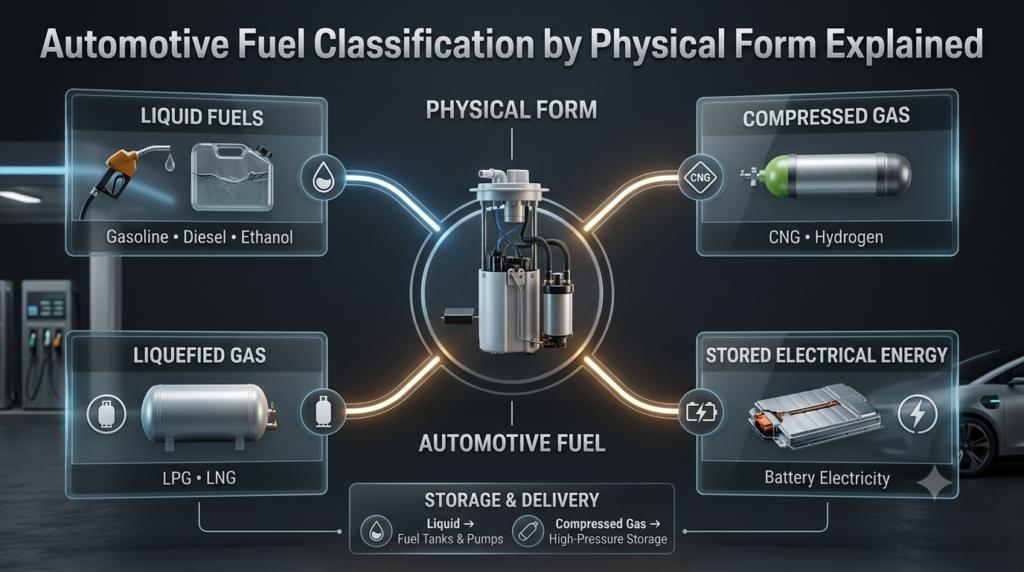
How Are Automotive Fuels Classified by Physical Form?
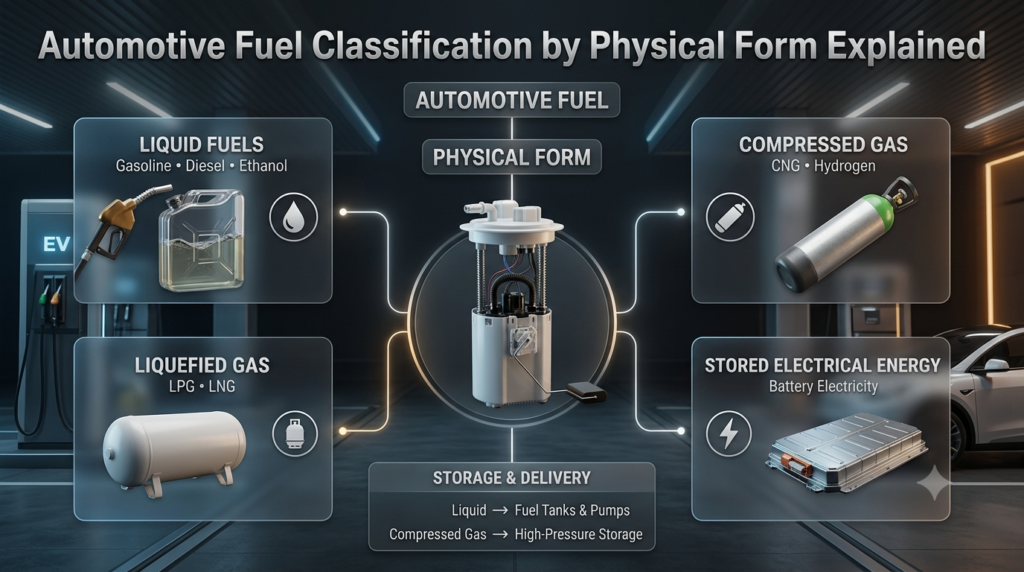
Fuel can also be classified according to its physical state.
| Physical Form | Examples |
|---|---|
| Liquid | Gasoline, diesel, ethanol |
| Compressed gas | CNG, hydrogen |
| Liquefied gas | LPG, LNG |
| Stored electrical energy | Battery electricity |
This classification matters because storage and delivery systems are different.
For example, liquid fuels can generally be transported using conventional fuel tanks and pumps, while compressed gases require specialized high-pressure storage equipment.
How Are Automotive Fuels Classified by Blend?
Blend classification is particularly important when dealing with ethanol and biodiesel.
The percentage indicates how much of a particular renewable component is included in the fuel.
Gasoline-Ethanol Blends
| Label | Approximate Ethanol Content |
|---|---|
| E5 | 5% |
| E10 | 10% |
| E15 | 15% |
| E20 | 20% |
| E85 | High ethanol content |
The exact fuel specification can vary by market.
Not every vehicle is approved for every ethanol concentration.
Diesel-Biodiesel Blends
| Label | Approximate Biodiesel Content |
|---|---|
| B5 | 5% |
| B10 | 10% |
| B20 | 20% |
| B100 | 100% biodiesel |
Again, compatibility depends on the vehicle and applicable fuel standard.
Common Mistake: Seeing a blend percentage and assuming it applies universally to every vehicle.
The label tells you what’s in the fuel. The owner’s manual tells you whether your vehicle can use it.
What Is Fuel Octane Classification?
Octane classification is mainly associated with gasoline.
The octane rating indicates resistance to engine knock.
Engine knock can occur when combustion happens in an uncontrolled or undesirable way.
A higher-octane fuel is more resistant to this type of combustion.
Common Gasoline Categories
Depending on the market, you may see:
- Regular
- Mid-grade
- Premium
The actual numerical rating differs between countries and measurement systems.
For drivers, the most important point is simple:
Use at least the minimum octane specified by the vehicle manufacturer.
If premium is required, don’t substitute a lower-octane fuel.
If regular is recommended, premium isn’t necessarily required.
What Is Diesel Cetane Classification?
Diesel fuel is commonly evaluated using cetane-related ignition characteristics.
Cetane quality is associated with the fuel’s ignition behavior in a compression-ignition engine.
Good ignition quality can contribute to smoother starting and combustion characteristics.
However, cetane isn’t the only property that determines diesel fuel quality.
Other factors can include:
- Sulfur content
- Lubricity
- Density
- Viscosity
- Cold-flow properties
- Water contamination
- Stability
- Fuel cleanliness
For modern diesel engines, meeting the correct fuel specification is more important than focusing on a single number.
Automotive Fuel Classification by Sulfur Content
Sulfur content is another important way to classify fuels.
Historically, petroleum fuels could contain relatively high levels of sulfur.
Modern emissions regulations have significantly reduced sulfur levels in many transportation fuels.
Low-sulfur and ultra-low-sulfur diesel are important examples.
Why Does Sulfur Matter?
Sulfur can contribute to sulfur oxide emissions during combustion.
It can also interfere with some modern emissions-control technologies.
Modern diesel vehicles may use systems such as:
- Diesel particulate filters
- Selective catalytic reduction
- Diesel oxidation catalysts
- Exhaust gas recirculation
These technologies make appropriate fuel quality increasingly important.
Pro Tip: Don’t choose diesel based only on price. Make sure the fuel meets the specification required by the vehicle.
Automotive Fuel Classification by Application
The best fuel can also depend on what the vehicle or equipment is designed to do.
Passenger Cars
Passenger vehicles commonly use:
- Gasoline
- Diesel
- Hybrid systems
- Battery electricity
- Some alternative fuels
The manufacturer’s specification should always determine the correct fuel.
Commercial Vehicles
Commercial fleets may use:
- Diesel
- Gasoline
- CNG
- LNG
- Electricity
- Other approved alternative fuels
Fleet operators generally need to consider both fuel compatibility and operating economics.
Heavy-Duty Trucks
Heavy trucks commonly use diesel because of its suitability for high-load operation and long-distance transportation.
Alternative powertrains are becoming more relevant, particularly in specific routes and applications.
Construction Equipment
Construction machinery can have significant fuel requirements.
Common energy sources include:
- Diesel
- Biodiesel blends
- Renewable diesel
- Electricity for selected equipment
Fuel quality, storage, and delivery become particularly important on large worksites.
Agricultural Equipment
Tractors and other agricultural machinery commonly use diesel.
Depending on the equipment and manufacturer, approved biodiesel or renewable diesel may also be available.
Fuel Classification for Fleet Management
Fuel classification becomes especially important when managing a large number of vehicles.
A fleet may contain:
- Petrol cars
- Diesel vans
- Heavy-duty trucks
- Hybrid vehicles
- Electric vehicles
- Specialized equipment
Each may require a different energy source.
A simple fleet fuel record can include:
| Vehicle | Powertrain | Required Fuel | Fuel Specification |
|---|---|---|---|
| Sedan | Petrol | Gasoline | Manufacturer specification |
| Van | Diesel | Diesel | Manufacturer specification |
| Truck | Diesel | Diesel | Heavy-duty specification |
| Hybrid | Hybrid | Gasoline + electricity | Manufacturer specification |
| EV | Electric | Electricity | Charging specification |
This type of classification reduces the chance of misfueling and helps businesses track fuel consumption.
For companies that need on-site fueling support, Fuel Delivery Dubai can be used as a resource for fuel delivery services.
How Fuel Classification Helps With Fuel Delivery
Fuel classification isn’t only useful when standing at a fuel station.
It becomes even more important when fuel needs to be delivered to a vehicle, fleet, generator, construction site, or commercial operation.
Before arranging fuel delivery, the following information should be confirmed:
- Fuel type
- Required quantity
- Vehicle or equipment type
- Delivery location
- Required fuel specification
- Any applicable blend requirements
For example, ordering “diesel” may not provide enough information for a specialized commercial operation. The required diesel specification and approved blend may also matter.
Likewise, ordering “petrol” without confirming the required octane grade can create unnecessary confusion.
Quick Tip: Keep your fuel order specific. Instead of simply requesting “fuel,” identify the exact fuel type and applicable specification.
For more information about different automotive fuel categories, see Types of Automotive Fuel.
Common Automotive Fuel Classification Mistakes
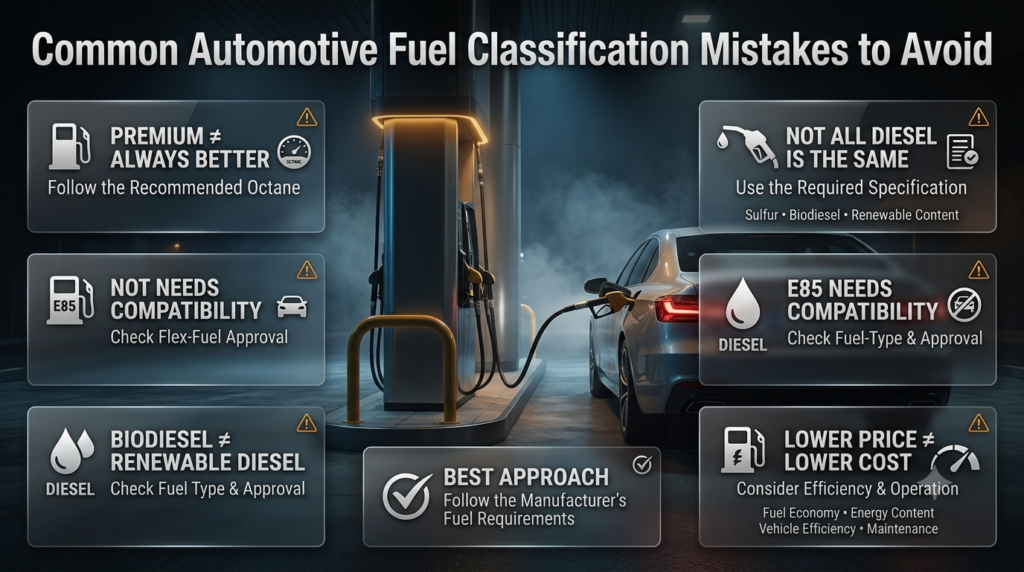
Understanding fuel categories can prevent several common and expensive mistakes.
Mistake 1: Thinking Premium Means Better
Premium generally refers to a higher-octane gasoline grade.
It doesn’t automatically mean the fuel is suitable or necessary for every engine.
Better approach: Follow the manufacturer’s recommended octane.
Mistake 2: Treating All Diesel as the Same
Diesel can differ in sulfur content, biodiesel content, renewable content, and other properties.
Better approach: Use fuel that meets the required specification.
Mistake 3: Assuming Every Gasoline Vehicle Can Use E85
E85 is designed for compatible flex-fuel vehicles.
Better approach: Check the vehicle’s documentation before using high-ethanol blends.
Mistake 4: Confusing Biodiesel With Renewable Diesel
Both can come from renewable sources, but they aren’t chemically identical.
Better approach: Check the exact fuel type and vehicle approval.
Mistake 5: Comparing Fuel Prices Without Considering Efficiency
A cheaper fuel isn’t necessarily cheaper to use.
Fuel economy, energy content, vehicle efficiency, and maintenance requirements can all affect the real operating cost.
How to Choose the Correct Automotive Fuel
Use this simple checklist before filling a vehicle.
Fuel Selection Checklist
- Identify whether the vehicle is petrol or diesel.
- Check the owner’s manual.
- Confirm the minimum octane if it’s a gasoline vehicle.
- Check approved ethanol content.
- Check approved biodiesel content for diesel vehicles.
- Confirm any special fuel specification.
- Check the fuel label before refueling.
- Don’t rely on assumptions when using an unfamiliar vehicle.
The manufacturer’s recommendation should always take priority over general fuel advice.
How Does Fuel Classification Affect Vehicle Performance?
Fuel classification matters because the fuel entering an engine must match the engine’s design.
The correct fuel can help an engine operate as intended, while unsuitable fuel can create drivability problems, poor combustion, increased emissions, or fuel-system issues.
However, fuel performance isn’t determined by one factor alone.
Engine design, fuel quality, driving conditions, maintenance, fuel formulation, and operating temperature can all influence results.
For example, two vehicles may use gasoline but achieve very different fuel economy because their engines, weights, transmissions, and driving conditions are different.
Expert Tip: Don’t judge a fuel only by its pump price or octane number. The vehicle’s complete fuel requirement matters more.
Fuel Quality vs Fuel Classification
Fuel classification and fuel quality are related, but they’re not the same thing.
Fuel classification tells you what category a fuel belongs to.
Fuel quality describes whether that fuel meets the required specification and is suitable for its intended application.
For example, two products may both be classified as diesel, but they could differ in:
- Sulfur content
- Cetane quality
- Water contamination
- Lubricity
- Cold-flow performance
- Additive package
- Storage condition
This distinction is particularly important for modern engines with sensitive fuel-injection and emissions-control systems.
Why Fuel Quality Matters
Poor-quality or contaminated fuel can cause:
- Hard starting
- Rough running
- Reduced performance
- Injector problems
- Fuel-filter blockage
- Corrosion
- Increased emissions
- Expensive repairs
The correct fuel category is therefore only the first step. The fuel must also meet the appropriate specification.
What Are Automotive Fuel Standards?
Fuel standards define technical requirements that fuels must meet for safety, engine compatibility, emissions, storage, and performance.
Different countries and regions use different regulatory frameworks and fuel specifications.
These standards may control properties such as:
- Octane
- Cetane
- Sulfur
- Vapor pressure
- Distillation characteristics
- Oxygenate content
- Biodiesel content
- Lubricity
- Contaminants
Fuel standards are especially important for modern vehicles because advanced engines and emissions systems are designed around specific fuel characteristics.
For consumers, this means that buying fuel from a legitimate supplier and using the correct grade is important.
Why Fuel Labels Matter
Fuel labels are one of the easiest ways to avoid a fueling mistake.
Depending on the country and fuel station, labels may identify:
- Fuel type
- Octane grade
- Ethanol content
- Biodiesel content
- Special fuel characteristics
Before inserting the nozzle, compare the pump label with the information on the vehicle’s fuel cap or owner’s manual.
Simple Fuel Check
Vehicle Requirement
       ↓
Check Fuel Cap
       ↓
Check Pump Label
       ↓
Confirm Fuel Type
       ↓
Confirm Grade / Blend
       ↓
Refuel
This simple habit can prevent many avoidable fueling mistakes.
Quick Tip: When driving a rental car, company vehicle, or someone else’s vehicle, don’t assume it uses the same fuel as your own car.
Petrol Fuel Grades Explained
Petrol stations may offer several gasoline grades.
The most common classification is based on octane.
Depending on the country, these may be called:
- Regular
- Mid-grade
- Premium
The actual numerical octane values vary between countries because different rating methods can be used.
Regular Gasoline
Regular gasoline generally has the lowest octane grade offered at a station.
It’s suitable for vehicles designed to operate on that minimum octane level.
Mid-Grade Gasoline
Mid-grade gasoline falls between regular and premium.
Some vehicles may benefit from or require this grade, but drivers should follow the manufacturer’s recommendation rather than choosing it simply because it is in the middle.
Premium Gasoline
Premium gasoline generally has a higher octane rating.
It may be required by high-compression, turbocharged, or high-performance engines.
Common Mistake: Believing that premium fuel automatically provides better fuel economy in every vehicle.
Diesel Fuel Grades and Specifications
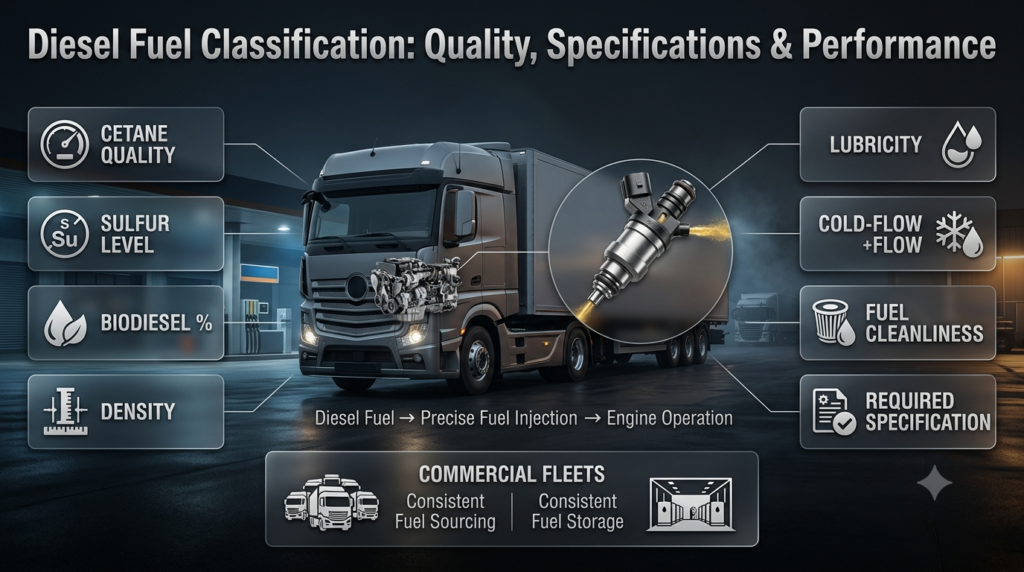
Diesel classification can be more complicated than simply selecting “diesel.”
Important characteristics can include:
- Cetane quality
- Sulfur level
- Biodiesel percentage
- Density
- Lubricity
- Cold-flow characteristics
- Fuel cleanliness
Modern diesel engines can have highly precise fuel-injection systems.
That’s why fuel that doesn’t meet the required specification can potentially cause problems.
For commercial fleets, it is especially important to maintain consistency in fuel sourcing and storage.
What Are Alternative Automotive Fuels?
Alternative automotive fuels are energy sources used instead of or alongside conventional gasoline and diesel.
They can include:
- Ethanol
- Biodiesel
- Renewable diesel
- CNG
- LNG
- LPG
- Hydrogen
- Electricity
The term “alternative fuel” doesn’t automatically mean environmentally superior in every situation.
The overall impact depends on:
- How the fuel is produced
- How it’s transported
- Vehicle efficiency
- Fuel consumption
- Infrastructure
- Local electricity or energy sources
- Vehicle lifecycle
This is why fuel classification should be separated from environmental claims.
Biofuels in Automotive Fuel Classification
Biofuels are produced from biological materials or renewable feedstocks.
Two of the most familiar examples are ethanol and biodiesel.
Ethanol
Ethanol is commonly blended with gasoline.
Depending on the blend, it can be used in conventional gasoline vehicles or specially designed flex-fuel vehicles.
Ethanol can also provide useful octane characteristics.
Biodiesel
Biodiesel is commonly blended with petroleum diesel.
It can be produced from vegetable oils, animal fats, and other suitable feedstocks.
Its use depends on vehicle compatibility and fuel specifications.
Renewable Diesel
Renewable diesel is different from biodiesel because its chemical characteristics can be much closer to conventional petroleum diesel.
This allows it to be used as a drop-in fuel in appropriate applications.
For readers comparing different fuel categories, Automotive Fuel Types provides a useful starting point.
Automotive Fuel Classification and Fuel Economy
One of the most common questions drivers ask is whether one fuel automatically provides better mileage.
The answer is more complicated.
Fuel economy depends on:
- Vehicle weight
- Engine efficiency
- Transmission
- Driving style
- Road conditions
- Traffic
- Tire pressure
- Air conditioning use
- Fuel properties
- Vehicle maintenance
Fuel energy content also matters.
Different fuels contain different amounts of usable energy per unit of volume.
This means a vehicle may consume a different volume of fuel even when the engine is operating efficiently.
Example
Imagine two fuels have different energy content.
The vehicle may need more volume of one fuel to produce the same amount of useful energy.
Therefore, comparing only liters consumed doesn’t always tell the complete story.
Expert Tip: For a meaningful fuel-cost comparison, consider both fuel price and real-world vehicle fuel consumption.
Fuel Classification for Emergency Fuel Delivery
Fuel classification becomes especially important when a vehicle runs out of fuel away from a fuel station.
In an emergency, the first question should be:
What fuel does the vehicle require?
The answer may be:
- Petrol
- Diesel
- Another approved fuel
Providing the wrong fuel can turn a simple empty-tank problem into a much more serious mechanical issue.
Before requesting emergency fuel delivery, provide:
- Vehicle make and model
- Fuel type
- Location
- Approximate quantity required
- Any special fuel requirement
For Dubai drivers and businesses looking for fuel delivery support, FuelDeliveryDubai can be used to learn more about available fuel-related services.
What Should You Do If You Put the Wrong Fuel in Your Car?
Misfueling can happen surprisingly easily, especially when driving an unfamiliar vehicle.
The correct response depends on the situation, but a general safety approach is:
Step 1: Don’t Start the Engine
If you realize the mistake before starting the vehicle, don’t turn the engine on.
Step 2: Move Away From the Pump if Necessary
Follow the fuel station’s safety instructions and avoid creating a hazard.
Step 3: Get Professional Assistance
Contact an appropriate roadside or fuel-drain service.
Step 4: Tell Them Exactly What Happened
Provide:
- Vehicle type
- Correct fuel
- Wrong fuel
- Approximate quantity
- Whether the engine was started
This information can help the technician determine the appropriate next step.
Common Mistake: Starting the engine “just to see if the car works.”
If the wrong fuel has entered the system, running the engine can circulate it through the fuel system.
How Should Automotive Fuel Be Stored?
Fuel classification is also important for storage.
Different fuels have different storage requirements.
Liquid petroleum fuels need appropriate:
- Containers
- Ventilation
- Fire-safety controls
- Spill protection
- Labeling
- Handling procedures
Compressed and liquefied gases have additional pressure and temperature considerations.
Fuel storage should always comply with applicable local regulations and safety requirements.
For businesses storing significant quantities of fuel, professional guidance is especially important.
Pro Tip: Never treat fuel storage like ordinary liquid storage. Fuel properties create specific fire, handling, environmental, and regulatory risks.
Fuel Classification for Commercial Fleets
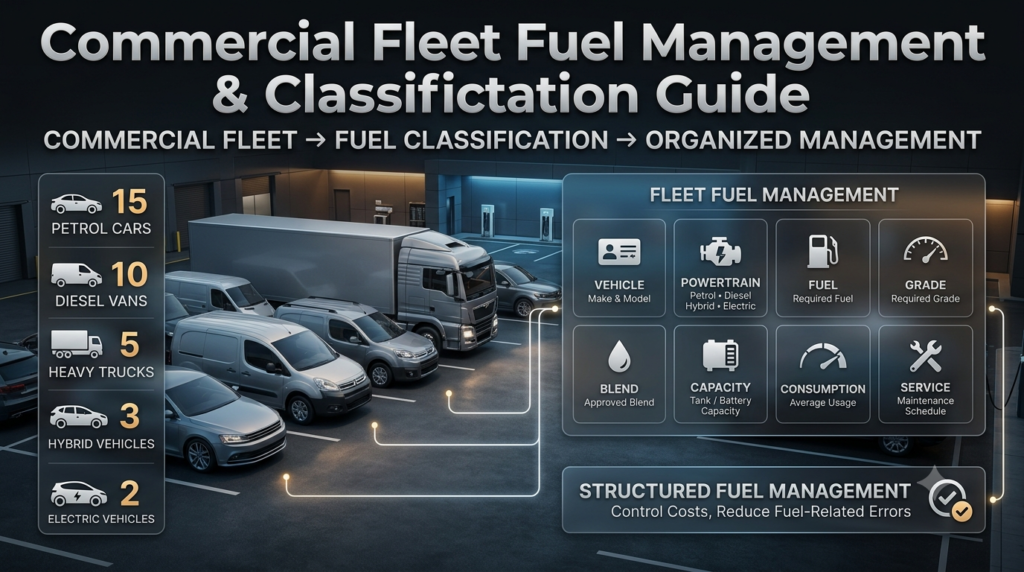
Businesses operating multiple vehicles can benefit significantly from a structured fuel classification system.
Imagine a company operates:
- 15 petrol cars
- 10 diesel vans
- 5 heavy trucks
- 3 hybrid vehicles
- 2 electric vehicles
Without clear records, drivers can easily become confused about fueling requirements.
A fleet fuel-management system can record:
| Category | Information |
|---|---|
| Vehicle | Make and model |
| Powertrain | Petrol, diesel, hybrid, electric |
| Fuel | Required fuel |
| Grade | Required grade |
| Blend | Approved blend |
| Capacity | Tank/battery capacity |
| Consumption | Average usage |
| Service | Maintenance schedule |
This can help businesses control costs and reduce fuel-related errors.
Automotive Fuel Classification for Fuel Delivery Businesses
Fuel suppliers and delivery companies also depend on accurate classification.
A delivery operation may need to distinguish between:
- Petrol
- Diesel
- High-octane gasoline
- Biodiesel blends
- Renewable diesel
- Commercial diesel specifications
- Other approved fuels
Accurate classification helps prevent delivery errors.
It also makes communication between the customer, dispatcher, driver, and supplier much easier.
A professional fuel order should include:
Fuel Type: Diesel
Required Specification: Vehicle-approved diesel specification
Quantity: Required liters
Location: Exact delivery location
Application: Commercial vehicle / fleet / equipment
This is much more useful than simply saying “I need fuel.”
How Technology Is Changing Automotive Fuel Classification
Modern vehicles are becoming increasingly dependent on electronic systems that monitor fuel and engine performance.
Many modern vehicles can detect:
- Combustion irregularities
- Fuel-system problems
- Emissions faults
- Engine knock
- Sensor abnormalities
- Fuel-pressure problems
Advanced engines are also designed around increasingly precise fuel-injection systems.
This means fuel quality and compatibility are becoming more important rather than less important.
At the same time, electric vehicles are expanding the definition of automotive energy.
The automotive industry is therefore moving from a simple:
Petrol vs Diesel
model toward a broader:
Liquid Fuel + Gas + Renewable Fuel + Hydrogen + Electricity
energy landscape.
The Future of Automotive Fuel Classification
Automotive fuel classification will likely become more diverse as transportation technology develops.
Traditional petrol and diesel will remain important in many applications, especially where existing infrastructure and vehicle fleets are extensive.
At the same time, other technologies are expanding.
These include:
- Battery-electric vehicles
- Hybrid vehicles
- Plug-in hybrids
- Hydrogen fuel cells
- Renewable diesel
- Advanced biofuels
- Alternative gaseous fuels
Different technologies are likely to remain suitable for different applications.
For example, a small urban car may be well suited to battery-electric operation, while a long-distance heavy truck may have very different energy and infrastructure requirements.
There isn’t necessarily one fuel or powertrain that will replace every other option.
Automotive Fuel Classification Decision Guide
If you’re unsure how to classify a vehicle’s fuel requirement, use this simple process.
Question 1: What powers the vehicle?
Gasoline engine?
Look for the manufacturer’s required gasoline grade.
Diesel engine?
Check the required diesel specification and approved blends.
Hybrid?
Check whether it uses gasoline or another internal-combustion fuel alongside electric power.
Electric?
The vehicle requires electrical charging rather than conventional fuel.
Fuel cell?
Check the required hydrogen specification and fueling system.
Question 2: Does the vehicle permit blends?
Check for:
- Ethanol percentage
- Biodiesel percentage
- Renewable fuel compatibility
Question 3: Does the vehicle require a specific grade?
Confirm:
- Octane
- Cetane-related requirements
- Fuel specification
- Manufacturer approvals
Question 4: Are you ordering fuel for delivery?
Give the supplier the exact:
- Fuel type
- Grade
- Blend
- Quantity
- Location
- Application
Professional Tips for Choosing Automotive Fuel
Tip 1: Follow the Owner’s Manual
The owner’s manual is the first source to check.
Tip 2: Don’t Chase the Highest Number
A higher octane number isn’t automatically better for every engine.
Tip 3: Check Blend Compatibility
Don’t use high ethanol or biodiesel blends without confirming compatibility.
Tip 4: Buy From Reliable Sources
Fuel contamination can create serious problems even when the fuel category is technically correct.
Tip 5: Watch for Water and Contamination
This is especially important with diesel fuel and stored fuel.
Tip 6: Keep Fleet Records
Businesses should document fuel requirements for every vehicle.
Tip 7: Confirm Before Emergency Delivery
When requesting roadside fuel, clearly state whether the vehicle requires petrol or diesel.
What are the main types of automotive fuel?
Automotive fuel can be classified into several major categories based on the engine, fuel composition, energy source, and application. The most common types are petrol (gasoline), diesel, ethanol-blended gasoline, biodiesel, renewable diesel, CNG, LNG, LPG, hydrogen, and electricity for electric vehicles.
For conventional cars, petrol and diesel remain the most familiar options. Petrol is generally used in spark-ignition engines, while diesel is designed for compression-ignition engines. Alternative fuels such as ethanol and biodiesel are often used as blends, while hydrogen and electricity represent different approaches to vehicle propulsion.
The right fuel isn’t determined simply by what’s available at a fuel station. It depends on the vehicle’s design, manufacturer’s specifications, fuel-system compatibility, and local fuel standards.
Important points:
Petrol is mainly associated with spark-ignition engines.
Diesel is mainly used in compression-ignition engines.
Ethanol is commonly blended with petrol.
Biodiesel is commonly blended with diesel.
Renewable diesel is different from biodiesel.
CNG, LNG, and LPG require specially designed fuel systems.
Electric vehicles use stored electricity rather than conventional liquid fuel.
For a broader breakdown, see Types of Automotive Fuel.
What is the difference between petrol and diesel fuel?
The biggest difference between petrol and diesel is the way the engine uses the fuel. Petrol engines generally use spark ignition, while diesel engines use compression ignition. This difference affects the engine design, fuel properties, fuel-injection system, and overall vehicle operation.
Petrol is commonly classified using its octane rating, which indicates resistance to engine knock. Diesel fuel is commonly evaluated using cetane-related ignition quality, along with other properties such as sulfur content, lubricity, density, and cold-flow performance.
Diesel engines are widely used in heavy-duty vehicles because they’re well suited to applications requiring strong pulling performance and efficient operation under load. Petrol engines are common in passenger vehicles and are often designed around responsive performance and higher engine speeds.
Key differences:
Petrol normally uses spark ignition.
Diesel normally uses compression ignition.
Petrol uses octane as a key fuel-rating concept.
Diesel uses cetane as an important ignition-quality measure.
Diesel and petrol aren’t interchangeable.
Each fuel requires a compatible fuel system and engine.
If you’re comparing the two in more detail, read Petrol and Diesel Fuel Types.
What do E10, E15, E85, B5 and B20 mean in automotive fuel?
These labels describe the percentage of a particular renewable fuel component in a blend. The “E” designation is generally associated with ethanol in gasoline, while “B” is associated with biodiesel in diesel fuel.
For example, E10 generally contains around 10% ethanol, while E85 is a high-ethanol gasoline blend intended for compatible flex-fuel vehicles. On the diesel side, B5 generally represents around 5% biodiesel and B20 around 20% biodiesel.
The important thing is that these numbers describe fuel composition, not simply fuel quality. A higher number doesn’t automatically mean better fuel, and not every vehicle can use every blend.
Common blend examples:
E10: Approximately 10% ethanol
E15: Approximately 15% ethanol
E85: High-ethanol gasoline blend
B5: Approximately 5% biodiesel
B20: Approximately 20% biodiesel
B100: Biodiesel
Before using a particular blend, check the vehicle manufacturer’s requirements. This is especially important with higher ethanol concentrations and higher biodiesel blends.
Professional tip: Never choose a fuel blend simply because its percentage sounds better or more environmentally friendly. Vehicle compatibility comes first.
What is the difference between octane and cetane in automotive fuel?
Octane and cetane measure different fuel characteristics and apply primarily to different engine types. Octane is mainly associated with gasoline and describes resistance to knock, while cetane is associated with diesel and describes ignition quality in a compression-ignition engine.
This distinction is important because people sometimes assume that a higher octane and a higher cetane number represent the same type of fuel improvement. They don’t.
A gasoline engine needs fuel that can resist unwanted combustion under the engine’s operating conditions. A diesel engine, on the other hand, depends on fuel that ignites appropriately when injected into highly compressed air.
Remember it this way:
Gasoline → Octane → Knock resistance
Diesel → Cetane → Ignition quality
Other fuel properties can also matter, including:
Sulfur content
Energy density
Lubricity
Density
Viscosity
Volatility
Cold-flow characteristics
Fuel cleanliness
The manufacturer’s required fuel specification should always be the final reference rather than choosing fuel based on one number alone.
How do I choose the correct fuel for my vehicle?
The safest way to choose the correct automotive fuel is to start with the vehicle manufacturer’s specification rather than choosing based on price, fuel popularity, or someone else’s recommendation.
First, identify whether the vehicle has a petrol, diesel, hybrid, alternative-fuel, or electric powertrain. For petrol vehicles, check the minimum required octane rating and any ethanol compatibility requirements. For diesel vehicles, check the required diesel specification and whether biodiesel or renewable diesel blends are approved.
The fuel cap, owner’s manual, manufacturer’s documentation, and sometimes the vehicle’s dashboard or information display can provide useful guidance.
Use this professional checklist:
Check the owner’s manual.
Confirm petrol or diesel.
Check the required octane for petrol vehicles.
Check approved ethanol blends.
Check approved biodiesel blends for diesel vehicles.
Confirm any special fuel specification.
Read the pump label before refueling.
Don’t assume premium fuel is automatically better.
Don’t use E85 unless the vehicle is designed for it.
Don’t assume every diesel vehicle accepts every biodiesel blend.
For businesses and fleet operators, fuel classification should also be recorded for each vehicle. This makes fuel ordering, fleet management, and emergency fuel delivery much easier.
If you need fuel-related information for Dubai vehicles or businesses, FuelDeliveryDubai can be used as a relevant resource.
Conclusion
Understanding automotive fuel classification makes it much easier to choose the right fuel, avoid costly mistakes, and understand why different vehicles require different fuel types. Petrol, diesel, ethanol blends, biodiesel, renewable diesel, CNG, LPG, hydrogen, and electricity all have different characteristics and applications.
The most important point is that there is no single fuel that’s best for every vehicle. The correct choice depends on the engine design, manufacturer’s requirements, fuel grade, blend compatibility, and applicable fuel standards. A higher octane number or a renewable label doesn’t automatically make a fuel suitable for every vehicle.
For everyday drivers, the safest approach is simple: check the owner’s manual, confirm the fuel type and required grade, and read the pump label before refueling. For businesses and fleet operators, keeping accurate fuel classifications for every vehicle can prevent misfueling, improve fuel management, and make fuel delivery easier to organize.
Whether you’re comparing conventional petrol and diesel or researching newer alternatives, understanding the classification behind each fuel helps you make a more informed decision.
For more information, you can continue with Fuel Fundamentals, explore Types of Automotive Fuel, or read the detailed guide to Petrol and Diesel Fuel Types.
Leave a Reply