Introduction
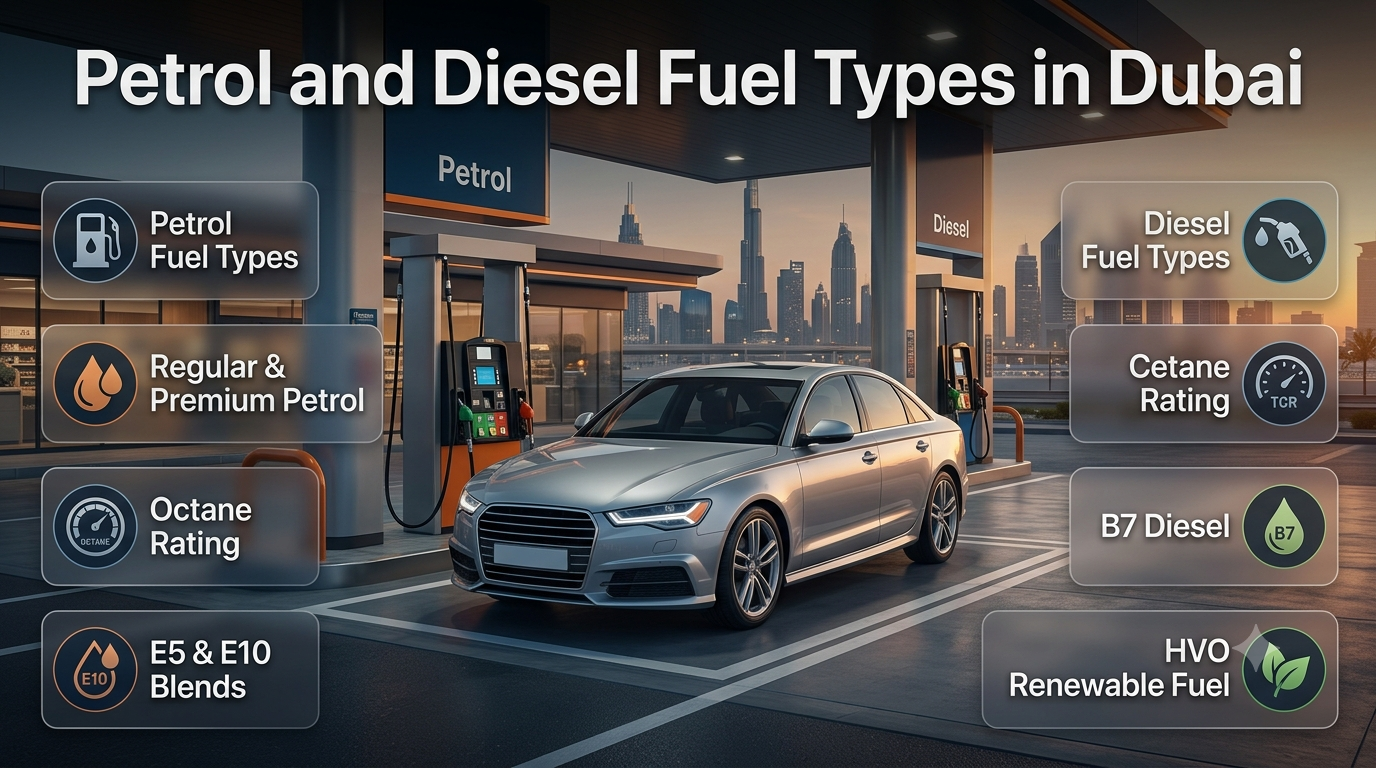
Petrol and Diesel Fuel Types in Dubai | Running a car seems simple until you stand at a fuel pump and see different petrol grades, diesel options, octane numbers, ethanol blends, and premium fuels. Choosing the wrong option can affect your vehicle’s performance, fuel economy, and in some situations, even the fuel system.
Understanding petrol and diesel fuel types helps you make a better decision every time you refuel. It also makes unfamiliar terms such as octane, cetane, E10, B7, and HVO much easier to understand.
In situations where drivers car ran out of petrol Dubai 👉 Fuel Delivery Dubai, knowing the correct fuel type for your vehicle can also help you make the right choice when arranging emergency fuel delivery.
In this guide, we’ll explain the main petrol and diesel fuel categories, how they differ, what the common fuel labels mean, and how to select fuel according to your vehicle manufacturer’s requirements.
For a broader introduction to automotive fuel, see our Fuel Fundamentals guide.
What Are the Main Petrol and Diesel Fuel Types?
Petrol and diesel are both liquid fuels derived primarily from crude oil, but they are designed for different combustion systems. Petrol is normally used in spark-ignition engines, while diesel is designed for compression-ignition engines.
Within these two main categories, fuels can differ according to their formulation, performance characteristics, renewable content, and applicable fuel standards.
The most common categories drivers encounter include:
- Regular petrol
- Premium or high-octane petrol
- E5 petrol
- E10 petrol
- Standard automotive diesel
- Premium diesel
- B7 diesel
- Renewable diesel fuels such as HVO
The exact fuel options available depend on the country, fuel supplier, vehicle, and applicable regulations.
Quick Tip: Don’t assume that the fuel with the highest number or the most expensive price is automatically the best choice. The correct fuel is the one that meets your vehicle manufacturer’s requirements.
Petrol Fuel Types Explained
Petrol, also known as gasoline, is primarily used in spark-ignition engines. The fuel is mixed with air and ignited by a spark plug inside the engine.
Different petrol products can have different octane ratings and ethanol content. These characteristics are important because they influence how the fuel behaves during combustion.
Regular Petrol
Regular petrol is a standard-grade petrol designed for vehicles that don’t require a higher octane rating.
If your vehicle manufacturer specifies regular petrol, there’s usually no need to choose a premium grade simply because it has a higher octane number.
The important thing is to meet the manufacturer’s minimum requirement.
For example, if a vehicle is designed to operate correctly on a particular regular-grade petrol, moving to a significantly more expensive premium fuel may not provide a noticeable benefit in everyday driving.
Premium Petrol
Premium petrol generally has a higher octane rating than regular petrol.
It’s particularly relevant to engines that require or recommend higher octane fuel. High-performance engines, turbocharged engines, and engines with higher compression ratios can be designed to operate with higher-octane petrol.
Higher octane doesn’t simply mean “more powerful fuel.” Its main purpose is to provide greater resistance to unwanted combustion, commonly referred to as engine knocking.
Expert Tip: Always check the fuel requirement in your owner’s manual or on the fuel-filler label before choosing between regular and premium petrol.
E5 Petrol
E5 is a petrol blend designation that indicates the fuel can contain up to 5% ethanol.
Ethanol is a renewable alcohol that can be blended with petrol for fuel formulation and environmental reasons.
For many modern petrol vehicles, approved ethanol blends are part of normal operation. However, compatibility can be more important with older vehicles, specialist equipment, and certain classic cars.
E10 Petrol
E10 petrol can contain up to 10% ethanol.
It’s widely used in markets where E10 fuel is an approved standard for compatible petrol vehicles.
The presence of ethanol doesn’t mean E10 is automatically suitable for every engine ever manufactured. Drivers with older vehicles should check the manufacturer’s compatibility information before using it.
Common Mistake: Assuming that every petrol vehicle can use every ethanol blend. Always check compatibility when dealing with an older or specialist vehicle.
What Does Petrol Octane Rating Mean?
Octane rating measures petrol’s resistance to knocking during combustion. A higher octane rating allows an engine designed for it to operate under more demanding combustion conditions without the same tendency toward knock. It doesn’t automatically mean the fuel contains more usable energy or that every engine will produce more power.
Octane is one of the most misunderstood fuel terms.
A petrol engine compresses an air-fuel mixture before ignition. Under certain conditions, the mixture can begin combusting in an uncontrolled way rather than burning as intended.
That unwanted combustion is associated with knocking.
A suitable higher-octane fuel can provide greater resistance to this problem.
Why Is Octane Important?
The correct octane level matters because engines are designed around specific combustion characteristics.
Using petrol below the manufacturer’s required octane rating can create problems, particularly in engines designed for higher-octane fuel.
Modern engine-management systems can adjust ignition timing in many vehicles, but this shouldn’t be treated as permission to ignore the manufacturer’s fuel specification.
The safest rule is straightforward:
Use the minimum octane rating specified by the vehicle manufacturer.
If premium fuel is recommended rather than strictly required, the potential benefit depends on the engine and how the vehicle is used.
Diesel Fuel Types Explained
Diesel fuel is designed for compression-ignition engines.
Unlike a conventional petrol engine, a diesel engine doesn’t normally rely on a spark plug to ignite the fuel. Instead, air is compressed to a high temperature, and diesel is injected into the combustion chamber.
Diesel fuel is commonly used in:
- Passenger cars
- SUVs
- Pickup trucks
- Vans
- Trucks
- Buses
- Commercial vehicles
- Agricultural machinery
- Construction equipment
- Generators
Modern diesel engines can be highly sophisticated, particularly those using high-pressure fuel injection and advanced emissions-control systems. This makes fuel quality and specification increasingly important.
Standard Automotive Diesel
Standard automotive diesel is formulated to meet the requirements of diesel engines used in road vehicles.
Its exact characteristics vary between markets, but fuel standards can control properties such as sulfur content, lubricity, cleanliness, and cold-flow behavior.
For everyday drivers, the practical rule is simple: use automotive diesel that meets the specification required for your vehicle.
If you’re unsure which fuel your vehicle needs, the owner’s manual should be your first reference.
Premium Diesel
Some fuel stations sell premium diesel products that contain specialized additive packages or have formulation differences intended to support fuel-system cleanliness or combustion characteristics.
Depending on the product, claimed benefits may include:
- Deposit control
- Injector cleanliness
- Fuel-system protection
- Improved combustion
- Better cold-weather performance
However, premium diesel isn’t automatically necessary for every diesel vehicle.
The actual benefits depend on the fuel formulation, vehicle, engine condition, and driving conditions.
Pro Tip: Don’t choose premium diesel solely because the word “premium” appears on the pump. First determine whether your vehicle actually needs or can meaningfully benefit from the additional characteristics.
What Does Diesel Cetane Rating Mean?
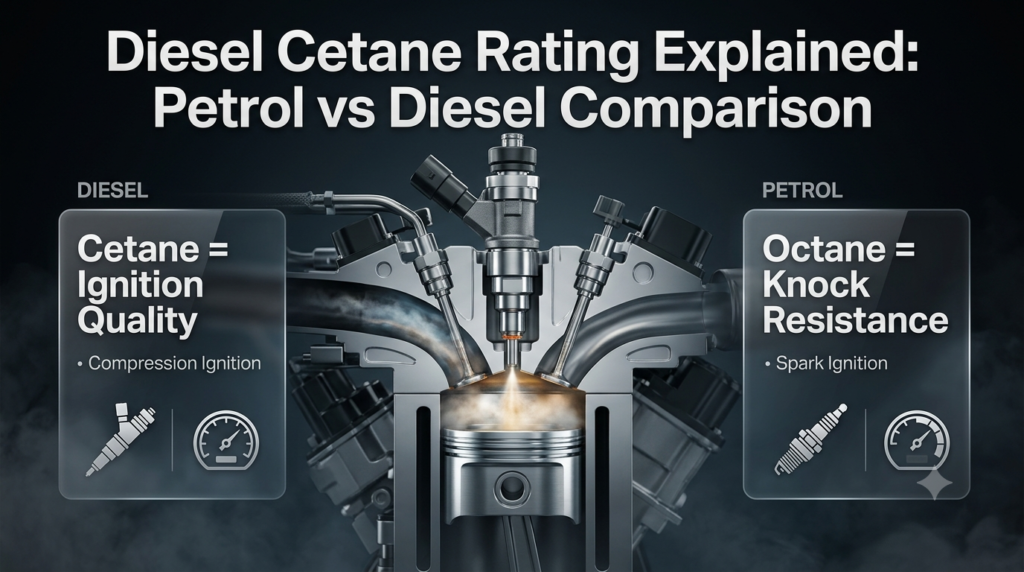
Cetane rating describes the ignition quality of diesel fuel. A higher cetane number generally indicates that diesel fuel is more willing to ignite under compression. Good ignition quality can contribute to smoother combustion and easier starting under suitable conditions.
Cetane is often compared with octane, but they aren’t measuring the same thing.
The basic difference is:
| Petrol | Diesel |
|---|---|
| Uses octane rating | Uses cetane rating |
| Spark-ignition engine | Compression-ignition engine |
| Octane relates to knock resistance | Cetane relates to ignition quality |
| Fuel is ignited using a spark | Fuel ignites under compression conditions |
This distinction is important because a higher number isn’t universally “better” in the same way across petrol and diesel.
Petrol vs Diesel: What’s the Difference?
Petrol and diesel differ mainly in how their engines create combustion.
Petrol engines generally use a spark plug to ignite a prepared air-fuel mixture. Diesel engines compress air to a high temperature before injecting fuel into the combustion chamber.
These differences affect how the vehicles behave and where each engine type is commonly used.
| Feature | Petrol | Diesel |
|---|---|---|
| Combustion system | Spark ignition | Compression ignition |
| Fuel quality measure | Octane | Cetane |
| Ignition | Spark plug | Compression heat |
| Common strength | Responsive operation | Strong low-speed torque |
| Common applications | Cars and SUVs | Cars, SUVs, vans and heavy vehicles |
| Fuel blend examples | E5, E10 | B7 |
| Key consideration | Correct octane | Correct diesel specification |
Neither fuel is universally better.
The right option depends on the vehicle’s engine design, intended use, driving conditions, maintenance requirements, and manufacturer’s specifications.
Petrol vs Diesel: Which Is Better for Different Drivers?
The better fuel type depends heavily on how the vehicle is used.
Petrol May Suit You Better If:
- Most journeys are relatively short.
- You mainly drive around town.
- Your vehicle is designed for petrol.
- You prefer the typical characteristics of petrol engines.
- Your annual mileage is relatively modest.
- Your manufacturer recommends petrol.
Diesel May Suit You Better If:
- You regularly travel long distances.
- Your vehicle is designed for diesel.
- You frequently carry passengers or heavy loads.
- You need strong low-speed pulling power.
- Your driving pattern is appropriate for the vehicle’s diesel emissions system.
However, this comparison only applies when you’re choosing between vehicles designed for different fuel types.
You should never put petrol into a diesel vehicle or diesel into a petrol vehicle simply because you believe one fuel is better suited to your driving style.
The engine determines the required fuel.
What Do E5, E10 and B7 Mean?
Fuel labels can appear confusing at first, but their basic structure is relatively easy to understand.
The letter identifies the renewable component:
- E = ethanol
- B = biodiesel
The number identifies the maximum percentage represented by the designation.
For example:
E5 = petrol containing up to 5% ethanol
E10 = petrol containing up to 10% ethanol
B7 = diesel containing up to 7% biodiesel
These labels are useful because they tell drivers something about the fuel composition without requiring technical knowledge of the complete fuel specification.
Why Do Fuel Blends Matter?
Fuel blends matter because engines and fuel systems are designed around particular material and fuel requirements.
Modern vehicles are generally engineered to operate with the fuel blends approved for their market. Older vehicles may have different compatibility requirements.
This is especially important for:
- Classic vehicles
- Older motorcycles
- Specialist machinery
- Certain marine engines
- Older fuel systems
Quick Tip: If you’re unsure whether your vehicle can use E10, B7, HVO, or another alternative fuel, check the manufacturer’s documentation instead of guessing.
What Is HVO Renewable Diesel?
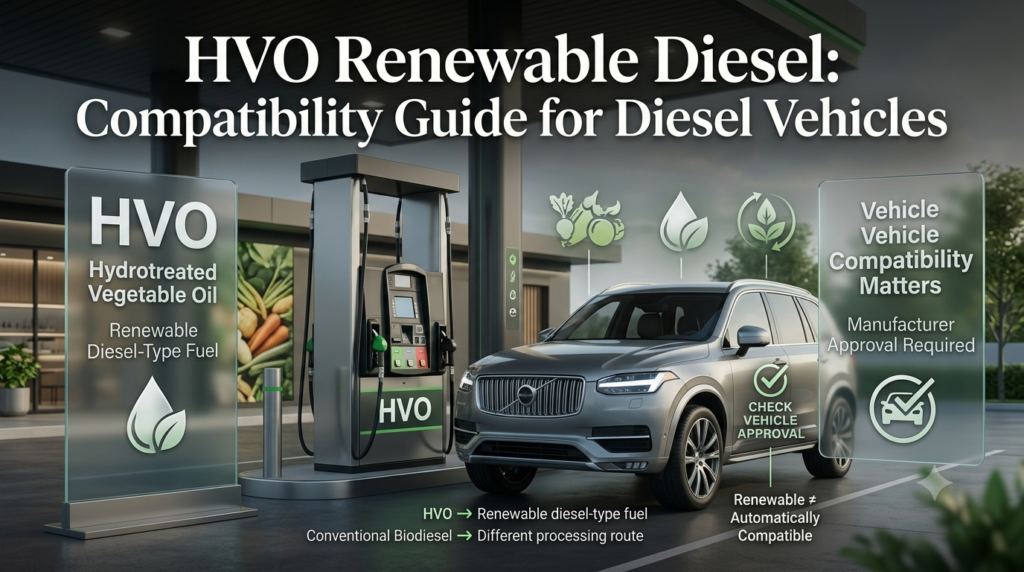
HVO stands for Hydrotreated Vegetable Oil.
It is a renewable diesel-type fuel produced through a different processing route from conventional biodiesel. Depending on the product and application, HVO can be used as an alternative diesel fuel in compatible engines.
One important point is often overlooked: renewable doesn’t automatically mean universally compatible.
A diesel vehicle may be approved for HVO, while another vehicle may not have manufacturer approval for it.
Before using HVO, check the vehicle manufacturer’s documentation or approved-fuel information.
For more information about different automotive fuel categories, see Types of Automotive Fuel.
What Happens If You Use the Wrong Fuel?
Putting the wrong fuel into a vehicle is one of the most common refueling mistakes, and the consequences can vary considerably depending on the fuel involved and whether the engine has been started.
Petrol and diesel have different combustion characteristics, so they’re not interchangeable. The vehicle’s fuel system, engine design, and injection components are built around the appropriate fuel.
The situation becomes more serious if the incorrect fuel has already circulated through the fuel system.
Petrol in a Diesel Vehicle
Putting petrol into a diesel vehicle can be particularly concerning because diesel fuel has an important lubrication role in certain fuel-system components.
Modern diesel engines can use high-pressure injection systems with precisely engineered components. Petrol doesn’t have the same lubrication characteristics as diesel fuel, so continued operation with the wrong fuel can potentially cause fuel-system damage.
Possible symptoms can include:
- Engine running roughly
- Loss of power
- Difficulty starting
- Unusual engine noise
- Warning lights
- Poor acceleration
- Engine stopping
The exact consequences depend on the vehicle and the amount of incorrect fuel introduced.
Diesel in a Petrol Vehicle
Diesel fuel in a petrol vehicle can also interfere with normal engine operation.
Because diesel isn’t designed to behave like petrol in a spark-ignition engine, the vehicle may develop:
- Difficulty starting
- Rough running
- Reduced performance
- Excessive smoke
- Engine warning lights
- Poor combustion
Again, the severity depends on how much diesel was added and whether the engine was operated afterward.
What Should You Do After Misfuelling?
If you realize you’ve selected the wrong fuel, the safest general approach is:
- Don’t start the engine if you haven’t already.
- Don’t attempt to drive the vehicle.
- Tell the fuel station staff what happened if you’re still there.
- Arrange suitable professional assistance.
- Explain exactly which fuel was added and approximately how much.
- Tell the technician whether the engine was started or driven.
Common Mistake: Starting the engine just to check whether the car still works can circulate the incorrect fuel through the system and potentially make the situation more complicated.
Does Premium Fuel Improve Fuel Economy?
Premium fuel can sometimes provide benefits, but it doesn’t automatically improve fuel economy in every vehicle.
The main purpose of higher-octane petrol is increased resistance to knocking. If an engine is specifically designed or calibrated to take advantage of higher octane, there may be a measurable benefit under certain operating conditions.
But if your vehicle is designed to run normally on regular petrol, simply paying more for premium fuel doesn’t guarantee a meaningful improvement in fuel consumption.
Fuel economy is influenced by many other factors, including:
- Driving style
- Traffic conditions
- Vehicle weight
- Tire pressure
- Engine condition
- Air-conditioning use
- Road conditions
- Vehicle aerodynamics
- Maintenance
- Journey length
For this reason, changing to premium fuel shouldn’t be the first solution when a vehicle suddenly starts consuming more fuel.
Expert Tip: If fuel economy has dropped noticeably without a change in your driving habits, investigate the vehicle’s condition before assuming you need a more expensive fuel.
Does Diesel Give Better Fuel Economy Than Petrol?
Diesel engines have traditionally been known for strong fuel efficiency, especially in larger vehicles and applications involving longer journeys or heavier loads.
One reason is that diesel engines can operate efficiently while producing substantial torque at relatively low engine speeds.
However, it isn’t accurate to say that every diesel vehicle will use less fuel than every petrol vehicle.
Real-world fuel economy depends on:
| Factor | Why It Matters |
|---|---|
| Engine design | Determines combustion efficiency |
| Vehicle weight | Heavier vehicles require more energy |
| Transmission | Affects how efficiently engine power is used |
| Driving style | Aggressive acceleration increases consumption |
| Traffic | Stop-start driving can reduce efficiency |
| Tire pressure | Incorrect pressure can increase rolling resistance |
| Maintenance | Mechanical faults can increase fuel consumption |
| Journey length | Short trips can be less efficient |
A modern petrol engine can be highly efficient, while an older or poorly maintained diesel vehicle may deliver disappointing fuel economy.
The best fuel choice should therefore be based on the complete vehicle and driving situation, not fuel type alone.
Does Fuel Quality Affect Engine Performance?
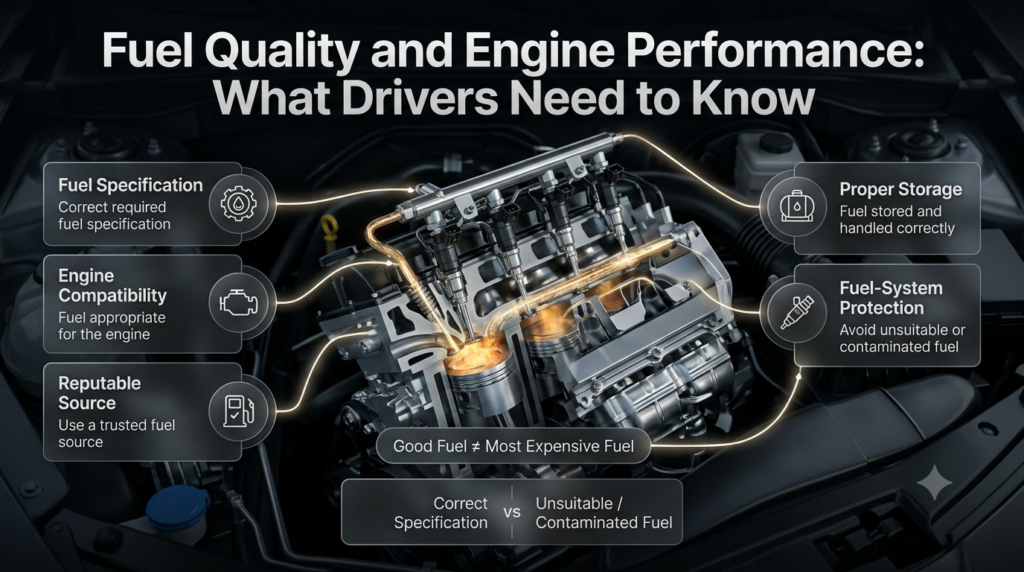
Yes. Fuel quality can influence combustion, fuel-system operation, emissions performance, and overall engine behavior.
However, “good fuel quality” doesn’t simply mean buying the most expensive product.
A suitable fuel should:
- Meet the required fuel specification
- Be appropriate for the engine
- Come from a reputable source
- Be stored and handled correctly
- Meet applicable quality requirements
Modern engines have sophisticated fuel-injection systems with tight tolerances. Contamination or fuel that doesn’t meet the required specification can potentially create problems.
Signs That Fuel May Need Investigation
If your vehicle suddenly develops problems after refueling, pay attention to symptoms such as:
- Unusual hesitation
- Rough running
- Difficulty starting
- Sudden loss of power
- Unusual exhaust behavior
- Engine warning lights
- Unexpected changes in fuel consumption
A timing connection between refueling and a new problem doesn’t automatically prove the fuel caused it. Mechanical or electrical faults can happen at the same time.
That’s why diagnosis matters.
How to Choose the Right Petrol or Diesel Fuel
Choosing the correct fuel doesn’t need to be complicated.
You can follow a simple process every time you refuel.
Step 1: Confirm the Fuel Type
First establish whether the vehicle requires petrol or diesel.
You can usually find this information on:
- Fuel-filler cap
- Fuel-filler flap
- Owner’s manual
- Vehicle documentation
- Manufacturer information
Never rely entirely on memory, especially when driving an unfamiliar vehicle.
Step 2: Check the Required Grade
For petrol vehicles, check the manufacturer’s minimum octane requirement.
For diesel vehicles, check the required diesel specification and any approved fuel types.
The owner’s manual is generally the best source of information.
Step 3: Check the Fuel Label
Before inserting the nozzle, look carefully at the pump label.
Pay attention to:
- Petrol or diesel designation
- Octane number
- Ethanol blend
- Biodiesel blend
- Renewable-fuel designation
This simple check can prevent an expensive mistake.
Step 4: Consider Compatibility
If you’re considering a fuel that differs from the standard fuel you normally use, confirm compatibility first.
This is particularly important with:
- Older vehicles
- Classic cars
- Specialist vehicles
- Modified vehicles
- Certain motorcycles
- Equipment with specific fuel requirements
Step 5: Don’t Assume Premium Means Necessary
Premium fuel can be appropriate when the manufacturer recommends or requires it.
But if your vehicle doesn’t need it, paying extra may not provide enough benefit to justify the additional cost.
Petrol and Diesel Fuel Types Comparison
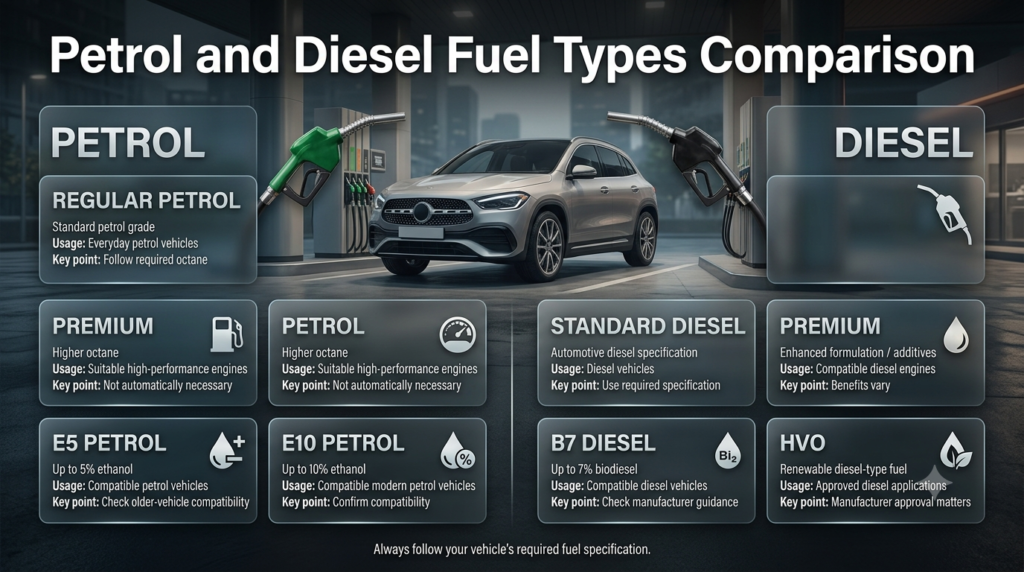
The following table gives a quick overview of the main categories discussed in this guide.
| Fuel Type | Main Characteristic | Typical Application | Important Point |
|---|---|---|---|
| Regular petrol | Standard petrol grade | Everyday petrol vehicles | Follow required octane |
| Premium petrol | Higher octane | Suitable high-performance engines | Not automatically necessary |
| E5 petrol | Up to 5% ethanol | Compatible petrol vehicles | Check older-vehicle compatibility |
| E10 petrol | Up to 10% ethanol | Compatible modern petrol vehicles | Confirm compatibility |
| Standard diesel | Automotive diesel specification | Diesel vehicles | Use required specification |
| Premium diesel | Enhanced formulation/additives | Compatible diesel engines | Benefits vary |
| B7 diesel | Up to 7% biodiesel | Compatible diesel vehicles | Check manufacturer guidance |
| HVO | Renewable diesel-type fuel | Approved diesel applications | Manufacturer approval matters |
Common Fuel Selection Mistakes Drivers Make
Many fuel-related mistakes happen because drivers make assumptions rather than checking the vehicle’s requirements.
Choosing the Highest Octane Automatically
Some drivers believe the highest octane fuel must be the best fuel for every petrol engine.
That’s not necessarily true.
Octane is about resistance to knocking, not a simple ranking of overall fuel quality.
How to avoid it: Use the octane level recommended by the vehicle manufacturer.
Assuming All Diesel Fuel Is Identical
Diesel fuels can differ in specifications, additives, renewable content, and seasonal characteristics.
How to avoid it: Check the fuel specification recommended for your vehicle.
Ignoring Ethanol Compatibility
Drivers with older vehicles sometimes switch to an ethanol blend without checking whether their vehicle was designed to use it.
How to avoid it: Verify compatibility before using a different ethanol blend.
Thinking Premium Fuel Fixes Mechanical Problems
Premium petrol or diesel isn’t a substitute for maintenance.
If your engine is losing power or using unusually large amounts of fuel, the problem may involve the engine, fuel system, sensors, ignition system, tires, or another component.
How to avoid it: Diagnose the underlying problem rather than continuously changing fuel grades.
Starting the Vehicle After Misfuelling
This is one of the mistakes worth avoiding most carefully.
If you realize you’ve selected the wrong fuel before starting the vehicle, don’t start it just to see what happens.
Professional recovery is the better option.
Expert Tips for Better Fuel Management
Good fuel management isn’t only about choosing petrol or diesel. Your driving habits and vehicle condition also matter.
Keep Your Vehicle Properly Maintained
A vehicle with worn or malfunctioning components may consume more fuel regardless of whether you use petrol or diesel.
Regular attention to the vehicle can include:
- Tire pressure checks
- Engine servicing
- Air-filter inspection
- Fuel-system maintenance
- Warning-light investigation
- Correct oil specification
- Cooling-system maintenance
Track Fuel Consumption
Instead of judging fuel economy from one tank, track several refueling cycles.
For example, if you record:
- Distance driven
- Amount of fuel purchased
- Fuel cost
- Driving conditions
you can identify meaningful changes over time.
A sudden increase in consumption can be a useful reason to investigate the vehicle.
Use Reputable Fuel Suppliers
Fuel should come from established sources that follow appropriate storage and handling practices.
This doesn’t mean the most expensive station is always the best. It means reliability and proper fuel handling matter.
Pay Attention to Sudden Changes
If your vehicle was running normally and suddenly behaves differently immediately after refueling, don’t ignore the timing.
Record what happened and seek appropriate diagnosis if the problem continues.
When Is Mobile Fuel Delivery Useful?
Sometimes the biggest fuel problem isn’t choosing between different grades. It’s simply running out of fuel when you’re away from a station.
A mobile fuel delivery service can be useful when a vehicle runs out of fuel at:
- Home
- Workplace
- Roadside
- Parking areas
- Industrial locations
- Long-distance routes
- Locations where reaching a fuel station is difficult
For drivers in Dubai, FuelDeliveryDubai provides information related to mobile fuel delivery services.
The most important thing when requesting fuel delivery is to clearly identify the vehicle’s fuel type.
For example:
Petrol vehicle → request the appropriate petrol
Diesel vehicle → request the appropriate diesel
If you’re unsure, check the vehicle documentation before placing the request.
Petrol and Diesel Fuel Types: Practical Decision Guide
If you’re standing at a fuel station and want a simple decision process, use this:
If You Drive a Petrol Vehicle
- Confirm the required octane.
- Check whether your vehicle is compatible with the available ethanol blend.
- Choose a reputable fuel source.
- Don’t assume premium is necessary.
- Follow the manufacturer’s recommendation.
If You Drive a Diesel Vehicle
- Confirm you’re using diesel.
- Check the required fuel specification.
- Confirm compatibility with biodiesel or renewable diesel if applicable.
- Don’t assume premium diesel is necessary.
- Follow the manufacturer’s fuel guidance.
If You’re Unsure
Don’t guess.
Check the owner’s manual, fuel-filler label, or manufacturer information before refueling.
A few seconds of checking can prevent a much more expensive mistake.
What Is the Difference Between Petrol and Diesel Fuel Types?
Petrol and diesel are designed for two different types of combustion engines. Petrol is normally used in spark-ignition engines, where a spark plug ignites the air-fuel mixture. Diesel is used in compression-ignition engines, where highly compressed air creates the conditions needed for the injected diesel fuel to ignite.
The difference goes beyond the engine itself. Petrol is commonly classified by its octane rating, while diesel fuel quality is often discussed using cetane rating and applicable fuel specifications. Diesel engines are also commonly associated with strong low-speed torque and efficient operation in suitable applications, while petrol engines are widely used for passenger vehicles and everyday driving.
Key points to remember:
Petrol and diesel aren’t interchangeable.
Petrol uses octane as an important fuel-quality measurement.
Diesel uses cetane as an ignition-quality measurement.
Diesel fuel has different lubrication characteristics from petrol.
The vehicle manufacturer’s specification should always determine which fuel you use.
Which Petrol or Diesel Fuel Should I Use in My Car?
The correct fuel isn’t necessarily the most expensive fuel or the one with the highest number on the pump. It is the fuel that meets your vehicle manufacturer’s specification. For petrol, this usually means checking the required octane rating and approved ethanol blend. For diesel, it means using the appropriate automotive diesel specification and checking compatibility with any biodiesel or renewable-diesel option.
This becomes particularly important when a vehicle is unfamiliar, recently purchased, or being driven in another country. Instead of relying on memory, check the fuel-filler label, owner’s manual, or manufacturer’s information before refueling.
Before filling the tank:
Confirm petrol or diesel.
Check the required petrol octane if applicable.
Check the approved diesel specification.
Verify E5/E10/B7 or other blend compatibility when relevant.
Don’t assume premium fuel is automatically necessary.
Use a reputable fuel supplier.
Is Premium Petrol or Premium Diesel Worth the Extra Cost?
Premium fuel can be worthwhile in the right vehicle, but it isn’t automatically a better choice for everyone. Premium petrol generally has a higher octane rating, which can be important for engines designed or recommended to operate on higher-octane fuel. If your engine is designed for regular petrol, however, paying more for premium fuel may not produce a noticeable improvement in everyday driving.
Premium diesel products may contain different additive packages designed around properties such as deposit control or injector cleanliness. The value depends on the specific product, vehicle, and manufacturer’s recommendations.
A useful way to think about it is: pay for a fuel characteristic when your vehicle has a reason to use it—not simply because the pump calls it premium.
Professional approach:
Follow the manufacturer’s minimum fuel requirement.
Don’t confuse higher octane with automatically higher overall fuel quality.
Don’t use premium fuel to compensate for poor maintenance.
Compare the additional price with the realistic benefit.
If fuel economy suddenly decreases, investigate the vehicle rather than immediately switching to premium fuel.
What Do E5, E10, B7 and HVO Mean on Fuel Pumps?
These labels describe different fuel compositions or fuel categories. E5 and E10 are petrol blend designations referring to ethanol content, while B7 is a diesel blend designation referring to biodiesel content. HVO, or hydrotreated vegetable oil, is a renewable diesel-type fuel produced using a different processing method from conventional biodiesel.
These labels matter because fuel compatibility depends on the vehicle. Many modern vehicles are designed to use commonly approved blends, but older vehicles, classic cars, motorcycles, and specialist equipment may require additional checking.
Quick reference:
E5: Petrol containing up to 5% ethanol.
E10: Petrol containing up to 10% ethanol.
B7: Diesel containing up to 7% biodiesel.
HVO: Renewable diesel-type fuel.
Always check manufacturer compatibility before using an alternative fuel.
Don’t assume that a fuel available at a station is automatically suitable for every vehicle.
What Happens If You Put the Wrong Fuel in Your Car?
Putting petrol into a diesel vehicle or diesel into a petrol vehicle can create serious operating problems because the two fuels have different combustion and physical characteristics. The situation is particularly important in modern vehicles because their fuel systems can use highly precise components and, in diesel applications, fuel properties also contribute to system lubrication.
If you realize the mistake before starting the engine, don’t start it just to see what happens. Avoid driving the vehicle and arrange appropriate professional assistance. Tell the technician exactly what fuel was added, approximately how much was added, and whether the engine was started.
If the vehicle has already been driven, don’t assume that continuing to drive will solve the problem.
If you’ve misfuelled:
Don’t start the engine if you haven’t already.
Don’t drive the vehicle to a workshop.
Record which fuel was added.
Estimate how much was added.
Tell the technician whether the engine was started.
Follow the appropriate professional recovery procedure.
The biggest mistake is treating misfuelling as a minor fuel-grade issue. Petrol and diesel are fundamentally different fuels, so the correct response is to stop and deal with the problem properly.
Conclusion
Understanding petrol and diesel fuel types makes it much easier to choose the right fuel and avoid common refueling mistakes. Petrol and diesel are designed for different engine systems, while individual fuel grades can vary in octane, cetane, ethanol content, biodiesel content, additives, and other specifications.
The best approach is simple: always follow your vehicle manufacturer’s fuel requirements rather than choosing fuel based only on price or the word “premium.” If you’re unsure about a fuel grade, blend, or compatibility, checking the owner’s manual before refueling can prevent unnecessary problems.
Whether you need to understand different fuel grades, compare automotive fuel options, or find practical fuel-related services, you can visit the FuelDeliveryDubai homepage for more information and guidance.
Ultimately, the right fuel is not necessarily the most expensive one—it is the fuel that is approved for your vehicle and suitable for its engine and operating conditions.
Leave a Reply