
Introduction
Dubai Roadside Fuel Assistance | Running out of petrol while driving is one of those situations most motorists never expect. You may leave home with what appears to be enough fuel, become caught in unexpected traffic, take an unfamiliar route or underestimate the distance to your destination. Suddenly, the fuel warning light appears, the engine begins losing power, or your vehicle stops completely.
In Dubai, where motorists travel between residential communities, commercial districts, highways and industrial areas, an unexpected fuel shortage can interrupt an otherwise ordinary journey. Finding a petrol station may not always be convenient, particularly when your vehicle has already stopped or you are travelling through an unfamiliar location.
Dubai Roadside Fuel Assistance provides a practical solution when motorists need petrol but cannot conveniently reach a fuel station. Through services such as Fuel Delivery Dubai, drivers can enquire about arranging petrol delivery at an accessible location, subject to service availability and applicable arrangements.
However, knowing how to request assistance is only one part of handling a roadside fuel emergency. Drivers should also understand what to do when the engine stops, how to select the correct petrol grade, what information to provide, and when a situation requires mechanical or emergency assistance instead.
This comprehensive guide explains the entire process, from recognising a fuel emergency to arranging suitable assistance and preventing similar situations during future journeys.
1. What Is Dubai Roadside Fuel Assistance?
Dubai Roadside Fuel Assistance refers to support available to motorists who experience an unexpected petrol shortage and cannot conveniently reach a conventional refuelling station.
Instead of attempting to drive with insufficient petrol, motorists can contact a suitable petrol delivery provider, share their location and enquire about receiving the required petrol.
The purpose is to address an immediate fuel shortage rather than provide general mechanical repairs or vehicle recovery.
For example, imagine travelling home after work when your low-fuel warning appears. You expect to reach a petrol station, but traffic becomes heavier than anticipated. Your remaining fuel becomes insufficient, and continuing the journey is no longer practical.
In this situation, roadside petrol assistance may help you arrange refuelling without making an unnecessary attempt to drive further.
What Situations Does Roadside Fuel Assistance Address?
Several everyday circumstances can create a need for emergency petrol delivery.
- Completely empty fuel tank: Your vehicle has stopped because it has no petrol available.
- Critically low fuel: The remaining petrol may not be sufficient to reach a suitable station safely.
- Unexpected traffic congestion: Your journey takes longer than expected, affecting your original refuelling plans.
- Missed refuelling opportunities: You pass a convenient station and cannot find another suitable option before the fuel becomes critically low.
- Unfamiliar locations: You are travelling through an area where finding an accessible petrol station is difficult.
- Unexpected route changes: Road diversions or additional driving increase your fuel requirements.
The important distinction is that roadside fuel assistance addresses petrol availability. If your vehicle has stopped because of a damaged engine, electrical failure or another mechanical problem, a different type of roadside service may be necessary.
2. Why Do Drivers in Dubai Need Emergency Roadside Petrol Assistance?
Dubai’s road network supports a wide variety of journeys. Some motorists travel short distances between residential communities and workplaces, while others regularly use major roads for longer journeys across the city.
Although petrol stations are available throughout many parts of Dubai, an unexpected fuel shortage can still create difficulties.
Unpredictable Journey Times
A journey that normally takes 20 minutes may take considerably longer when traffic becomes congested.
This difference matters when a driver is already travelling with limited petrol. The original journey estimate may no longer reflect the actual conditions.
For example, a motorist leaving a commercial district during a busy period might expect to reach a petrol station within a few minutes. However, traffic queues, road restrictions and diversions can change the situation.
Unfamiliar Roads and Locations
Residents and visitors sometimes travel through areas they do not regularly visit.
They may not know where the nearest accessible petrol station is located or which route provides the easiest access.
Searching for a station while driving with critically low fuel can also distract the driver from the road.
Unexpected Changes in Travel Plans
Daily journeys do not always follow the original plan.
A driver might need to collect someone, visit another location, take a different route or complete additional work-related travel.
These changes increase the distance covered and can affect the amount of petrol required.
Long-Distance Driving
Longer journeys require more careful fuel preparation.
Drivers who concentrate only on reaching their destination may overlook additional driving, return travel and unexpected delays.
Our guide to Dubai Long-Distance Driving explains the wider considerations involved in preparing for longer journeys.
Vehicle Fuel Consumption
Different vehicles consume petrol at different rates.
An SUV, a compact car and a performance vehicle may have considerably different fuel requirements, even when travelling along the same route.
Driving conditions, vehicle condition, passenger load, tyre pressure and air-conditioning use can also influence consumption.
Professional advice: Don’t calculate your fuel requirements using distance alone. Consider your vehicle’s typical consumption and allow for changes in journey conditions.
3. What Should You Do Immediately When Your Car Runs Out of Petrol?

The first few decisions after a vehicle stops are important. A petrol shortage may be relatively straightforward to resolve, but an unsafe stopping position can create a much more serious situation.
Your priority should always be personal safety and protecting other road users.
Step 1: Assess Your Vehicle’s Position
If the vehicle is still moving and you can safely control it, move towards an appropriate stopping area.
Avoid sudden manoeuvres or attempting to cross traffic lanes simply to reach a more convenient location.
If the engine has already stopped, do not put yourself in danger by trying to push the vehicle across a busy road.
Step 2: Activate Hazard Warning Lights
Switch on your hazard lights to make the stationary vehicle more visible to approaching motorists.
If your vehicle is in a dangerous position, follow the applicable roadside safety procedures and seek assistance from the appropriate authorities.
Do not assume that hazard lights alone make every roadside position safe.
Step 3: Avoid Repeated Starting Attempts
When there is no petrol available, repeatedly turning the ignition is unlikely to solve the problem.
Unnecessary attempts can also place additional demands on the battery and starter system.
Stop repeated attempts and focus on identifying the cause of the problem.
Step 4: Protect Yourself and Your Passengers
Assess the surrounding traffic and follow appropriate safety procedures.
If it is safer to leave the vehicle, move away from moving traffic using a safe route. Avoid standing directly behind the vehicle or beside passing traffic.
Never attempt to walk along a busy highway looking for a petrol station.
Step 5: Identify Your Exact Location
Before requesting assistance, establish where your vehicle is positioned.
Useful location information includes:
- Road or highway name.
- Nearest exit or interchange.
- Direction of travel.
- Nearby building or landmark.
- Parking facility or access point.
- Live location where available.
A general area name may not be sufficient when the provider needs to identify your precise stopping position.
Step 6: Arrange the Appropriate Assistance
If the problem is an empty petrol tank and your vehicle is in an accessible location, contact a suitable petrol delivery provider.
Explain the situation and confirm whether delivery can be arranged.
If the vehicle is creating an immediate road hazard, contact the appropriate emergency authorities rather than waiting for a petrol delivery.
Quick Tip: Keep your phone charged during longer journeys. Accurate location sharing and communication become particularly important when your vehicle stops somewhere unfamiliar.
4. How Does Roadside Petrol Delivery Work in Dubai?
Roadside petrol delivery generally involves contacting a provider, sharing your location, confirming the correct petrol grade and arranging delivery where service is available.
The exact process, delivery arrangements and charges depend on the provider.
Understanding each stage makes it easier to communicate your requirements and avoid unnecessary confusion.
Step 1: Contact a Petrol Delivery Provider
Start by explaining why you need assistance.
For example, tell the provider whether:
- Your vehicle has completely run out of petrol.
- The low-fuel warning has appeared.
- You still have a small amount of petrol remaining.
- The vehicle is unable to start.
- You are positioned on a roadside or inside a parking facility.
Clear information helps establish whether the service is suitable for your situation.
Step 2: Share Your Exact Location
Location accuracy is particularly important during roadside emergencies.
Share your live location or a suitable map pin where possible.
If your vehicle is near a large commercial building, parking entrance or road interchange, provide additional directions.
Avoid giving only a neighbourhood name when your vehicle is positioned at a specific access point.
Step 3: Confirm Your Vehicle’s Petrol Requirements
Dubai motorists commonly use three petrol grades:
- E-Plus 91.
- Special 95.
- Super 98.
Your vehicle manufacturer’s recommendation determines which grade is appropriate.
Check the owner’s manual or fuel flap before confirming your requirements.
Step 4: Confirm Service Coverage and Charges
Before proceeding, ask the provider whether your location is covered and whether the vehicle can be accessed safely.
Clarify:
- Whether the requested petrol grade is available.
- What quantity can be supplied.
- Whether delivery is possible at your location.
- Applicable petrol and service charges.
- Estimated arrival information.
- Any access restrictions.
Do not assume that a service covers every road or location in Dubai.
Step 5: Coordinate the Delivery
Once arrangements are confirmed, remain reachable using the contact method agreed with the provider.
If your vehicle is parked inside a large property or facility, explain the appropriate access point.
Step 6: Follow the Correct Refuelling Procedure
Once petrol is supplied, follow the provider’s instructions and the vehicle manufacturer’s recommendations.
If the vehicle does not restart normally, avoid repeated ignition attempts and seek qualified mechanical assistance.
Receiving petrol resolves a fuel shortage, but it does not automatically correct unrelated vehicle faults.
5. Which Petrol Grade Should You Request During a Roadside Emergency?
Selecting the correct petrol grade is one of the most important parts of arranging emergency refuelling.
Different petrol engines are designed to operate with particular octane requirements. Using a grade that does not meet the manufacturer’s recommendation may affect engine operation.
Dubai motorists commonly encounter E-Plus 91, Special 95 and Super 98.
E-Plus 91 Petrol
E-Plus 91 is a petrol grade with a 91 octane rating.
It is suitable for vehicles whose manufacturers approve this grade.
Drivers should not assume that every petrol vehicle can use it simply because it is a lower-priced option.
Special 95 Petrol
Special 95 is widely used by motorists whose vehicles require or recommend 95-octane petrol.
Many everyday passenger vehicles specify this grade, but the manufacturer’s instructions should always take priority over general assumptions.
Super 98 Petrol
Super 98 has a higher octane rating and is intended for vehicles that require or recommend higher-octane petrol.
It may be appropriate for certain high-performance or high-compression engines.
However, using a higher octane grade does not automatically produce additional power or improved fuel economy in a vehicle designed for a lower grade.
Petrol Grade Comparison
| Petrol grade | Octane rating | Selection guidance |
|---|---|---|
| E-Plus 91 | 91 | For vehicles approved for 91 |
| Special 95 | 95 | For vehicles requiring or recommending 95 |
| Super 98 | 98 | For vehicles requiring or recommending 98 |
How Can You Confirm the Correct Petrol?
Check the following sources:
- Vehicle owner’s manual.
- Fuel recommendation displayed near the fuel filler.
- Manufacturer’s official vehicle documentation.
- Guidance from an authorised service professional.
If you are unsure, do not guess.
Expert Tip: A roadside emergency is not the right time to experiment with petrol grades. Confirm the manufacturer’s requirements before ordering.
6. Roadside Fuel Assistance vs Vehicle Recovery: Which One Do You Need?

Not every vehicle that stops on the road needs the same type of assistance.
Some situations require petrol delivery, while others require mechanical inspection or vehicle recovery.
Choosing the correct service can save time and prevent unnecessary arrangements.
Roadside Fuel Assistance
This is suitable when the immediate problem is insufficient petrol.
For example, your engine stops because the tank is empty, the vehicle is otherwise in working condition, and a provider can safely access your location.
Vehicle Recovery
Recovery may be necessary when the vehicle cannot safely continue its journey because of an accident, major mechanical problem or another issue that makes driving unsuitable.
Mechanical Roadside Assistance
A mechanical service may be required when the problem involves:
- Battery failure.
- Alternator problems.
- Engine overheating.
- Electrical faults.
- Starting-system problems.
- Fuel-system malfunction.
Choosing the Appropriate Service
| Situation | Appropriate assistance |
|---|---|
| Empty petrol tank | Petrol delivery enquiry |
| Low petrol and unsafe journey continuation | Roadside petrol assistance |
| Flat or failed battery | Battery assistance |
| Serious engine fault | Mechanical assistance |
| Accident damage | Emergency or recovery assistance |
| Vehicle cannot safely move | Vehicle recovery |
The important point is to identify the actual problem rather than automatically assuming every breakdown is fuel-related.
7. How Dubai Road and Traffic Conditions Affect Roadside Fuel Emergencies
Road conditions influence both journey duration and fuel consumption.
Drivers who understand these factors can make better decisions when planning refuelling stops.
Heavy Traffic and Frequent Stopping
Stop-and-go traffic involves repeated acceleration, braking and periods of stationary idling.
These conditions can increase fuel consumption compared with steady driving.
They can also make it difficult to estimate when a vehicle will reach its next petrol station.
Highway Travel
Highway journeys often involve longer distances between convenient exits and refuelling opportunities.
Drivers should avoid assuming that a petrol station will always be immediately accessible.
Before beginning a longer highway journey, check your fuel level and consider suitable refuelling opportunities along the route.
Road Diversions and Unexpected Exits
A missed exit or road diversion can add distance to a journey.
When fuel is already low, even a relatively small change in the route may affect whether you can reach your intended destination.
Air Conditioning During Hot Weather
Air conditioning places an additional load on conventional petrol engines.
The actual fuel impact depends on temperature, cooling demand, vehicle design and driving conditions.
During Dubai’s hotter months, drivers should consider the additional demands placed on their vehicles rather than relying on ideal fuel-consumption estimates.
Parking and Access Restrictions
Not every location is suitable for a delivery vehicle.
Some properties have restricted access, security-controlled entrances or parking arrangements that require coordination.
When requesting assistance, explain whether your vehicle is on a public road, inside a private parking area or near a restricted entrance.
For a broader understanding of local driving conditions, read our guide to Dubai Road and Traffic.
It explains the road-related considerations that influence everyday journeys and driver decisions.
8. Can You Rely on Your Low-Fuel Warning Light?
The low-fuel warning light is an important vehicle indicator, but it should not be treated as an exact measurement of the distance remaining.
It indicates that the fuel level has reached a point where refuelling should become a priority.
The amount of petrol remaining when the warning appears differs between vehicle models.
Why Remaining Range Estimates Can Change
Many modern vehicles display an estimated remaining driving range.
Although useful, this figure is calculated using vehicle information and previous or current consumption patterns.
It may change when driving conditions change.
For example:
- Heavy congestion can increase consumption.
- High-speed driving may affect fuel requirements.
- Additional passengers and luggage increase vehicle load.
- Extended idling consumes petrol without covering distance.
- Air conditioning can add to engine load.
- Detours increase the total distance travelled.
What Should Drivers Do When the Warning Appears?
Do not wait for the engine to stop.
Look for a suitable refuelling opportunity and assess whether reaching it is practical.
If the remaining fuel is critically low and you cannot confidently reach a station, arrange appropriate assistance from a safe location.
Is Driving Until the Tank Is Completely Empty a Good Idea?
No. Deliberately driving until the tank is empty is not a sensible refuelling strategy.
An unexpected stop can create a traffic hazard, interrupt your journey and introduce unnecessary starting or fuel-system complications.
Treat the warning light as an early reminder rather than a challenge to test your vehicle’s remaining range.
9. What If Your Vehicle Still Does Not Start After Receiving Petrol?
A common misunderstanding is that adding petrol will automatically solve every starting problem.
In many situations, it resolves the immediate fuel shortage. However, some vehicles may require a specific restarting procedure, and other mechanical issues may prevent the engine from starting.
Fuel-System Priming Requirements
Certain vehicles may need a manufacturer-specified procedure after completely running out of petrol.
The procedure depends on the vehicle’s design and fuel system.
Follow the owner’s manual instead of attempting an improvised solution.
Weak Battery
Repeated starting attempts can reduce battery charge.
If your battery was already weak, the vehicle may fail to start even after the correct petrol is supplied.
Existing Fuel Pump Problem
An existing fuel pump fault can affect petrol delivery to the engine.
Running out of petrol does not prove that the pump has failed, but a pre-existing problem may become noticeable when the vehicle stops.
Ignition or Electrical Fault
A vehicle may also fail to start because of an unrelated electrical or ignition problem.
Warning lights, unusual sounds or other symptoms can help a qualified technician identify the issue.
What Should You Do?
- Confirm that the correct petrol grade was supplied.
- Follow the manufacturer’s restarting instructions.
- Avoid repeatedly turning the ignition.
- Check for unusual dashboard warnings.
- Arrange mechanical inspection if the problem continues.
If the vehicle remains unable to start, explain that petrol has already been supplied when contacting a mechanic or recovery provider.
This information helps avoid unnecessary repetition and makes the next stage of assistance more straightforward.
10. Roadside Safety Rules Every Dubai Driver Should Understand

A vehicle running out of petrol may appear to be a minor inconvenience, but the surrounding environment can make the situation dangerous.
The risk is particularly important on busy roads, highway shoulders and locations with limited stopping space.
Never Walk Along a Busy Highway Looking for Petrol
Leaving your vehicle to search for a petrol station on foot exposes you to moving traffic.
Do not cross traffic lanes or walk along an unsafe roadside.
Arrange assistance instead.
Avoid Improvised Petrol Handling
Petrol is highly flammable and must be handled using appropriate equipment and procedures.
Never attempt to transfer petrol using unsuitable bottles, containers or improvised methods.
Do Not Attempt Repairs in an Exposed Location
If the vehicle stops on a busy road, avoid standing in an unsafe position to inspect the engine or fuel system.
A mechanical problem should be assessed in an appropriate location by a qualified professional.
Avoid Blocking Traffic
Do not position yourself or your vehicle in a way that unnecessarily obstructs moving traffic.
If your vehicle is creating an immediate road hazard, seek assistance from the appropriate authorities.
Follow the Provider’s Safety Instructions
Petrol delivery may not be possible at every location.
If the provider explains that your vehicle is inaccessible or the position is unsafe, follow the recommended arrangements rather than insisting on an unsuitable delivery point.
11. What Information Should You Prepare Before Requesting Roadside Petrol Assistance?
Clear communication makes a roadside assistance request easier to manage.
Drivers who prepare the necessary information can reduce confusion and help the provider understand their requirements.
Your Exact Vehicle Location
This is usually the most important detail.
Share a live location where possible and mention the nearest recognisable landmark.
Vehicle Make and Model
Provide the vehicle’s make, model and, if necessary, approximate year.
This information can help clarify petrol requirements.
Required Petrol Grade
Confirm whether your vehicle requires E-Plus 91, Special 95 or Super 98.
Use the manufacturer’s recommendation rather than guessing.
Current Fuel Situation
Explain whether:
- The tank is completely empty.
- The engine has stopped.
- The low-fuel warning has appeared.
- The vehicle still starts.
- Another warning or mechanical symptom is present.
Contact Information
Provide a reachable phone number and remain available for coordination.
Roadside Assistance Information Checklist
| Information | What to provide |
|---|---|
| Location | Live location or precise map pin |
| Road | Road name or nearest exit |
| Vehicle | Make and model |
| Petrol | Correct grade |
| Situation | Empty tank or low fuel |
| Access | Roadside, parking or property entrance |
| Contact | Reachable phone number |
Professional recommendation: Before confirming a request, ask about coverage, petrol availability, delivery arrangements and all applicable charges. Clear expectations help prevent misunderstandings.
12. How to Prevent Running Out of Petrol During Everyday Driving
Roadside assistance is useful when an unexpected shortage occurs, but regular fuel management reduces the likelihood of needing it.
Drivers do not need complicated calculations to develop better refuelling habits.
A few consistent checks can make everyday journeys more predictable.
Check Your Fuel Before Leaving
Make a habit of checking your fuel level before starting a journey.
This is particularly important when travelling to work, attending appointments or planning a longer drive.
If the fuel is already low, consider refuelling before leaving.
Understand Your Vehicle’s Typical Consumption
Learn how your vehicle behaves during your normal journeys.
Fuel consumption may differ between city driving, highway driving and congested traffic.
Understanding these differences helps you make more realistic refuelling decisions.
Avoid Depending Entirely on the Remaining-Range Display
The remaining-range display is helpful, but it is an estimate.
Use it alongside your actual fuel level, journey distance and driving conditions.
Keep Your Tyres Properly Inflated
Incorrect tyre pressure can increase rolling resistance and affect fuel efficiency.
Check tyre pressure according to the vehicle manufacturer’s recommendations.
Avoid Unnecessary Idling
When the engine runs without the vehicle moving, petrol is consumed without making journey progress.
Avoid unnecessary extended idling whenever practical and safe.
Maintain Your Vehicle Regularly
A poorly maintained vehicle may experience reduced efficiency or reliability.
Pay attention to:
- Engine oil condition.
- Air filter condition.
- Spark plug condition.
- Tyre pressure.
- Cooling system condition.
- Fuel system performance.
- Dashboard warning indicators.
Keep Your Journey Flexible
Allow room for unexpected traffic and route changes.
Do not plan your refuelling around an assumption that everything will happen exactly as expected.
13. How to Plan Petrol Requirements Before a Long Journey
Long-distance driving creates different fuel-management challenges from ordinary short trips.
Drivers may travel through several road networks, encounter changing traffic conditions and spend additional time at their destination.
A journey should therefore be considered as a complete travel plan.
Consider the Entire Journey
Think about the outward trip, return journey and any additional driving after reaching the destination.
A plan that accounts for only one direction may underestimate the actual petrol required.
Identify Suitable Refuelling Opportunities
Before departure, consider where convenient petrol stations are located along your route.
Do not assume that every exit or road will provide an immediately accessible refuelling option.
Account for Unexpected Delays
Traffic congestion, road restrictions and route changes can increase journey duration.
Allow a sensible margin rather than depending on the minimum estimated fuel requirement.
Consider Your Vehicle’s Condition
Tyre pressure, maintenance condition and vehicle load can affect fuel consumption.
A properly maintained vehicle is generally easier to plan for than one with unresolved mechanical issues.
Keep Assistance Information Accessible
Know how to contact a suitable roadside assistance provider if an unexpected situation occurs.
Our Dubai Fuel Planning guide offers additional information about preparing for different driving requirements and managing fuel needs.
14. Understanding Petrol Quality and Safe Refuelling Practices
During an emergency, motorists naturally concentrate on getting their vehicles moving again.
However, choosing the correct petrol and following safe refuelling procedures remain important.
Always Confirm the Correct Petrol Grade
Do not select petrol based only on price or assumptions about performance.
The manufacturer’s recommendation should determine the appropriate octane rating.
Avoid Contamination
Fuel quality matters because contamination can affect engine operation.
Petrol should be supplied and handled using suitable equipment and proper procedures.
Never Mix Different Products Without Understanding Compatibility
Do not experiment with unfamiliar fuel additives or other products during a roadside emergency.
If your vehicle has specific requirements, follow the manufacturer’s guidance.
Pay Attention to Unusual Vehicle Behaviour
After refuelling, pay attention to warning lights, unusual engine behaviour or starting difficulties.
If something seems wrong, stop unnecessary operation and seek qualified assistance.
For additional information about responsible refuelling and petrol quality, visit our Dubai Fuel Quality and Refuelling guide.
15. Common Mistakes Drivers Make During Roadside Fuel Emergencies
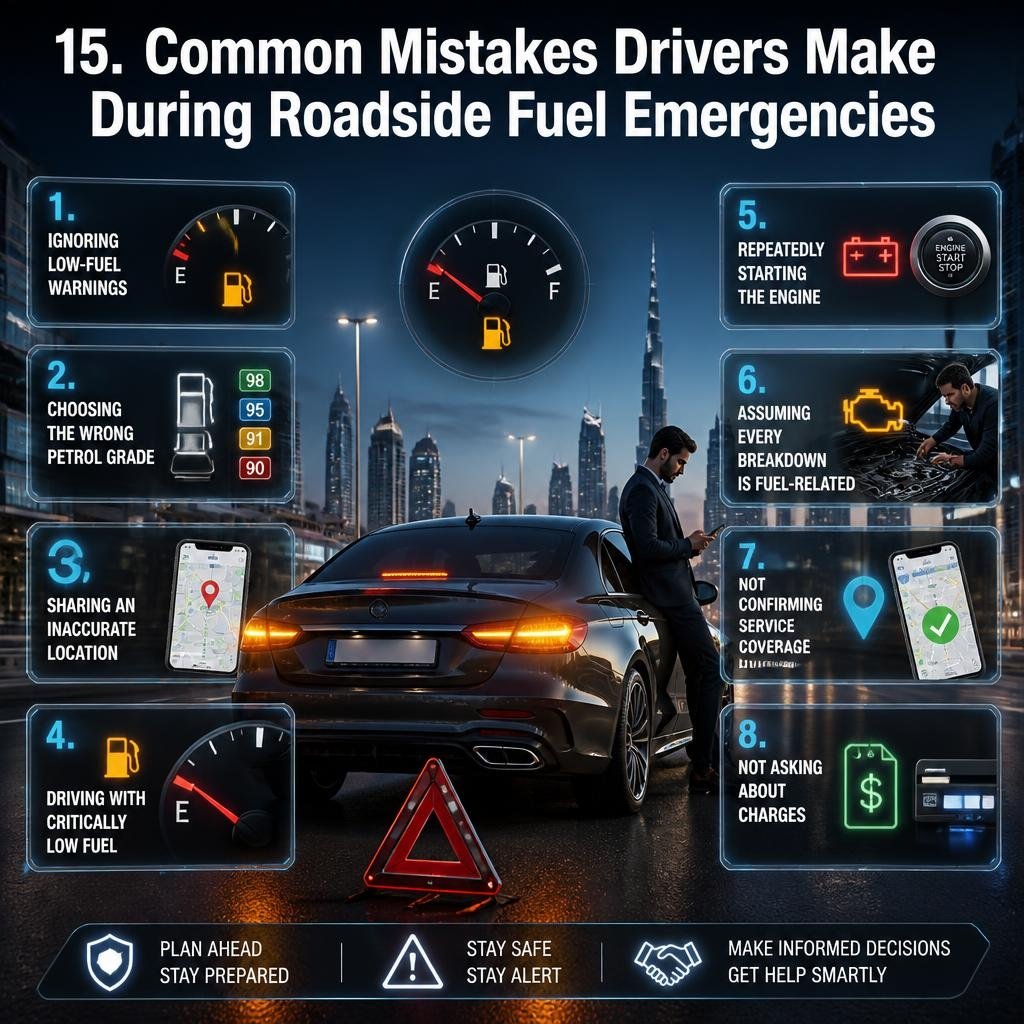
A roadside fuel shortage can create pressure, and drivers sometimes make decisions without properly assessing the situation.
Understanding these common mistakes can help motorists avoid unnecessary risks.
Mistake 1: Waiting Until the Engine Stops
Why it happens: Drivers assume that the remaining petrol will be enough to reach their destination.
Why it is harmful: Traffic, detours and changing road conditions can reduce the available driving range.
How to avoid it: Treat a low-fuel warning as a prompt to arrange refuelling rather than waiting for the engine to stop.
Mistake 2: Ignoring the Vehicle’s Fuel Recommendation
Why it happens: Drivers believe that all petrol grades are suitable for every petrol engine.
Why it is harmful: The selected grade may not meet the engine manufacturer’s requirements.
How to avoid it: Check the owner’s manual or fuel flap before confirming a petrol order.
Mistake 3: Sharing Only a General Location
Why it happens: Drivers mention a neighbourhood or district without identifying their actual position.
Why it is harmful: The provider may struggle to locate the vehicle, particularly near large roads or properties.
How to avoid it: Share a live location, road name, nearest exit and recognisable landmark.
Mistake 4: Trying to Drive Further With Almost No Petrol
Why it happens: Drivers want to avoid waiting for assistance.
Why it is harmful: The vehicle may stop in a more dangerous or inaccessible location.
How to avoid it: Do not take unnecessary risks to reach a station when the fuel supply is critically low.
Mistake 5: Repeatedly Starting the Engine
Why it happens: Drivers expect the engine to restart if they keep trying.
Why it is harmful: Repeated attempts may unnecessarily drain the battery and strain the starting system.
How to avoid it: Stop unnecessary attempts and follow the manufacturer’s instructions.
Mistake 6: Assuming Fuel Delivery Will Fix Every Problem
Why it happens: The vehicle stopped unexpectedly, so the driver assumes an empty tank is the only possible cause.
Why it is harmful: A battery, electrical, ignition or fuel-system fault may still prevent the engine from starting.
How to avoid it: Pay attention to warning signs and arrange mechanical inspection when necessary.
Mistake 7: Not Confirming Service Coverage
Why it happens: Drivers assume that every provider can reach every location.
Why it is harmful: Restricted access, road conditions or service limitations may prevent delivery.
How to avoid it: Confirm location coverage and safe access before finalising arrangements.
Mistake 8: Not Asking About Charges
Why it happens: Drivers concentrate on receiving assistance quickly.
Why it is harmful: They may misunderstand the total amount payable.
How to avoid it: Confirm petrol costs and any applicable delivery or service charges before proceeding.
16. Professional Recommendations for Managing Roadside Fuel Situations
Good roadside preparation involves more than keeping an assistance number on your phone.
Drivers should understand their vehicles, recognise early warning signs and know which service is appropriate for a particular problem.
Develop a Refuelling Habit
Choose a practical point at which you normally arrange refuelling.
For example, rather than waiting for the warning light, you might decide to refuel before starting a long journey whenever the fuel level is already low.
The exact approach should reflect your vehicle and driving routine.
Learn Your Vehicle’s Warning Indicators
Dashboard indicators provide useful information about vehicle condition.
Understand the difference between a low-fuel warning and other warnings relating to engine temperature, oil pressure or electrical systems.
If an important warning appears, do not assume that adding petrol will solve the problem.
Keep Your Vehicle Information Accessible
Know where to find your manufacturer’s fuel recommendations and restarting instructions.
This information becomes particularly useful when requesting assistance.
Prioritise Safe Access Over Convenience
The closest point to your vehicle is not necessarily a suitable delivery location.
A safe, accessible stopping area is more important than arranging delivery at an unsafe position.
Distinguish Between Immediate and Long-Term Solutions
Petrol delivery addresses an immediate shortage.
It does not replace regular maintenance, proper journey preparation or mechanical inspection.
Once the immediate situation is resolved, consider why the shortage happened and whether a change in your refuelling routine could prevent it in the future.
Keep Your Roadside Options Clear
Drivers should understand the difference between:
- Petrol delivery for an empty tank.
- Battery assistance for a battery problem.
- Mechanical support for vehicle faults.
- Recovery for a vehicle that cannot safely continue.
Choosing the appropriate service avoids unnecessary delays.
For broader guidance about everyday vehicle use and fuel-related driving decisions, explore Dubai Driving and Fuel Insights.
17. When Should You Request Roadside Petrol Assistance Instead of Driving to a Station?
The decision depends on your remaining fuel, vehicle condition, location and road safety.
There is no universal distance that every vehicle can travel after its low-fuel warning appears.
Request Assistance When:
- The engine has stopped because the tank is empty.
- Your vehicle cannot safely reach a petrol station.
- The remaining fuel is critically low.
- You are in an unfamiliar location and cannot identify a suitable station.
- Driving further could leave the vehicle in a more dangerous position.
Drive to a Petrol Station When:
- Your vehicle is operating normally.
- There is sufficient fuel to reach an accessible station safely.
- The route is practical and does not require unnecessary detours.
- You are not ignoring another important vehicle warning.
Do Not Treat Every Warning as a Fuel Problem
If the engine stops while the fuel gauge shows sufficient petrol, consider another possible fault.
An electrical failure, overheating problem or fuel-system malfunction may require professional attention.
The most sensible decision is the one that addresses the actual problem without creating additional roadside risks.
What Should I Do If My Car Runs Out of Petrol on a Busy Road in Dubai?
Running out of petrol on a busy road requires immediate attention to vehicle and passenger safety. The first priority is to avoid creating a traffic hazard. Do not attempt to drive further when the engine is losing power or has stopped because of an empty tank.
If possible, move your vehicle to a safe stopping position before the engine stops completely. Switch on your hazard lights and follow the appropriate roadside safety procedures. If the vehicle is in a dangerous position, contact the relevant authorities.
Once you are safe, arrange suitable roadside petrol assistance.
Important steps to follow:
Switch on hazard warning lights.
Avoid standing beside moving traffic.
Move passengers to a safer position when appropriate.
Share your exact location and direction of travel.
Provide the nearest exit, road name or landmark.
Confirm whether your vehicle needs petrol delivery or mechanical assistance.
Professional advice: Never walk along a Dubai highway to find a petrol station. If your vehicle is creating an immediate traffic hazard, seek emergency assistance rather than waiting for a delivery vehicle.
How Can I Arrange Emergency Petrol Delivery to My Exact Location in Dubai?
Emergency petrol delivery can be arranged by contacting a suitable fuel delivery provider and providing accurate information about your vehicle and location. The process generally starts with identifying the vehicle’s petrol requirements, sharing a live location and confirming whether the requested service is available.
Location accuracy is particularly important in Dubai because major roads often have multiple exits, service roads, parking entrances and different directions of travel.
For example, saying that your car has stopped on Sheikh Zayed Road may not be enough. The provider may also need your nearest exit, direction of travel and a recognisable landmark.
Information to prepare before requesting assistance:
Your live GPS location or map pin.
Vehicle make and model.
Required petrol grade: E-Plus 91, Special 95 or Super 98.
Whether the fuel tank is completely empty.
Nearest landmark or road exit.
Whether the vehicle is parked safely.
Any parking or access restrictions.
Professional advice: Before confirming your request, ask about petrol availability, delivery coverage, applicable charges and estimated arrival information. Never assume that delivery is automatically available at every roadside location.
Which Petrol Grade Should I Choose for Emergency Fuel Delivery in Dubai?
Choosing the correct petrol grade is essential because different petrol engines have different octane requirements. In Dubai, the commonly available petrol grades include E-Plus 91, Special 95 and Super 98. The correct option depends on your vehicle manufacturer’s specifications, not simply the price or octane rating.
For instance, if your vehicle requires Special 95, requesting Super 98 does not necessarily provide better performance or fuel economy. Similarly, E-Plus 91 should only be selected when your vehicle is approved for that grade.
Understand the available petrol grades:
E-Plus 91: Suitable for vehicles whose manufacturers approve 91-octane petrol.
Special 95: Suitable for vehicles requiring or recommending 95-octane petrol.
Super 98: Designed for vehicles requiring or recommending higher-octane petrol.
Before confirming your petrol request:
Check the manufacturer’s owner’s manual.
Look at the fuel recommendation inside the fuel flap.
Confirm the required octane rating.
Do not choose a grade based only on assumptions about engine performance.
Professional advice: Keep your vehicle’s fuel specification accessible on your phone. During a roadside emergency, this simple preparation can help prevent an incorrect petrol selection.
What Should I Do If My Car Still Doesn’t Start After Emergency Petrol Delivery?
Receiving petrol does not guarantee that every vehicle will restart immediately. Although an empty tank may be the original problem, other factors can prevent the engine from starting. These may include fuel-system priming requirements, a weak battery, a fuel pump problem or an unrelated mechanical fault.
The first step is to confirm that the correct petrol grade has been supplied. Then follow the restarting instructions provided by your vehicle manufacturer.
Avoid repeatedly turning the ignition because unnecessary starting attempts may drain the battery and create additional complications.
Possible reasons your car may not restart:
Fuel-system issue: The vehicle may require a manufacturer-specific procedure after running out of petrol.
Weak battery: Previous starting attempts may have reduced the available battery charge.
Fuel pump fault: An existing problem may prevent petrol from reaching the engine correctly.
Electrical problem: An ignition or electrical fault may prevent normal starting.
Other mechanical issues: An unrelated engine problem may have occurred at the same time.
What should you do next?
Check for unusual dashboard warning lights.
Follow the vehicle manufacturer’s restarting procedure.
Avoid unnecessary ignition attempts.
Explain the situation to a qualified mechanic.
Arrange mechanical assistance or recovery if required.
Professional advice: Don’t assume that every no-start problem is caused by an empty tank. If the vehicle still refuses to start after refuelling, further diagnosis is more useful than repeatedly attempting to restart it.
How Can I Prevent Running Out of Petrol During Daily Driving and Long Journeys in Dubai?
Preventing a roadside fuel emergency starts with developing a consistent refuelling routine. Drivers should understand their vehicle’s consumption, monitor the fuel level and consider actual road conditions rather than relying entirely on the dashboard’s remaining-range estimate.
Dubai traffic, additional journeys, unexpected diversions and extended idling can all affect fuel requirements. A journey that normally consumes a predictable amount of petrol may require more when traffic conditions change.
For long-distance travel, drivers should also consider the return journey and additional driving after reaching their destination.
Practical fuel-management habits:
Check the fuel level before leaving home or work.
Refuel before starting a long journey if the tank is already low.
Understand your vehicle’s normal fuel consumption.
Avoid unnecessary engine idling.
Maintain the recommended tyre pressure.
Keep your vehicle properly maintained.
Consider traffic congestion when planning journeys.
Identify convenient refuelling opportunities along longer routes.
Avoid relying entirely on the remaining-range display.
Professional advice: Develop a refuelling routine instead of waiting for the low-fuel warning light. Consistent fuel management reduces the chances of unexpected roadside interruptions and makes everyday driving more predictable.
Conclusion
Dubai roadside fuel assistance provides practical support when a vehicle runs out of petrol unexpectedly, whether the problem occurs during daily commuting, heavy traffic, or a longer journey. Instead of making risky decisions or leaving your vehicle unattended, taking the right safety precautions and arranging suitable assistance can help you manage the situation more confidently.
The most important step is to act early. Pay attention to your fuel gauge, understand your vehicle’s low-fuel warning, and avoid delaying refuelling when your remaining range is limited. If your car stops because of an empty tank, move to a safe position if possible, switch on your hazard lights, and share your accurate location when requesting assistance.
For better preparation, drivers should also understand their vehicle’s recommended petrol grade, plan fuel stops before long journeys, and consider changing routes when traffic or road conditions may increase fuel consumption. These simple habits can reduce unexpected interruptions and make driving across Dubai more convenient.
For drivers who need convenient petrol support, Fuel Delivery Dubai provides information about available petrol delivery assistance across Dubai. Being prepared and knowing where to seek help can make an unexpected low-fuel situation easier to handle and help you continue your journey with greater peace of mind.
Leave a Reply