

Introduction
Petrol vs Diesel Fuel Consumption in Dubai | Choosing between a petrol and diesel vehicle in Dubai is not just about engine performance. It is also about how much fuel you use every month, how far you travel, and whether your vehicle suits the roads and driving conditions you experience daily. A car that looks economical on paper may cost more to operate when you consider traffic, air-conditioning, maintenance, and fuel prices.
Understanding petrol vs diesel fuel consumption in Dubai helps drivers make better decisions before purchasing a vehicle or trying to reduce their existing fuel expenses. Diesel engines often provide better fuel economy than comparable conventional petrol engines, especially on long journeys. However, petrol vehicles, including modern hybrids, can be more suitable for certain urban driving patterns.
Dubai presents a mixture of driving conditions. Some motorists spend much of their time in congested city traffic, while others regularly travel along Sheikh Zayed Road, use major highways, or commute between different emirates. These different driving patterns can produce significantly different fuel-consumption results.
This guide explains how petrol and diesel fuel consumption compares, how to calculate actual running costs, how Dubai’s climate and traffic affect efficiency, and which engine type may suit your needs. It also covers common mistakes, practical fuel-saving techniques, and expert recommendations to help you evaluate vehicles based on realistic ownership costs.
For general information about fuel services and roadside fuel assistance, visit Fuel Delivery Dubai.
1. What Is Petrol vs Diesel Fuel Consumption?
Petrol vs diesel fuel consumption refers to the amount of fuel each vehicle uses to travel a particular distance. Petrol and diesel engines operate differently, and these differences influence their efficiency, performance, and running costs.
Fuel consumption is commonly measured in litres per 100 kilometres (L/100 km) or kilometres per litre (km/L). A vehicle using fewer litres to cover 100 kilometres consumes less fuel, while a vehicle travelling more kilometres on one litre has better fuel economy.
For example, consider two hypothetical vehicles:
- Petrol vehicle: 10 km/L.
- Diesel vehicle: 14 km/L.
The petrol vehicle uses 10 litres to travel 100 kilometres. The diesel vehicle uses approximately 7.14 litres to cover the same distance.
In this example, the diesel vehicle consumes about 28.6% less fuel by volume. However, these figures are illustrative rather than guaranteed results for every vehicle.
Why do petrol and diesel engines consume different amounts of fuel?
Diesel engines typically achieve higher thermal efficiency than comparable conventional petrol engines. Their combustion process, compression ratio, and operating characteristics allow them to convert a greater proportion of the fuel’s energy into useful work.
Petrol engines use spark ignition, whereas diesel engines use compression ignition. These differences affect combustion, engine performance, and fuel requirements.
However, engine efficiency is only one part of the equation. Vehicle weight, transmission, engine size, aerodynamic design, tyre condition, and driving behaviour also affect consumption.
A compact petrol car may consume less fuel than a large diesel SUV because the two vehicles have very different energy requirements.
Expert tip: Compare similar vehicles under similar driving conditions. The most useful comparison considers the complete vehicle rather than assuming that every diesel model is more economical than every petrol model.
2. Petrol vs Diesel Fuel Consumption in Dubai: Main Differences
Dubai drivers need to consider fuel economy alongside the type of journeys they make. A vehicle that performs well during long highway journeys may deliver different results during short trips through congested streets.
| Factor | Petrol vehicle | Diesel vehicle |
|---|---|---|
| Fuel consumption | Varies by model and engine technology | Often lower than comparable conventional petrol models |
| Highway efficiency | Can be very good in efficient vehicles | Often offers an advantage over long distances |
| City driving | Suitable for many commuting patterns | Suitable when the engine and journey pattern are compatible |
| Engine response | Generally smooth and responsive | Often provides strong low-speed torque |
| Noise and vibration | Usually quieter | Can produce more combustion noise and vibration |
| Short journeys | Often suitable for regular short trips | Some models may be less suitable for repeated short journeys |
| Maintenance | Depends on engine and vehicle design | Emissions systems can add maintenance requirements |
| Ownership cost | Depends on purchase price and running costs | Depends on fuel savings and total ownership costs |
These differences are general tendencies rather than universal rules. Modern petrol engines, turbocharged engines, diesel powertrains, and hybrids can produce very different results.
Which fuel type is more economical?
Diesel often has an advantage when comparing conventional vehicles of similar size and capability. However, the cost of each journey also depends on the price per litre.
A vehicle can consume less fuel but still cost more to operate if its fuel is more expensive or its purchase and maintenance costs are substantially higher.
For example, a diesel vehicle that uses 25% less fuel does not necessarily save 25% of the total ownership budget. The percentage applies to fuel consumption by volume, not every expense associated with the vehicle.
For a broader comparison of engine characteristics, read Petrol vs Diesel Comparisons Dubai.
3. How Dubai Traffic Affects Petrol and Diesel Consumption
Traffic conditions are among the most important factors affecting real-world fuel consumption in Dubai. Repeated acceleration, braking, idling, and low-speed movement can increase fuel use regardless of whether a vehicle runs on petrol or diesel.
A driver travelling a short distance through heavy congestion may use more fuel per kilometre than someone covering a longer distance at a steady speed.
Petrol consumption in city traffic
Petrol vehicles are widely used for commuting, school runs, shopping, and other everyday journeys. Their fuel consumption can increase when the driver repeatedly accelerates from a stop and brakes shortly afterwards.
Common situations include:
- Waiting at busy traffic signals.
- Moving slowly through congested junctions.
- Making several short journeys during the day.
- Running the engine while parked.
- Driving with the air-conditioning operating in extreme heat.
The size of the effect depends on the vehicle. A small, efficient petrol car may remain economical in city traffic, while a large petrol SUV may consume considerably more fuel.
Petrol hybrids can also be worth considering because their electric assistance and regenerative braking may improve efficiency in stop-and-go conditions.
Diesel consumption in city traffic
Diesel engines can remain efficient in urban driving, but their suitability depends on the specific vehicle and how it is used.
Some diesel vehicles are designed for regular longer journeys. If these vehicles repeatedly make very short trips, they may not reach the operating conditions needed for certain emissions-control processes.
For example, a diesel vehicle equipped with a diesel particulate filter may require suitable driving conditions to complete regeneration. Repeatedly interrupting this process can contribute to warning lights or additional maintenance requirements.
This does not mean every diesel car performs poorly in Dubai traffic. It means that the manufacturer’s intended use and maintenance guidance should be considered before purchasing one.
How to reduce traffic-related fuel waste
You can improve efficiency without changing your vehicle or driving aggressively.
- Accelerate progressively when traffic conditions permit.
- Anticipate traffic lights and slowdowns.
- Avoid unnecessary idling.
- Combine nearby errands into one journey.
- Maintain appropriate tyre pressure.
- Keep the engine and transmission properly maintained.
For a more detailed explanation of stationary engine use, read Car Idling Fuel Consumption in Dubai.
4. Petrol vs Diesel Fuel Consumption on Dubai Highways

Highway driving often highlights the efficiency advantages of diesel engines. Once a vehicle reaches a steady cruising speed, the engine can operate under more consistent conditions than it does in stop-and-go traffic.
Diesel engines frequently combine efficient combustion with strong torque, making them suitable for long-distance travel. Nevertheless, the result depends on the vehicle’s design, cruising speed, load, and engine technology.
Why diesel may perform better on long journeys
Diesel engines generally extract more useful work from each litre of fuel than comparable conventional petrol engines.
This can benefit drivers who regularly travel between Dubai and other emirates, particularly when they cover substantial distances throughout the year.
However, the advantage should be evaluated using real-world consumption figures rather than assumptions about fuel type.
A diesel SUV with a heavy body and large engine may consume more fuel than a smaller petrol sedan. Vehicle size and aerodynamic efficiency can outweigh some of the benefits associated with diesel combustion.
How highway speed influences consumption
Air resistance increases as vehicle speed rises. At higher speeds, the engine must use more energy to overcome aerodynamic drag.
A vehicle travelling at a steady, legal cruising speed may therefore use less fuel than the same vehicle driven considerably faster over the same distance.
Other factors also matter:
- Vehicle load and passenger weight.
- Tyre pressure and tyre design.
- Transmission gearing.
- Road gradient and wind conditions.
- Acceleration and overtaking habits.
- Engine and cooling-system condition.
Drivers should maintain a legal, safe speed rather than trying to maximise fuel economy at the expense of road safety.
Is a petrol vehicle still economical on highways?
Yes. Modern petrol vehicles can offer good highway efficiency, particularly when they have an efficient engine, suitable transmission gearing, and a relatively light body.
The comparison should focus on actual consumption for the models being considered. A well-designed petrol vehicle may be a better overall purchase if its highway economy is competitive and its ownership costs are lower.
5. Typical Petrol and Diesel Fuel Consumption by Vehicle Type
Fuel consumption varies widely according to vehicle size, engine technology, transmission, age, and driving conditions. General estimates can help with initial planning, but they should not replace model-specific figures.
The following ranges are illustrative estimates for conventional vehicles.
| Vehicle category | Petrol consumption | Diesel consumption |
|---|---|---|
| Compact car | 5.5–8 L/100 km | 4.5–6.5 L/100 km |
| Family sedan | 7–11 L/100 km | 5–8 L/100 km |
| Mid-size SUV | 9–14 L/100 km | 7–11 L/100 km |
| Large SUV | 12–18+ L/100 km | 9–14+ L/100 km |
Actual consumption may fall outside these ranges. High-performance models, older vehicles, heavy-duty SUVs, and petrol hybrids can produce very different results.
How should you interpret these estimates?
Suppose a petrol sedan uses 9 litres per 100 km, while a comparable diesel sedan uses 6.5 litres per 100 km.
For 100 kilometres, the difference is 2.5 litres.
If both vehicles cover 2,000 kilometres per month under similar conditions, the estimated monthly consumption would be:
- Petrol: 180 litres.
- Diesel: 130 litres.
- Difference: 50 litres.
This example demonstrates how a modest difference in consumption can become significant over repeated journeys.
However, the calculation assumes that both vehicles maintain their stated consumption rates. Real-world traffic and seasonal conditions may change the results.
How to compare kilometres per litre with litres per 100 kilometres
Some vehicles display fuel economy in km/L, while others use L/100 km.
Use these formulas to convert between the two:
L/100 km = 100 ÷ km/L
km/L = 100 ÷ L/100 km
For example, a vehicle averaging 12.5 km/L consumes 8 litres per 100 km.
Remember that a higher km/L figure means better economy, whereas a lower L/100 km figure means better economy.
6. How Dubai’s Hot Climate Affects Fuel Consumption
Dubai’s climate creates additional demands on vehicles, particularly during the summer months. Air-conditioning, cooling-system condition, traffic, and the way a vehicle is used can influence its fuel consumption.
However, hot weather does not automatically mean every healthy vehicle will consume dramatically more fuel. The actual effect depends on the vehicle, driving pattern, and operating conditions.
Air-conditioning and fuel use
In conventional petrol and diesel vehicles, the air-conditioning compressor generally places an additional load on the engine. The amount of extra fuel required depends on the cooling demand, outside temperature, cabin heat, and system design.
When a car has been parked in direct sunlight, the cabin may become extremely hot. Cooling it down requires more work from the air-conditioning system than maintaining an already comfortable temperature.
Practical steps include:
- Park in the shade whenever practical.
- Use a sunshade to reduce heat entering the cabin.
- Allow hot air to escape briefly before cooling the cabin, where safe.
- Maintain the air-conditioning system according to the manufacturer’s schedule.
- Address weak cooling rather than assuming the system is working normally.
Passenger comfort and safety should always take priority during extreme heat.
Cooling systems and engine condition
A properly functioning cooling system helps the engine maintain its intended operating temperature.
Low coolant, restricted airflow, damaged hoses, faulty fans, or other mechanical problems can affect reliability and may contribute to poor performance.
Drivers should not open a hot cooling system or remove a pressurised radiator cap. If the engine overheats, stop in a safe place and follow the manufacturer’s instructions.
Regular maintenance helps identify problems before they become more serious.
Does summer affect petrol and diesel engines differently?
The effect varies by vehicle rather than following one universal rule.
A petrol engine may experience additional fuel demand from air-conditioning and traffic. A diesel vehicle faces similar accessory loads, although its overall consumption may remain lower because of its operating efficiency.
A vehicle’s size, engine design, and condition are often more useful predictors than fuel type alone.
7. Current UAE Fuel Prices and Their Effect on Running Costs
Fuel prices directly affect the financial difference between petrol and diesel vehicles. The UAE uses a monthly fuel-pricing mechanism, so the cost of filling a tank can change from one month to the next.
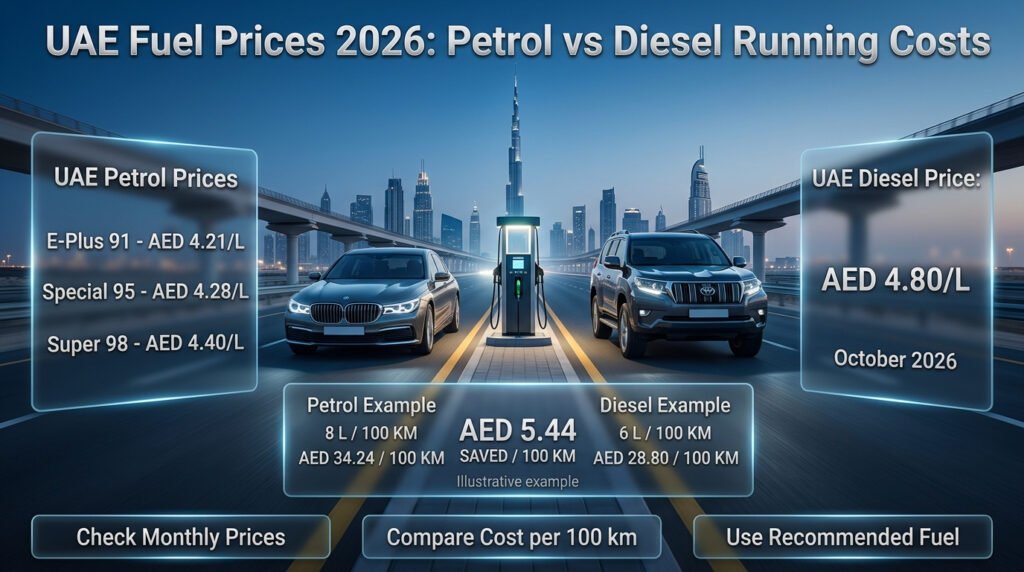
According to the UAE fuel-price announcement reported by Emirates News Agency, the October 2026 prices are as follows.
| Fuel grade | October 2026 price per litre |
|---|---|
| E-Plus 91 petrol | AED 4.21 |
| Special 95 petrol | AED 4.28 |
| Super 98 petrol | AED 4.40 |
| Diesel | AED 4.80 |
These prices apply to October 2026 and may change in November. Always check the latest announced rates before calculating your future fuel budget.
Why the price per litre matters
Diesel engines may consume fewer litres per kilometre, but the price per litre can differ from petrol prices.
Therefore, the most useful financial comparison is not simply how many litres each vehicle consumes. It is how much money each vehicle requires to cover the same distance.
For example, using the October 2026 prices above, assume a petrol vehicle uses 8 litres per 100 km and a diesel vehicle uses 6 litres per 100 km.
The estimated cost per 100 km would be:
Petrol at AED 4.28 per litre
8 × AED 4.28 = AED 34.24.
Diesel at AED 4.80 per litre
6 × AED 4.80 = AED 28.80.
Under these assumptions, the diesel vehicle saves AED 5.44 per 100 km.
This example uses Special 95 petrol and assumes that each vehicle’s consumption figures are realistic for the driver’s journeys. Your actual result may differ.
Which petrol grade should you use?
Use the petrol grade recommended by your vehicle manufacturer. A vehicle designed for a particular octane rating should not automatically be filled with a lower grade simply because it costs less.
Similarly, diesel vehicles must use the correct diesel fuel specification.
Choosing an inappropriate fuel to save money can create performance or reliability problems and may conflict with the manufacturer’s requirements.
8. How to Calculate Petrol and Diesel Fuel Costs in Dubai
A fuel-consumption comparison becomes more useful when you convert it into monthly and annual expenses.
The basic formula is:
Fuel cost = Distance driven ÷ Fuel economy in km/L × Price per litre
If your fuel consumption is measured in L/100 km, use:
Fuel cost = Distance driven × Consumption in L/100 km ÷ 100 × Price per litre
Both formulas calculate fuel expenditure for a given distance.
Example: Monthly driving costs
Suppose a driver covers 2,000 kilometres every month.
The petrol vehicle averages 10 km/L and uses Special 95 petrol at AED 4.28 per litre. The diesel vehicle averages 14 km/L and uses diesel at AED 4.80 per litre.
These are example consumption figures, not claims about any specific vehicle.
Petrol vehicle
2,000 ÷ 10 = 200 litres.
200 × AED 4.28 = AED 856 per month.
Diesel vehicle
2,000 ÷ 14 = approximately 142.86 litres.
142.86 × AED 4.80 = approximately AED 685.71 per month.
Estimated difference
AED 856 − AED 685.71 = AED 170.29 per month.
Annualised over 12 months, the estimated fuel saving is approximately AED 2,043.48.
The calculation assumes the same monthly distance and consistent fuel economy throughout the year. Actual consumption and fuel prices may vary.
Why annual calculations are important
A small difference in the cost of one journey may not seem significant. Over thousands of kilometres, however, the difference can become meaningful.
Annual calculations are particularly useful when deciding whether a diesel model’s higher purchase price is justified.
For example, if a diesel vehicle saves AED 2,000 annually in fuel but costs AED 7,000 more to purchase, it would take approximately 3.5 years to recover the initial price difference through fuel savings alone.
That estimate excludes financing, resale value, insurance differences, and maintenance. These expenses should be considered before making a final decision.
9. Which Vehicle Is Better for City Driving, Highway Travel, and Daily Commuting?
There is no single answer that applies to every Dubai driver. The most appropriate vehicle depends on annual mileage, journey length, traffic exposure, vehicle size, and ownership budget.
Petrol for short daily journeys
Petrol vehicles can be a practical choice for drivers who cover relatively short distances, make occasional trips, or use their cars mainly for everyday commuting.
Many petrol engines are well suited to frequent starts and stops. They can also offer quieter operation and lower purchase prices in certain vehicle categories.
However, a large petrol SUV may still consume substantial fuel during short, congested journeys.
Diesel for frequent long-distance travel
Diesel may suit motorists who regularly cover long highway distances or use their vehicles for commercial and heavy-duty applications.
The potential advantages include:
- Lower fuel consumption in many comparable vehicles.
- Strong torque in many diesel engine designs.
- Good efficiency during sustained highway driving.
- Potentially lower fuel expenditure at high annual mileage.
These advantages should be weighed against maintenance requirements and the vehicle’s suitability for your typical journeys.
Petrol hybrids for urban driving
Petrol hybrids combine a petrol engine with an electric motor and battery system.
Depending on the design, they can recover energy during braking and use electric assistance to reduce fuel consumption in suitable conditions.
This can make them attractive for city driving involving frequent stops. However, the degree of benefit varies with traffic, route, temperature, vehicle design, and battery-system operation.
A petrol hybrid may be more economical than either a conventional petrol or diesel model in certain circumstances.
Compare the complete ownership picture
Before choosing, consider:
- Expected annual distance.
- Real-world fuel consumption.
- Current fuel prices.
- Purchase price and financing.
- Servicing and repair costs.
- Insurance and depreciation.
- Expected resale value.
- Suitability for your normal journey length.
The best vehicle is the one that meets your practical requirements at an acceptable total cost, rather than simply having the lowest advertised fuel-consumption figure.
10. Common Mistakes When Comparing Petrol and Diesel Fuel Consumption
Fuel-economy comparisons can be misleading when the vehicles or driving conditions are not equivalent.
Mistake 1: Comparing vehicles of different sizes
A compact petrol sedan and a large diesel SUV have different weight, aerodynamic, and performance requirements.
Why it matters: The difference in fuel consumption may reflect the vehicle’s size rather than fuel type.
How to avoid it: Compare vehicles from similar categories with similar performance and equipment.
Mistake 2: Using only manufacturer figures
Official figures are useful for comparing vehicles under standardised conditions, but actual consumption depends on traffic, speed, temperature, and driving habits.
How to avoid it: Check credible real-world reports and record consumption over several refills.
Mistake 3: Ignoring fuel prices
A diesel vehicle may use fewer litres but still have a different cost per kilometre because diesel and petrol prices differ.
How to avoid it: Calculate the cost of travelling 100 km using the correct fuel grade and current price.
Mistake 4: Overlooking maintenance requirements
Fuel savings can be reduced by higher servicing or repair costs. The extent of this difference depends on the model, its age, and its condition.
How to avoid it: Review the manufacturer’s service schedule and obtain a professional inspection before buying a used vehicle.
Mistake 5: Assuming every diesel suits short journeys
Some diesel vehicles require particular operating conditions for their emissions-control systems.
How to avoid it: Check the manufacturer’s guidance and make sure the vehicle suits your daily journey pattern.
Mistake 6: Measuring consumption from a single refill
Fuel-pump shut-off, different filling conditions, and unusual driving patterns can affect an individual measurement.
How to avoid it: Use a consistent full-to-full method across several tanks.
Mistake 7: Using the wrong fuel grade
Choosing fuel purely by price can be inappropriate if the vehicle requires a particular specification.
How to avoid it: Follow the owner’s manual and use approved fuel.
11. How to Measure Real-World Fuel Consumption Accurately
You do not need specialised equipment to estimate your vehicle’s fuel economy. A consistent refuelling method and a simple record of kilometres and litres are usually enough to produce a useful estimate.
Step 1: Fill the tank consistently
Refuel using the same full-tank method. Allow the pump to stop automatically rather than repeatedly topping up the tank.
Step 2: Reset the trip meter
Record the starting odometer reading or reset the trip meter immediately after refuelling.
Step 3: Drive under normal conditions
Use the vehicle as you usually would. Include your normal commuting routes, air-conditioning use, and typical traffic conditions.
Step 4: Refill and record the litres
At the next comparable refill, record the distance travelled and the number of litres added.
Step 5: Calculate your fuel economy
Suppose you travel 560 km and use 50 litres.
560 ÷ 50 = 11.2 km/L.
To convert this into litres per 100 km:
100 ÷ 11.2 = approximately 8.93 L/100 km.
Step 6: Repeat the measurement
Repeat the process over several tanks to reduce the effect of unusual journeys or inconsistent refuelling.
If your dashboard reading differs from your calculated result, compare multiple measurements rather than assuming that one reading is completely accurate.
Track city and highway results separately
If you regularly drive in both conditions, maintain separate records where practical. This helps you identify whether congestion, speed, or journey length has the greatest effect on your fuel economy.
The results can also help you decide whether your vehicle is consuming more fuel than expected and whether a mechanical inspection is warranted.
12. Expert Tips to Improve Fuel Economy in Dubai
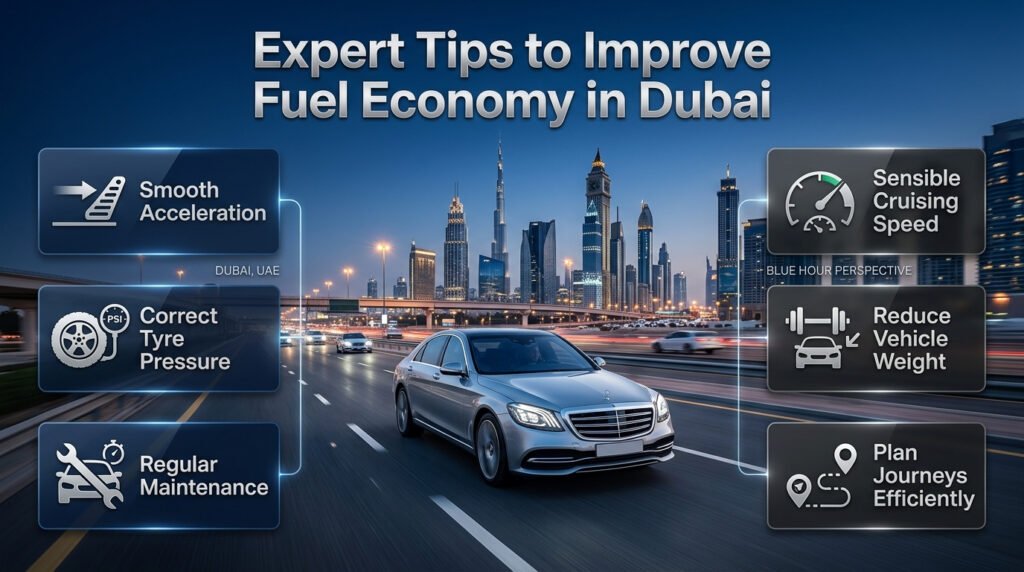
Improving fuel economy does not require aggressive driving or expensive modifications. Consistent habits and appropriate maintenance can help reduce unnecessary fuel use in petrol and diesel vehicles.
Maintain smooth acceleration
Accelerate progressively and anticipate changes in traffic. Repeated hard acceleration followed by heavy braking wastes energy compared with smoother driving when road conditions permit.
Smooth driving does not mean driving too slowly or obstructing traffic. Maintain an appropriate speed and follow traffic rules.
Maintain an appropriate cruising speed
Higher speeds generally increase aerodynamic drag. Travelling at a sensible, legal cruising speed can help reduce unnecessary fuel consumption.
Avoid excessive acceleration and unnecessary changes in speed, particularly on longer journeys.
Check tyre pressure regularly
Underinflated tyres increase rolling resistance and can increase fuel consumption. Check tyre pressure against the vehicle manufacturer’s recommendations, including the specified pressure for the vehicle’s load.
Do not use the maximum pressure printed on the tyre sidewall as a substitute for the recommended operating pressure.
Keep up with maintenance
Follow the correct servicing schedule and use the recommended engine oil specification.
If fuel consumption increases unexpectedly, check tyre condition, air-filter condition, brake operation, diagnostic warnings, and other relevant maintenance items. A technician can investigate faults that are not obvious during a basic visual inspection.
Reduce unnecessary weight
Remove heavy items that do not need to remain in the vehicle. Unnecessary weight can increase the energy required to accelerate, particularly in city traffic.
Roof accessories may also increase aerodynamic drag, depending on their design and how they are used.
Plan journeys sensibly
Combining nearby errands can reduce repeated cold starts and unnecessary kilometres.
Check likely traffic conditions when planning a journey, but do not automatically choose a longer route simply because it appears faster. Compare distance, expected delays, and safety.
For further practical advice, visit Fuel Delivery Dubai.
13. How Engine Technology Influences Fuel Consumption
Petrol and diesel engines differ in more than the fuel they use. Their combustion processes, operating characteristics, and supporting technologies all affect how efficiently they convert fuel into useful movement.
Understanding these differences can help you make sense of why two vehicles with similar engine sizes may deliver very different fuel-economy results.
Petrol engines
Petrol engines generally use spark plugs to ignite an air-fuel mixture. Their performance depends on factors such as engine design, compression ratio, fuel delivery, ignition timing, transmission, and vehicle load.
Modern petrol engines may use direct injection, turbocharging, variable valve timing, and other technologies to improve efficiency.
These technologies can produce significant differences between older petrol vehicles and newer models.
Diesel engines
Diesel engines ignite fuel through the heat created by compressing air inside the cylinder. Their operating characteristics typically provide strong torque and good fuel efficiency in comparable vehicles.
Modern diesel engines may also use turbocharging, high-pressure fuel injection, particulate filters, and selective catalytic reduction systems.
These systems help improve performance and control emissions, but they also introduce specific maintenance requirements.
Why engine size alone is not enough
A smaller engine is not always more economical under every condition. Vehicle weight, power demand, gearing, and driving behaviour influence the final result.
An engine working hard to move a heavy vehicle may consume more fuel than a larger engine in a lighter or more aerodynamically efficient vehicle.
For a dedicated explanation of combustion and powertrain differences, read Petrol Engine vs Diesel Engine Technology in Dubai.
14. How to Choose Between Petrol and Diesel Based on Annual Mileage
Annual mileage is one of the most useful factors when deciding whether diesel’s potential fuel savings justify any additional ownership costs.
A driver covering a few thousand kilometres each year has a different financial situation from someone travelling tens of thousands of kilometres for work.
Calculate your annual distance
Start by estimating the distance you travel in a typical week. Multiply it by the number of weeks you expect to drive during the year, then add any regular longer journeys.
For example, a person travelling 60 km on five working days covers approximately 15,600 km over 52 weeks, before accounting for holidays, additional trips, or changes in routine.
This estimate provides a starting point for comparing annual fuel expenses.
Calculate the annual fuel bill
Suppose two comparable vehicles cover 20,000 km annually.
The petrol vehicle averages 10 km/L, while the diesel vehicle averages 14 km/L.
The petrol vehicle uses:
20,000 ÷ 10 = 2,000 litres.
The diesel vehicle uses:
20,000 ÷ 14 = approximately 1,428.57 litres.
At the illustrative October 2026 prices of AED 4.28 per litre for Special 95 petrol and AED 4.80 per litre for diesel, the estimated annual costs are:
- Petrol: AED 8,560.
- Diesel: approximately AED 6,857.14.
- Estimated annual fuel difference: AED 1,702.86.
The result depends on the assumed consumption figures and fuel prices. The actual difference may be higher or lower.
Compare the break-even period
If the diesel model costs more to buy, calculate how long its expected fuel savings would take to recover the additional purchase cost.
Divide the extra purchase price by the estimated annual fuel saving.
This provides a simple break-even estimate, but it does not include financing, depreciation, maintenance, insurance, or resale value. A more complete ownership comparison should account for those factors too.
Is Petrol or Diesel More Fuel-Efficient in Dubai’s Traffic and Hot Weather?
Diesel vehicles generally deliver better fuel economy than comparable conventional petrol vehicles because diesel engines typically convert more of the fuel’s energy into useful work. However, Dubai’s traffic congestion, frequent stops, air-conditioning demand, and journey length can significantly influence real-world consumption. For drivers making frequent short trips, a modern petrol hybrid may deliver better fuel economy than some diesel vehicles. The most accurate comparison depends on the vehicle’s engine technology, size, condition, and typical driving conditions.
Important factors to consider:
Traffic conditions: Repeated acceleration and braking increase fuel consumption in both petrol and diesel vehicles.
Air-conditioning: Heavy cooling demand can increase fuel use, particularly during Dubai’s summer.
Journey length: Diesel vehicles equipped with particulate filters may need suitable operating conditions for regeneration.
Vehicle efficiency: A smaller, efficient petrol car may consume less fuel than a large diesel SUV.
How Much Does It Cost to Drive 100 km Using Petrol vs Diesel in Dubai?
The cost of travelling 100 km depends on the vehicle’s actual fuel consumption and the price per litre of the fuel it requires. Diesel vehicles may use fewer litres per 100 km, but diesel can cost more per litre than some petrol grades. Therefore, the cheapest option should be determined by calculating the cost of covering the same distance rather than comparing fuel prices alone.
For example, suppose a petrol vehicle consumes 8 litres per 100 km and a diesel vehicle consumes 6 litres per 100 km. Using illustrative prices of AED 4.28 per litre for petrol and AED 4.80 per litre for diesel, the petrol journey costs AED 34.24, while the diesel journey costs AED 28.80. The diesel vehicle saves AED 5.44 over 100 km under these assumptions.
How to compare your costs accurately:
Record the actual fuel consumption of each vehicle in L/100 km.
Use the current UAE price for the correct petrol grade or diesel.
Calculate the cost of travelling 100 km and your expected annual fuel expenditure.
Include purchase price, maintenance, and repair costs when evaluating overall savings.
Which Is Better for Daily Commuting in Dubai: Petrol, Diesel, or a Petrol Hybrid?
The best choice depends on your daily distance, traffic exposure, and vehicle requirements. A conventional petrol vehicle can be practical for short commutes and occasional journeys, while diesel may be advantageous for drivers who regularly cover longer distances. A petrol hybrid can be particularly economical in stop-and-go traffic because its electric motor and regenerative braking system can reduce fuel consumption under suitable conditions.
Drivers who spend considerable time in congested urban areas should compare real-world consumption figures instead of assuming diesel will always provide the best results. Similarly, motorists who frequently travel on highways should assess diesel models alongside efficient petrol vehicles.
Choose based on your driving pattern:
Short urban journeys: Compare efficient petrol cars and petrol hybrids.
Frequent highway travel: Consider diesel models with strong real-world fuel economy.
High annual mileage: Calculate whether fuel savings justify any additional purchase or maintenance costs.
Mixed driving: Compare the complete vehicle, including transmission, weight, engine technology, and ownership expenses.
Why Is My Petrol or Diesel Car Consuming More Fuel Than Usual in Dubai?
Higher-than-normal fuel consumption can result from traffic congestion, excessive idling, frequent short journeys, incorrect tyre pressure, or changes in driving habits. In Dubai, heavy air-conditioning use may also contribute to increased fuel demand. However, if consumption rises suddenly without an obvious change in driving conditions, the vehicle may require further investigation.
Possible mechanical causes include restricted air intake, faulty engine sensors, dragging brakes, wheel-alignment problems, or other engine-management issues. The exact cause depends on the vehicle and its symptoms, so replacing parts without a proper diagnosis can lead to unnecessary expense.
What you should check first:
Measure fuel economy over several refills using a consistent full-to-full method.
Check tyre pressure against the manufacturer’s recommendations.
Review recent changes in traffic, journey length, and air-conditioning use.
Look for warning lights, unusual noises, poor acceleration, or other changes in performance.
Arrange a professional inspection if the increase persists or the vehicle develops additional symptoms.
Is Buying a Diesel Car Worth It in Dubai When Fuel Prices and Maintenance Costs Are Considered?
Buying a diesel car can make financial sense when it delivers substantial fuel savings over your expected annual mileage and suits your normal driving conditions. However, a higher purchase price, maintenance requirements, emissions-control equipment, and potential repair expenses can reduce the overall benefit. A petrol vehicle may be the more economical choice for someone who drives relatively few kilometres each year or mainly makes short journeys.
For example, if a diesel vehicle saves AED 2,000 annually in fuel but costs AED 7,000 more to purchase, it would take approximately 3.5 years to recover that additional purchase cost through fuel savings alone. This calculation excludes maintenance, financing, depreciation, and resale-value differences.
Before making your decision:
Estimate your annual driving distance.
Compare real-world fuel consumption and current UAE fuel prices.
Calculate annual fuel savings using the same distance for both vehicles.
Review the service schedule, warranty, and likely maintenance requirements.
Compare the total cost of ownership over the period you expect to keep the vehicle.
The most economical choice is not necessarily the vehicle with the lowest fuel consumption. It is the vehicle that provides the right balance of fuel efficiency, reliability, purchase price, and maintenance costs for your driving needs in Dubai.
Conclusion: Petrol vs Diesel Fuel Consumption in Dubai
Choosing between petrol and diesel depends on more than the fuel consumption figure shown in a vehicle brochure. In Dubai, your driving habits, daily distance, traffic conditions, air-conditioning use, vehicle type, maintenance costs, and current fuel prices all influence how much you spend on fuel. A petrol vehicle can be a practical choice for everyday commuting, short trips, and general city driving, while a diesel vehicle may offer better fuel efficiency for suitable models that regularly cover long distances.
To make the right decision, compare real-world fuel economy in kilometres per litre rather than relying entirely on manufacturer estimates. Calculate your expected monthly and annual fuel expenses, consider the vehicle’s purchase price, and include maintenance and ownership costs. Regular servicing, correct tyre pressure, smooth acceleration, sensible cruising speeds, and avoiding unnecessary idling can also help reduce fuel consumption in Dubai’s demanding driving conditions.
For a more complete comparison, explore our guides to Petrol vs. Diesel Comparisons Dubai, Petrol Engine vs Diesel Engine Technology in Dubai, and Petrol vs. Diesel Fuel Economy in Dubai. You can also review our Petrol vs Diesel Mileage Comparison in Dubai to understand how different vehicles may perform under comparable conditions.
Ultimately, the most economical vehicle is the one that matches your actual driving needs and delivers a sensible balance between fuel efficiency, reliability, performance, and long-term running costs. By comparing these factors carefully and maintaining your vehicle properly, you can make a more informed decision and manage your fuel budget more effectively. For convenient fuel assistance in Dubai, visit Fuel Delivery Dubai to learn more about available services.
Leave a Reply