
Introduction
Petrol Engine vs Diesel Engine Technology in Dubai | Choosing between a petrol and diesel vehicle in Dubai can be confusing. One vehicle may offer better fuel economy, another may provide stronger pulling power, and a third may be cheaper to maintain over several years. The right decision depends on understanding how each engine works and how its technology performs under your actual driving conditions.
Petrol engine vs diesel engine technology in Dubai is an important comparison for drivers who want to understand combustion systems, engine efficiency, performance, maintenance requirements, and long-term ownership costs. Dubai’s hot climate, heavy traffic, frequent air-conditioning use, and long highway journeys can all influence how a vehicle operates.
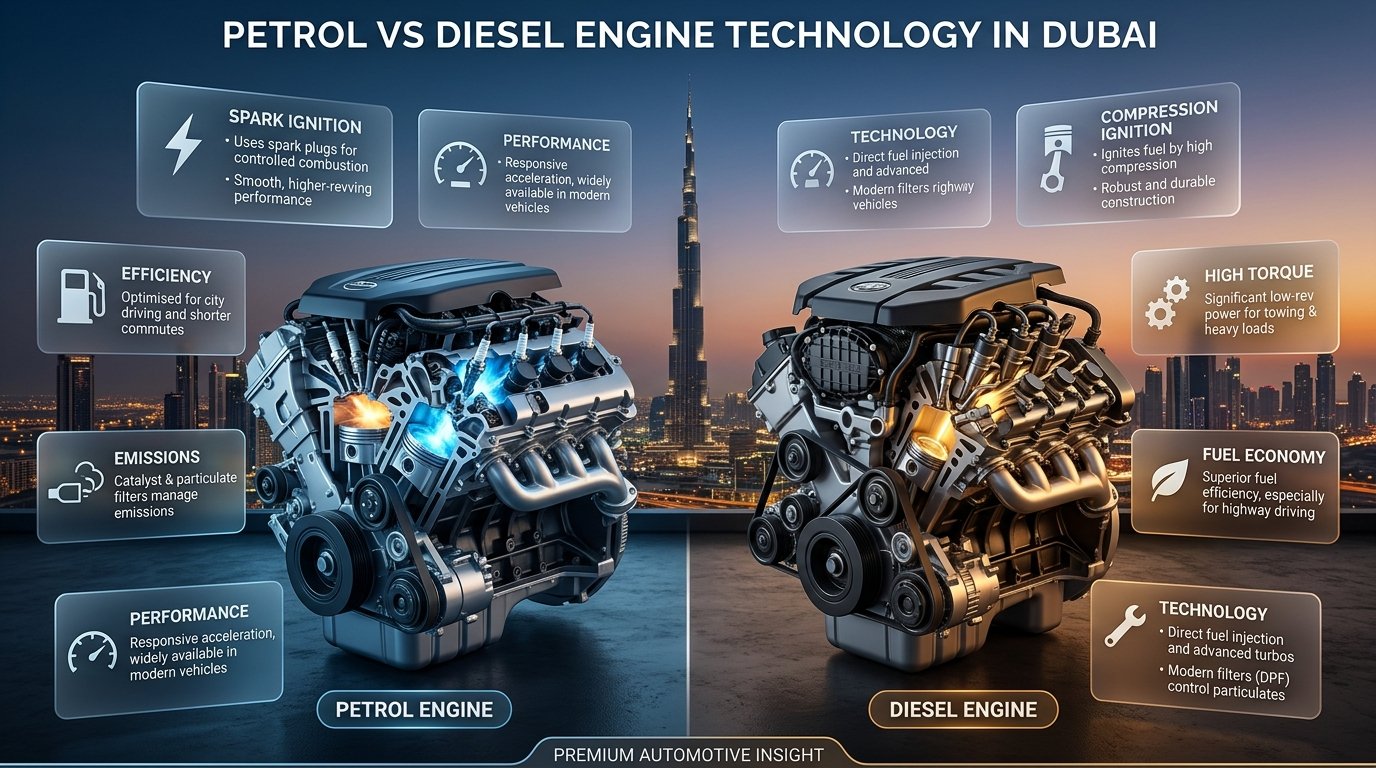
Petrol engines generally use spark plugs to ignite an air-fuel mixture, while diesel engines use heat generated by compressing air to ignite injected fuel. This difference affects fuel consumption, torque delivery, engine design, and emissions-control equipment.
For general vehicle and fuel-related information, visit FuelDeliveryDubai.
This guide explains both engine technologies in practical terms. You’ll learn how combustion works, why modern engines use advanced injection systems, how Dubai’s driving conditions affect performance, and how to compare petrol and diesel vehicles before buying or maintaining one.
1. What Is Petrol Engine Technology?
Petrol engine technology refers to the engineering systems used to burn petrol inside an internal combustion engine and convert its chemical energy into mechanical power. These systems include the intake, fuel injection, ignition, compression, lubrication, cooling, exhaust, and electronic engine management systems.
Petrol engines are common in passenger cars, SUVs, crossovers, sports cars, and many hybrid vehicles. Their design can prioritise smooth acceleration, responsive performance, low noise, or fuel efficiency, depending on the vehicle’s purpose.
How does a petrol engine work?
Most conventional petrol car engines operate on a four-stroke cycle. Each cylinder completes intake, compression, power, and exhaust strokes over two crankshaft revolutions.
1. Intake stroke
The intake valve opens, allowing air into the cylinder. Depending on the engine design, petrol is injected into the intake port or directly into the combustion chamber.
2. Compression stroke
The piston moves upward and compresses the charge. Compression prepares the mixture for combustion, although the exact process depends on whether the engine uses port injection, direct injection, or a combination of both.
3. Power stroke
The spark plug ignites the combustible mixture at the correct point in the cycle. Expanding gases push the piston downward, producing the force that turns the crankshaft.
4. Exhaust stroke
The exhaust valve opens, and the piston pushes the combustion gases out of the cylinder. The cycle then repeats.
The engine’s crankshaft transfers rotational power through the transmission and drivetrain to the wheels.
Which technologies improve modern petrol engines?
Modern petrol engines are far more advanced than older carburettor-based designs. Electronic controls manage fuel delivery, ignition timing, airflow, and emissions.
Important technologies include:
- Electronic fuel injection: Controls the amount of petrol delivered to the engine.
- Direct injection: Sprays fuel directly into the combustion chamber.
- Turbocharging: Uses exhaust energy to increase the amount of air entering the engine.
- Variable valve timing: Adjusts valve operation to suit different engine speeds and loads.
- Knock control: Helps prevent damaging abnormal combustion by adjusting engine operation.
- Hybrid assistance: Uses an electric motor and battery to improve efficiency in compatible vehicles.
These technologies help manufacturers achieve a balance between power, efficiency, drivability, and emissions compliance.
Are petrol engines suitable for Dubai?
Petrol engines can be a practical choice for drivers who make regular city journeys, commute through congested roads, or use their vehicles for family transport and everyday errands.
However, suitability depends on the particular engine. A small naturally aspirated petrol engine, a turbocharged petrol SUV, and a petrol-hybrid vehicle may have very different fuel consumption and performance characteristics.
The most useful approach is to compare the complete vehicle rather than judging its efficiency by engine type alone.
2. What Is Diesel Engine Technology?
Diesel engine technology uses compression ignition to convert diesel fuel into mechanical power. Instead of relying on a spark plug to initiate normal combustion, the engine compresses air until its temperature rises sufficiently for injected diesel fuel to ignite.
Diesel engines are widely used in commercial vehicles, pickups, heavy-duty SUVs, buses, and some passenger cars. Their design often favours strong torque, efficient operation under sustained loads, and long-distance driving capability.
How does a diesel engine work?
A conventional four-stroke diesel engine follows a similar overall cycle to a petrol engine, but the fuel preparation and ignition processes differ.
1. Intake stroke
The intake valve opens, and air enters the cylinder. In a conventional diesel engine, fuel is not mixed with the incoming air in the same way as in a typical petrol engine.
2. Compression stroke
The piston compresses the air to a high pressure. This increases the air temperature significantly.
3. Power stroke
Near the end of compression, the fuel injector sprays diesel into the hot air. The fuel ignites, and expanding combustion gases push the piston downward.
4. Exhaust stroke
The exhaust valve opens, allowing combustion gases to leave the cylinder. The cycle repeats as the engine continues operating.
The combustion process depends on accurate fuel-injection timing, pressure, spray quality, airflow, and electronic control.
Why do diesel engines use high-pressure fuel injection?
Diesel fuel must be delivered in a controlled spray that mixes effectively with the hot compressed air. Modern common-rail injection systems maintain fuel at high pressure and use electronically controlled injectors to deliver carefully measured quantities.
This precision helps manage engine performance, combustion noise, fuel economy, and emissions.
A poorly functioning injector can cause rough running, hard starting, excessive smoke, or reduced performance. However, these symptoms can have several causes, so professional diagnosis is preferable to replacing injectors based on guesswork.
What role does turbocharging play?
Many modern diesel engines use turbochargers to increase the volume of air entering the cylinders. Additional air allows the engine to produce more power while maintaining controlled combustion.
An intercooler can reduce the temperature of compressed intake air, helping improve air density and engine operation.
Turbocharging is common in both petrol and diesel engines, so it should not be treated as an exclusive diesel advantage.
For a more focused technical explanation, read How Petrol and Diesel Engines Work Differently in Dubai.
3. Petrol vs Diesel Engine Technology: The Main Differences
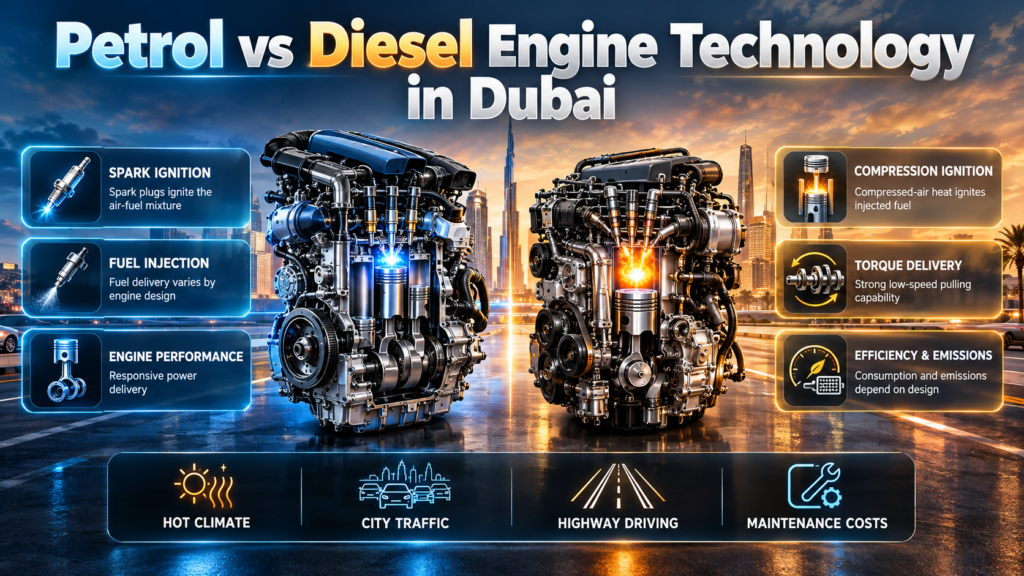
Petrol and diesel engines share many mechanical components, but their ignition methods, fuel-delivery systems, and operating characteristics differ. These differences influence how each vehicle accelerates, consumes fuel, produces torque, and manages exhaust emissions.
| Feature | Petrol engine | Diesel engine |
|---|---|---|
| Ignition method | Spark ignition | Compression ignition |
| Fuel type | Petrol | Diesel |
| Fuel preparation | Port injection, direct injection, or both | Commonly high-pressure direct injection |
| Compression ratio | Generally lower in conventional designs | Generally higher |
| Low-speed torque | Depends on design; often lower in comparable naturally aspirated engines | Often strong |
| Fuel economy | Varies by engine and vehicle | Often better in comparable applications |
| Engine sound | Often quieter, especially at idle | May produce more combustion noise |
| High-load operation | Suitable when correctly designed and rated | Commonly suited to sustained heavy loads |
| Ignition components | Spark plugs and associated components | No spark plugs for normal combustion |
| Cold-start assistance | Usually conventional starting and fuel-control systems | Glow plugs may assist where fitted |
| Emissions systems | Catalysts and sometimes particulate filters | May include DPF, EGR and SCR |
| Common applications | Passenger cars, SUVs and sports cars | Commercial vehicles, pickups and some passenger cars |
Which engine is more efficient?
Diesel engines often achieve better fuel economy than comparable petrol engines because of their combustion characteristics, compression ratios, and reduced throttling losses in many conventional designs. Diesel fuel also contains more energy per litre than petrol.
However, fuel economy depends on the complete powertrain. Vehicle weight, transmission gearing, aerodynamics, engine size, hybrid assistance, and driving conditions can change the outcome substantially.
The US Department of Energy explains the fundamental differences between spark-ignition and compression-ignition engines, while the US Environmental Protection Agency discusses fuel energy content and technologies that improve efficiency. These principles provide a useful engineering basis for comparing vehicles.
Why is torque different from horsepower?
Torque measures rotational force, while horsepower describes the rate at which work is performed. A diesel engine can produce strong torque at relatively low engine speeds, which helps a vehicle pull away with a load or climb a gradient.
However, torque alone does not determine acceleration. Vehicle weight, gear ratios, traction, engine power, and transmission response also matter.
A high-revving petrol engine may provide excellent acceleration, while a turbocharged diesel may feel stronger at low engine speeds. The driving experience depends on the engine’s complete design.
For a broader ownership comparison, see Petrol vs. Diesel Comparisons Dubai.
4. How Does Dubai’s Climate Affect Petrol and Diesel Engines?
Dubai’s hot climate makes cooling-system performance, lubrication, air filtration, and regular maintenance particularly important. Both petrol and diesel engines are engineered to operate within specified temperature limits, but prolonged heat, dust, heavy traffic, and high accessory loads can increase operating demands.
Petrol engines during Dubai’s summer
Petrol engines generate substantial heat during combustion. The cooling system transfers excess heat away from the engine, while the radiator, cooling fan, thermostat, coolant passages, and water pump help maintain suitable operating temperatures.
When a vehicle remains stationary in congested traffic, natural airflow through the radiator decreases. The cooling fan therefore becomes especially important.
Air-conditioning use also increases the vehicle’s energy demand. Depending on the engine and system design, this additional load can increase fuel consumption, particularly during slow urban journeys.
Drivers should pay attention to:
- Unusual increases in engine temperature.
- Coolant loss or visible leaks.
- Cooling fans that fail to operate correctly.
- Damaged hoses or deteriorating belts where fitted.
- Warning lights, unusual smells, or steam.
- Reduced performance associated with overheating.
Never remove a radiator cap or open a hot, pressurised cooling system. Allow the engine to cool and follow the manufacturer’s safety instructions.
Diesel engines during Dubai’s summer
Diesel engines also depend on effective cooling and lubrication. Turbocharged diesel engines require suitable oil and correct servicing because the turbocharger operates at high speeds and temperatures.
Dusty conditions make air-filter maintenance important. Restricted airflow can affect performance and fuel consumption, although the symptoms vary by engine design.
Modern diesel vehicles may also use diesel particulate filters, exhaust-gas recirculation, and selective catalytic reduction systems. These components help reduce harmful exhaust pollutants, but they require the correct maintenance and operating conditions.
For example, a diesel SUV that regularly travels long distances may operate differently from one that makes repeated short trips through congested streets. The latter may have difficulty completing DPF regeneration under certain conditions.
Does extreme heat make diesel better than petrol?
No universal conclusion is justified. Both engine types can operate reliably in Dubai when designed for the local environment and maintained correctly.
Reliability depends on cooling-system condition, engine design, lubrication, fuel quality, operating load, service history, and repair quality.
A neglected diesel engine is not automatically more durable than a well-maintained petrol engine. Likewise, a petrol engine is not inherently unsuitable for hot weather.
Professional advice: Follow the maintenance schedule for your exact vehicle. Avoid unnecessary part replacement based solely on the assumption that Dubai’s heat is damaging the engine.
5. Which Engine Is Better for Dubai’s Stop-Start Traffic?
Petrol engines are often a practical choice for everyday urban driving, particularly when journeys are short and annual mileage is relatively low. Diesel engines can also work well in city traffic, but the suitability of a particular model depends on its emissions equipment and operating requirements.
Petrol engines for daily commuting
A petrol vehicle may suit drivers who regularly travel between home, work, shops, and other nearby destinations.
Its advantages may include smooth operation, responsive acceleration, and a practical ownership proposition when annual mileage is modest. Some petrol engines also warm up quickly, although warm-up time varies with design and ambient conditions.
For example, consider a driver who travels short distances around residential areas and occasionally drives on Sheikh Zayed Road. The fuel savings from choosing diesel may be too small to offset a higher purchase price or maintenance costs.
Diesel engines in congested conditions
Diesel engines are not automatically unsuitable for city driving. Modern designs can provide good drivability and efficient operation.
The important consideration is the emissions system. Some diesel vehicles require particular exhaust temperatures and driving conditions to complete DPF regeneration. Repeated short journeys may interrupt this process.
If a manufacturer specifies a particular driving procedure following a DPF warning, follow the vehicle’s instructions only when it is safe and legal to do so. Persistent warnings require appropriate diagnosis.
What about idling and air-conditioning?
Both petrol and diesel engines consume fuel while running at idle. The amount depends on engine size, operating temperature, accessory demand, and other factors.
Leaving the engine running unnecessarily wastes fuel. However, drivers should follow the manufacturer’s instructions and local safety requirements when operating the air-conditioning system while stationary.
For either engine type, smooth acceleration, sensible route planning, correct tyre pressure, and timely maintenance can help reduce unnecessary fuel consumption.
6. Petrol vs Diesel for Dubai Highway Driving
Highway driving can favour diesel engines because many are designed to deliver strong torque and efficient operation under sustained loads. Nevertheless, modern petrol engines can also provide good highway fuel economy, especially when paired with an efficient transmission or hybrid system.
When diesel may make more sense
Diesel may be worth considering if you regularly:
- Drive long distances between Dubai and other emirates.
- Travel on highways several days each week.
- Carry heavy equipment or cargo within the vehicle’s rated capacity.
- Tow a suitable trailer where permitted.
- Accumulate high annual mileage.
Under these conditions, lower fuel consumption may provide meaningful savings over time.
When petrol may be the better choice
Petrol may be attractive when most driving involves short urban journeys, annual mileage is modest, and the selected model has a competitive purchase price and service plan.
Some modern petrol vehicles also offer strong highway performance and efficient cruising. A turbocharged petrol engine can provide substantial torque, while a petrol-hybrid system may improve efficiency in mixed driving.
A practical Dubai driving example
Imagine two drivers comparing similar-sized vehicles.
Driver A covers approximately 12,000 kilometres annually, with most journeys occurring in city traffic. Driver B covers 35,000 kilometres annually, with frequent inter-emirate highway journeys.
Driver B has more opportunity to recover a diesel vehicle’s additional purchase cost through fuel savings. Driver A may not achieve enough savings to justify the same premium.
These figures are illustrative, not a claim about average Dubai mileage. Actual results depend on the models, prices, fuel economy, and maintenance requirements.
7. Modern Petrol Engine Technologies Explained
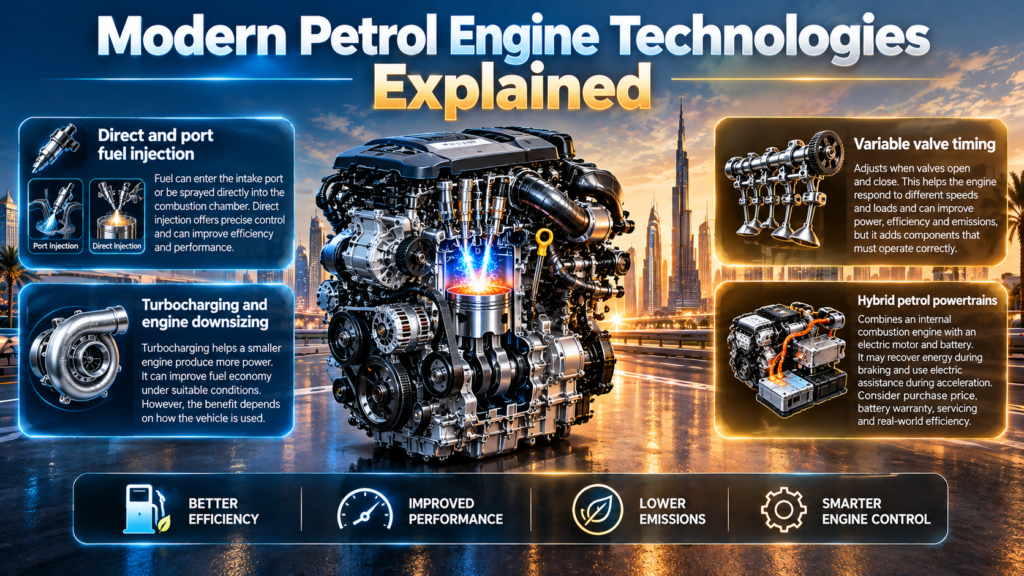
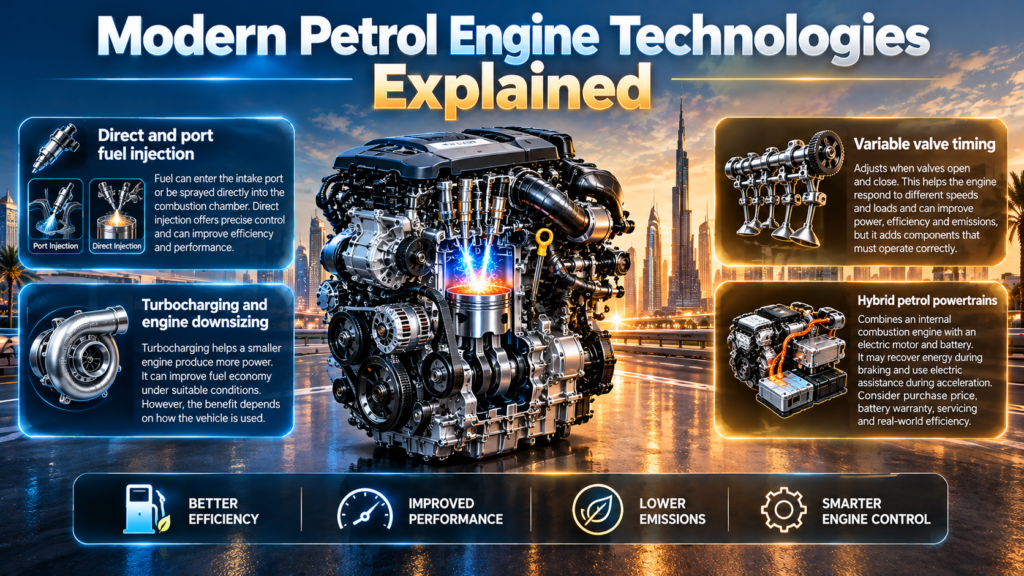
Modern petrol engines use a combination of mechanical engineering and electronic control to improve efficiency, performance, and emissions.
Direct and port fuel injection
In a port-injected engine, fuel enters the intake port before reaching the cylinder. In a direct-injection engine, fuel is sprayed directly into the combustion chamber.
Direct injection offers precise fuel control and can support improved efficiency and performance. Some designs combine port and direct injection to balance different operating requirements.
Neither system is universally superior. Reliability and maintenance requirements depend on the engine’s engineering and operating history.
Turbocharging and engine downsizing
Turbocharging allows a smaller engine to produce more power than it could without forced induction. This can improve fuel economy under suitable conditions.
However, downsized turbocharged engines may consume more fuel when driven aggressively or placed under sustained heavy loads. The fuel-saving benefit depends on how the vehicle is used.
Variable valve timing
Variable valve timing adjusts when valves open and close. This helps the engine respond to different speeds and loads.
The technology can improve the balance between power, efficiency, and emissions, but it adds components that must operate correctly.
Hybrid petrol powertrains
A petrol-hybrid vehicle combines an internal combustion engine with an electric motor and battery. Depending on the system, it may recover energy during braking and use electric assistance during acceleration.
Hybrid assistance can be particularly beneficial in stop-start traffic. However, not every hybrid works the same way, and purchase price, battery warranty, servicing, and real-world efficiency should be considered.
8. Modern Diesel Engine Technologies Explained
Diesel engines have evolved significantly. Modern systems use electronically controlled fuel injection, turbocharging, advanced sensors, and exhaust after-treatment to balance performance and emissions.
Common-rail fuel injection
A common-rail system supplies high-pressure fuel to electronically controlled injectors. The engine control unit adjusts injection timing and quantity according to operating conditions.
Some systems use multiple injection events during a single combustion cycle. This can help control combustion noise, performance, and emissions.
If the fuel system develops a fault, proper diagnostic testing is essential because symptoms such as hard starting or reduced power can have several possible causes.
Turbochargers and intercoolers
Turbochargers increase the mass of air entering the cylinders, allowing the engine to produce more power. Intercoolers reduce the temperature of compressed air.
These components must operate within the manufacturer’s specifications. Incorrect oil, leaks, excessive deposits, or mechanical wear can affect performance.
Diesel particulate filters
A diesel particulate filter captures soot from exhaust gases. The system periodically regenerates by raising the filter temperature sufficiently to burn accumulated soot.
Regeneration behaviour varies by vehicle. Some systems operate automatically under suitable driving conditions, while others may request driver action or require workshop intervention.
Repeated DPF warnings should not be ignored, and a filter should not be replaced without establishing the cause of the problem.
Selective catalytic reduction and DEF
Some diesel vehicles use selective catalytic reduction (SCR) to reduce nitrogen oxide emissions. These systems typically require diesel exhaust fluid, often called DEF or AdBlue in applicable vehicles.
The fluid is not diesel fuel and must be stored and used according to the manufacturer’s instructions. Using the wrong fluid or ignoring system warnings can cause faults or starting restrictions on some vehicles.
Exhaust-gas recirculation
An exhaust-gas recirculation system returns a controlled portion of exhaust gas to the intake under selected operating conditions. This helps reduce nitrogen oxide formation.
Deposits, sensor problems, and mechanical faults can affect operation. Diagnosis should determine whether the EGR system, airflow, fuel injection, or another component is responsible for the symptoms.
9. Which Engine Has Lower Maintenance Costs in Dubai?
There is no universal answer. Petrol engines may require spark plugs and ignition coils, while diesel engines may have expensive high-pressure fuel components and additional exhaust after-treatment systems.
Both need regular engine oil, filters, cooling-system care, and inspections. The exact cost depends on vehicle design, mileage, parts availability, workshop expertise, and warranty coverage.
Typical maintenance differences
| Maintenance item | Petrol engine | Diesel engine |
|---|---|---|
| Engine oil and filter | Required | Required |
| Air filter | Important in dusty conditions | Important in dusty conditions |
| Spark plugs | Used in conventional spark-ignition engines | Not used for normal combustion |
| Glow plugs | Generally not required | May be fitted for starting assistance |
| Fuel injection | Port or direct injection | Often high-pressure direct injection |
| Turbocharger | Present on some models | Present on many modern models |
| DPF | May be fitted to some petrol models | Common on many modern diesel models |
| SCR/DEF | Depends on vehicle design | Fitted to some vehicles |
| Cooling system | Essential | Essential |
How should buyers compare servicing costs?
Before purchasing, request the scheduled service requirements for the exact vehicle and engine.
Compare:
- Routine servicing costs over your expected ownership period.
- Recommended oil specifications and replacement intervals.
- Fuel-filter and air-filter replacement requirements.
- Warranty coverage for fuel injection and emissions equipment.
- Availability of qualified technicians and genuine or approved parts.
- Expected resale value and the vehicle’s service history.
A lower fuel bill does not automatically mean lower total ownership costs. A diesel vehicle that costs substantially more to purchase or repair may not be the cheapest choice for a low-mileage driver.
10. Petrol vs Diesel Engine Emissions and Environmental Impact
Both petrol and diesel engines produce exhaust emissions, but the types and quantities vary with combustion design, fuel, vehicle calibration, driving conditions, and emissions-control equipment.
Petrol engines can produce carbon monoxide, hydrocarbons, nitrogen oxides, and carbon dioxide. Diesel engines can produce nitrogen oxides, particulate matter, and carbon dioxide.
Modern emissions systems are designed to reduce harmful pollutants. Petrol vehicles commonly use catalytic converters, while some petrol models also have particulate filters. Modern diesel vehicles may combine DPF, EGR, and SCR technologies.
Does diesel produce less carbon dioxide?
Diesel fuel generally contains more energy per litre than petrol, and diesel engines often consume less fuel per kilometre in comparable applications. These factors can help reduce carbon dioxide emissions per kilometre in some comparisons.
However, diesel contains more carbon per litre, so the result depends on actual fuel consumption and the specific vehicles being compared.
A meaningful comparison should consider the same type of vehicle, similar performance, real-world fuel consumption, and the relevant emissions standards.
Why should emissions equipment be maintained?
A damaged or malfunctioning emissions system may increase pollution, reduce performance, trigger warning lights, or cause a vehicle to enter a restricted operating mode.
Removing or disabling emissions equipment is not a sound maintenance strategy. The correct approach is to identify the fault and repair the system according to the manufacturer’s specifications and applicable requirements.
11. Common Mistakes When Choosing Petrol or Diesel Technology
A few common assumptions can lead drivers to choose an unsuitable vehicle or spend money unnecessarily.
Mistake 1: Choosing diesel only because it uses less fuel
Fuel consumption is only one part of ownership cost. A higher purchase price, more expensive repairs, and lower annual mileage can reduce or eliminate the financial benefit.
Better approach: Calculate fuel savings using realistic consumption figures and compare the result with the purchase premium and expected maintenance expenses.
Mistake 2: Assuming diesel engines are always more powerful
Diesel engines often offer strong low-speed torque, but torque and horsepower measure different characteristics. A petrol engine may deliver more peak power or faster acceleration.
Better approach: Compare the power and torque figures, transmission, vehicle weight, and real-world driving performance.
Mistake 3: Ignoring short-trip driving requirements
Some diesel emissions systems need suitable operating conditions for DPF regeneration. Repeated short journeys may contribute to recurring warnings or incomplete regeneration.
Better approach: Check the owner’s manual and assess whether the vehicle suits your typical route lengths.
Mistake 4: Assuming every petrol engine is cheaper to repair
Petrol engines can also have expensive turbochargers, direct-injection systems, timing components, and electronic controls.
Better approach: Research the exact engine model and review its service history rather than relying on general fuel-type stereotypes.
Mistake 5: Ignoring warning lights
A warning light can indicate anything from a minor sensor issue to a serious engine or emissions problem.
Better approach: Read the warning, follow the owner’s manual, and arrange diagnosis when required. Stop safely if the vehicle shows signs of overheating, serious oil-pressure problems, or other urgent faults.
Mistake 6: Using the wrong fuel
Petrol and diesel engines use different fuels and fuel-delivery systems. Misfuelling can cause significant damage if the engine is started or the vehicle is driven.
Better approach: Confirm the fuel type before refuelling. If the wrong fuel has been added, avoid starting the engine and seek appropriate assistance.
12. How to Calculate Which Engine Is More Economical
A simple calculation can help you compare petrol and diesel vehicles without relying on broad claims about fuel economy.
Use this formula:
Annual fuel cost = Annual distance ÷ Real-world fuel economy × Fuel price per litre
For example, suppose a hypothetical petrol vehicle averages 12 km/L and a comparable diesel vehicle averages 16 km/L. If both travel 24,000 km annually, the estimates would be:
| Calculation | Petrol | Diesel |
|---|---|---|
| Annual distance | 24,000 km | 24,000 km |
| Assumed economy | 12 km/L | 16 km/L |
| Estimated annual fuel use | 2,000 L | 1,500 L |
Under these assumptions, the diesel vehicle uses 500 fewer litres annually. This is an illustrative calculation, not a claim that every diesel achieves 16 km/L or every petrol vehicle achieves 12 km/L.
To compare costs, multiply each fuel-use figure by the current applicable price per litre. Then account for the difference in purchase price, servicing, insurance, and likely repairs.
If the diesel vehicle costs significantly more to buy, calculate how many years of fuel savings would be needed to recover that difference.
Also remember that highway fuel economy may differ considerably from stop-start city consumption. Use estimates that reflect your actual Dubai driving pattern.
13. A Step-by-Step Guide to Choosing the Right Engine
The best engine is the one that fits your driving requirements, budget, and long-term plans. Use this process to compare vehicles consistently.
Step 1: Calculate your annual mileage
Estimate the kilometres you drive each year. Include commuting, weekend travel, family journeys, and inter-emirate trips.
Why it matters: High annual mileage provides more opportunities to benefit from lower fuel consumption.
Step 2: Categorise your journeys
Identify whether you mainly drive short urban trips, mixed routes, or long highway distances.
Why it matters: A vehicle that performs well on highways may not be the most suitable option for repeated short journeys.
Step 3: Compare similar vehicles
Compare petrol and diesel models with similar size, seating capacity, power, equipment, and intended use.
Why it matters: Differences in vehicle weight and aerodynamics can be as important as engine technology.
Step 4: Review maintenance requirements
Check service intervals, warranty terms, parts costs, and model-specific issues.
Why it matters: Fuel savings can be offset by higher maintenance expenses.
Step 5: Assess your performance needs
Consider whether you prioritise smooth commuting, quick acceleration, low-speed torque, towing, or carrying loads.
Why it matters: Engine response and transmission design influence the driving experience.
Step 6: Calculate total ownership costs
Combine estimated fuel expenses with purchase price, servicing, insurance, tyres, and likely repairs.
Why it matters: This provides a more realistic comparison than fuel economy alone.
Step 7: Check the vehicle’s service history
For a used vehicle, review maintenance records, warning lights, diagnostic findings, and evidence of repairs.
Why it matters: A well-maintained example of either engine type may be a better purchase than a neglected vehicle with attractive specifications.
14. Expert Advice for Petrol and Diesel Engine Owners in Dubai
Good engine maintenance begins with understanding the manufacturer’s specifications and recognising changes in vehicle behaviour. Replacing parts without proper diagnosis can increase costs without solving the underlying problem.
For petrol engine owners
Pay attention to misfires, rough idling, unusual fuel consumption, loss of power, and overheating.
Potential causes may include ignition components, injectors, intake leaks, sensors, fuel pressure problems, or cooling-system faults. These symptoms can overlap, so testing is important.
For diesel engine owners
Monitor hard starting, unusual exhaust smoke, loss of torque, fuel leaks, and emissions-system warnings.
A diesel vehicle may need checks of the fuel filter, injector operation, boost pressure, airflow, EGR system, or DPF. The appropriate tests depend on the symptoms and diagnostic findings.
For both engine types
- Follow the recommended oil and filter intervals.
- Use the correct engine oil and fuel specification.
- Inspect the cooling system according to the service schedule.
- Keep air filters in suitable condition for dusty environments.
- Maintain recommended tyre pressure to reduce unnecessary fuel consumption.
- Investigate repeated warning lights instead of clearing them without diagnosis.
- Use a qualified technician for high-pressure fuel-system repairs.
For further engine-specific comparisons, see Petrol vs. Diesel Engine Differences in Dubai.
For information about fuel-related assistance and services, visit FuelDeliveryDubai.
Which Is Better for Dubai Driving: Petrol Engine or Diesel Engine?
Choosing between petrol and diesel depends on your daily driving pattern, annual mileage, vehicle type, and maintenance budget. Petrol engines are often a practical option for short urban journeys, daily commuting, and family vehicles. Diesel engines can be more suitable for drivers who regularly cover long highway distances, carry heavy loads, or need strong low-speed pulling power. Dubai’s hot climate makes proper maintenance essential for both technologies, so the decision should be based on the complete vehicle rather than fuel type alone.
Key points to consider:
City driving: Petrol may be more practical for frequent short trips and stop-start traffic.
Long-distance driving: Diesel may offer better fuel economy on regular highway journeys.
Maintenance costs: Compare the specific model’s servicing requirements, warranty, and potential repair expenses.
Driving conditions: Consider air-conditioning demand, traffic congestion, and annual mileage before purchasing.
Do Diesel Engines Consume Less Fuel Than Petrol Engines in Dubai?
Diesel engines often consume less fuel per kilometre than comparable petrol engines because they generally operate more efficiently and diesel fuel contains more energy per litre. This can make diesel attractive for drivers who travel long distances regularly. However, real-world fuel consumption depends on engine design, vehicle weight, transmission, driving speed, traffic conditions, and maintenance. A modern petrol-hybrid vehicle, for example, may achieve better efficiency in urban traffic than some conventional diesel vehicles.
How to compare fuel economy professionally:
Compare real-world consumption figures for vehicles of similar size and performance.
Calculate annual fuel expenses using your actual mileage and current UAE fuel prices.
Include the purchase-price difference and expected servicing costs.
Check whether frequent short journeys could affect a diesel vehicle’s emissions system.
How Does Dubai’s Hot Weather Affect Petrol and Diesel Engine Performance?
Dubai’s high summer temperatures increase the importance of cooling-system performance, suitable engine oil, clean air filters, and regular maintenance. Both petrol and diesel engines generate substantial heat during operation, and prolonged traffic congestion can reduce natural airflow through the radiator. Air-conditioning also adds to the vehicle’s energy demand. A well-maintained engine designed for the local operating conditions should manage normal heat loads, but cooling-system faults, inadequate lubrication, or neglected servicing can lead to serious problems.
Important maintenance practices:
Check coolant levels according to the manufacturer’s instructions and investigate repeated coolant loss.
Inspect the radiator, cooling fan, hoses, and other cooling-system components.
Use the correct engine oil specification and follow the recommended service intervals.
Keep air filters in good condition, particularly in dusty environments.
Stopand seek assistance if the engine overheats; never open a hot, pressurised cooling system.
Why Do Diesel Engines Produce More Torque Than Many Petrol Engines?
Diesel engines commonly produce strong torque at relatively low engine speeds because of their combustion characteristics, high compression ratios, fuel-injection systems, and turbocharging in many modern designs. This makes them useful for vehicles that need to carry heavy loads, tow within approved limits, or maintain performance during long-distance driving. However, diesel engines do not automatically produce more horsepower or accelerate faster than petrol engines. Vehicle weight, transmission gearing, turbocharger response, and engine calibration all influence real-world performance.
What buyers should compare:
Torque: Important for pulling power and acceleration at lower engine speeds.
Horsepower: Helps explain the engine’s capacity to sustain work across its operating range.
Transmission: Gear ratios and shift behaviour affect how effectively power reaches the wheels.
Vehicle purpose: Choose an engine based on commuting, highway travel, cargo, or towing requirements.
Is a Diesel Engine More Expensive to Maintain Than a Petrol Engine in Dubai?
Diesel maintenance can be more expensive in some vehicles because high-pressure fuel injectors, turbochargers, diesel particulate filters (DPFs), and selective catalytic reduction systems can require specialised diagnosis or costly repairs. Petrol engines also have maintenance requirements, including spark plugs in conventional designs, ignition coils, fuel-injection components, and cooling-system servicing. The actual cost depends on the specific model, mileage, service history, parts availability, and warranty coverage. Neither technology is automatically cheaper to maintain.
How to avoid unnecessary maintenance expenses:
Review the manufacturer’s service schedule before buying.
Check the vehicle’s maintenance history, especially when purchasing a used car.
Investigate warning lights and performance changes rather than replacing parts without diagnosis.
Follow the correct oil, filter, and fuel specifications.
For diesel vehicles equipped with a DPF, understand the manufacturer’s regeneration guidance and address repeated warnings promptly.
Professional recommendation: For Dubai drivers, the best engine is the one that matches their driving habits and long-term budget. Compare actual fuel economy, maintenance requirements, vehicle performance, and annual mileage before making a final decision.
Conclusion: Choosing the Right Petrol or Diesel Engine for Dubai Driving
Petrol and diesel engines use different combustion technologies, and understanding these differences helps drivers make better decisions about vehicle performance, fuel consumption, maintenance, and long-term ownership costs. Petrol engines generally offer smooth acceleration, quieter operation, and practical performance for everyday city driving. Diesel engines are often valued for their low-speed torque, fuel efficiency on longer journeys, and suitability for vehicles that regularly carry heavy loads or cover substantial distances.
In Dubai, the right choice depends on more than the type of fuel an engine uses. Traffic congestion, frequent short trips, highway driving, air-conditioning demand, high ambient temperatures, annual mileage, and the manufacturer’s maintenance requirements all influence real-world performance. Modern petrol and diesel engines also use advanced fuel-injection systems, electronic controls, turbocharging, and emissions technologies, making vehicle-specific specifications more important than broad assumptions about either engine type.
Before choosing a vehicle, compare its actual fuel economy, service intervals, spare-parts costs, warranty coverage, and suitability for your regular driving conditions. Drivers who mainly travel short distances within the city may find a petrol engine more convenient, while those who frequently drive long highway routes may benefit from the efficiency and torque offered by a suitable diesel model. However, the final decision should always consider the complete vehicle rather than the engine alone.
For further guidance, explore our detailed resources on petrol vs. diesel engine differences in Dubai and the petrol vs. diesel combustion process in Dubai. Understanding how each technology works makes it easier to evaluate performance claims, recognise maintenance needs, and select an engine that matches your driving habits.
Ultimately, neither petrol nor diesel is the best option for every driver. The most practical choice is an engine that meets your daily requirements, delivers dependable performance, and remains economical to maintain over time. With informed vehicle selection and consistent servicing, you can make a more confident decision and keep your vehicle ready for Dubai’s demanding driving conditions. For additional automotive guidance and fuel-related support, visit Fuel Delivery Dubai.
Leave a Reply