

Introduction
Petrol vs Diesel Combustion Process in Dubai | Two cars can travel along the same Dubai highway, carry similar loads, and use different amounts of fuel. One may deliver smooth acceleration at higher engine speeds, while the other produces strong pulling power at lower speeds. Much of this difference begins inside the engine, where petrol and diesel fuel release energy through different combustion processes.
The petrol vs diesel combustion process in Dubai is an important topic for drivers who want to understand engine performance, fuel efficiency, maintenance requirements, and vehicle reliability. Dubai’s hot weather, heavy traffic, frequent air-conditioning use, dusty surroundings, and long highway journeys make it useful to understand how these combustion systems operate under real driving conditions.
Both petrol and diesel engines are internal combustion engines. They burn fuel inside cylinders, generate expanding gases, push pistons, and convert chemical energy into mechanical power. However, petrol engines generally use spark ignition, while diesel engines use compression ignition. This fundamental difference affects how fuel enters the cylinder, how combustion begins, how engine power is controlled, and how exhaust emissions are managed.
This guide explains both combustion processes step by step, compares their advantages and limitations, examines the effect of Dubai driving conditions, and explains how drivers can identify common engine problems.
For practical information about fuel-related assistance and vehicle support, visit Fuel Delivery Dubai. The aim of this guide is to help you understand the technology behind your vehicle so you can make better decisions about driving, servicing, and long-term ownership.
1. What Is the Combustion Process in a Petrol or Diesel Engine?
The combustion process is the controlled chemical reaction between fuel and oxygen that releases energy inside an engine. This energy increases the pressure of gases in the cylinder, forcing the piston downward and turning the crankshaft. Petrol engines normally initiate combustion with a spark, whereas diesel engines use the heat generated by compressing air.
Combustion is not simply about burning fuel. The timing of the reaction, the quality of the fuel-air mixture, the amount of oxygen available, and the pressure inside the cylinder all influence engine performance.
How petrol combustion works
A petrol engine receives air and fuel through its intake and fuel-injection systems. Depending on the design, fuel may be injected into the intake port or directly into the combustion chamber.
The piston compresses the charge, and the spark plug ignites it at a carefully controlled point in the cycle. A flame then travels through the combustible mixture, increasing cylinder pressure and producing the force needed for the power stroke.
Modern petrol engines use electronic engine-management systems to coordinate fuel delivery, ignition timing, airflow, and emissions control.
How diesel combustion works
A conventional diesel engine generally draws air into the cylinder without introducing the main fuel charge during intake. The piston compresses this air, raising its pressure and temperature.
Near the end of compression, the injector sprays diesel fuel into the hot air. The fuel atomises, vaporises, mixes with oxygen, and ignites under suitable conditions.
Diesel combustion is therefore strongly influenced by injection pressure, spray pattern, fuel-air mixing, and the time between injection and ignition.
Why does the difference matter?
The combustion method affects:
- Fuel consumption and thermal efficiency.
- Low-speed torque and acceleration characteristics.
- Engine noise and vibration.
- Fuel-injection and ignition-system requirements.
- Exhaust emissions and after-treatment equipment.
- Maintenance costs and suitability for different journeys.
For Dubai drivers, understanding these differences is useful when comparing vehicles designed for city commuting, family travel, commercial use, or frequent highway driving.
2. What Are the Four Strokes of Petrol and Diesel Combustion?
Most conventional petrol and diesel car engines use a four-stroke cycle: intake, compression, power, and exhaust. The piston completes four movements over two crankshaft revolutions. Although the sequence is similar, petrol and diesel engines prepare and ignite fuel differently.
Stroke 1: Intake
In a petrol engine, the intake system supplies air, while fuel is delivered through port injection or direct injection. In a port-injected design, fuel can mix with air before entering the cylinder. In a direct-injection design, fuel is injected directly into the cylinder.
A diesel engine normally draws in air alone during the intake stroke. Fuel is introduced later, which allows the engine to compress air without first compressing the main fuel charge.
The intake system must provide sufficient clean air for efficient combustion. A restricted air filter, damaged intake hose, or airflow-sensor fault can affect performance in either engine type.
Stroke 2: Compression
During compression, the piston moves upward and reduces the volume inside the cylinder.
In a conventional petrol engine, the air-fuel charge or the air present in the cylinder is compressed. The compression process raises its temperature, but the engine is designed to avoid uncontrolled ignition before the spark occurs.
In a diesel engine, air is compressed to a higher pressure and temperature. The resulting hot air provides the conditions needed for the injected diesel fuel to ignite.
Compression ratio, cylinder sealing, operating temperature, and engine design influence the effectiveness of this stage.
Stroke 3: Power
In a petrol engine, the spark plug initiates combustion. The flame spreads through the prepared mixture, increasing pressure and pushing the piston downward.
In a diesel engine, fuel injection begins near the end of compression. Fuel mixes with hot air and ignites, releasing energy as combustion develops.
The expanding gases act on the piston in both engines. The connecting rod transfers this force to the crankshaft, which converts the piston’s reciprocating movement into rotation.
Stroke 4: Exhaust
The exhaust valve opens, and the piston moves upward to expel combustion gases.
Petrol engines generally use catalytic converters to reduce harmful pollutants. Many modern diesel engines use additional emissions-control technologies, such as exhaust gas recirculation, diesel particulate filters, and selective catalytic reduction, depending on their design.
Once exhaust is expelled, the cycle begins again.
Expert tip: If your engine develops rough running, investigate the cause before replacing parts. The problem may involve fuel delivery, airflow, ignition, compression, or emissions equipment rather than the combustion process alone.
3. What Is the Difference Between Spark Ignition and Compression Ignition?

Spark ignition and compression ignition are two different ways to start combustion inside an engine cylinder. Petrol engines normally rely on an electrical spark to ignite a prepared charge. Diesel engines compress air until it becomes hot enough for injected fuel to ignite.
Spark ignition in petrol engines
The petrol ignition system includes spark plugs, ignition coils, sensors, and an engine control unit. These components work together to initiate combustion at the appropriate crankshaft position.
The spark must occur at the correct time. If ignition happens too early or too late, the engine may lose efficiency, produce less power, or develop abnormal combustion.
Modern petrol engines continuously adjust ignition timing according to engine speed, load, temperature, fuel quality, and other operating conditions.
Compression ignition in diesel engines
Diesel engines use compression-generated heat rather than a spark to initiate normal combustion.
Their fuel-injection systems must deliver the correct quantity of fuel at the right time and with an appropriate spray pattern. The injected fuel must mix with hot compressed air before combustion can proceed effectively.
Many modern diesel engines use electronic common-rail injection systems. These systems allow accurate control over injection timing, pressure, and multiple injection events.
Why do some diesel engines have glow plugs?
Glow plugs help certain diesel engines start under cold conditions by heating the combustion chamber or nearby surfaces. They can also support combustion during specific operating phases, depending on the design.
Glow plugs do not replace petrol-style spark plugs. Normal diesel combustion still relies on the temperature of compressed air and the controlled injection of fuel.
This distinction matters when diagnosing a starting problem. A petrol engine may have an ignition-coil fault, while a diesel engine may require checks of its glow-plug system, fuel pressure, compression, battery, or starter.
4. Why Do Diesel Engines Generally Have Higher Compression Ratios?
Compression ratio describes the relationship between the cylinder’s total volume when the piston is at the bottom of its travel and the remaining volume when it reaches the top.
Diesel engines generally use higher compression ratios because compressing air raises its temperature enough to support compression ignition. Petrol engines normally use lower ratios to maintain controlled spark ignition and reduce the risk of knock.
What happens when air is compressed?
As the piston moves upward, the trapped air occupies less space. Under suitable conditions, its pressure and temperature rise.
Diesel engines depend on this temperature increase to ignite fuel after injection. The exact temperature reached depends on compression ratio, starting temperature, heat transfer, engine speed, and other factors.
Petrol engines also benefit from compression because it prepares the charge for combustion. However, excessive pressure and temperature can cause unwanted auto-ignition or knock.
Does a higher compression ratio always improve fuel economy?
No. Higher compression can support better thermal efficiency, but fuel economy depends on the entire engine and vehicle system.
Important factors include:
- Combustion-chamber design.
- Fuel-injection precision.
- Ignition timing and engine calibration.
- Turbocharging and intercooling.
- Friction and mechanical losses.
- Vehicle weight and transmission gearing.
- Driving conditions and maintenance.
A modern petrol engine can be highly efficient, while a diesel engine can consume more fuel than expected if it has a mechanical fault, carries a heavy load, or operates in unsuitable conditions.
Common mistake: Comparing compression ratios alone and assuming that the engine with the highest figure must always be the most economical. A meaningful comparison considers the actual vehicles and how they will be used.
5. How Does Fuel Injection Change the Combustion Process?
Fuel injection controls how much fuel enters the engine, when it enters, and how it mixes with air. Accurate injection is essential because combustion depends on the fuel-air mixture, spray quality, injection timing, and available oxygen.
Petrol fuel injection systems
Petrol engines commonly use port fuel injection or direct injection.
Port fuel injection sprays fuel into the intake port before the mixture enters the cylinder. This arrangement can provide good drivability and relatively straightforward fuel-system operation.
Direct injection sprays petrol directly into the combustion chamber. It gives the engine more control over fuel delivery and can improve efficiency under suitable operating conditions.
Some engines combine these technologies. The correct arrangement depends on the engine’s design and performance objectives.
Diesel fuel injection systems
Diesel engines usually inject fuel directly into compressed air through high-pressure injectors.
The injection system must create a suitable spray so that fuel droplets mix with oxygen effectively. If the spray pattern deteriorates or injection timing becomes incorrect, combustion may become less efficient.
Possible symptoms of a diesel fuel-system problem include difficult starting, rough running, increased consumption, abnormal smoke, or reduced power. However, these symptoms can also arise from other faults.
Why fuel quality matters in Dubai
Fuel systems are engineered for specific fuel types and standards. Using the correct fuel from reputable suppliers reduces the risk of contamination-related problems.
Petrol and diesel must never be treated as interchangeable. If the wrong fuel is added to a vehicle, avoid starting the engine and seek professional advice before proceeding.
A driver should also avoid using unapproved additives as a substitute for proper maintenance. If fuel consumption suddenly changes, diagnostic testing is more useful than guessing that the engine needs a cleaning product.
6. How Do Petrol and Diesel Fuel Properties Affect Combustion?
Petrol and diesel have different physical and chemical properties. Petrol is generally more volatile, while diesel is less volatile and is formulated to ignite readily under compression-ignition conditions.
These characteristics influence fuel storage, injection, atomisation, ignition behaviour, and engine design.
Octane rating in petrol engines
Octane rating describes petrol’s resistance to knock. It does not directly measure the total energy contained in the fuel or guarantee that a higher-octane product will improve every engine’s performance.
An engine designed for a particular octane requirement should use fuel that meets the manufacturer’s specification.
Using a lower octane grade than required can increase the risk of knock under certain conditions. Using a higher grade than required does not necessarily provide a measurable benefit.
Cetane quality in diesel engines
Cetane quality relates to how readily diesel fuel ignites under compression-ignition conditions. Appropriate ignition quality helps the engine manage the delay between injection and combustion.
Fuel properties also influence cold starting, combustion noise, and emissions. However, no single fuel-quality measurement can compensate for faulty injectors, poor compression, or incorrect engine calibration.
Why should drivers care?
Drivers do not normally need to calculate octane or cetane characteristics themselves. The practical rule is to use the fuel grade specified by the vehicle manufacturer and buy from reputable suppliers.
Correct fuel selection helps the engine operate as designed and reduces the chance of avoidable fuel-related problems.
7. How Does Dubai’s Hot Climate Affect Petrol and Diesel Combustion?

Dubai’s high ambient temperatures increase the importance of effective cooling and air management. Hot intake air is less dense than cooler air at the same pressure, potentially reducing the oxygen available per unit of intake volume. Both petrol and diesel engines are designed to manage normal operating conditions, but faults can become more noticeable when heat loads are high.
Petrol engines in hot weather
Petrol engines rely on controlled spark ignition. High intake temperatures and excessive combustion-chamber temperatures can increase the risk of knock in some operating conditions.
Modern engine-management systems may adjust ignition timing and other parameters to protect the engine. Turbocharged petrol engines also depend on intercoolers and suitable air-temperature management.
During slow traffic, the cooling fan, radiator, coolant, and air-conditioning load become particularly important. If the cooling system is not operating correctly, engine temperature may rise beyond its intended range.
Diesel engines in hot weather
Diesel engines also depend on effective cooling and sufficient oxygen for combustion. Turbocharging, intercooling, fuel injection, and engine calibration influence how well they maintain performance under changing conditions.
Hot weather alone does not mean diesel fuel will burn incorrectly. Problems are more likely when a system is faulty, an engine is overloaded, or maintenance has been neglected.
Practical maintenance for Dubai drivers
- Monitor the temperature gauge and warning lights.
- Follow the manufacturer’s coolant and engine-oil specifications.
- Inspect air filters according to the service schedule and operating conditions.
- Investigate repeated coolant loss rather than repeatedly topping up without diagnosis.
- Address unusual smoke, rough running, or sudden power loss promptly.
- Keep the radiator, cooling fan, and associated systems in suitable condition.
Pro tip: If the engine begins overheating, switch off the air-conditioning when safe, move away from traffic, and stop in a safe location. Never open a hot radiator cap. If the temperature continues rising, stop the engine when safe and arrange professional assistance.
8. Which Engine Is More Fuel-Efficient in Dubai?
Diesel engines often achieve better fuel economy than comparable petrol engines, particularly during sustained driving or when carrying heavier loads. However, real-world efficiency depends on engine design, vehicle weight, traffic, maintenance, fuel prices, and driving habits.
The fairest comparison is between vehicles of similar size and capability performing similar journeys.
Why diesel engines often use less fuel
Diesel engines typically achieve higher thermal efficiency because of their compression-ignition design and ability to operate with excess air under many conditions. Their fuel also generally contains more energy per litre than petrol.
This can allow a suitable diesel vehicle to travel farther on a given volume of fuel. However, the actual result varies by engine technology, transmission, aerodynamics, and driving pattern.
Why petrol engines can still be economical
Modern petrol engines use technologies such as direct injection, turbocharging, variable valve timing, and hybrid assistance to reduce consumption.
For drivers making short journeys or covering relatively low annual mileage, a petrol vehicle may provide a practical balance of purchase price, comfort, and running costs.
How Dubai traffic changes the comparison
| Driving condition | Petrol engine | Diesel engine |
|---|---|---|
| Short urban journeys | Often suitable for everyday use | Some models may be less suitable if short trips interrupt DPF regeneration |
| Heavy traffic | Repeated acceleration and idling can increase consumption | Consumption also increases, depending on the engine and vehicle |
| Long highway journeys | Can be efficient at a steady speed | Often offers strong fuel economy under sustained loads |
| Carrying heavy loads | Depends on engine torque and vehicle design | Often advantageous where strong low-speed torque is useful |
| Frequent stop-and-go driving | Compare actual urban consumption | Consider fuel economy and emissions-system requirements together |
How can you calculate real running costs?
Suppose one vehicle consumes 8 litres per 100 kilometres and another consumes 6 litres per 100 kilometres. The second vehicle uses 2 fewer litres over that distance.
To calculate the financial difference, multiply each vehicle’s consumption by the current price of its fuel. Then include servicing, insurance, purchase price, and expected repairs to estimate total ownership cost.
Do not assume that diesel will always be cheaper simply because its fuel economy figure is lower. The full cost depends on the vehicle and how long you plan to keep it.
9. How Do Combustion Differences Affect Engine Power and Torque?
Combustion determines how cylinder pressure develops and how effectively the engine transfers force to the crankshaft. Petrol and diesel engines are calibrated differently, which often results in different power-delivery characteristics.
However, fuel type alone does not determine performance. Engine displacement, turbocharging, gearing, vehicle weight, and electronic controls all matter.
Petrol engine performance
Petrol engines often deliver smooth acceleration and can operate effectively at higher engine speeds. Their performance depends on airflow, ignition timing, combustion speed, and the engine’s ability to maintain suitable conditions at different loads.
Many petrol engines are well suited to passenger cars and everyday city driving. Turbocharged petrol engines can also provide strong low-speed torque and rapid acceleration.
Diesel engine performance
Diesel engines often produce substantial torque at relatively low engine speeds. This characteristic can be useful for heavier vehicles, commercial applications, towing, and sustained highway travel.
Modern diesel engines rely heavily on accurate injection and turbocharging. A faulty injector, restricted intake, or turbocharger problem can significantly affect performance.
What does this mean for Dubai roads?
A driver who frequently travels long distances may value cruising efficiency and torque. Someone driving a small car mainly on short urban journeys may prioritise smooth operation, purchase price, and maintenance requirements.
The best choice depends on the vehicle’s intended use rather than a general assumption that one combustion method is superior in every situation.
10. What Emissions Do Petrol and Diesel Combustion Produce?
Both petrol and diesel combustion produce carbon dioxide and water when hydrocarbons burn completely. Real engines also produce other substances, including nitrogen oxides, carbon monoxide, hydrocarbons, and particulate matter, depending on operating conditions and combustion quality.
The quantities differ according to engine design, fuel properties, operating conditions, and emissions-control technology.
Petrol engine emissions
Petrol vehicles generally use catalytic converters to reduce harmful exhaust pollutants. Engine-management systems control fuelling and ignition to help the emissions system operate effectively.
Misfires, sensor problems, incorrect fuelling, and damaged catalytic converters can increase emissions and reduce performance.
Diesel engine emissions
Diesel engines can produce nitrogen oxides and soot particles, especially when combustion and air-fuel mixing are not properly controlled.
Modern diesel vehicles may use several emissions-control systems:
- Exhaust gas recirculation (EGR): Recirculates a controlled portion of exhaust gas to help reduce nitrogen oxide formation.
- Diesel particulate filter (DPF): Captures soot and periodically removes accumulated material through regeneration.
- Selective catalytic reduction (SCR): Uses a suitable reducing agent, commonly an automotive urea solution, to reduce nitrogen oxides.
The exact equipment depends on the vehicle’s design and emissions standard.
Why can short trips affect a diesel emissions system?
Some diesel vehicles require suitable exhaust temperatures and operating conditions to complete DPF regeneration. Repeated short journeys can interrupt the process on certain models.
Drivers should follow the owner’s manual and respond to warning messages. Persistent warnings need investigation rather than repeated attempts to force regeneration without understanding the cause.
11. What Are the Common Combustion Problems in Petrol and Diesel Engines?
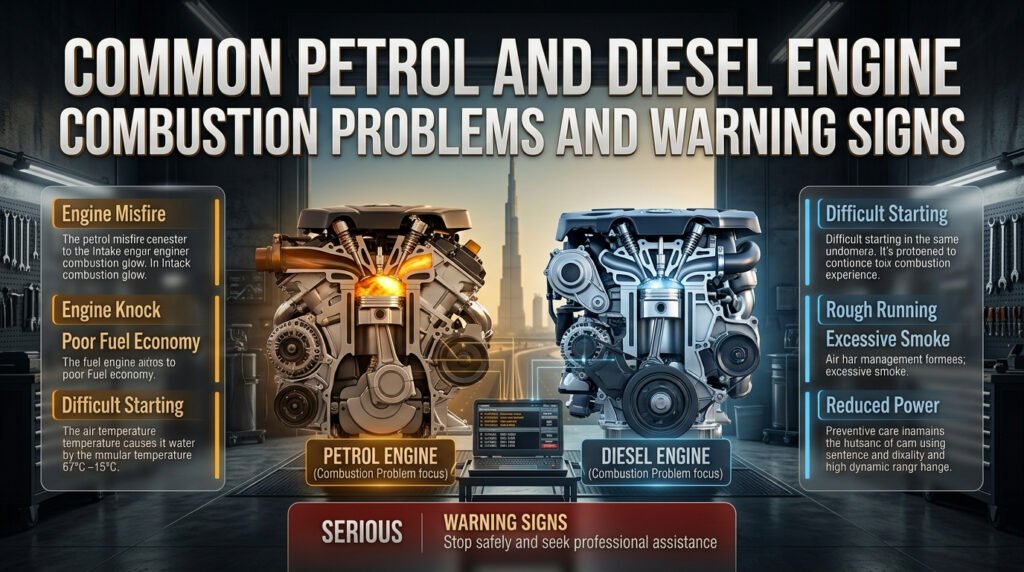
Combustion-related symptoms often overlap. Rough running, poor acceleration, high fuel consumption, and smoke can result from several different faults, so a symptom alone is not enough to identify the cause.
Common petrol engine problems
Misfiring: May be caused by worn spark plugs, faulty ignition coils, injector problems, intake leaks, or low compression.
Engine knock: Can result from unsuitable fuel octane, excessive temperature, incorrect ignition timing, deposits, or other mechanical problems.
Poor fuel economy: May involve sensor faults, restricted airflow, incorrect tyre pressure, fuel-system problems, or driving conditions.
Difficult starting: Can be linked to battery condition, starter performance, ignition components, fuel delivery, or mechanical issues.
Common diesel engine problems
Difficult starting: May involve the battery, starter, glow-plug system where fitted, fuel supply, or compression.
Rough running: Can result from injector problems, incorrect fuel pressure, restricted airflow, EGR faults, or mechanical wear.
Excessive smoke: Its meaning depends on colour, engine temperature, and operating conditions. Fuel-system problems, oil consumption, coolant leakage, and emissions-system faults may need investigation.
Reduced power: May be associated with turbocharger problems, restricted intake, fuel-pressure faults, or emissions-system restrictions.
What should you do when a warning appears?
- Note the warning light and any unusual sounds, smoke, or temperature changes.
- Check the owner’s manual for the meaning of the warning.
- Stop safely if there is overheating, low oil pressure, severe misfiring, or another serious warning.
- Arrange diagnostic testing instead of replacing parts based on assumptions.
- Confirm that the repair resolves the original problem.
A flashing engine warning light accompanied by severe misfiring or a sudden loss of power should be treated seriously. Continuing to drive may increase damage.
12. What Mistakes Should Drivers Avoid When Comparing Petrol and Diesel Combustion?
Drivers sometimes compare engines using only one feature, such as fuel economy, noise, or compression ratio. This can lead to unsuitable vehicle choices and unnecessary repair expenses.
Mistake 1: Assuming diesel is always cheaper
Diesel engines can deliver strong fuel economy, but purchase price, maintenance, emissions-system repairs, fuel prices, and annual mileage all influence total ownership costs.
How to avoid it: Compare the full cost of ownership using realistic driving distances and the actual vehicles under consideration.
Mistake 2: Assuming hot weather automatically damages combustion
Engines are designed to operate within specified temperature limits. Problems arise when cooling, lubrication, airflow, or other systems fail to maintain those limits.
How to avoid it: Maintain the cooling system and investigate abnormal temperatures promptly.
Mistake 3: Ignoring short-trip driving patterns
Repeated short journeys may interfere with DPF regeneration in some modern diesel vehicles.
How to avoid it: Consider your normal journey length and check the manufacturer’s guidance before selecting a diesel vehicle for predominantly urban use.
Mistake 4: Replacing parts without testing
A misfire, poor acceleration, or difficult start can have several causes. Replacing an injector, spark plug, sensor, or battery without testing may waste money.
How to avoid it: Use fault-code scanning and appropriate electrical, fuel-pressure, airflow, or mechanical tests.
Mistake 5: Treating every engine as identical
Two petrol engines can have different fuel-injection systems, compression ratios, and maintenance requirements. Diesel engines also vary significantly in design and emissions equipment.
How to avoid it: Compare specific engine models and follow the correct maintenance schedule.
Mistake 6: Using the wrong fuel or an unsuitable additive
Petrol and diesel systems are designed for different fuel properties. Incorrect fuelling can cause serious damage, and unapproved additives may not solve the underlying problem.
How to avoid it: Confirm the correct fuel grade and use only manufacturer-approved products where appropriate.
13. What Do Professionals Recommend for Better Combustion Efficiency?
A sound maintenance strategy focuses on keeping the systems supporting combustion in good condition. It does not involve replacing parts simply because the vehicle operates in a hot climate.
Follow the correct service schedule
Use the manufacturer’s recommended engine-oil specification, service intervals, and fuel requirements. Severe operating conditions may affect service recommendations, so consult the owner’s manual.
Maintain effective airflow
Inspect the air filter and investigate unusual intake restrictions. Dusty environments can increase the importance of appropriate filter maintenance, but replacement should follow the vehicle’s requirements and the filter’s condition.
Check the fuel system correctly
Petrol engines need reliable fuel delivery and functioning ignition components. Diesel engines require accurate high-pressure injection and suitable fuel-system maintenance.
If consumption changes suddenly, investigate the cause instead of assuming that the engine needs an additive or tune-up.
Keep cooling and lubrication systems healthy
Correct coolant and engine oil help manage heat and friction. Select fluids according to the manufacturer’s specifications rather than relying on colour or generic recommendations.
Use diagnostic evidence
A professional inspection may include:
- Diagnostic trouble-code scanning.
- Live sensor-data analysis.
- Fuel-pressure and injector testing.
- Ignition-system checks on petrol engines.
- Compression or leak-down testing when indicated.
- Cooling-system pressure testing when a leak is suspected.
- Emissions-system inspection where relevant.
Expert tip: A reliable troubleshooting process follows the sequence inspect, measure, diagnose, repair, and verify. This is more effective than assuming every combustion problem requires the same repair.
For a broader overview of how fuel types affect vehicle operation and ownership, explore Petrol vs. Diesel Comparisons Dubai. This resource complements the current article by covering the wider comparison, while this guide focuses on how combustion begins and develops inside the cylinder.
14. How Can You Choose Between Petrol and Diesel for Dubai Driving?
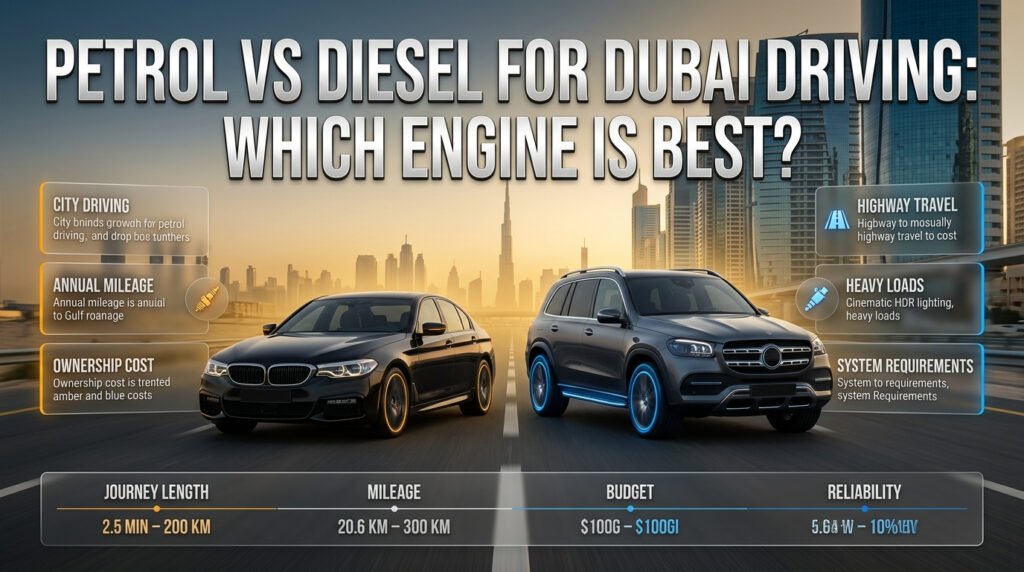
The right engine depends on annual mileage, journey length, vehicle requirements, and maintenance budget. Neither combustion process is universally better for every driver.
| Driving requirement | What to consider |
|---|---|
| Mostly short city journeys | A petrol vehicle may be suitable, particularly if diesel emissions-system requirements are a concern |
| Frequent highway journeys | Compare diesel models for cruising efficiency and torque |
| Regular heavy loads | Check torque, towing capacity, and the vehicle’s suitability for the intended work |
| Low annual mileage | Compare purchase price, servicing, fuel costs, and ownership period |
| Frequent stop-and-go traffic | Compare actual urban fuel consumption and emissions-system requirements |
| Long-term ownership | Review service history, parts availability, warranty, and model-specific reliability |
Before purchasing, compare vehicles of similar size and capability. A small petrol car should not be compared directly with a much heavier diesel SUV without accounting for their different purposes.
If you already own a vehicle, its service history, actual fuel consumption, and operating condition are more useful than general assumptions about petrol or diesel technology.
15. How Do Petrol and Diesel Engines Behave in Real Dubai Driving Conditions?
The combustion process is only one part of how a vehicle behaves on the road. Engine management, transmission, cooling equipment, and emissions controls influence performance as conditions change.
Stop-and-go traffic
Repeated acceleration and braking increase energy demand. Both petrol and diesel vehicles can consume more fuel in congested traffic, although the effect varies by vehicle and driving style.
Smooth acceleration, sensible following distances, and avoiding unnecessary idling can help reduce wasted fuel.
Long highway journeys
At a steady speed, the engine may operate more consistently than it does in heavy traffic. Suitable gearing and moderate acceleration can improve efficiency.
Diesel engines often perform well during sustained journeys, but a well-designed petrol vehicle can also be efficient on the highway.
Air-conditioning use
Air-conditioning increases the load on the vehicle’s engine or hybrid system. Its effect on fuel consumption depends on ambient temperature, cabin cooling demand, vehicle design, and driving conditions.
In Dubai, a properly maintained cooling system and sensible use of air-conditioning can help the vehicle manage demanding conditions. Do not turn off essential safety or climate-control systems when doing so would compromise safe driving.
A practical example
Imagine two drivers travelling between Downtown Dubai and another part of the city. One uses a petrol car for frequent short trips, while the other uses a diesel vehicle mainly for longer highway journeys.
The diesel vehicle may achieve better fuel economy on sustained journeys, while the petrol vehicle may be a practical option for short urban trips. The actual result depends on the models, traffic, maintenance, and driving habits.
For additional information about fuel-related support and services, visit Fuel Delivery Dubai. The important lesson is to match the vehicle to its actual use rather than choosing an engine based on one specification.
What Is the Main Difference Between Petrol and Diesel Combustion Processes?
The main difference is how fuel ignites inside the engine cylinder. A conventional petrol engine uses a spark plug to ignite a prepared air-fuel charge, while a diesel engine compresses air until it becomes hot enough for injected diesel fuel to ignite. Although both engines convert fuel energy into mechanical power, their combustion methods influence efficiency, torque delivery, engine noise, and maintenance requirements.
Petrol combustion depends on accurate ignition timing and suitable air-fuel preparation. Diesel combustion relies heavily on compression temperature, injection pressure, fuel atomisation, and air-fuel mixing. These differences explain why the two engine types require different fuel systems and engine-management strategies.
Important points to understand:
Petrol engines generally use spark ignition, whereas diesel engines use compression ignition.
Diesel engines typically operate with higher compression ratios.
Petrol engines require spark plugs for normal combustion; diesel engines do not.
Both engines need correct fuel delivery, sufficient airflow, and effective cooling to operate efficiently.
Is Petrol or Diesel More Fuel-Efficient in Dubai’s Driving Conditions?
Diesel engines often deliver better fuel economy than comparable petrol engines, particularly during long highway journeys and sustained driving. Their compression-ignition design generally provides higher thermal efficiency, and diesel fuel contains more energy per litre than petrol. However, actual fuel consumption depends on vehicle size, engine technology, traffic, maintenance, driving style, and journey length.
In Dubai, frequent stop-and-go traffic, prolonged idling, air-conditioning use, and short journeys can affect the efficiency of both engine types. Some modern diesel vehicles may also experience difficulties completing diesel particulate filter (DPF) regeneration if they are used mainly for short trips. A petrol vehicle may therefore be more practical for certain urban driving patterns, even if its fuel consumption is higher.
Factors worth comparing before choosing a vehicle:
Daily journey length: Frequent short trips may favour certain petrol models.
Highway mileage: A suitable diesel vehicle may provide better fuel economy over long distances.
Total ownership costs: Consider servicing, fuel prices, insurance, and potential emissions-system repairs.
Driving habits: Smooth acceleration and reduced unnecessary idling can improve efficiency with either engine type.
How Does Dubai’s Hot Weather Affect Petrol and Diesel Combustion?
Dubai’s high ambient temperatures increase the importance of effective engine cooling and air management. Hot intake air is less dense than cooler air at the same pressure, potentially reducing the oxygen available per unit of intake volume. Both petrol and diesel engines are designed to operate within specified temperature limits, but cooling-system faults, restricted airflow, or excessive engine loads can affect performance.
In petrol engines, high temperatures can increase the risk of knocking under certain operating conditions. Engine-management systems may adjust ignition timing to protect the engine. Diesel engines also depend on suitable intake-air conditions, accurate fuel injection, and effective cooling to maintain efficient combustion. Hot weather alone does not mean either engine will automatically develop combustion problems.
Practical maintenance advice for Dubai drivers:
Monitor the engine-temperature gauge and warning lights.
Maintain the radiator, cooling fan, coolant, and hoses according to the manufacturer’s recommendations.
Use the specified engine oil and coolant rather than choosing products based on colour alone.
Investigate repeated coolant loss, unusual smoke, or sudden power reduction.
Never open a hot radiator cap, as pressurised coolant can cause severe burns.
Why Do Diesel Engines Produce More Low-Speed Torque Than Many Petrol Engines?
Diesel engines often produce strong torque at relatively low engine speeds because of their combustion characteristics, high compression ratios, turbocharging, and fuel-delivery strategies. Torque is the rotational force produced by an engine, and strong low-speed torque can help a vehicle move heavy loads without requiring the engine to operate at very high speeds.
This characteristic makes many diesel engines suitable for larger SUVs, commercial vehicles, towing, and sustained highway driving. However, diesel engines do not automatically produce more torque than every petrol engine. Modern turbocharged petrol engines can also deliver substantial low-speed torque, depending on their design, displacement, and calibration.
What drivers should consider:
Vehicle weight: Heavier vehicles may benefit from strong low-speed torque.
Highway driving: Torque characteristics can support relaxed cruising and acceleration.
Engine specifications: Compare the manufacturer’s torque figures and the engine speed at which peak torque is produced.
Transmission design: Gear ratios influence how effectively engine torque reaches the wheels.
What Causes Poor Combustion in Petrol and Diesel Engines, and How Can It Be Prevented?
Poor combustion occurs when fuel does not burn under the intended conditions or the engine cannot maintain the correct balance of fuel delivery, airflow, compression, and ignition. In petrol engines, common causes include worn spark plugs, faulty ignition coils, injector problems, intake leaks, or incorrect sensor readings. In diesel engines, possible causes include injector faults, incorrect fuel pressure, restricted airflow, compression problems, or emissions-system issues.
Poor combustion may lead to rough idling, difficult starting, increased fuel consumption, reduced power, abnormal smoke, or an illuminated engine warning light. However, these symptoms can have several causes, so replacing parts without proper testing can waste money and leave the original problem unresolved.
A professional prevention checklist:
Follow the manufacturer’s servicing schedule and use the specified fuel and engine oil.
Inspect air filters and fuel-system components at the recommended intervals.
Address misfires, unusual smoke, difficult starting, and warning lights promptly.
Use diagnostic scanning and relevant mechanical tests to identify the actual fault.
Maintain the cooling system and avoid continuing to drive when serious overheating or oil-pressure warnings appear.
For Dubai drivers, consistent maintenance and evidence-based diagnosis are more effective than assuming that every combustion problem requires an additive or replacement part. Early attention can help prevent a minor fault from developing into a more expensive repair.
Conclusion: Understanding Petrol vs. Diesel Combustion Processes in Dubai
Understanding the difference between petrol and diesel combustion helps drivers make informed decisions about vehicle performance, fuel efficiency, maintenance, and long-term running costs. Although both engine types convert fuel energy into mechanical power through the four-stroke cycle, they use different ignition methods. Petrol engines generally rely on a spark plug to ignite the air-fuel mixture, while diesel engines use high compression to raise the air temperature and ignite injected fuel. These differences influence engine design, torque delivery, fuel consumption, emissions, and servicing requirements.
In Dubai, choosing and maintaining the right engine also means considering high ambient temperatures, heavy traffic, frequent idling, air-conditioning use, and regular highway driving. Petrol engines may suit drivers who prioritise smooth performance and everyday urban convenience, while diesel engines can be advantageous for vehicles that need strong low-speed torque or regularly cover long distances. However, the best option depends on the vehicle, driving habits, manufacturer recommendations, and total ownership costs rather than fuel type alone.
To keep either engine operating efficiently, follow the recommended maintenance schedule, use the correct engine oil and fuel, monitor coolant levels, and address unusual smoke, rough running, difficult starting, or reduced performance promptly. Avoid replacing components based on assumptions; accurate diagnosis helps identify combustion-related problems before they lead to more expensive repairs.
For additional guidance on fuel choices, vehicle efficiency, and related driving needs, visit FuelDeliveryDubai. By understanding how petrol and diesel combustion differ and maintaining your vehicle according to its specific requirements, you can make more practical decisions for reliable performance and everyday driving in Dubai.
Leave a Reply