
Introduction
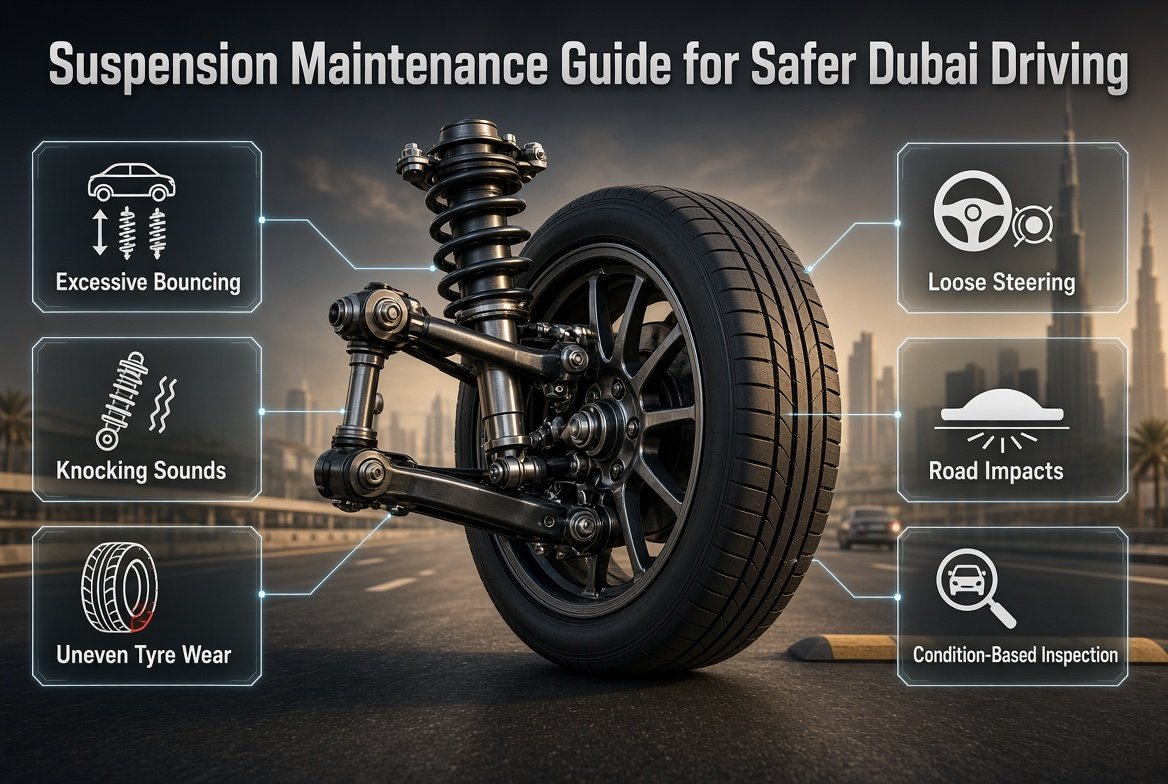
Suspension Maintenance Guide | Imagine driving through Dubai and noticing that your car doesn’t feel quite the same anymore. It bounces more than usual after a speed bump, the steering feels slightly loose, or you hear a knock every time the wheels pass over an uneven surface. Maybe the tyres are wearing unevenly even though you’ve been maintaining their pressure.
These symptoms are easy to ignore because the engine may still run perfectly and the car may still move normally. But they can be early signs that the suspension needs attention.
A proper suspension maintenance guide helps you understand what the suspension system does, which components are involved, how to recognize wear, when an inspection is necessary, and which maintenance habits can help prevent avoidable problems.
For Dubai drivers, suspension care is particularly relevant because daily driving can involve speed bumps, heavy traffic, highway journeys, uneven road surfaces, high temperatures, dust, and frequent acceleration and braking. These conditions don’t automatically mean suspension parts will fail early, but they make regular observation and condition-based inspection worthwhile.
Your suspension is also closely connected with your tyres, steering, braking, and wheel alignment. That’s why a suspension problem shouldn’t always be treated as an isolated repair.
In this guide, you’ll learn how the suspension works, what each major component does, the warning signs of suspension problems, how to inspect your vehicle, how often suspension should be checked, common maintenance mistakes, and what to do when you notice a problem.
What Is a Car Suspension System?
A car suspension system connects the vehicle’s body and wheels while allowing the wheels to move over road imperfections. Its job isn’t simply to make the ride comfortable. It also helps control wheel movement, body movement, handling, and tyre contact with the road.
A typical suspension system uses springs, shock absorbers or struts, control arms, bushings, ball joints, stabilizer components, and mounting hardware. The exact design varies between vehicles.
The basic principle is simple:
Road impact → suspension movement → spring absorbs movement → shock absorber controls movement → tyre remains more consistently connected with the road
Shock absorbers and struts gradually lose effectiveness as they wear, and their deterioration can be difficult to notice because it often happens slowly. Road conditions, driving style, vehicle load, and environmental conditions can all affect wear.
What does the suspension actually do?
A healthy suspension helps:
- Absorb bumps and road impacts
- Control spring movement
- Maintain tyre contact with the road
- Reduce excessive body movement
- Support predictable steering
- Improve cornering stability
- Reduce unnecessary tyre wear
- Control vehicle movement during braking and acceleration
- Improve overall ride quality
This is why suspension maintenance isn’t simply a comfort issue.
If suspension components become worn, the vehicle can become less predictable even though the engine, transmission, and brakes appear to be working normally.
Why Is Suspension Maintenance Important?
Suspension components experience movement every time you drive.
Every speed bump, pothole, road joint, corner, braking event, acceleration, and change in road surface causes the suspension to respond. Over thousands of kilometres, this repeated movement creates normal wear.
The problem is that suspension wear can be gradual.
You may not wake up one morning and suddenly discover that the shocks are worn. Instead, the vehicle might slowly become:
- More bouncy
- Less stable
- Noisier
- Less precise through corners
- More sensitive to uneven roads
- More prone to irregular tyre wear
This gradual change can make the problem difficult to recognize because the driver becomes accustomed to the vehicle’s changing behaviour.
Technical guidance on shock and strut inspection also emphasizes that wear can gradually affect steering, stopping, and stability without always being immediately obvious to the driver.
Suspension maintenance can help you identify problems earlier
Routine inspection doesn’t mean replacing every component before it wears out.
Instead, it means monitoring condition and looking for evidence of:
- Leakage
- Damage
- Excessive movement
- Deteriorated bushings
- Broken springs
- Worn joints
- Abnormal tyre wear
- Alignment-related symptoms
- Changes in ride or handling
The goal is straightforward:
Find the problem, understand the cause, and repair the component when necessary.
What Are the Main Components of a Car Suspension?
Understanding the main suspension components makes it much easier to understand maintenance.
Different vehicles use different suspension designs, but several components are common.
Shock Absorbers
Shock absorbers control suspension movement.
When a wheel hits a bump, the spring compresses and rebounds. Without damping, the spring would continue oscillating, causing excessive bouncing.
The shock absorber controls this movement so the vehicle settles more quickly.
Worn shocks can contribute to:
- Excessive bouncing
- Poor body control
- Increased body movement
- Uneven tyre wear
- Excessive nose-diving during braking
- Excessive rear squat during acceleration
- Swaying during cornering
A shock absorber doesn’t necessarily have to be completely broken before its performance becomes reduced.
Struts
A strut performs both structural and damping functions in many suspension designs.
MacPherson strut systems are common on many modern vehicles.
Because a strut can be connected to the steering and suspension assembly, problems involving the strut or its mounting components can sometimes affect more than ride comfort.
Possible warning signs include:
- Clunking
- Knocking
- Excessive bouncing
- Steering changes
- Uneven tyre wear
- Poor directional stability
Coil Springs
Springs support the weight of the vehicle and allow the wheels to move over uneven surfaces.
A spring can become weak, damaged, or broken.
Possible signs include:
- One corner sitting lower
- Reduced ride height
- Unusual noises
- Harsh or unstable ride
- Visible spring damage
A broken spring shouldn’t be treated as a cosmetic issue because the damaged component can interfere with other parts.
Control Arms
Control arms help locate the wheel assembly relative to the vehicle body while allowing controlled movement.
They normally work with bushings and ball joints.
A damaged or worn control arm assembly can contribute to:
- Clunking
- Steering instability
- Uneven tyre wear
- Pulling
- Abnormal wheel movement
Bushings
Bushings are designed to allow controlled movement while reducing vibration, noise, and harshness.
They can deteriorate with age, heat, movement, load, and environmental exposure.
Worn bushings may cause:
- Squeaking
- Clunking
- Excessive movement
- Vibration
- Steering changes
- Alignment-related problems
Bushings aren’t always easy to diagnose visually. Some wear may only become obvious when the component is physically inspected.
Ball Joints
Ball joints allow controlled movement between suspension components while accommodating wheel movement and steering.
Excessive wear can create unwanted play.
Because ball joints can affect wheel control, significant wear should be diagnosed and addressed promptly.
Stabilizer Bar and Stabilizer Links
The stabilizer system helps control body roll during cornering.
Worn stabilizer links or bushings may create:
- Knocking
- Rattling
- Clunking over uneven surfaces
- Increased body movement
Not every suspension noise comes from shocks or struts. This is one reason accurate diagnosis matters.
What Are the Signs of Suspension Problems?
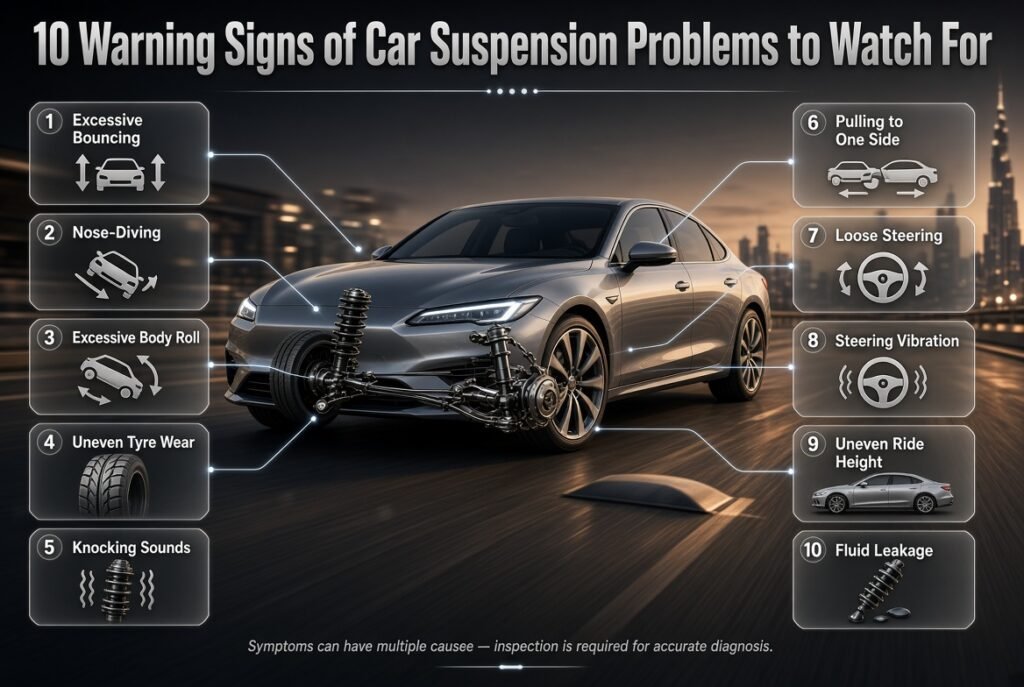
Your vehicle often provides warning signs before a suspension component becomes severely damaged.
The key is recognizing changes rather than waiting for complete failure.
1. Excessive Bouncing
One of the most recognizable symptoms is excessive bouncing after a bump.
A vehicle should settle after passing over an uneven surface. If it continues moving excessively, the damping system may not be controlling spring movement effectively.
Worn shocks and struts are one possible cause.
However, don’t diagnose a failed shock based only on bouncing. Other suspension problems can produce similar changes.
2. Nose-Diving During Braking
If the front of the vehicle drops noticeably when braking, suspension condition should be investigated.
Worn shocks or struts can contribute to excessive body movement during braking.
But remember that braking behaviour can also involve brake components, tyres, weight distribution, and road conditions.
For a broader look at brake-related maintenance, you can refer to the Brake Maintenance Basics in Dubai.
3. Excessive Body Roll
Does the vehicle feel like it leans more than it used to when turning?
Excessive rolling or swaying can indicate a problem with ride-control or stabilizer components.
It can also make the car feel less predictable during cornering.
4. Uneven Tyre Wear
Suspension problems can contribute to abnormal tyre wear.
Look for:
- Inner-edge wear
- Outer-edge wear
- Cupping
- Scalloping
- Irregular tread patterns
However, don’t automatically blame suspension.
Tyre pressure, wheel alignment, wheel balance, tyre condition, and driving habits can also contribute.
For a complete tyre inspection routine, see the Tire Maintenance Guide in Dubai.
5. Knocking or Clunking Sounds
A new knocking sound over bumps deserves attention.
Possible sources include:
- Stabilizer links
- Bushings
- Ball joints
- Control arms
- Strut mounts
- Other suspension hardware
The same noise can sometimes come from different components, so sound alone isn’t enough to identify the exact part.
6. Vehicle Pulling to One Side
If your car consistently pulls left or right, don’t immediately assume suspension failure.
Possible causes include:
- Incorrect tyre pressure
- Tyre condition
- Wheel alignment
- Brake issues
- Steering components
- Suspension components
- Road crown
A proper diagnosis should consider the complete system.
7. Steering Feels Loose
If the steering feels less precise than before, the suspension and steering systems should be inspected.
This is particularly important if the change appeared after:
- A pothole impact
- Kerb contact
- A major road bump
- Suspension work
- Tyre replacement
8. Vibration Through the Steering Wheel
Vibration can have many causes.
Possible sources include:
- Wheel imbalance
- Tyre problems
- Alignment
- Suspension components
- Steering components
- Wheel damage
If vibration appears on a smooth road and wasn’t previously present, arrange an inspection rather than assuming it is normal.
9. Vehicle Sits Lower on One Side
Look at the vehicle when parked on a reasonably level surface.
If one side or corner is noticeably lower, possible causes include:
- Broken spring
- Weak spring
- Air suspension issue
- Damaged suspension component
- Uneven loading
The cause needs to be identified before driving normally.
10. Visible Fluid Leakage
Some shock absorbers and struts contain hydraulic fluid.
Excessive fluid visible on the outside of the component can indicate a problem.
A technician should determine whether the observed condition is normal surface moisture or a significant leak requiring replacement.
How Often Should Suspension Be Inspected?
There isn’t a single suspension inspection interval that applies to every car.
Your vehicle manufacturer’s maintenance schedule should be the starting point.
Driving conditions also matter.
A vehicle regularly driven over rough roads, speed bumps, heavy loads, or poor surfaces may experience different suspension stress from a vehicle used mainly on smooth roads.
Some technical guidance recommends annual inspection of shocks and struts and inspection when the vehicle is already receiving tyre, brake, or alignment work.
For practical vehicle ownership, a good approach is:
Inspect suspension when:
- The manufacturer recommends it
- The vehicle receives routine servicing
- Tyres show unusual wear
- New suspension noises appear
- Steering behaviour changes
- The vehicle starts bouncing excessively
- A major pothole or kerb impact occurs
- The vehicle begins pulling
- Ride height changes
- You are preparing for a long journey
Don’t use a mileage figure as an automatic replacement rule for every suspension component.
Condition matters.
What Does a Professional Suspension Inspection Include?
A good inspection should look at the suspension as a system rather than focusing on one component immediately.
A technician may begin by asking about:
- The vehicle’s mileage
- Previous suspension repairs
- Driving conditions
- Vehicle loading
- Recent pothole or kerb impacts
- Changes in ride quality
- New noises
- Steering behaviour
- Tyre wear
A road test may then be used to observe:
- Bouncing
- Body roll
- Nose-dive
- Rear squat
- Steering response
- Directional stability
- Unusual noises
- Harshness
- Bottoming or topping out
A physical inspection can then look for signs of:
- Leakage
- Physical damage
- Loose components
- Worn bushings
- Excessive movement
- Damaged mounts
- Broken springs
- Other abnormalities
This approach is more useful than simply saying, “The car feels rough, so replace the shocks.”
A professional inspection should connect the symptom to evidence.
Can You Check Your Suspension at Home?
You can perform basic observations at home, but a home inspection shouldn’t replace professional diagnosis when there are significant symptoms.
Step 1: Check the vehicle’s stance
Park the car on reasonably level ground.
Stand several metres away and look at the vehicle from the front and rear.
Check whether:
- One corner appears lower
- The vehicle leans
- Ride height looks unusual
- One side looks different from the other
Why it matters
An uneven stance can provide an early clue about a spring, air suspension, or other suspension problem.
Step 2: Inspect the tyres
Look closely at the tread.
Look for:
- Uneven edge wear
- Cupping
- Scalloping
- Irregular patches
- Sidewall damage
Also verify tyre pressure according to the vehicle manufacturer’s specification.
Why it matters
Tyres can reveal problems that aren’t obvious from the driver’s seat.
Step 3: Listen for unusual sounds
Drive slowly in a safe area and listen for:
- Knocks
- Clunks
- Rattles
- Squeaks
- Repeated suspension noises
Try to notice when the sound occurs.
Does it happen:
- Over bumps?
- During braking?
- While turning?
- When entering a driveway?
- On rough roads?
The conditions can help a technician narrow down the cause.
Step 4: Observe steering behaviour
Notice whether the steering:
- Feels loose
- Pulls
- Vibrates
- Feels less stable
- Doesn’t return normally after a turn
Don’t attempt unsafe DIY suspension repairs if you don’t have the correct equipment or experience.
Step 5: Get professional inspection if symptoms persist
If you notice a combination of warning signs, arrange a proper inspection.
A technician can safely lift the vehicle and examine components that cannot be properly assessed from ground level.
How Does Suspension Affect Tyres?
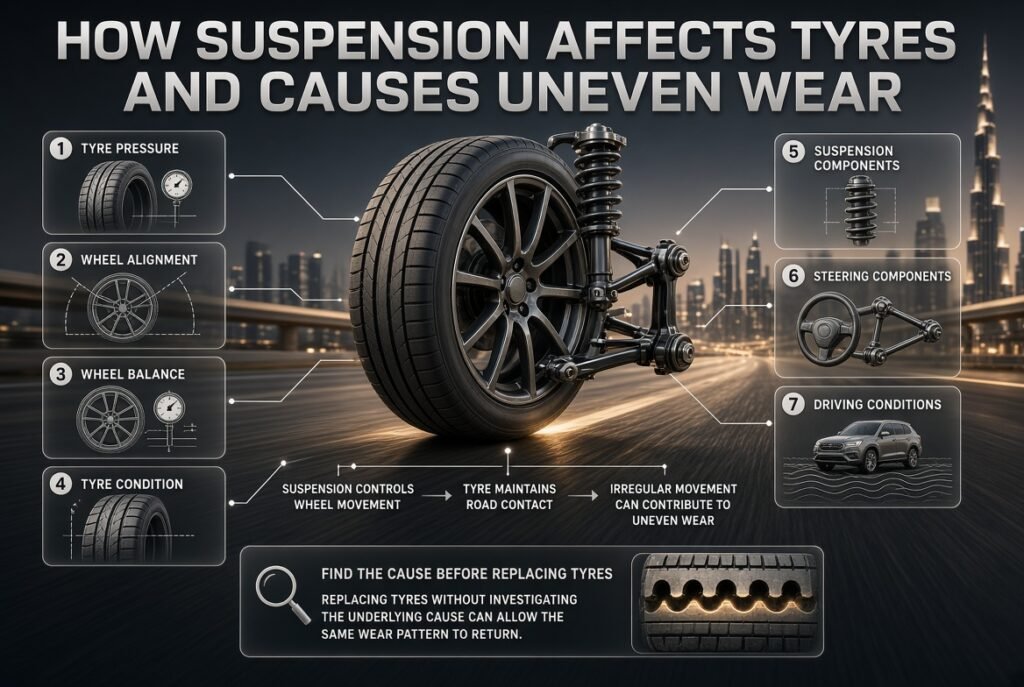
Suspension and tyres work together.
The tyre provides the physical contact with the road, while the suspension controls wheel movement and helps manage how the tyre interacts with the surface.
If suspension components become worn, the wheel may move differently from its intended behaviour.
This can contribute to irregular tyre wear.
For example, worn shocks can allow excessive wheel movement, which may contribute to cupping or scalloping patterns.
But this doesn’t mean every irregular tyre pattern is caused by suspension.
When you notice uneven tyre wear, check:
- Tyre pressure
- Wheel alignment
- Wheel balance where appropriate
- Tyre condition
- Suspension components
- Steering components
- Driving conditions
Replacing tyres without investigating the underlying cause can result in the same wear pattern returning.
What Is the Connection Between Suspension and Wheel Alignment?
Wheel alignment and suspension aren’t the same thing, but they influence each other.
Alignment refers to the wheel angles relative to the vehicle and road.
Suspension components help locate and control the wheel assembly.
If a suspension component becomes worn or damaged, the wheel’s position may change under load.
Likewise, a strong pothole or kerb impact can affect alignment and may also damage suspension components.
Check alignment when:
- The car pulls consistently
- The steering wheel isn’t centred
- Tyres wear unevenly
- The vehicle has had a significant impact
- Suspension components have been replaced
- Handling changes noticeably
Common mistake: Getting an alignment repeatedly without investigating worn suspension parts.
If a worn component is causing the wheel to move incorrectly, alignment alone may not solve the underlying problem.
Suspension Maintenance in Dubai: What Drivers Should Watch For
Dubai driving can involve a combination of conditions that make regular vehicle inspection sensible.
Speed bumps
Repeatedly crossing speed bumps aggressively can create unnecessary impact loads.
The best practice is simple:
Slow down appropriately before the speed bump rather than braking hard while already crossing it.
Potholes and road impacts
A significant pothole can affect:
- Tyres
- Wheels
- Alignment
- Steering
- Suspension
If you feel a major impact, pay attention to what happens afterward.
New vibration, pulling, steering changes, or suspension noises are reasons to investigate.
Highway driving
Highway driving makes vehicle stability particularly important.
A suspension issue that feels minor at low speed may become much more noticeable at higher speed.
If the car feels unstable, requires excessive steering correction, or behaves differently from before, arrange an inspection.
Heavy traffic
Stop-and-go traffic creates repeated braking and acceleration.
Although this isn’t necessarily a direct cause of suspension failure, it means the vehicle experiences frequent weight transfer.
High temperatures
Heat is part of the operating environment for vehicles in Dubai.
Rubber components such as bushings can age over time, while shocks and other components also experience repeated thermal cycles.
This doesn’t mean that every suspension part needs early replacement. It means age and condition should be considered alongside mileage.
Should You Replace Shocks and Struts by Mileage?
Mileage can be useful information, but it should not be treated as an automatic replacement trigger for every vehicle.
Suspension life depends on:
- Vehicle design
- Road conditions
- Driving style
- Vehicle load
- Component quality
- Climate
- Previous repairs
- Driving frequency
Technical inspection guidance notes that mileage, road use, loading, and changes in ride or handling can all be relevant when evaluating shocks and struts.
A better question than:
“Have I reached the mileage for replacement?”
is:
“What is the actual condition of the component, and what evidence shows that replacement is needed?”
That’s a much more useful maintenance approach.
When Should Suspension Components Be Replaced?
Replacement becomes appropriate when inspection confirms that a component is no longer performing correctly or has significant damage.
Examples can include:
- Broken springs
- Excessively worn bushings
- Damaged control arms
- Excessive ball-joint play
- Failed or severely leaking shocks
- Damaged struts
- Damaged mounts
- Significant suspension looseness
- Air suspension leaks
- Other confirmed component failures
The correct repair depends on the vehicle and the component involved.
Why diagnosis matters
Several different suspension components can produce similar symptoms.
A clunk doesn’t automatically mean the shock absorber is bad.
A pulling car doesn’t automatically mean the control arm is damaged.
Uneven tyre wear doesn’t automatically mean the suspension needs replacement.
Diagnosis prevents unnecessary repairs.
Should Shocks or Struts Be Replaced in Pairs?
In many situations, shocks or struts on the same axle may be replaced as a pair so that damping performance remains more consistent from side to side.
However, the correct repair depends on:
- Vehicle design
- Component condition
- Manufacturer recommendations
- Age and condition of the opposite component
- Repair history
Don’t assume that every suspension part must always be replaced as a pair.
Ask the technician to explain the recommended repair and why it is appropriate for your vehicle.
Can Bad Suspension Affect Braking?
Yes, suspension condition can influence how the vehicle behaves during braking.
Worn shocks or struts can allow greater body movement and may contribute to excessive nose-diving.
However, stopping performance is not controlled by suspension alone.
It also depends on:
- Brake pads
- Brake discs
- Brake fluid
- Tyres
- ABS
- Road surface
- Vehicle load
- Driver input
This is why suspension symptoms should be evaluated alongside the braking system when the vehicle behaves differently during braking.
For a dedicated guide, see Brake Maintenance Basics in Dubai.
Can Bad Suspension Increase Tyre Wear?
Yes, suspension problems can contribute to premature or uneven tyre wear.
Worn shocks may allow increased wheel movement, reducing consistent road contact and contributing to irregular tread patterns such as cupping or scalloping.
But tyre wear should always be investigated broadly.
Example
Suppose the inner edge of your front tyre is wearing quickly.
Possible causes could include:
- Alignment issue
- Suspension wear
- Incorrect tyre pressure
- Steering geometry problem
- Damaged component
- Combination of several factors
Replacing the tyre alone may temporarily hide the symptom while the underlying problem continues.
How to Protect Your Car Suspension
You cannot stop suspension components from wearing completely, but you can reduce unnecessary stress and detect problems earlier.
Slow down for speed bumps
Approach speed bumps at a suitable speed.
Avoid hitting them aggressively.
Maintain correct tyre pressure
Correct tyre pressure supports proper tyre operation and helps the tyre handle road impacts as designed.
Underinflated or overinflated tyres can also affect ride and handling.
Avoid unnecessary overload
Carrying excessive weight increases the load on the suspension.
Follow the manufacturer’s recommended loading limits.
Avoid hitting potholes when possible
If a pothole cannot be avoided, don’t make a dangerous sudden manoeuvre.
Reduce speed safely and maintain control.
Inspect after major impacts
A strong impact should be followed by attention to:
- Steering
- Tyre condition
- Wheel condition
- Alignment
- Vibration
- Suspension noises
Don’t ignore new noises
A new noise is information.
It doesn’t automatically mean an expensive repair, but it deserves investigation if it persists.
Suspension Maintenance Before a Long Journey

Before a long highway journey, suspension should be part of your general vehicle inspection.
You don’t necessarily need a separate suspension service every time you travel.
Instead, check for changes in condition.
Long-trip suspension checklist
- Check tyre pressure
- Inspect tyre tread
- Look for uneven tyre wear
- Check for visible suspension damage
- Pay attention to ride height
- Listen for unusual suspension noises
- Notice steering behaviour
- Check for vibration
- Consider wheel alignment if symptoms exist
- Review previous suspension repairs
- Check brakes
- Check engine oil
- Check coolant
- Check battery
- Check lights
- Check wipers
- Confirm fuel level
For general vehicle preparation, the Vehicle Maintenance Guides section can be used alongside your suspension checks.
The point isn’t to turn every trip into a workshop inspection.
It’s simply to avoid starting a long journey while ignoring obvious warning signs.
Common Suspension Maintenance Mistakes
Mistake 1: Waiting until the suspension completely fails
Many drivers continue driving because the vehicle still moves.
Why this happens
Suspension wear can be gradual.
Why it matters
The vehicle may already have reduced handling or abnormal tyre wear before a component completely fails.
Better approach
Investigate noticeable changes early.
Mistake 2: Replacing shocks based only on mileage
Mileage doesn’t tell you everything.
Why it’s a problem
Different vehicles and driving environments create different wear patterns.
Better approach
Use mileage as one piece of information, then consider actual condition and symptoms.
Mistake 3: Blaming every noise on the shocks
A knocking sound can come from many suspension components.
Better approach
Have the complete suspension inspected instead of ordering a specific part based only on the sound.
Mistake 4: Ignoring tyre wear
Some owners replace tyres without asking why they wore unevenly.
Better approach
When tyre wear is abnormal, inspect pressure, alignment, suspension, steering, and wheel condition.
Mistake 5: Assuming alignment fixes everything
Alignment can correct alignment angles, but it can’t repair a broken suspension component.
Better approach
Check suspension condition when alignment problems repeatedly return.
Mistake 6: Ignoring a pothole impact
A vehicle may still drive normally after an impact.
Better approach
Pay attention to any new vibration, pulling, tyre damage, steering change, or suspension noise.
Mistake 7: Checking only visible components
Some suspension wear is not obvious from outside.
Internal wear and hidden looseness may require professional inspection.
What Should You Ask a Mechanic About Suspension?
You don’t need to become a suspension specialist to make a good repair decision.
Ask straightforward questions.
Ask:
Which component is worn?
This identifies the actual part.
What evidence shows that it is worn?
This helps distinguish diagnosis from guesswork.
Is it safe to continue driving?
The answer depends on the severity and component involved.
Does the opposite side need inspection?
This is useful when considering paired components.
Could this issue be causing the tyre wear?
This helps connect the suspension diagnosis to other symptoms.
Is wheel alignment required after the repair?
Some suspension repairs can affect wheel geometry.
Are any other components showing early wear?
This can help you plan future maintenance without unnecessarily replacing parts immediately.
Air Suspension: Does It Need Different Maintenance?
Some vehicles use air suspension instead of conventional steel coil springs.
Air suspension can use pneumatic springs, compressors, valves, sensors, and related components.
Because the system is different, the warning signs can also differ.
Possible symptoms include:
- Vehicle sitting lower than normal
- One corner sagging
- Uneven ride height
- Compressor running excessively
- Suspension warning light
- Hissing sounds
- Slow height adjustment
Air suspension problems should be diagnosed according to the vehicle manufacturer’s system.
A leak can also make the compressor work harder, potentially contributing to additional wear.
Don’t assume that air suspension problems can be diagnosed the same way as a conventional coil-spring suspension.
A Practical Suspension Inspection Routine
If you want a simple routine, use this approach.
Monthly: Observe
Pay attention to:
- Ride quality
- Steering
- New noises
- Vehicle height
- Tyre wear
You don’t need to dismantle anything.
During tyre checks: Inspect
When checking tyre pressure and tread, look for:
- Uneven wear
- Cupping
- Damage
- Changes between left and right
During routine servicing: Review
Ask for suspension condition to be checked if:
- Mileage is increasing
- The vehicle is used heavily
- You notice new symptoms
- Tyres are wearing abnormally
After a major impact: Reassess
After a significant pothole or kerb strike, check for:
- Pulling
- Vibration
- Steering changes
- Tyre damage
- New suspension noises
Before long trips: Confirm
Make sure there are no unresolved suspension symptoms before committing to a long journey.
Suspension Maintenance Checklist
Use this as a quick reference.
Suspension condition
- No excessive bouncing
- No abnormal body roll
- No unusual knocking
- No persistent squeaking
- No visible major damage
- No obvious leakage
- Vehicle sits evenly
- Steering feels predictable
Tyres
- Correct tyre pressure
- Adequate tread
- No severe uneven wear
- No damaged sidewalls
- No unusual cupping or scalloping
Steering and alignment
- Vehicle doesn’t consistently pull
- Steering wheel is reasonably centred
- No new steering vibration
- Alignment checked when symptoms require it
Service history
- Suspension inspection completed when appropriate
- Previous repairs recorded
- Manufacturer maintenance schedule followed
- Significant impact checked
- Long-trip inspection completed when necessary
Suspension Maintenance vs Suspension Repair
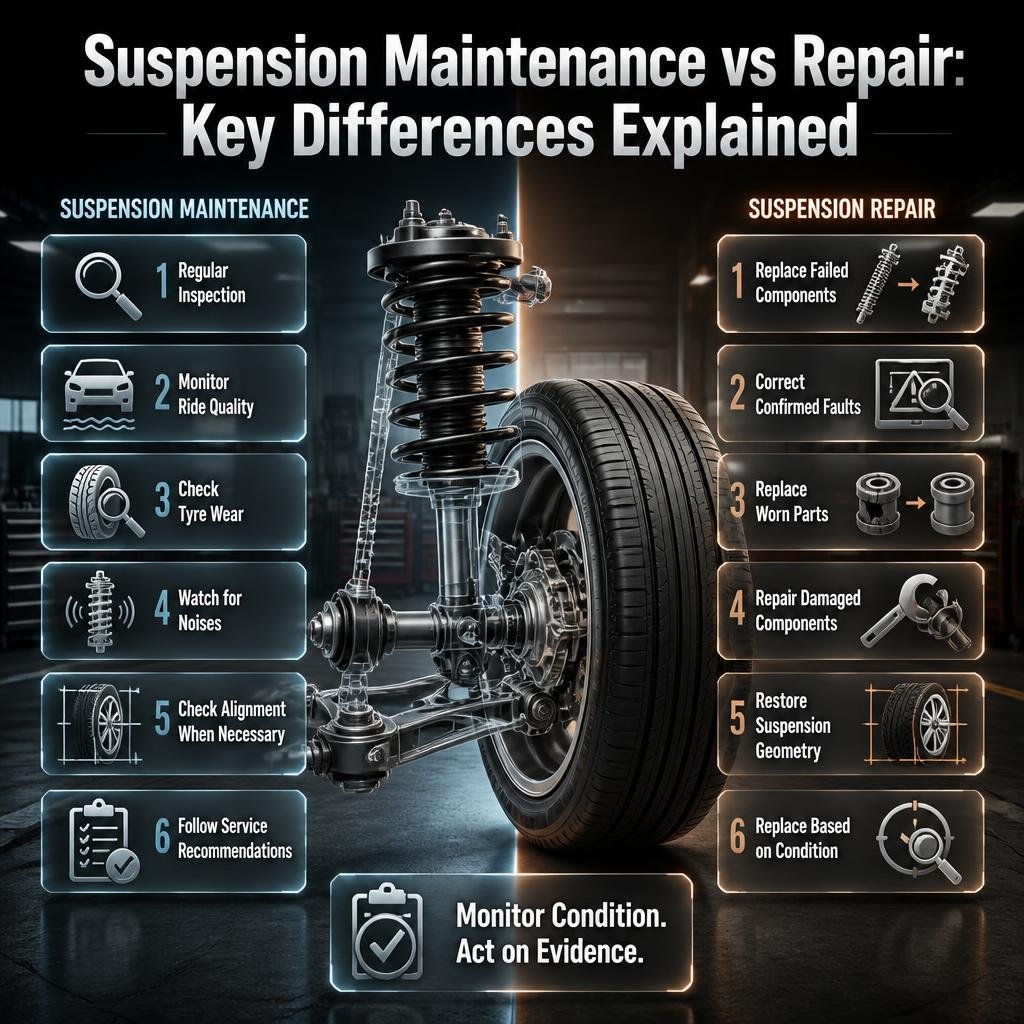
It’s useful to understand the difference.
| Suspension Maintenance | Suspension Repair |
|---|---|
| Regular inspection | Replacing failed components |
| Monitoring ride quality | Correcting confirmed faults |
| Checking tyre wear | Replacing worn suspension parts |
| Watching for noises | Repairing damaged components |
| Checking alignment when necessary | Restoring correct suspension geometry |
| Following service recommendations | Replacing components based on condition |
Maintenance doesn’t mean replacing everything early.
Good maintenance means monitoring condition and acting when there is evidence of a problem.
Expert Suspension Maintenance Advice
A few practical principles can make suspension maintenance much easier.
Don’t diagnose from one symptom
A noise, vibration, or pulling sensation can have several possible causes.
Look for combinations
For example:
Knocking + uneven tyre wear + steering change
is more useful information than simply saying:
“The car makes a noise.”
Compare before and after
If the vehicle used to feel stable but now bounces more over the same road, that change is important.
Consider the vehicle’s environment
Road conditions, loading, driving style, and mileage all influence component wear.
Don’t confuse maintenance with upselling
A good recommendation should be supported by inspection findings.
Don’t ignore safety-related changes
If handling, steering, braking behaviour, or vehicle stability changes significantly, don’t continue normal driving simply because the engine is running properly.
How Do I Know If My Car Suspension Needs Maintenance or Repair?
The most reliable way to know is to pay attention to changes in how the vehicle rides, handles, steers, and responds to uneven roads. Suspension wear doesn’t always cause an obvious failure. In many cases, the first signs are excessive bouncing, unusual knocking sounds, increased body roll, uneven tyre wear, steering changes, vibration, or the vehicle sitting lower on one side.
One important point is that these symptoms don’t automatically identify a particular suspension component. For example, a clunking noise could come from a stabilizer link, bushing, ball joint, control arm, strut mount, or another component. Similarly, pulling to one side can be caused by tyre pressure, alignment, brakes, steering, or suspension.
That’s why professional inspection is more useful than replacing a part based on one symptom.
Signs that deserve a suspension inspection:
Excessive bouncing after bumps
New knocking or clunking noises
Increased body roll during turns
Uneven or abnormal tyre wear
Vehicle pulling to one side
Steering feeling loose or less precise
Vibration through the steering wheel
One corner of the vehicle sitting lower
Visible suspension damage or leakage
Noticeable change in ride quality
Professional tip: Compare your vehicle’s current behaviour with how it normally drives. A gradual change is often more useful information than a single unusual noise.
If several symptoms appear together—for example, uneven tyre wear + knocking noise + steering change—don’t keep treating each symptom separately. Have the suspension, steering, tyres, and alignment checked as a complete system.
How Often Should Car Suspension Be Checked?
There isn’t one universal suspension inspection interval that works for every vehicle. The correct schedule depends on the manufacturer’s recommendations, vehicle age, mileage, road conditions, driving habits, vehicle loading, and the condition of individual components.
For most drivers, suspension should be checked during routine servicing and whenever a new symptom appears. An inspection is also particularly sensible after a significant pothole or kerb impact, before a long highway journey, or when tyres begin showing unusual wear.
Drivers who regularly use speed bumps, rough roads, heavy loads, or long highway routes may want to pay closer attention to suspension condition than someone whose vehicle is driven mostly on smooth roads.
Consider checking the suspension when:
The manufacturer’s service schedule calls for inspection
You notice a new suspension noise
The car begins bouncing more than usual
Steering behaviour changes
Tyres develop irregular wear
The vehicle starts pulling
Ride height appears uneven
You experience a strong pothole or kerb impact
You’re preparing for a long journey
Suspension components have recently been replaced
The important distinction is between inspection and replacement. Regular inspection doesn’t mean suspension parts should automatically be changed at a certain mileage.
Common mistake: Replacing shocks, struts, or other suspension components simply because the car has reached a particular kilometre figure without checking their actual condition.
A better maintenance strategy is to follow the manufacturer’s schedule while also responding to real symptoms and inspection findings.
Can Bad Suspension Cause Uneven Tyre Wear?
Yes, worn or damaged suspension can contribute to uneven tyre wear, but suspension isn’t the only possible cause. Tyres, alignment, pressure, wheels, steering components, and driving conditions can all influence how a tyre wears.
A suspension system is responsible for controlling wheel movement and helping maintain consistent contact between the tyre and road. When components such as shocks, struts, bushings, control arms, or related parts become worn, wheel movement may no longer be controlled as effectively.
This can contribute to irregular tread patterns, including cupping, scalloping, or other abnormal wear.
However, it’s important not to diagnose suspension failure just by looking at the tyre.
If you notice unusual tyre wear, check:
Tyre pressure
Wheel alignment
Wheel balance where appropriate
Tyre condition
Suspension components
Steering components
Wheel condition
Driving conditions
For example, if the inner edge of a front tyre is wearing much faster than the rest of the tread, the correct response isn’t simply to replace the tyre. The underlying cause should be investigated first.
Otherwise, the replacement tyre may develop the same wear pattern.
Expert tip: Tyres can provide valuable clues about suspension condition. During routine tyre inspections, look at both front and rear tyres and compare the left and right sides rather than checking only tread depth.
This is one reason suspension maintenance and tyre maintenance should be considered together rather than as completely separate jobs.
Is It Safe to Drive With Worn Suspension?
The answer depends on which component is worn, how severely it is worn, and how the vehicle is behaving. Minor deterioration doesn’t necessarily mean the vehicle must immediately stop moving, but significant suspension damage can affect steering, stability, tyre contact, and vehicle control.
A vehicle with severe suspension problems shouldn’t simply be driven normally because the engine and transmission are still functioning.
Particular attention is needed when you notice:
Severe or sudden steering changes
Excessive vehicle bouncing
Major body movement
A broken spring
Significant suspension looseness
A wheel appearing incorrectly positioned
Severe vibration
Major fluid leakage from a relevant component
Sudden ride-height changes
Difficulty keeping the vehicle stable
A strong pothole or road impact also deserves attention if the vehicle behaves differently afterward.
For example, if the car was driving normally before an impact but immediately afterward develops steering vibration and pulling, continuing at normal highway speeds without inspection isn’t a sensible maintenance decision.
Before continuing to drive normally, consider:
How severe the symptom is
Whether steering has changed
Whether the vehicle remains stable
Whether the tyre or wheel is damaged
Whether a suspension component is visibly broken
Whether the problem appeared suddenly
Whether the vehicle can be safely controlled
Professional advice: Don’t judge suspension safety only by whether the car can still move. A vehicle can remain driveable while having a developing problem that affects handling or tyre wear.
If vehicle control feels significantly different, arrange an appropriate inspection rather than continuing normal driving and waiting for the problem to become obvious.
Should Shocks and Struts Be Replaced in Pairs?
In many cases, replacing shocks or struts in pairs on the same axle can provide more consistent damping from one side to the other. However, the correct repair depends on the vehicle, the condition of the opposite component, manufacturer recommendations, previous repairs, and the actual cause of the problem.
If one shock absorber is clearly worn, it doesn’t automatically mean every suspension component on the vehicle needs replacement.
At the same time, replacing only one side without considering the condition of the opposite side may result in different damping characteristics between the two sides.
Before replacing shocks or struts, ask:
Which component has failed or deteriorated?
What evidence confirms the problem?
How is the opposite side performing?
Does the manufacturer recommend paired replacement?
Are the mounting components also in good condition?
Will wheel alignment need to be checked afterward?
Are the tyres showing related wear?
Are any other suspension components worn?
Expert tip: Don’t make the decision based solely on the fact that one component has a visible leak or one side feels different. The entire suspension assembly should be considered.
For many vehicles, balanced performance across the same axle is an important consideration, but the repair strategy should still be based on the vehicle manufacturer’s specifications and the technician’s inspection.
The goal isn’t simply to replace more parts. The goal is to restore predictable suspension performance with the correct repair.
Conclusion
Suspension maintenance is an important part of keeping your vehicle safe, stable, comfortable, and predictable on the road. Components such as shocks, struts, springs, bushings, control arms, ball joints, and stabilizer links gradually wear, and the first signs may appear as bouncing, knocking noises, uneven tyre wear, body roll, pulling, vibration, or changes in ride height.
Regular inspections help identify these problems before they develop into more expensive repairs or affect tyre contact, steering control, or braking stability. For Dubai driving, it is especially important to pay attention to speed bumps, potholes, heavy traffic, high-speed highway driving, and repeated road impacts.
The key is not to replace suspension parts based only on mileage or guesswork. Pay attention to changes in vehicle behavior, inspect the system after significant impacts, follow the manufacturer’s maintenance guidance, and have suspicious symptoms properly diagnosed. A well-maintained suspension system supports better handling, more consistent tyre contact, and a safer driving experience.
Leave a Reply