
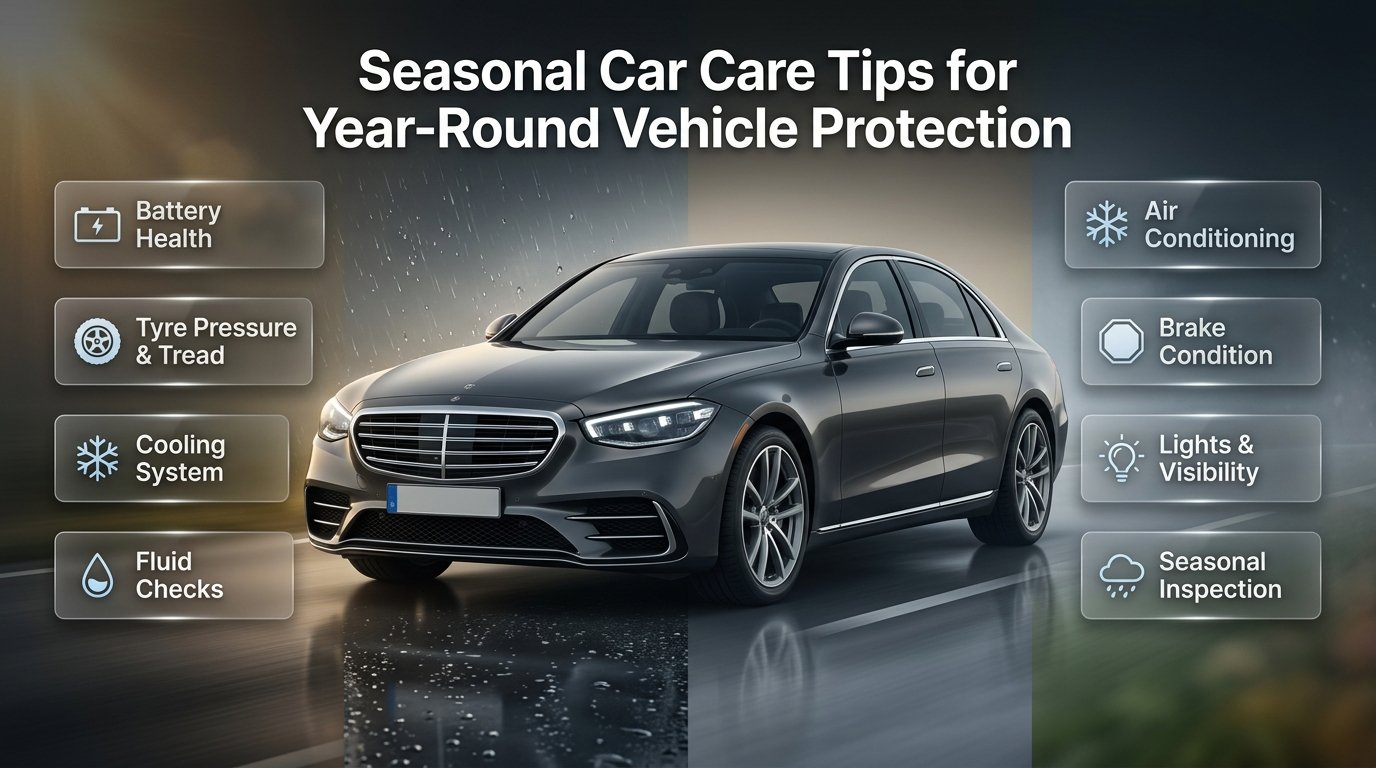
Introduction
A car can feel completely normal today and still leave you with a serious problem tomorrow. A battery that starts the engine without hesitation can suddenly become too weak to crank. Tyres that look fine at first glance may have uneven wear or incorrect pressure. An air-conditioning system that worked reasonably well last month may struggle when temperatures rise sharply.
This is exactly why seasonal car care tips matter.
Fuel at My Location Dubai 👉 Fuel Delivery Dubai provides useful fuel and vehicle-related information, but seasonal maintenance goes far beyond fuel. It means preparing the entire vehicle for the environmental conditions it is likely to face and identifying potential problems before they turn into expensive repairs or roadside emergencies.
Weather affects different vehicle systems in different ways. Hot temperatures can place additional stress on batteries, cooling systems, tyres, fluids, and air-conditioning components. Heavy rain can make tyre grip, brakes, wipers, and exterior lights especially important. Cold weather can make engine starting more difficult while increasing the demands placed on the battery, fluids, and heating system.
The good news is that seasonal vehicle preparation does not have to be complicated.
You do not need to replace parts simply because a new season has arrived. Instead, the goal is to understand which components deserve attention, recognize early warning signs, and address minor issues before they develop into major problems.
This complete guide explains how to prepare your car for summer, winter, rainy conditions, spring, and autumn, while also covering the demanding driving environment found in places such as Dubai. You will learn which checks you can perform yourself, when professional inspection makes sense, which maintenance mistakes drivers commonly make, and how to build a simple year-round car care routine that helps keep your vehicle safe, reliable, and ready for the road.
What Does Seasonal Car Care Mean?
Seasonal car care means adjusting your vehicle inspection and maintenance priorities according to changes in weather, temperature, road conditions, and driving habits.
It doesn’t mean performing a completely different service every few months.
Instead, seasonal maintenance is about asking a practical question:
What will my vehicle experience during the coming season, and which systems are most affected by those conditions?
For example, a driver in a very hot climate may prioritize:
- Battery condition
- Engine cooling
- Air conditioning
- Tyre pressure
- Tyre condition
- Engine oil
- Coolant
- Belts and hoses
A driver in a cold climate may give more attention to:
- Battery performance
- Coolant and antifreeze protection
- Tyres
- Windshield washer fluid
- Heating and defrosting
- Wipers
- Lights
Someone driving during a rainy season may focus more heavily on:
- Tyre tread
- Brake condition
- Wipers
- Lights
- Windshield visibility
- Water drainage around the vehicle
The important point is that seasonal maintenance should be condition-based rather than product-based.
You don’t need to buy something just because an advertisement says it’s a “summer product.” You need the correct component or fluid that meets your vehicle manufacturer’s specifications.
Why Is Seasonal Car Maintenance Important?
Seasonal maintenance is important because weather can expose weaknesses that remain hidden during normal driving.
Imagine a battery that is already near the end of its useful life. It may start your car normally on a mild morning. But after repeated exposure to demanding temperatures, its performance may deteriorate enough to cause a starting failure.
The same principle applies to other components.
A tyre with marginal tread may feel acceptable on a dry road but provide significantly less confidence on wet pavement.
A cooling system with a small leak may seem fine during moderate temperatures but struggle when the engine is working hard in extreme heat.
A worn wiper blade may seem acceptable during dry weather but become a major visibility problem during heavy rain.
Seasonal maintenance therefore provides an opportunity to identify weaknesses before conditions become demanding.
The basic idea is simple:
Changing conditions → increased vehicle stress → weak components become noticeable
A preventive inspection attempts to identify those weak components before they fail.
Seasonal maintenance can help you:
- Reduce avoidable breakdowns
- Improve road safety
- Maintain better visibility
- Protect tyres
- Identify fluid leaks
- Monitor battery health
- Detect cooling-system problems
- Maintain climate-control performance
- Reduce unnecessary emergency repairs
- Improve confidence before long journeys
It cannot prevent every mechanical failure, but it can reduce many preventable problems.
How Often Should You Check Your Car Seasonally?

There isn’t one universal interval that applies to every vehicle.
Your manufacturer’s maintenance schedule should remain the primary reference for scheduled servicing. Seasonal inspections are an additional layer of preventive care.
For many drivers, a practical approach is to perform a basic inspection when there is a significant change in weather or before a period of demanding driving.
For example:
| Vehicle Area | What to Check |
|---|---|
| Tyres | Pressure, tread, damage, uneven wear |
| Battery | Starting performance, terminals, test results |
| Coolant | Level, leaks, correct specification |
| Engine oil | Level, condition, scheduled replacement |
| Brakes | Noise, vibration, pedal feel, stopping performance |
| Wipers | Cracks, streaking, clearing performance |
| Lights | Headlights, brake lights, indicators |
| Air conditioning | Cooling performance, airflow, unusual smells |
| Hoses | Cracks, swelling, visible damage |
| Belts | Wear, cracking, abnormal noise |
| Emergency kit | Equipment and supplies |
The purpose isn’t to obsess over every component.
The purpose is to build a habit of noticing changes before they become failures.
Summer Car Care Tips
How Do You Prepare Your Car for Summer?
Hot weather can place additional stress on several vehicle systems. Before the hottest part of the year, pay particular attention to the battery, cooling system, tyres, air conditioning, engine oil, and other fluids.
In extremely hot climates, preparation is especially valuable because the vehicle may operate under high temperatures for long periods.
1. Check Your Car Battery Before Extreme Heat
The battery is one of the most commonly overlooked components until it stops working.
Drivers often think of battery failure as a winter problem, but high temperatures can also accelerate battery deterioration.
Heat can contribute to internal battery degradation, and an already weak battery may eventually struggle to provide sufficient starting power.
Watch for warning signs such as:
- Slow engine cranking
- Clicking when starting
- Repeated starting difficulties
- Dim electrical equipment
- Battery warning indicators
- Corrosion around terminals
- Swelling or visible battery damage
If your car starts normally but has recently become slower to crank, don’t ignore the change.
A professional battery and charging-system test can provide much more useful information than simply guessing whether the battery is “old.”
Pro Tip: Don’t wait for a complete battery failure if you already notice starting changes. Testing the battery early can help you make a planned decision rather than dealing with an unexpected roadside problem.
2. Inspect the Cooling System
The engine produces a large amount of heat during operation. The cooling system is responsible for helping maintain an appropriate operating temperature.
That makes cooling-system condition particularly important during hot weather.
Check for:
- Low coolant level
- Visible coolant leaks
- Damaged hoses
- Cracks
- Unusual engine temperature
- Steam
- Repeated coolant loss
- Cooling-system warning messages
Never open a pressurized coolant reservoir or radiator cap while the engine is hot.
Hot coolant can cause severe burns.
If the temperature gauge rises significantly above its normal position, don’t assume that continuing to drive will solve the problem. Stop safely and allow the vehicle to cool as appropriate.
Repeated overheating requires proper diagnosis.
3. Check Tyre Pressure in Hot Weather
Tyre pressure is affected by temperature.
Driving with incorrect pressure can influence handling, braking, tyre wear, rolling resistance, and overall tyre performance.
The correct pressure isn’t determined by the maximum pressure printed on the tyre sidewall. Instead, use the vehicle manufacturer’s recommended pressure, which is commonly listed on a vehicle label or in the owner’s manual.
Inspect tyres for:
- Uneven tread wear
- Cracks
- Bulges
- Cuts
- Embedded objects
- Excessive wear
- Incorrect pressure
Don’t inspect only the outer edge of the tyre. Uneven wear can occur across the tread.
Common Mistake: Some drivers reduce tyre pressure because the road feels extremely hot. That isn’t a reliable maintenance strategy. Use the manufacturer’s recommended pressure and check tyres according to the appropriate cold-tyre procedure.
4. Test the Air Conditioning Before Peak Heat
Air conditioning becomes essential in very hot environments.
If the system is weak, don’t wait until temperatures reach their highest point before investigating it.
Check:
- Cooling performance
- Airflow
- Blower operation
- Unusual smells
- Unusual sounds
- Uneven cooling
- Strange noises when the compressor operates
Poor cooling can have several possible causes, including refrigerant issues, airflow restrictions, electrical faults, compressor problems, or other system faults.
Simply adding refrigerant without diagnosing why the system is underperforming may not solve the underlying issue.
Expert Tip: Test your air conditioning before you actually need it every day. Early diagnosis gives you more time to arrange proper repairs.
5. Check Engine Oil
Engine oil lubricates internal engine components and helps manage heat and friction.
Hot conditions don’t automatically mean you need a special oil. What matters is using the specification and viscosity recommended for your engine.
Check the oil level according to your manufacturer’s instructions.
If the oil level repeatedly falls, investigate the cause.
Possible reasons can include:
- Oil leakage
- Oil consumption
- Mechanical issues
- Incorrect servicing
Never assume that repeatedly adding oil is a complete solution to unexplained oil loss.
6. Inspect Belts and Hoses
Rubber components can deteriorate over time.
Before periods of high heat, visually inspect accessible belts and hoses for obvious signs of:
- Cracking
- Swelling
- Fraying
- Softness
- Damage
- Leaks
Some components are difficult to inspect safely without specialist equipment.
If you see obvious deterioration, have the component assessed by a qualified technician.
7. Keep the Engine Bay Clean Without Creating New Problems
Dust and debris can accumulate around vehicle components, especially in dry environments.
However, cleaning an engine bay incorrectly can create electrical or mechanical problems.
Don’t spray high-pressure water directly onto sensitive electrical components without knowing the manufacturer’s recommendations.
Cleaning should be performed carefully and appropriately for the vehicle.
Rainy Season Car Care Tips
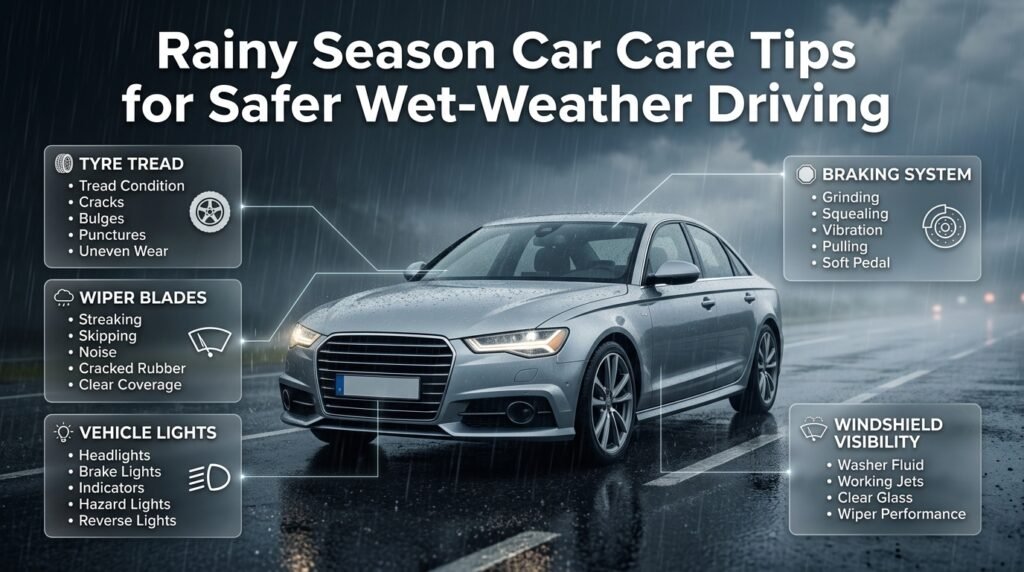
How Should You Prepare Your Car for Heavy Rain?
Rain changes the driving environment quickly.
Road surfaces become wet, visibility can decrease, and stopping distances may be affected by available grip and driving conditions.
Before heavy rain becomes common, focus on tyres, brakes, wipers, lights, and windshield visibility.
1. Check Tyre Tread
Tyre tread helps channel water away from the contact area between the tyre and road.
As tread wears down, the tyre’s ability to manage water can be reduced.
Inspect the tread across the entire tyre.
Don’t assume that a tyre is safe simply because it still has some visible tread.
Also check for:
- Cracks
- Bulges
- Punctures
- Uneven wear
- Foreign objects
If a tyre has serious damage, don’t continue driving simply because it isn’t flat.
2. Replace Worn Wiper Blades
Wiper blades are inexpensive compared with the consequences of poor visibility.
Replace them when they:
- Leave large streaks
- Skip across the glass
- Make excessive noise
- Leave sections uncleared
- Have cracked rubber
- Perform inconsistently
A windshield that looks clear when dry can become difficult to see through once rain starts.
Quick Tip: Test the wipers before the rainy season rather than during the first major storm.
3. Check All Vehicle Lights
Rain, clouds, road spray, and poor visibility make working lights more important.
Check:
- Headlights
- Brake lights
- Indicators
- Hazard lights
- Reverse lights
- Fog lights if fitted
A simple way to check brake lights is to have another person stand behind the vehicle while you operate the brake pedal.
4. Inspect the Braking System
Wet roads can make driving conditions more challenging.
If your vehicle already has a braking problem, rain can make the situation more uncomfortable or unpredictable.
Warning signs include:
- Grinding
- Persistent squealing
- Vibration
- Pulling
- Soft pedal
- Unusual pedal behavior
- Increased stopping distance
Don’t postpone a brake inspection when symptoms appear.
5. Check Windshield Washer Fluid
Clean windshield glass is important during rain because road spray can quickly create a dirty film.
Make sure the washer reservoir contains an appropriate fluid and that the spray system works correctly.
Check that:
- Washer jets operate
- Fluid sprays properly
- Wipers clear the glass
- Reservoir isn’t empty
Winter Car Care Tips
How Do You Prepare a Vehicle for Winter?
Cold-weather preparation depends heavily on how severe the winter conditions are.
In regions where temperatures fall below freezing, battery performance, coolant protection, tyres, washer fluid, heating, and visibility become particularly important.
1. Test the Battery
Cold temperatures can reduce a battery’s effective starting performance.
A battery that was already weak may struggle significantly more in cold conditions.
Signs of potential trouble include:
- Slow cranking
- Clicking
- Dim lights during starting
- Repeated jump starts
- Intermittent electrical problems
A battery test can help identify whether the battery or charging system requires attention.
2. Check Coolant and Antifreeze Protection
In freezing climates, the cooling system needs appropriate protection against low temperatures.
Don’t assume that any coolant is acceptable.
Use the coolant type and mixture specified for the vehicle.
An incorrect coolant mixture can create problems for both cooling performance and freeze protection.
3. Check Tyre Pressure
Cold temperatures can affect tyre pressure.
Check the pressure when tyres are cold and use the vehicle manufacturer’s recommended specification.
Don’t adjust pressure based solely on how the tyre looks.
4. Test the Heater and Defroster
The heating system isn’t only about comfort.
The defroster helps maintain visibility by clearing condensation and frost from windows.
Before winter:
- Test the heater
- Test windshield defrosting
- Check blower speeds
- Check airflow direction
- Inspect wipers
- Keep windows clean
5. Use Appropriate Washer Fluid
In freezing climates, ordinary water may not be suitable for windshield washer systems.
Use a washer fluid designed for the temperatures your vehicle will experience.
Spring Car Care Tips
What Should You Check on Your Car in Spring?
Spring is an excellent time to inspect the vehicle after a demanding winter.
Even when there are no obvious problems, seasonal transition provides a useful opportunity to review the vehicle.
Check:
- Tyres
- Brakes
- Wipers
- Battery
- Engine fluids
- Lights
- Air conditioning
- Belts
- Hoses
- Exterior damage
If the vehicle has been exposed to road salt, snow, mud, or heavy winter conditions, cleaning and inspection become especially useful.
Autumn Car Care Tips
Why Should You Inspect Your Car in Autumn?
Autumn provides an opportunity to prepare the vehicle for colder or wetter conditions.
This is a good time to check:
- Battery performance
- Tyres
- Wipers
- Lights
- Coolant
- Heating
- Defrosting
- Emergency equipment
It is easier to repair a small issue before demanding weather arrives than during an emergency.
Seasonal Car Care for Dubai Drivers
What Car Maintenance Matters Most in Dubai?
Dubai’s driving environment creates different seasonal priorities compared with cold-weather countries.
Extreme summer heat, high road temperatures, heavy air-conditioning use, dust, and long periods of vehicle operation can put additional demands on specific systems.
Dubai drivers should pay particular attention to:
Battery Condition
High temperatures can accelerate battery deterioration.
If your vehicle shows slow starting or electrical symptoms, arrange testing.
Cooling System
The cooling system is one of the most important systems to monitor during extreme heat.
A small cooling-system problem can become much more serious when the engine is operating in demanding temperatures.
Tyres
Hot road surfaces combined with incorrect pressure or existing tyre damage can create additional risk.
Inspect pressure and tyre condition regularly.
Air Conditioning
Because air conditioning may be used extensively, weak cooling should be investigated before it becomes a major problem.
Fluids
Monitor oil, coolant, brake fluid, and other relevant fluids according to manufacturer requirements.
For a broader look at driving and fuel considerations in Dubai, Dubai Driving and Fuel Insights provides additional useful context.
How Does Extreme Heat Affect a Car?
Extreme heat can affect several systems at the same time.
Battery
High temperatures can accelerate battery deterioration.
Tyres
Temperature changes affect pressure, while high road temperatures increase operating stress.
Cooling System
The cooling system has to remove engine heat efficiently.
Air Conditioning
Heavy use increases demand on the climate-control system.
Fluids
Fluids need to remain within their appropriate operating specifications.
Interior
Extreme temperatures can also affect plastics, seals, dashboards, and other interior components over time.
This doesn’t mean a vehicle can’t handle hot weather.
Modern vehicles are designed to operate in a wide range of conditions.
The important factor is maintaining them properly.
Seasonal Car Maintenance Checklist
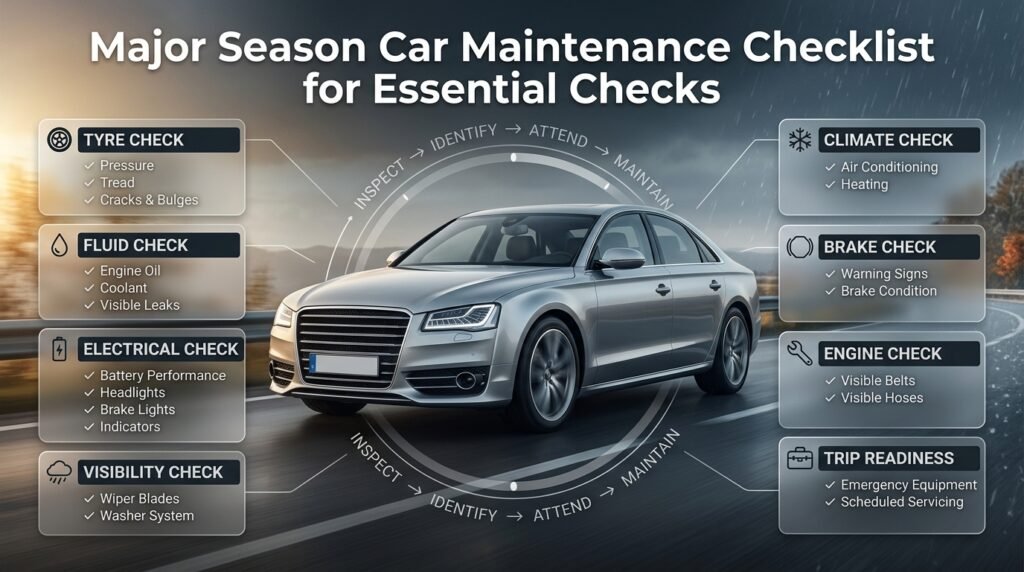
What Should You Check Before Every Major Season?
Use this checklist as a practical starting point.
- Check tyre pressure
- Inspect tyre tread
- Look for cracks and bulges
- Check engine oil level
- Inspect coolant level
- Look for visible fluid leaks
- Test battery performance
- Check headlights
- Check brake lights
- Check indicators
- Inspect wiper blades
- Test washer system
- Test air conditioning or heating
- Check brakes for warning signs
- Inspect visible belts
- Inspect visible hoses
- Review emergency equipment
- Confirm scheduled servicing is up to date
This checklist doesn’t replace professional servicing.
Instead, it helps you identify areas that may deserve attention.
What Are the Most Important Seasonal Car Checks?
If you don’t have much time, prioritize safety and failure-related systems.
A practical order is:
- Tyres
- Brakes
- Battery
- Cooling system
- Lights
- Wipers and visibility
- Fluids
- Climate control
- Belts and hoses
- Emergency equipment
This doesn’t mean number ten is unimportant.
It simply means that tyres, brakes, and other critical systems should receive immediate attention when problems are identified.
Seasonal Maintenance vs Routine Maintenance
Is Seasonal Maintenance the Same as Regular Servicing?
No.
Routine maintenance follows the vehicle manufacturer’s service schedule.
Seasonal maintenance is an additional inspection based on weather and operating conditions.
| Routine Maintenance | Seasonal Maintenance |
|---|---|
| Based on service intervals | Based on changing conditions |
| Manufacturer scheduled | Weather and driving focused |
| May include major servicing | Usually focused inspection |
| Includes scheduled replacements | Identifies seasonal risks |
| Essential for long-term maintenance | Supports preventive care |
The two systems should work together.
You shouldn’t skip scheduled servicing simply because you perform seasonal inspections.
Likewise, you shouldn’t assume scheduled servicing means weather-related inspections are unnecessary.
How Can Seasonal Maintenance Prevent Breakdowns?
The relationship can be understood simply:
Weak component → seasonal stress → failure
versus:
Weak component → seasonal inspection → early detection → repair → reduced failure risk
For example, suppose a battery is already weak.
During normal conditions, the car may still start.
During a demanding period, the battery may finally fail.
A battery test before that period could identify reduced performance and allow you to address the problem before the vehicle becomes stranded.
The same concept applies to tyres, cooling systems, brakes, wipers, and other components.
Common Seasonal Car Care Mistakes
What Mistakes Do Drivers Make Most Often?
Mistake 1: Waiting for a Warning Light
Warning lights are important, but they aren’t a replacement for inspection.
Not every mechanical problem triggers an immediate dashboard warning.
Better approach
Pay attention to physical symptoms such as:
- Strange sounds
- New vibrations
- Slow starting
- Unusual smells
- Fluid loss
- Poor braking
- Temperature changes
Mistake 2: Ignoring Slow Starting
A car that starts more slowly than normal is giving you useful information.
It doesn’t automatically mean the battery is defective, but the battery and charging system deserve attention.
Better approach
Test the system before the vehicle stops starting altogether.
Mistake 3: Using the Wrong Fluid
Different engines and cooling systems can require different specifications.
Why it happens
Drivers sometimes choose a product because the packaging says “premium,” “universal,” or “extreme temperature.”
Better approach
Use the manufacturer’s required specification.
Mistake 4: Checking Tyres Only Before Long Trips
Tyres are safety-critical every day.
Better approach
Make tyre inspection part of your regular routine.
Mistake 5: Replacing Parts Without Diagnosis
A symptom doesn’t always identify the failed component.
For example, weak air conditioning could have several possible causes.
Replacing random parts can become expensive.
Better approach
Diagnose first, replace second.
Mistake 6: Ignoring Small Leaks
A small fluid leak isn’t necessarily harmless.
Depending on the fluid and location, it can indicate a developing mechanical problem.
Better approach
Investigate unexplained fluid loss.
Mistake 7: Forgetting the Emergency Kit
Many drivers think about emergency equipment only after becoming stranded.
Better approach
Check the emergency kit whenever you perform seasonal maintenance.
How Should You Prepare a Car for a Long Seasonal Road Trip?
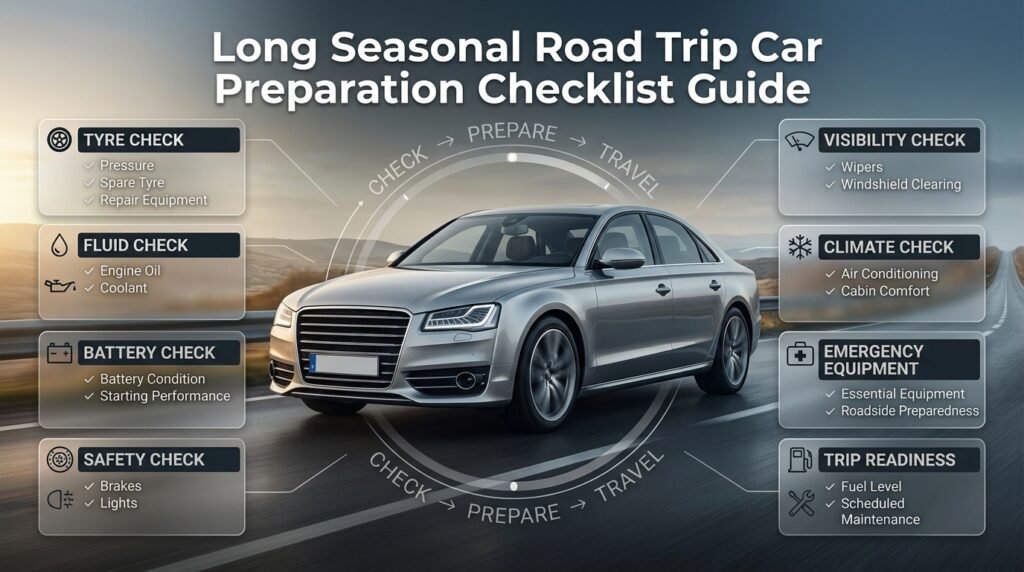
Before a long journey, don’t rely only on your last service appointment.
Perform a basic pre-trip inspection.
Check the following:
- Tyre pressure
- Spare tyre or repair equipment
- Engine oil
- Coolant
- Battery
- Brakes
- Lights
- Wipers
- Air conditioning
- Emergency equipment
- Fuel level
Also check whether your vehicle is due for scheduled maintenance.
If your journey is particularly long, arrange professional inspection if you’re unsure about the condition of the vehicle.
Seasonal Driving and Fuel Efficiency
Vehicle maintenance and driving habits can influence fuel consumption.
Incorrect tyre pressure, unnecessary idling, aggressive acceleration, excessive vehicle weight, poor maintenance, and heavy air-conditioning use can all contribute to increased fuel consumption under certain conditions.
Good seasonal maintenance therefore supports more than reliability.
It can also help the vehicle operate efficiently.
Useful habits include:
- Maintaining recommended tyre pressure
- Avoiding unnecessary idling
- Removing unnecessary weight
- Keeping the engine properly maintained
- Planning routes efficiently
- Driving smoothly
- Combining short trips where practical
For drivers specifically interested in reducing fuel consumption, Fuel-Saving Driving Tips offers additional guidance.
Does Fuel Choice Matter During Seasonal Driving?
Fuel selection should always follow the requirements of your vehicle.
Drivers should not change fuel type simply because the season changes unless the vehicle manufacturer specifies a particular requirement.
The more important seasonal considerations are vehicle condition, driving conditions, fuel planning, and correct operation.
For a detailed comparison of petrol and diesel characteristics, see Petrol vs. Diesel Comparisons.
What Should You Keep in Your Car for Seasonal Emergencies?
A practical emergency kit can make an unexpected situation easier to manage.
Consider carrying:
- Phone charger
- Flashlight
- Reflective warning equipment
- Basic first-aid supplies
- Drinking water
- Vehicle documents
- Basic tools where appropriate
- Spare tyre or approved repair equipment
- Jack and wheel tools where supplied
- Gloves
- Emergency contact details
The correct emergency equipment depends on your vehicle and location.
For fuel emergencies, the safest solution is to use appropriate roadside assistance or a legitimate fuel-delivery service rather than attempting unsafe roadside improvisation.
Professional Seasonal Maintenance Advice
What Do Experienced Technicians Recommend?
Good maintenance isn’t about replacing everything before a season begins.
It is about identifying risk.
An experienced technician generally looks for evidence of wear, deterioration, leakage, abnormal operation, and manufacturer-specified service requirements.
The most useful approach is:
Inspect
Look at the condition of the component.
Test
Where necessary, use appropriate diagnostic equipment.
Diagnose
Identify the actual cause of the problem.
Repair
Fix the problem using appropriate parts and specifications.
Monitor
Pay attention to whether the symptom returns.
This approach avoids unnecessary parts replacement and helps keep maintenance decisions practical.
Expert Tip: The best seasonal maintenance is preventive, not reactive. A short inspection can sometimes prevent hours of roadside trouble.
When Should You Stop Driving and Seek Professional Help?
Some symptoms should not be ignored.
Stop driving or seek professional assistance when you experience serious symptoms such as:
- Engine overheating
- Serious brake problems
- Significant fluid leaks
- Severe tyre damage
- Strong burning smells
- Major steering problems
- Persistent warning indicators
- Severe vibration
- Repeated starting failure
- Loss of essential vehicle control
The exact response depends on the situation.
Safety should always come before reaching your destination.
What Should I Check on My Car Before the Summer Season?
Before summer, don’t focus only on the air conditioner. A proper summer inspection should cover the cooling system, battery, tyres, engine oil, air conditioning, brakes, belts, hoses, and essential fluids. High temperatures can expose weaknesses that may not be obvious during normal driving, particularly when the vehicle is stuck in traffic or used for long journeys.
The smartest approach is to check the systems that have to work hardest in hot weather rather than replacing parts unnecessarily. For example, if the battery is still healthy after testing, there is no reason to replace it simply because summer has arrived. If the coolant level is dropping repeatedly, however, that deserves investigation rather than simply topping it up again and again.
Before summer, pay particular attention to:
Battery condition and terminal corrosion
Coolant level and visible cooling-system leaks
Tyre pressure, tread and sidewalls
Engine oil level and scheduled oil service
Air-conditioning cooling performance
Brake response and unusual brake noises
Belts and hoses for visible deterioration
Wipers, washer fluid and lights
Professional advice: Check the coolant only when the engine is properly cool. Never open a hot pressurized cooling system. If the temperature gauge rises abnormally or the vehicle shows an overheating warning, continuing to drive can turn a cooling problem into serious engine damage.
How Does Extreme Heat Affect a Car Battery?
Extreme heat can be just as demanding on a car battery as cold weather, particularly when a battery is already aging or weakened. High temperatures can accelerate internal battery deterioration, while heavy use of air conditioning and electrical equipment adds to the vehicle’s electrical demand.
One of the biggest mistakes drivers make is waiting until the car refuses to start. A battery often gives clues before complete failure. If the engine takes noticeably longer to crank, you hear repeated clicking, or electrical performance seems weaker than normal, that’s the right time to investigate.
A visual inspection is useful, but it doesn’t tell you the battery’s actual starting capability. A proper battery and charging-system test gives you much better information about whether the problem is the battery, alternator, connection, or another electrical component.
Watch for these signs:
Slower-than-normal engine cranking
Clicking when attempting to start
Corrosion around battery terminals
Swollen or physically damaged battery casing
Repeated need for jump-starting
Unusual electrical behavior
Battery or charging warning lights
Professional advice: Don’t replace a battery purely because somebody says, “It’s old.” Age matters, but condition and test results matter too. On the other hand, don’t ignore a battery that is already showing symptoms simply because the car still starts.
For drivers in very hot climates such as Dubai, battery checks deserve particular attention before periods of extreme heat because heat can accelerate deterioration.
How Can I Prevent My Car From Overheating in Hot Weather?
Preventing overheating starts with maintaining the entire cooling system, not simply adding coolant whenever the reservoir looks low. The cooling system includes components such as coolant, radiator, hoses, thermostat, cooling fans, water pump and other related parts.
If the coolant level repeatedly drops, there may be a leak or another underlying problem. Likewise, a vehicle can have enough coolant and still overheat because another component isn’t operating correctly.
This is particularly important during hot-weather city driving. Stop-and-go traffic places significant demands on the cooling system because the engine continues producing heat while vehicle speed and airflow are low. Current summer maintenance guidance specifically recommends checking coolant, radiator condition, cooling fans, hoses and the temperature gauge before peak heat.
Before hot-weather driving, check:
Coolant level when the engine is cold
Visible coolant leaks
Radiator hoses for cracks or swelling
Temperature gauge behavior
Cooling-fan operation where appropriate
Signs of steam or overheating
Repeated need to add coolant
If the engine starts overheating:
Pull over somewhere safe.
Stop stressing the engine.
Do not open a hot radiator or pressurized coolant reservoir.
Allow the vehicle to cool appropriately.
Arrange professional assistance if the cause isn’t obvious.
Don’t continue driving simply because the vehicle still moves.
Professional advice: A low coolant level is a symptom worth investigating, not automatically a maintenance task that should be repeated indefinitely. If you keep adding coolant, find out where it is going.
How Often Should I Check Tyres During Seasonal Changes?
Tyres deserve attention throughout the year, but seasonal changes are an excellent reminder to check them properly. Temperature changes can affect tyre pressure, while heat, road conditions, age, uneven wear and incorrect inflation can influence tyre performance.
Before a demanding season or long trip, don’t just look at whether the tyre appears inflated. Check the pressure with an appropriate gauge and compare it with the vehicle manufacturer’s recommended pressure.
Also inspect the complete tyre rather than only the visible tread.
Look for:
Uneven tread wear
Low or incorrect pressure
Sidewall cracks
Bulges
Cuts
Punctures
Embedded objects
Excessive tread wear
Age-related deterioration
Hot road surfaces can increase tyre stress, while incorrect inflation can affect handling, performance and tyre wear.
During rainy weather, tread condition becomes particularly important because worn tyres have less ability to manage water effectively. Recent monsoon guidance for Pakistan specifically highlights tyre tread, sidewall damage and manufacturer-recommended tyre pressure as important pre-rain checks.
Professional advice: Never use the maximum pressure printed on the tyre sidewall as your normal target simply because it is the largest number you can see. Use the vehicle manufacturer’s recommended specification.
And don’t check only before a highway trip. A tyre problem can become a safety issue during an ordinary city journey too.
What Should I Check on My Car Before the Rainy Season?
Before the rainy season, your priority should shift toward tyres, brakes, wipers, lights, washer fluid, visibility and electrical condition.
Rain itself isn’t necessarily damaging to a properly maintained car. The bigger concern is how rain changes the driving environment. Wet roads can reduce available grip, heavy spray can reduce visibility, and flooded roads can hide potholes and other hazards.
Worn wipers are a particularly common problem. A blade that looks acceptable on a dry windshield may smear water across the glass once heavy rain begins. Likewise, tyres with marginal tread can become a bigger concern when roads are wet.
Before the rainy season, check:
Tyre tread and pressure
Brake response
Brake warning signs
Wiper blades
Windshield washer fluid
Headlights
Brake lights
Indicators
Hazard lights
Door and window seals
Battery terminals and electrical connections
If your vehicle has been exposed to standing water or flooding, don’t assume everything is fine simply because the engine continues running. Water can affect brakes, electrical components, underbody areas and other systems.
Professional advice: If the engine stops while the vehicle is in deep water, don’t repeatedly attempt to restart it. Have the vehicle assessed appropriately, because restarting a water-affected engine can potentially cause serious mechanical damage.
The Professional Seasonal Car Care Rule
The best way to approach seasonal maintenance is not to replace everything before every season.
Instead:
Inspect → Test → Diagnose → Repair → Monitor
That approach keeps maintenance practical and prevents you from spending money on parts that don’t actually need replacement.
For a strong seasonal car care article, these five FAQs are the ones I’d keep because they directly address the decisions a real driver needs to make: what to inspect, what can fail, what warning signs matter, and when professional attention is necessary.
Conclusion
Seasonal car care isn’t about waiting for a problem to appear and then trying to fix it. It’s about understanding how changing weather can affect your battery, tyres, cooling system, brakes, fluids, air conditioning, wipers, and overall vehicle performance before those conditions become demanding.
A few simple checks at the right time can help you identify small problems early. Before summer, focus on heat-sensitive systems such as the battery, cooling system, tyres, and AC. Before rainy weather, give extra attention to tyre tread, brakes, wipers, lights, and visibility. And whenever you notice unusual starting, overheating, vibration, fluid loss, or braking behavior, don’t wait for the next seasonal inspection—get it checked.
The most effective approach is simple: inspect regularly, follow the manufacturer’s specifications, fix problems early, and never ignore warning signs. Good seasonal maintenance won’t guarantee that a breakdown can never happen, but it can significantly reduce avoidable problems and help you drive with greater confidence throughout the year.
For more practical guidance on vehicle care, fuel, driving, and roadside situations, visit 👉 Fuel Delivery Dubai.
Leave a Reply