Introduction
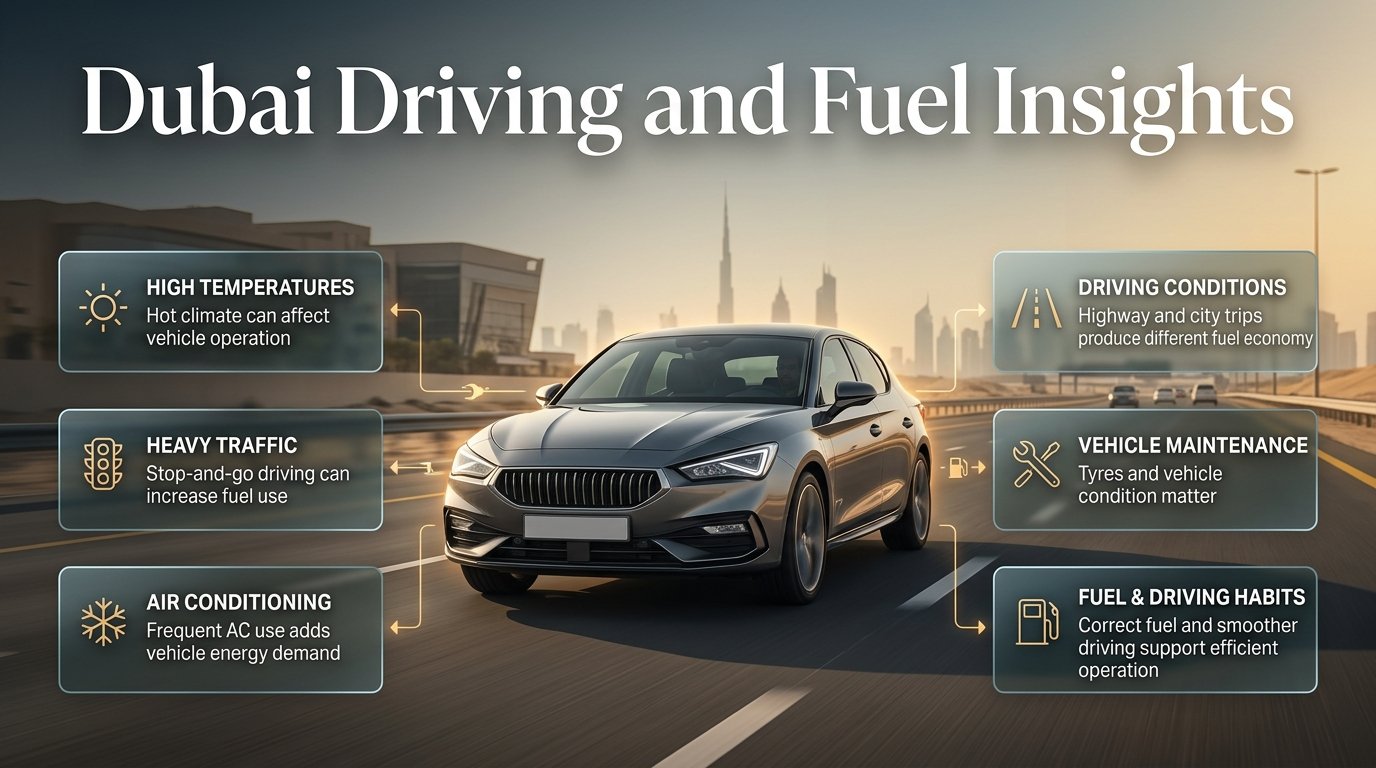
Dubai Driving and Fuel Insights | Driving in Dubai comes with a combination of conditions that can affect both vehicle performance and fuel consumption. High temperatures, heavy traffic, frequent use of air conditioning, long highway journeys, short city trips, stop-and-go driving, and different driving patterns can all change how efficiently a vehicle uses fuel.
A driver may notice that the same car gives different fuel economy on different days. One journey may involve steady highway driving, while another may involve congestion, frequent braking, waiting at signals, and repeated acceleration. The difference doesn’t necessarily mean there is a problem with the vehicle. Operating conditions matter.
For drivers looking for practical Dubai driving and fuel insights, the most useful approach is to understand how the vehicle, fuel, road conditions, maintenance, and driving habits work together.
If you’re looking for a broader understanding of automotive fuel and vehicle refuelling, you can also visit Petrol Delivery to Car Dubai 👉 Fuel Delivery Dubai for additional information.
This guide explains the main factors affecting fuel consumption in Dubai, how petrol and diesel vehicles differ, how climate and traffic influence driving, how to improve fuel efficiency, how to recognize possible fuel-related problems, and what to do if your vehicle unexpectedly runs out of fuel.
The goal isn’t to promise unrealistic fuel savings. It’s to help drivers make sensible decisions that protect the vehicle, reduce unnecessary fuel waste, and make everyday driving easier.
What Are the Main Fuel Challenges for Drivers in Dubai?
Dubai driving conditions can vary considerably from one journey to another. A vehicle travelling smoothly on a highway is operating very differently from the same vehicle moving through congested urban traffic.
The biggest factors that commonly influence fuel consumption include:
- Traffic congestion
- Frequent acceleration and braking
- High ambient temperatures
- Heavy air-conditioning use
- Excessive idling
- High driving speeds
- Incorrect tyre pressure
- Unnecessary vehicle weight
- Poor maintenance
- Short journeys
- Route conditions
- Driving behaviour
- Incorrect fuel selection
- Changes in vehicle condition
No single factor determines fuel economy.
For example, a driver may blame air conditioning for higher fuel consumption when the real reason is a combination of traffic, aggressive acceleration, low tyre pressure, and short journeys.
Understanding the complete picture is much more useful than focusing on one factor.
How Does Dubai’s Climate Affect Vehicle Fuel Consumption?
Dubai’s hot climate creates operating conditions that many vehicles experience throughout the year. Modern vehicles are engineered to operate in hot environments, but temperature can still influence how a vehicle is used.
One of the most noticeable factors is air conditioning.
During very hot weather, drivers depend heavily on the vehicle’s cooling system. The air-conditioning system requires energy to operate, and this can contribute to increased fuel consumption.
The effect isn’t identical for every vehicle. It depends on the engine, air-conditioning system, vehicle size, outside temperature, driving conditions, cabin temperature, and how frequently the system is used.
Does Air Conditioning Always Cause a Large Increase in Fuel Use?
Not necessarily.
Air conditioning can increase fuel consumption, but drivers shouldn’t avoid necessary climate control simply to save fuel. In Dubai’s climate, maintaining a comfortable and safe cabin can be important.
A better strategy is to use the system sensibly.
For example:
- Park in shade when practical.
- Use sunshades when appropriate.
- Don’t leave the vehicle cooling unnecessarily while nobody is inside.
- Keep the air-conditioning system properly maintained.
- Replace relevant filters according to the vehicle manufacturer’s schedule.
- Avoid extreme settings when they’re not necessary.
- Keep doors and windows properly closed when using air conditioning.
The objective is not to eliminate air-conditioning use. It’s to avoid unnecessary energy consumption.
Pro Tip: If the air conditioner suddenly becomes much weaker than usual, don’t assume the hot weather is the only reason. A maintenance issue can affect cooling performance and may deserve inspection.
Why Is Tyre Pressure Important in Dubai?
Tyre pressure is one of the simplest things a driver can monitor, yet it is often overlooked.
A tyre that isn’t inflated according to the manufacturer’s recommendation can affect handling, braking, tyre wear, and rolling resistance.
Underinflated tyres can create additional rolling resistance, which means the engine may need to use more energy to move the vehicle.
Incorrect pressure can also affect how the vehicle feels on the road.
Should Tyre Pressure Be Changed Because of Hot Weather?
Drivers shouldn’t guess.
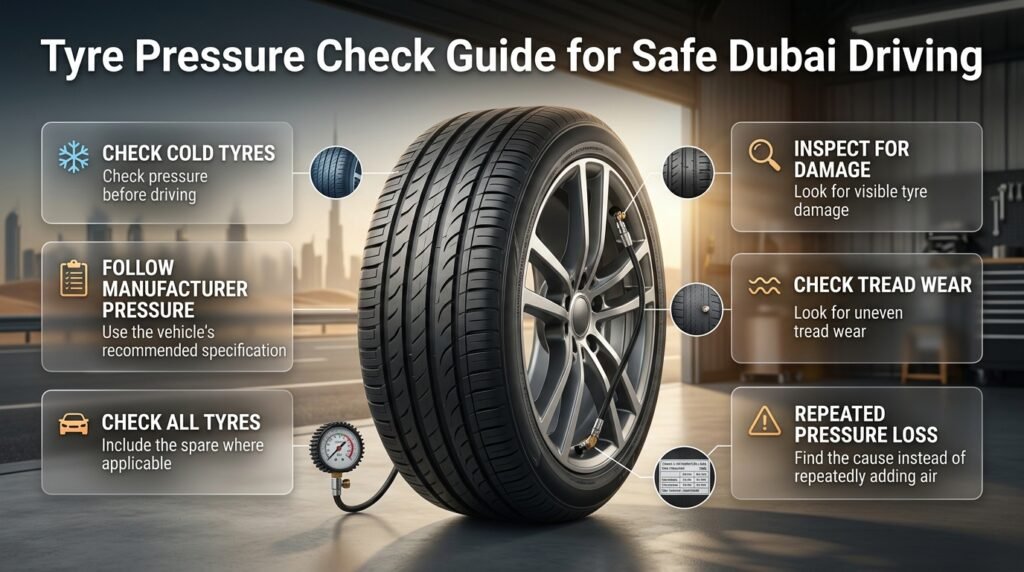
The correct pressure is the pressure recommended by the vehicle manufacturer. It is usually listed on a vehicle information label or in the owner’s manual.
Pressure should generally be checked when tyres are cold because driving generates heat and changes pressure readings.
Do not intentionally reduce tyre pressure simply because the outside temperature is high.
Simple Tyre Check
Before a long journey:
- Check all four tyres.
- Check the spare tyre if applicable.
- Compare the readings with the manufacturer’s recommendation.
- Inspect for visible damage.
- Look for uneven tread wear.
- Check for objects embedded in the tread.
- Arrange inspection if a tyre repeatedly loses pressure.
A tyre that keeps losing pressure needs attention. Repeatedly adding air without identifying the cause isn’t a proper solution.
How Does Driving Style Affect Fuel Economy?
Driving behaviour can have a significant influence on fuel consumption.
Two people can drive the same vehicle on the same road and obtain different fuel-economy results because their driving patterns are different.
Aggressive acceleration is one common example.
When a driver accelerates hard, the engine has to produce more power. If the driver then brakes heavily a few seconds later because traffic has slowed, much of that gained speed is lost.
The cycle can repeat:
Hard acceleration → rapid speed increase → heavy braking → repeat acceleration
A smoother approach is usually more efficient:
Observe traffic → accelerate progressively → maintain suitable speed → anticipate slowing traffic
This doesn’t mean driving unusually slowly or interfering with normal traffic flow.
It means reducing unnecessary changes in speed.
Practical Driving Habits for Better Fuel Efficiency
Try to:
- Look further ahead in traffic.
- Accelerate progressively.
- Maintain a safe following distance.
- Avoid unnecessary lane changes.
- Anticipate traffic signals where possible.
- Avoid repeated hard braking.
- Maintain a sensible speed.
- Avoid unnecessary engine idling.
- Remove unnecessary weight.
- Keep the vehicle maintained.
Expert Tip: The most useful fuel-saving habit is often anticipation. If you can see that traffic ahead is slowing, there’s usually little benefit in accelerating aggressively only to brake moments later.
Is Highway Driving More Fuel-Efficient Than City Driving?
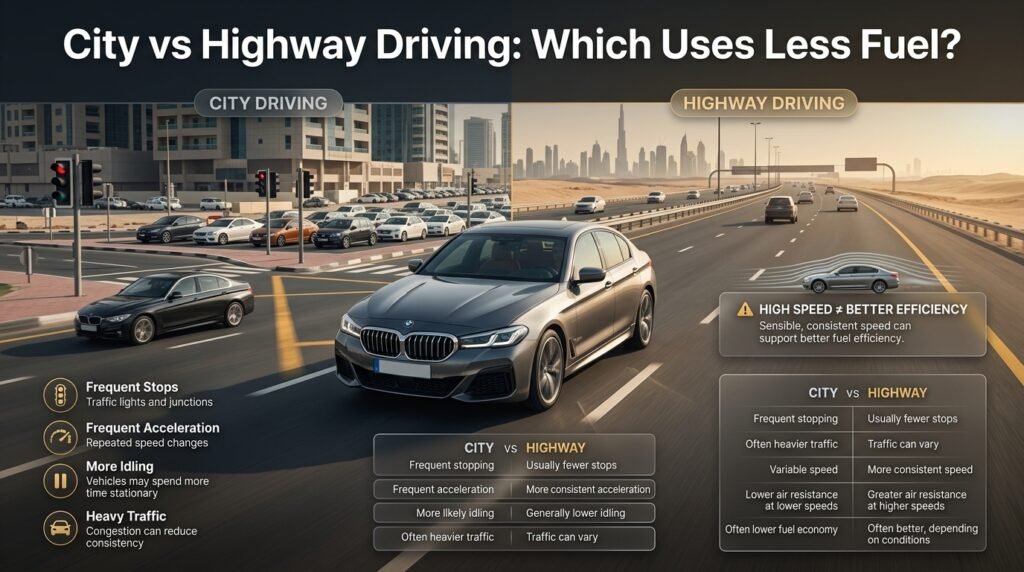
Highway driving can be more fuel-efficient than urban driving because it often allows the vehicle to maintain a relatively consistent speed.
City driving commonly includes:
- Traffic lights
- Junctions
- Congestion
- Frequent stopping
- Frequent acceleration
- Short trips
- Idling
- Heavy traffic
Highway driving can reduce some of these factors.
However, highway driving isn’t automatically efficient.
Driving at very high speeds can increase aerodynamic resistance and therefore increase energy demand.
A driver who maintains a sensible and consistent speed may use less fuel than someone travelling much faster and repeatedly accelerating.
City vs Highway Driving
| Factor | City Driving | Highway Driving |
|---|---|---|
| Stopping | Frequent | Usually less frequent |
| Acceleration | Frequent | Usually more consistent |
| Idling | More likely | Generally lower |
| Traffic | Often heavier | Variable |
| Speed | Variable | More consistent |
| Air resistance | Lower at lower speeds | More significant at higher speeds |
| Fuel economy | Often lower | Often better, depending on speed and conditions |
The actual result depends on the vehicle and the journey.
Does Excessive Idling Waste Fuel?
Yes.
When an engine is running while the vehicle is stationary, fuel is being consumed without the vehicle travelling any distance.
Some idling may be necessary. For example, traffic conditions or operational requirements can make it unavoidable.
The problem is unnecessary idling.
Common examples include:
- Waiting for someone outside a building
- Sitting in a parking area with the engine running
- Leaving the engine running during an unnecessary stop
- Waiting for a short task when the vehicle doesn’t need to remain running
Reducing avoidable idling can help improve overall fuel efficiency.
At the same time, safety should come first. Drivers shouldn’t switch off a vehicle in a situation where doing so would create a safety or operational problem.
How Does Vehicle Maintenance Affect Fuel Consumption?
Vehicle maintenance and fuel economy are closely related, although maintenance is not the only factor.
A vehicle that has a mechanical issue may not operate as efficiently as it should.
Potential contributors to increased fuel consumption can include:
- Incorrect tyre pressure
- Poor wheel alignment
- Dragging brakes
- Engine problems
- Faulty sensors
- Air-intake problems
- Ignition problems
- Fuel-system problems
- Poorly maintained cooling systems
- Incorrect or overdue service items
A small change in fuel economy doesn’t automatically indicate a mechanical fault.
For example, heavy traffic during one week may explain higher consumption.
But a persistent increase combined with other symptoms deserves attention.
Warning Signs Worth Investigating
Pay attention if higher fuel consumption appears alongside:
- Rough engine operation
- Difficult starting
- Reduced acceleration
- Unusual engine noise
- Warning lights
- Strong or unusual smells
- Engine hesitation
- Smoke
- Unusual exhaust behaviour
When several symptoms appear together, professional diagnosis is usually more useful than simply changing driving habits.
What Role Does Fuel Quality Play in Vehicle Performance?
Fuel quality matters because modern engines depend on fuel meeting the requirements for which the engine and fuel system were designed.
Fuel should be appropriate for the vehicle and meet the relevant quality specifications.
Drivers sometimes assume that every fuel-related engine problem is caused by poor fuel. That’s not always correct.
A similar symptom can be produced by:
- Ignition problems
- Injector problems
- Sensor faults
- Air-intake issues
- Electrical faults
- Mechanical wear
- Fuel-system faults
Therefore, diagnosis should be based on evidence.
For drivers who want to understand this subject in greater detail, resources covering fuel quality standards and fuel quality and engine performance can provide useful background.
What Is the Difference Between Petrol and Diesel Vehicles?
Petrol and diesel engines use different combustion principles.
Petrol engines generally use spark ignition. The air-fuel mixture is ignited by a spark from the ignition system.
Diesel engines use compression ignition. Air is compressed to a high temperature and diesel fuel is injected under conditions that allow combustion to occur.
This difference affects how the engines operate and what type of fuel they require.
Drivers should always follow the vehicle manufacturer’s fuel specification.
Putting the wrong fuel into a vehicle can create a much more serious problem than simply using a different fuel grade.
For readers who want a deeper introduction, petrol and diesel fuel types explains the subject in more detail.
Why Should Drivers Use the Correct Fuel?
Fuel selection should never be based only on price.
The first question is:
What fuel does the vehicle manufacturer specify?
A petrol engine requires the appropriate petrol. A diesel engine requires diesel fuel.
If the wrong fuel is added, don’t assume the vehicle can simply continue driving normally.
The correct response depends on the situation, the amount of incorrect fuel added, whether the engine has been started, and the vehicle.
When the wrong fuel is suspected, obtaining appropriate professional advice before continuing to drive can help prevent additional damage.
Common Fuel Selection Mistakes
- Assuming petrol and diesel are interchangeable
- Choosing fuel based only on price
- Ignoring the manufacturer’s fuel specification
- Assuming premium fuel is always necessary
- Continuing to drive after suspected misfuelling
The fuel cap, owner’s manual, and vehicle manufacturer’s documentation are useful references.
What Is Octane and Why Does It Matter?
Octane rating relates to petrol’s resistance to knocking under specified test conditions.
Engine design matters because compression ratio and combustion conditions influence the fuel requirements of a petrol engine.
A higher octane number doesn’t simply mean that the fuel contains more energy.
Instead, octane is primarily associated with resistance to abnormal combustion known as knock.
Drivers should follow the minimum octane requirement specified for their vehicle.
You can learn more about regular vs premium petrol octane before deciding whether a higher grade is actually necessary for a particular engine.
Is Premium Petrol Always Better?
No.
Premium petrol can be appropriate when a manufacturer recommends or requires a higher octane fuel.
But putting a higher-octane fuel into an engine that doesn’t need it doesn’t automatically make the vehicle faster, more economical, or mechanically healthier.
The correct fuel is the fuel appropriate for the engine.
Better Decision
Instead of asking:
“Is premium fuel better?”
Ask:
“What fuel specification does my vehicle require?”
That’s a more useful question.
What Is Fuel Contamination?
Fuel contamination occurs when unwanted material enters fuel.
Possible contaminants can include:
- Water
- Dirt
- Sediment
- Foreign material
- Other unsuitable substances
Contamination can occur through storage, handling, equipment, or other fuel-system circumstances.
The risk becomes especially important when fuel is stored for extended periods or transferred between systems.
Drivers and fleet operators should take sensible precautions to keep fuel systems clean and properly maintained.
More detailed information about fuel quality testing basics can help explain how fuel quality may be assessed.
What Are the Characteristics of Good-Quality Petrol?
Good-quality petrol should meet the relevant requirements for the vehicle and fuel system.
The important issue isn’t simply how the fuel looks. Fuel quality involves specifications, handling, storage, and contamination control.
Drivers should be cautious about making conclusions based on appearance alone.
If a vehicle develops unusual symptoms shortly after refuelling, record what happened and consider professional diagnosis.
A useful resource on good-quality petrol characteristics can help readers understand the subject more clearly.
What Causes Fuel Contamination?
Fuel contamination can have different causes.
Potential sources include:
- Water entering storage
- Dirty transfer equipment
- Poor storage conditions
- Contaminated containers
- Improper handling
- Sediment
- Incorrect fuel handling procedures
Commercial operators should take particular care because a fuel-storage problem can affect multiple vehicles.
A fleet shouldn’t wait for several vehicles to develop symptoms before investigating fuel handling.
Information about factors affecting fuel quality can help operators understand why fuel quality can change.
What Are the Symptoms of Contaminated Petrol?
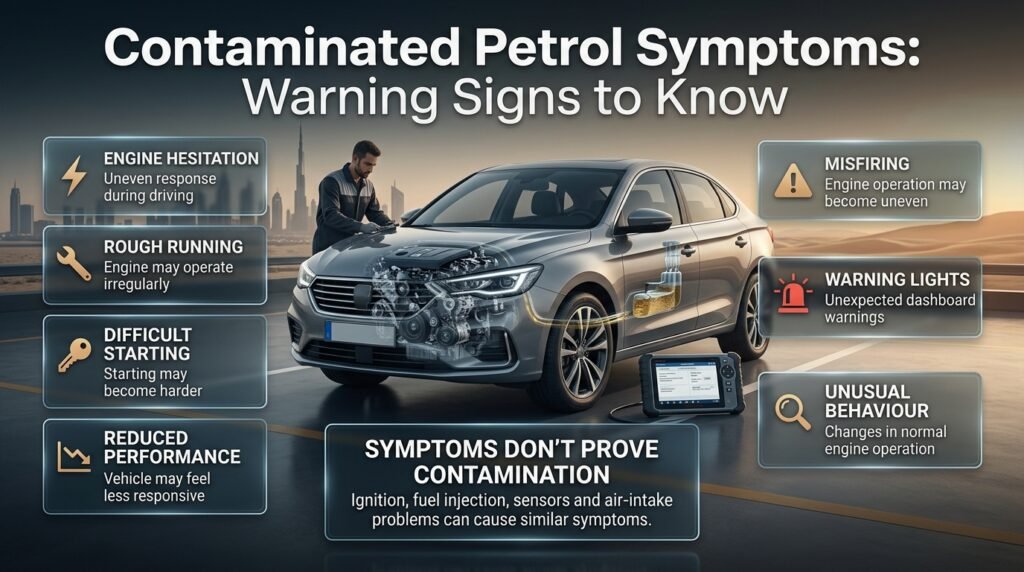
Possible symptoms can include:
- Engine hesitation
- Rough running
- Difficulty starting
- Reduced performance
- Misfiring
- Unexpected warning lights
- Unusual engine behaviour
However, none of these symptoms proves that petrol is contaminated.
A vehicle’s ignition, fuel injection, sensors, air intake, and other systems can cause similar problems.
That’s why diagnosis matters.
For a more focused explanation, see contaminated petrol symptoms.
What Problems Can Contaminated Diesel Cause?
Diesel fuel systems can be sensitive to contamination, especially water and particulate material.
Possible issues can involve:
- Poor engine performance
- Difficult starting
- Fuel-system wear
- Injector problems
- Reduced power
- Rough running
The actual consequences depend on the type and amount of contamination and the vehicle’s fuel system.
Fleet operators should take fuel storage and handling seriously.
A technical guide covering contaminated diesel causes can provide additional information.
How Can Drivers Improve Fuel Economy on Short Trips?
Short journeys can be demanding for a vehicle because the engine may have limited time to reach normal operating conditions.
If several short trips are combined into one planned journey, it may sometimes be possible to reduce unnecessary travel.
For example, instead of making separate trips to:
- A supermarket
- A pharmacy
- A bank
- A pickup point
a driver may be able to combine stops into a single route.
This doesn’t mean every trip should be combined. The point is simply to plan when practical.
Short-Trip Fuel Checklist
Before leaving:
- Combine practical stops.
- Check traffic.
- Choose an efficient route.
- Avoid unnecessary detours.
- Remove unnecessary cargo.
- Make sure tyres are correctly inflated.
Good planning can save both time and fuel.
How Can Drivers Save Fuel on Long-Distance Trips?
Long journeys require a different strategy.
Before leaving, check the vehicle and plan the route.
Before the Journey
Check:
- Tyre pressure
- Fuel level
- Engine condition
- Coolant
- Lights
- Wipers
- Essential fluids
- Route
- Traffic
- Rest stops
Avoid carrying unnecessary heavy items.
During the journey:
- Maintain a sensible speed.
- Accelerate smoothly.
- Watch traffic ahead.
- Avoid unnecessary braking.
- Use cruise control when suitable.
- Plan refuelling stops.
Don’t wait until the fuel gauge is critically low if the route has limited convenient refuelling options.
How Does Route Planning Help Fuel Efficiency?
Route planning can reduce unnecessary distance, congestion, and stop-and-go driving.
A shorter route isn’t always the most efficient route if it contains severe congestion.
For example:
Route A: 25 km with heavy stop-and-go traffic
Route B: 32 km with smoother highway movement
The longer route may sometimes take less time and provide more consistent driving.
The best choice depends on current traffic and road conditions.
This is why drivers should consider both distance and journey conditions.
How Does Vehicle Weight Affect Fuel Consumption?
The heavier a vehicle is, the more energy is required to accelerate it.
A small amount of extra weight may not produce a dramatic difference on a single trip, but unnecessary weight carried continuously doesn’t provide any benefit.
Examples can include:
- Unused equipment
- Heavy tools
- Sports equipment
- Boxes
- Materials left in the trunk
- Items carried “just in case”
Drivers should remove unnecessary items while keeping essential equipment.
Fleet operators should pay particular attention to vehicle loads because commercial vehicles can carry substantial weight.
Does Wheel Alignment Affect Fuel Economy?
Wheel alignment can influence how the tyres contact the road.
Poor alignment can contribute to:
- Uneven tyre wear
- Steering problems
- Vehicle pulling
- Increased rolling resistance in some circumstances
If the vehicle pulls to one side, the steering wheel isn’t centred when travelling straight, or tyres wear unevenly, an inspection may be appropriate.
Alignment isn’t simply a fuel-economy issue. It is also important for tyre life and vehicle behaviour.
What Should Drivers Know About Brake Drag?
A brake that doesn’t release correctly can create resistance.
Potential signs may include:
- Vehicle feeling less free than usual
- Unusual heat from a wheel
- Burning smell
- Uneven braking
- Reduced fuel economy
- Vehicle pulling
Brake problems should be treated as safety issues rather than fuel-economy problems.
If brake drag is suspected, professional inspection is appropriate.
How Should You Monitor Fuel Consumption?
One of the easiest ways to understand fuel economy is to track fuel purchased against distance travelled.
A simple record can include:
| Date | Odometer | Fuel Added | Distance | Notes |
|---|---|---|---|---|
| 1 | 25,000 km | 40 L | 420 km | Mixed driving |
| 2 | 25,450 km | 42 L | 450 km | Heavy traffic |
| 3 | 25,920 km | 36 L | 470 km | Highway |
This allows the driver to see trends rather than relying on memory.
One unusually high fuel bill doesn’t necessarily mean the vehicle has a problem.
Look for patterns over several refuelling cycles.
What Should Fleet Managers Monitor?
Fuel management becomes more important as vehicle numbers increase.
A fleet operator should ideally monitor:
- Fuel purchases
- Mileage
- Fuel consumption
- Vehicle type
- Route
- Driver behaviour
- Maintenance
- Idling
- Load
- Unusual changes
A sudden change in one vehicle’s consumption can be useful information.
For example, if ten similar vehicles average similar fuel consumption but one suddenly uses much more, investigate the difference.
Possible causes include:
- Mechanical problems
- Tyre pressure
- Driver behaviour
- Increased load
- Route changes
- Traffic
- Fuel-system problems
Data helps identify patterns before small issues become expensive ones.
How Can Fleet Drivers Reduce Unnecessary Fuel Use?
Fleet drivers should receive clear practical guidance rather than vague instructions such as “save fuel.”
Useful policies can include:
- Avoid unnecessary idling.
- Report warning lights.
- Check tyres.
- Follow maintenance schedules.
- Use the correct fuel.
- Report unusual vehicle behaviour.
- Avoid unnecessary acceleration.
- Follow planned routes.
- Record fuel purchases accurately.
Training should explain why these behaviours matter.
Drivers are more likely to follow a procedure when they understand the operational reason behind it.
What Should You Do If Your Car Runs Out of Fuel?
Running out of fuel can happen even to careful drivers.
The most important priority is safety.
If the vehicle stops because the tank is empty:
- Move to a safer location if possible.
- Activate hazard warning lights.
- Stay aware of surrounding traffic.
- Avoid standing in dangerous areas.
- Contact an appropriate roadside assistance or mobile fuel service.
- Provide your exact location.
- Tell the provider whether the vehicle uses petrol or diesel.
- Follow the provider’s instructions.
Don’t guess the fuel type.
If you are unsure whether the vehicle uses petrol or diesel, check the fuel cap, vehicle documentation, or manufacturer information where possible.
When Is Mobile Fuel Delivery Useful?
Mobile fuel delivery can be particularly useful when a vehicle cannot conveniently reach a fuel station.
Examples include:
- Empty fuel tank
- Vehicle stranded away from a convenient station
- Late-night fuel emergency
- Driver unable to leave the vehicle
- Fleet vehicle requiring urgent refuelling
- Unexpected fuel shortage during a journey
The service should be treated as an emergency convenience rather than a replacement for sensible fuel planning.
Drivers should still monitor the fuel gauge and plan refuelling stops.
What Should You Do After Accidentally Using the Wrong Fuel?
Misfuelling should be treated seriously.
If you realize that the wrong fuel has been added, don’t assume that driving away is harmless.
The appropriate response depends on:
- What fuel was added
- How much was added
- Whether the engine was started
- Whether the vehicle has been driven
- The vehicle’s fuel-system design
When possible, stop before starting the engine and obtain appropriate professional advice.
If the vehicle has already been driven, explain exactly what happened to the service provider or technician.
Accurate information helps them determine the appropriate next step.
What Are the Most Common Fuel-Efficiency Mistakes?
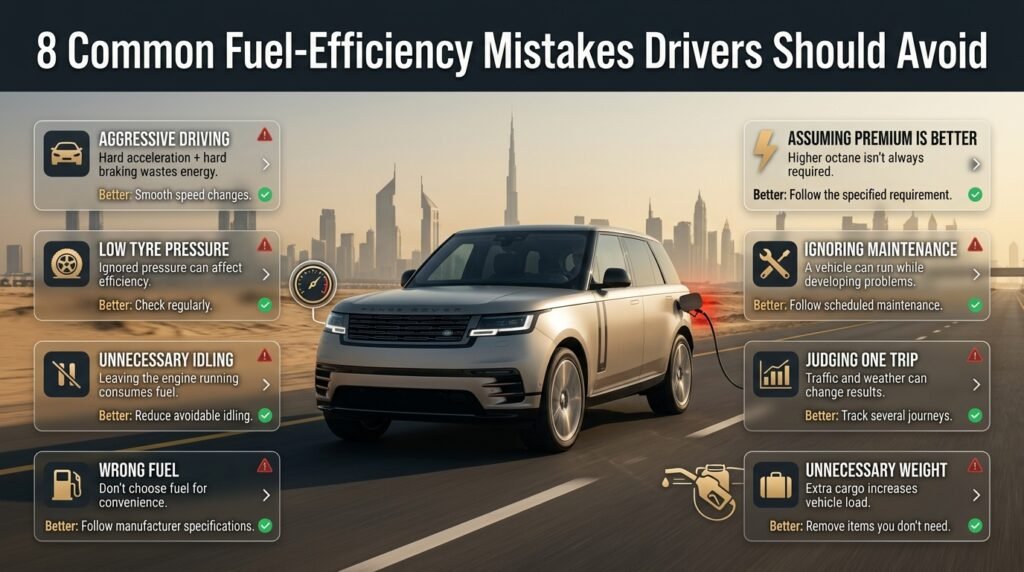
Mistake 1: Driving Aggressively
Hard acceleration followed by hard braking wastes energy.
Better approach: Anticipate traffic and maintain smoother speed changes.
Mistake 2: Ignoring Tyre Pressure
Drivers often don’t notice low pressure until it becomes obvious.
Better approach: Check pressure regularly.
Mistake 3: Leaving the Engine Running
Unnecessary idling consumes fuel.
Better approach: Reduce avoidable idling where safe and practical.
Mistake 4: Using the Wrong Fuel
Fuel type shouldn’t be selected based on convenience.
Better approach: Follow manufacturer specifications.
Mistake 5: Assuming Premium Fuel Is Always Better
Higher octane isn’t automatically required.
Better approach: Follow the specified octane requirement.
Mistake 6: Ignoring Maintenance
A vehicle can continue running while developing a problem.
Better approach: Follow scheduled maintenance and investigate persistent changes.
Mistake 7: Judging Fuel Economy From One Trip
Traffic and weather can change results.
Better approach: Track several journeys.
Mistake 8: Carrying Unnecessary Weight
Extra cargo increases the vehicle’s load.
Better approach: Remove items that aren’t needed.
What Are the Best Everyday Driving Habits in Dubai?
Drivers don’t need complicated techniques.
A practical daily routine can be as simple as:
Before driving
- Check the vehicle.
- Look at tyre condition.
- Confirm adequate fuel.
- Check warning lights.
While driving
- Accelerate smoothly.
- Maintain a safe distance.
- Anticipate traffic.
- Avoid unnecessary braking.
- Maintain sensible speeds.
After driving
- Pay attention to unusual sounds.
- Notice changes in fuel consumption.
- Don’t ignore warning lights.
- Schedule maintenance when required.
Small habits are easier to maintain than complicated fuel-saving programs.
How Can Drivers Balance Fuel Economy and Safety?
Fuel economy should never come before road safety.
For example, a driver shouldn’t:
- Drive below a safe traffic speed simply to save fuel.
- Avoid necessary air conditioning in dangerous heat.
- Delay tyre replacement when tyres are unsafe.
- Ignore brake problems.
- Continue driving with serious warning lights.
- Make risky manoeuvres to avoid traffic.
The best strategy is safe, predictable driving combined with sensible vehicle maintenance.
Fuel savings are valuable, but they are not worth creating a safety risk.
How Can I Reduce Fuel Consumption While Driving in Dubai?
Reducing fuel consumption in Dubai is less about one special trick and more about controlling the everyday factors that make your engine work harder. Traffic, frequent acceleration, heavy air-conditioning use, tyre pressure, unnecessary weight, high speeds and poor maintenance can all contribute to higher fuel use. UAE automotive guidance also highlights tyre condition, sensible driving and proper vehicle maintenance as important factors during extreme heat.
A practical approach is to focus first on the things you can actually control. Don’t accelerate hard only to brake a few seconds later. Look ahead in traffic, maintain a sensible following distance and make your speed changes gradually. On longer roads, maintaining a steady and appropriate speed is generally more useful than constantly changing speed.
You should also treat tyre pressure as part of normal fuel management, not just tyre maintenance. Under-inflated tyres increase rolling resistance, while incorrect pressure can also affect handling and tyre wear. Always use the vehicle manufacturer’s recommended pressure rather than trying to create your own “fuel-saving” tyre pressure.
Useful points:
Keep tyres at the manufacturer’s recommended pressure.
Avoid unnecessary hard acceleration and braking.
Reduce unnecessary idling.
Remove heavy items you don’t need.
Maintain the vehicle according to the manufacturer’s schedule.
Plan routes where practical to avoid unnecessary congestion.
Monitor fuel consumption over several refuelling cycles rather than judging one trip.
Does Dubai’s Hot Weather and Air Conditioning Increase Fuel Consumption?
Yes, but the important point is understanding why it happens rather than simply blaming the weather. Dubai’s extreme heat means drivers often depend on air conditioning for most of their journeys. The AC system places an additional load on a conventional engine, while very hot conditions can also affect tyres, cooling systems and other vehicle components. Recent UAE automotive guidance specifically recommends paying attention to tyres, AC and cooling-system condition during summer.
You shouldn’t avoid using air conditioning just to save fuel. In Dubai, keeping the cabin at a comfortable temperature is a practical part of driving. Instead, make the cooling process more efficient. Parking in shade where possible, using a sunshade and allowing excessive cabin heat to escape briefly before setting off can reduce the initial cooling burden. Recirculation can also help the system cool already-conditioned cabin air rather than continuously bringing in hot outside air.
The condition of the AC system matters as well. A weak or poorly maintained system may struggle to cool the cabin effectively, which can lead to longer or harder operation. If your AC suddenly becomes weaker, starts producing unusual smells or behaves differently from normal, it’s better to have it inspected instead of assuming that Dubai’s temperature is the only explanation.
Useful points:
Use AC when necessary; don’t compromise comfort or safety for small fuel savings.
Park in shade when practical.
Use a suitable sunshade.
Use recirculation when appropriate.
Keep the cabin air filter and AC system properly maintained.
Don’t leave the engine running unnecessarily just to keep an empty vehicle cool.
If cooling performance suddenly changes, have the system checked.
How Often Should I Check Tyre Pressure in Dubai’s Hot Climate?
Tyre pressure deserves more attention in Dubai because high temperatures and very hot road surfaces create demanding conditions for tyres. Heat causes the air inside a tyre to expand, so the pressure reading can be different when the tyre is hot compared with when it is cold. UAE automotive experts recommend checking pressure regularly and using the manufacturer’s recommended specification rather than adjusting it based on guesswork.
The key mistake is thinking that hot weather means you should deliberately put less air into the tyres. That’s not the right approach. The correct pressure is determined by the vehicle manufacturer and is normally found on the driver’s door-area label or in the owner’s manual.
For a driver who regularly travels on Dubai highways, checking pressure before longer journeys is particularly sensible. Don’t only inspect the four tyres visually. A tyre can be significantly underinflated without looking obviously flat.
Pressure isn’t only about fuel economy. Incorrect pressure can affect steering response, braking, tyre wear and road grip. In extreme cases, tyre damage or failure can become a serious safety concern.
Useful points:
Check tyre pressure when tyres are cold.
Follow the vehicle manufacturer’s recommended PSI/bar.
Don’t deliberately overinflate tyres to save fuel.
Don’t deliberately underinflate tyres because the weather is hot.
Check the spare tyre where applicable.
Look for cracks, bulges, uneven wear and tread damage.
If one tyre repeatedly loses pressure, have it inspected.
Which Fuel Should I Use in Dubai: 91, 95, 98 or Diesel?
The correct fuel isn’t necessarily the most expensive one. The right choice depends on the vehicle manufacturer’s specification. UAE fuel stations offer different petrol octane grades, including 91, 95 and 98, as well as diesel for diesel-powered vehicles. Fuel providers and automotive guidance emphasize checking the vehicle’s requirements rather than automatically selecting a higher-octane grade.
Octane rating is related to a petrol fuel’s resistance to knocking under specified test conditions. A higher number doesn’t simply mean the fuel contains more energy or that every engine will perform better with it.
For example, if your vehicle manufacturer specifies a minimum octane requirement, that’s the specification you should follow. Paying for a higher grade that your engine doesn’t require may simply increase your refuelling cost without delivering a meaningful benefit.
Diesel is different because diesel engines use a different combustion process from petrol engines. Petrol and diesel should never be treated as interchangeable fuels.
The best habit is very simple: check the owner’s manual, fuel-filler information or manufacturer guidance before deciding what to put into the tank.
Useful points:
Check the manufacturer’s fuel requirement first.
Don’t choose fuel only because it has the highest octane number.
Don’t assume premium petrol is automatically better.
Never treat petrol and diesel as interchangeable.
If you’re unsure about the correct fuel, verify it before refuelling.
If you accidentally add the wrong fuel, don’t simply continue driving without getting appropriate advice.
What Should I Do If My Car Runs Out of Fuel in Dubai?
Running out of fuel is usually a planning problem rather than a mechanical failure, but once it happens, the priority changes from fuel economy to roadside safety. A stranded vehicle can become dangerous if it stops in an unsuitable location, particularly on a busy road or highway.
If possible, move the vehicle to a safer position without creating additional risk. Switch on the hazard warning lights and remain aware of surrounding traffic. Don’t stand unnecessarily close to moving vehicles while waiting for assistance.
The next step is to arrange appropriate roadside help or mobile fuel delivery. When contacting a service, provide your location as accurately as possible and clearly state whether the vehicle requires petrol or diesel. If you’re uncertain about the fuel type, check the vehicle documentation or fuel-filler information rather than guessing.
This is also where sensible fuel planning makes a difference. Drivers who regularly travel long distances should avoid treating the last part of the fuel gauge as guaranteed extra driving range. Traffic congestion, detours, air-conditioning use and driving conditions can change how quickly fuel is consumed.
A good driver doesn’t need to keep the tank completely full at all times, but should understand the vehicle’s typical range and plan refuelling before the situation becomes urgent.
Useful points:
Prioritize your safety before dealing with the fuel problem.
Move to a safer location if it can be done safely.
Turn on hazard warning lights.
Give the fuel-delivery or roadside provider your exact location.
Confirm whether the vehicle needs petrol or diesel.
Don’t guess the fuel type.
Don’t rely blindly on the estimated remaining range.
Plan refuelling stops on long or unfamiliar journeys.
Conclusion
Dubai driving and fuel management become much easier when you focus on the factors you can actually control. Hot weather, heavy traffic, frequent air-conditioning use and long highway journeys can all affect fuel consumption, but good driving habits and proper vehicle care can make a noticeable difference.
The most practical approach is to use the correct fuel, maintain recommended tyre pressure, avoid unnecessary idling, drive smoothly, keep the vehicle properly serviced and monitor any unusual changes in performance or fuel consumption. These simple habits can help reduce unnecessary fuel use while supporting safer and more reliable driving.
For longer journeys, don’t wait until the fuel level is critically low. Plan refuelling stops in advance and know what to do if an unexpected fuel emergency occurs. If the vehicle runs out of fuel, prioritise roadside safety and arrange appropriate fuel assistance rather than taking unnecessary risks.
Ultimately, good Dubai driving and fuel insights come down to preparation, sensible driving and regular vehicle care. When these three areas are managed properly, drivers can make better fuel decisions, avoid common mistakes and keep everyday journeys more predictable and efficient.
Leave a Reply