Introduction
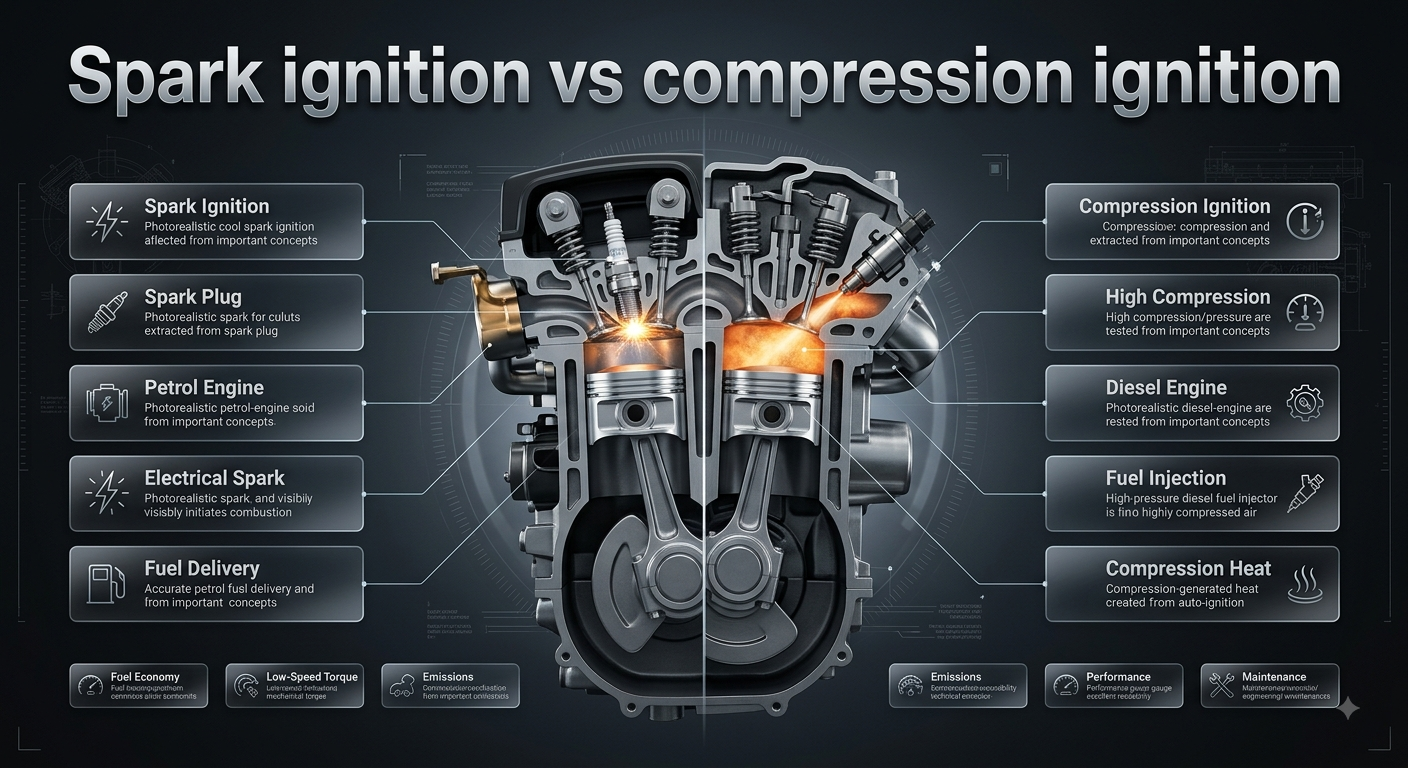
Spark ignition vs compression ignition | When people compare petrol and diesel engines, they usually look at fuel economy, power, mileage, or maintenance costs. But the most important difference actually starts inside the engine cylinder: how the fuel is ignited.
A petrol engine normally uses an electrical spark to start combustion, while a diesel engine relies on the heat created by highly compressed air. These two methods are known as spark ignition (SI) and compression ignition (CI).
Understanding spark ignition vs compression ignition makes it much easier to understand why petrol engines use spark plugs, why diesel engines use high compression ratios, why glow plugs are used in diesel engines, why diesel engines often produce strong low-speed torque, and why petrol and diesel engines have different fuel systems. For drivers who need convenient access to fuel in Dubai, Fuel Delivery Dubai can also be useful when refuelling at a station is not convenient.
The difference also affects fuel economy, engine design, emissions, performance, maintenance, and the type of driving each engine is best suited for.
In this detailed guide, we’ll compare spark ignition and compression ignition from the basics to more advanced concepts. You’ll learn how each system works, how combustion begins, how fuel is delivered, why compression ratio matters, the difference between spark plugs and glow plugs, which engine is more efficient, which produces more torque, and how to choose between petrol and diesel for real-world driving.
If you want to understand the bigger picture of automotive fuels first, you can also explore Fuel Fundamentals before going deeper into engine combustion.
What Is Spark Ignition?
Spark ignition is a combustion system in which an electrical spark from a spark plug starts the combustion process. Most conventional petrol engines use spark ignition.
In a spark ignition engine, air and fuel are prepared in a controlled way before combustion. Depending on the engine design, fuel may be injected into the intake port or directly into the combustion chamber.
The piston then compresses the charge.
Near the end of the compression stroke, the spark plug produces a high-voltage electrical spark. That spark creates a small initial flame, which develops into combustion throughout the prepared mixture.
The burning fuel releases chemical energy as heat. This rapidly increases cylinder pressure, forcing the piston downward.
The piston is connected to the crankshaft through the connecting rod, so the piston’s movement is converted into rotational movement that ultimately powers the vehicle.
The basic spark ignition process
Air + Fuel
     ↓
Mixture Preparation
     ↓
Compression
     ↓
Spark Plug
     ↓
Ignition
     ↓
Combustion
     ↓
Cylinder Pressure Rises
     ↓
Piston Moves Down
     ↓
Crankshaft Rotation
The spark itself isn’t what produces the engine’s mechanical power. Its job is to initiate the combustion event at the correct moment.
This timing is extremely important.
If the spark occurs too early or too late, combustion may not produce pressure at the ideal point in the engine cycle. This can reduce performance, increase emissions, increase fuel consumption, or contribute to knocking and other combustion problems.
Modern petrol engines therefore use electronic control systems to determine ignition timing very precisely.
What Is Compression Ignition?
Compression ignition is a combustion system in which fuel ignites because it is injected into sufficiently hot compressed air. Conventional diesel engines are the most common example.
The combustion process begins differently from a petrol engine.
A conventional diesel engine draws primarily air into the cylinder during the intake stroke. The piston then compresses this air to a much higher pressure than is normally used in a conventional petrol engine.
As the air is compressed, its temperature rises significantly.
Near the end of the compression stroke, diesel fuel is injected into the hot compressed air through a high-pressure fuel injector.
The fuel is atomized into small droplets, mixes with oxygen in the cylinder, and begins to ignite when the local temperature and chemical conditions are suitable.
There is normally no spark plug initiating this combustion.
The basic compression ignition process
Air
 ↓
High Compression
 ↓
Air Temperature Rises
 ↓
High-Pressure Diesel Injection
 ↓
Fuel Atomization
 ↓
Fuel-Air Mixing
 ↓
Auto-Ignition
 ↓
Combustion
 ↓
Power Stroke
This is why a conventional diesel engine is called a compression ignition engine.
For a detailed look at what happens inside a diesel cylinder, see Diesel Engine Combustion Process.
Spark Ignition vs Compression Ignition: What Is the Main Difference?
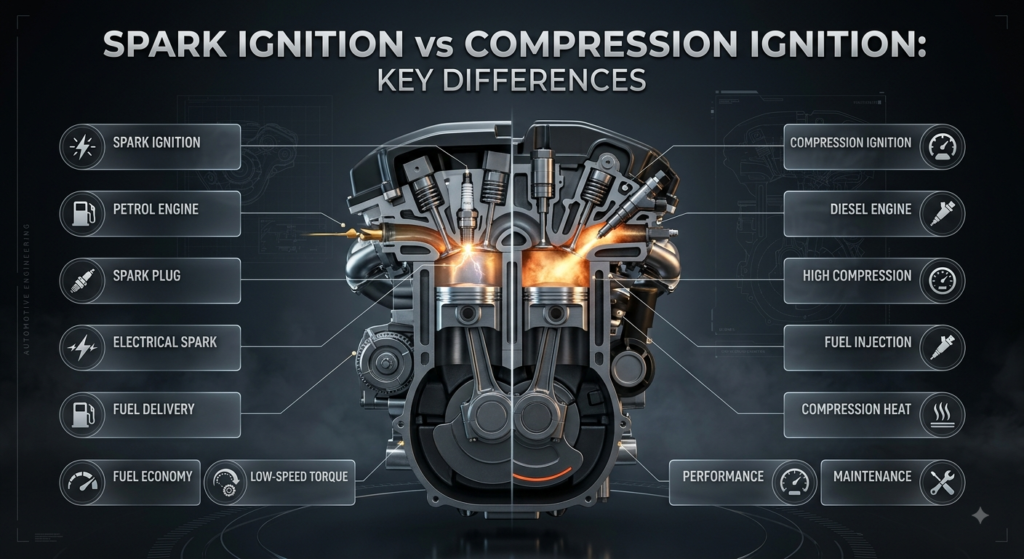
The fundamental difference is how combustion starts.
A spark ignition engine uses a spark plug to initiate combustion. A compression ignition engine creates high-temperature compressed air and then injects fuel into that environment so the fuel can ignite.
| Feature | Spark Ignition | Compression Ignition |
|---|---|---|
| Common fuel | Petrol/gasoline | Diesel |
| Common engine | Petrol engine | Diesel engine |
| Ignition source | Electrical spark | Heat from compressed air |
| Main component | Spark plug | Fuel injector |
| Compression ratio | Generally lower | Generally higher |
| Fuel preparation | Air-fuel charge | Air first, fuel injected later |
| Cold-start aid | Normally no glow plug | Glow plugs may assist |
| Typical torque | Strong response, often higher RPM | Strong low-speed torque |
| Conventional efficiency | Generally lower | Generally higher |
| Common applications | Cars, motorcycles, performance vehicles | Trucks, buses, machinery |
| Fuel quality concern | Octane/knock resistance | Ignition quality/cetane |
This comparison gives you the basic answer, but there’s much more to understand.
The two systems use different combustion strategies, fuel properties, compression ratios, injection systems, and engine control methods.
How Does a Spark Ignition Engine Work?
A conventional four-stroke spark ignition engine operates through four basic strokes:
- Intake
- Compression
- Power
- Exhaust
Each stroke has a specific purpose.
1. Intake Stroke
During the intake stroke, the piston moves downward while the intake valve is open.
Air enters the cylinder.
In older or simpler petrol engines, fuel and air may be mixed before entering the cylinder.
Modern petrol engines commonly use electronic fuel injection. Depending on the design, fuel may be injected into the intake port or directly into the combustion chamber.
The engine control unit determines how much fuel is needed based on operating conditions.
2. Compression Stroke
After the intake stroke, the intake valve closes.
The piston moves upward and compresses the air-fuel charge.
Compression increases the pressure and temperature of the mixture.
The engine control system then determines the appropriate ignition point.
The spark plug fires at a carefully calculated moment.
It usually isn’t simply a matter of firing the spark exactly when the piston reaches the top of its travel. Combustion takes time to develop, so ignition timing is adjusted to produce useful pressure at the appropriate point in the cycle.
3. Power Stroke
The spark initiates combustion.
The flame spreads through the mixture and releases energy.
Cylinder pressure rises sharply.
The expanding gases push the piston downward.
This is the stroke that delivers useful mechanical work.
4. Exhaust Stroke
After the power stroke, the exhaust valve opens.
The piston moves upward and pushes the burned gases out of the cylinder.
The cycle then repeats.
For a more detailed explanation of petrol combustion, see Petrol Engine Combustion Process.
How Does a Compression Ignition Engine Work?
A diesel engine can also operate on a four-stroke cycle, but its combustion process is different.
1. Intake Stroke
The piston moves downward and the intake valve opens.
Air enters the cylinder.
Unlike a conventional petrol engine, the cylinder generally receives mostly air rather than a fully prepared air-fuel mixture.
2. Compression Stroke
The intake valve closes.
The piston moves upward.
The trapped air is compressed strongly.
Because the compression ratio is high, the air temperature rises substantially.
This hot compressed air provides the conditions needed for diesel fuel ignition.
3. Fuel Injection and Combustion
Near the end of the compression stroke, the fuel injector sprays diesel fuel into the hot compressed air.
The fuel breaks into tiny droplets.
Those droplets vaporize and mix with the surrounding air.
Under suitable conditions, combustion begins without a spark.
Cylinder pressure rises.
The expanding gases force the piston downward.
4. Exhaust Stroke
The exhaust valve opens.
The piston moves upward and pushes combustion gases out of the cylinder.
The cycle then repeats.
The four-stroke layout may therefore look familiar in both petrol and diesel engines, but the combustion preparation and ignition process are fundamentally different.
Why Does a Petrol Engine Need a Spark Plug?
A petrol engine needs a spark plug because conventional petrol combustion is designed around controlled spark ignition.
The spark plug produces a precisely timed electrical spark inside the combustion chamber.
That spark provides the initial energy required to start combustion.
The engine control system determines when the spark should occur based on information such as:
- Engine speed
- Engine load
- Engine temperature
- Throttle position
- Intake pressure
- Fuel characteristics
- Knock detection
- Crankshaft position
- Camshaft position
The spark plug must also operate in an extremely demanding environment.
Inside the combustion chamber, it is exposed to high temperatures, high pressures, and repeated combustion cycles.
A worn or damaged spark plug can cause:
- Misfires
- Rough idle
- Difficult starting
- Reduced acceleration
- Poor fuel economy
- Increased emissions
However, spark plugs aren’t always the only possible cause of these symptoms.
Ignition coils, injectors, sensors, compression, air leaks, and other components can also cause similar problems.
Pro Tip: Don’t replace spark plugs blindly whenever an engine misfires. A professional diagnosis should identify whether the problem is actually related to the plug, ignition coil, fuel system, air supply, or engine compression.
Why Doesn’t a Diesel Engine Need a Spark Plug?
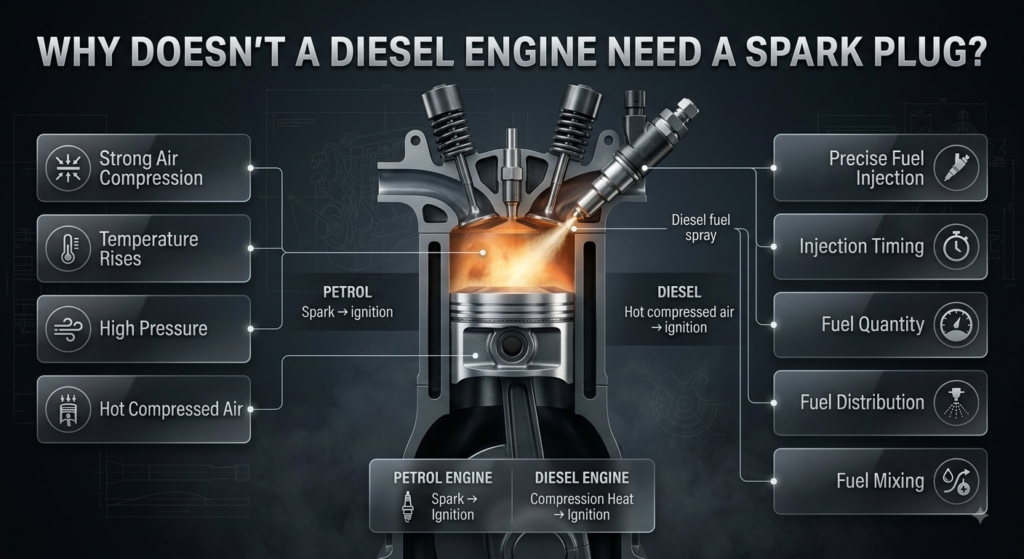
A conventional diesel engine doesn’t need a spark plug for normal combustion because the engine creates the ignition conditions through compression.
The piston compresses air strongly.
The compression process raises the air temperature.
Diesel fuel is then injected into that hot air.
If the temperature, pressure, fuel properties, and mixing conditions are suitable, the fuel begins to ignite.
The important idea is:
Petrol engine: create an ignition spark.
Diesel engine: create hot compressed air.
The diesel injector therefore becomes one of the most important components in the combustion process.
The injector determines when fuel enters the cylinder, how much fuel is delivered, and how the fuel is distributed within the combustion chamber.
This means that diesel engines still require extremely precise combustion control even though they don’t use spark plugs.
Spark Plug vs Glow Plug: What’s the Difference?
One of the most common misconceptions about diesel engines is that glow plugs are simply “diesel spark plugs.”
They aren’t.
A spark plug creates an electrical spark.
A glow plug is essentially a controlled heating element.
Spark plug
A spark plug:
- Produces a spark
- Initiates combustion
- Is normally used in petrol engines
- Operates as part of the normal ignition process
Glow plug
A glow plug:
- Produces heat
- Helps diesel engines start when cold
- Supports suitable combustion conditions
- Doesn’t create the normal ignition spark
When a diesel engine is cold, the compressed air may not reach the ideal temperature quickly enough for easy ignition.
Glow plugs help overcome this problem by heating the combustion environment.
Once the engine is operating normally, the primary ignition mechanism remains compression ignition.
Common Mistake: Saying “diesel engines use glow plugs instead of spark plugs” is an oversimplification. Glow plugs assist starting; they aren’t the component responsible for normal spark-style ignition.
Why Do Diesel Engines Use Higher Compression Ratios?
Compression ratio is one of the most important differences between traditional petrol and diesel engines.
A diesel engine needs high compression because it relies on compressed air becoming hot enough to support fuel ignition.
When air is compressed into a smaller volume, its pressure and temperature increase.
The engine takes advantage of this physical effect.
A higher compression ratio can contribute to better thermal efficiency, but it also increases mechanical demands.
Diesel engine components may therefore be designed to handle substantial cylinder pressures.
This can require:
- Strong pistons
- Strong connecting rods
- Robust crankshafts
- Durable cylinder blocks
- Strong bearings
- High-pressure fuel systems
However, it would be incorrect to say that high compression is automatically better.
Engine designers must balance:
- Efficiency
- Durability
- Combustion noise
- Emissions
- Mechanical stress
- Weight
- Manufacturing cost
Expert Tip: Compression ratio and compression ignition are not the same thing. Compression ratio describes an engine’s geometry, while compression ignition describes its method of initiating combustion.
Spark Ignition vs Compression Ignition Fuel Systems
The fuel delivery system is another major difference.
Modern petrol engines can use either port fuel injection or direct fuel injection.
Port Fuel Injection
With port injection, fuel is introduced into the intake port before entering the combustion chamber.
The fuel mixes with incoming air before the mixture enters the cylinder.
Direct Fuel Injection
With direct injection, fuel is injected directly into the combustion chamber.
This allows the engine to control the timing and location of fuel delivery more precisely.
Direct injection can support efficiency and performance improvements, although it also introduces additional design and emissions considerations.
Diesel Fuel Injection
Diesel engines generally rely on high-pressure fuel injection.
The injector must deliver a carefully controlled amount of fuel into the hot compressed air.
Modern common-rail systems can operate at extremely high fuel pressures and perform multiple injection events within a single engine cycle.
These may include:
- Pilot injection
- Main injection
- Post injection
The purpose of multiple injection events can include:
- Smoother combustion
- Reduced combustion noise
- Better fuel efficiency
- Improved emissions control
- Better exhaust after-treatment performance
For a broader understanding of different automotive fuels, see Types of Automotive Fuel.
Why Is Diesel Fuel Injected at High Pressure?
High-pressure injection helps diesel fuel break into very small droplets.
Smaller droplets provide more surface area for interaction with hot compressed air.
This improves fuel-air mixing and gives the engine better control over combustion.
The injector must deliver fuel with extremely precise timing.
Even small changes in injection behavior can affect:
- Engine noise
- Fuel economy
- Smoke
- Emissions
- Power
- Starting
- Combustion stability
A damaged or dirty diesel injector can therefore cause serious drivability problems.
Possible symptoms include:
- Rough idle
- Poor acceleration
- Difficult starting
- Increased fuel consumption
- Excessive smoke
- Engine vibration
- Reduced power
This is one reason fuel quality and proper diesel fuel-system maintenance are so important.
How Does Fuel Type Affect Ignition?
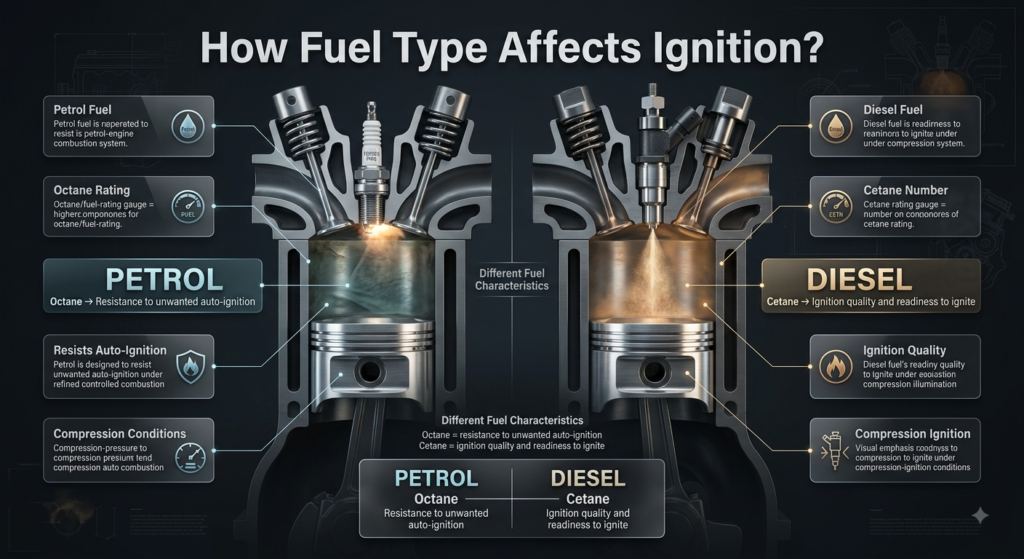
Petrol and diesel fuels are designed with different combustion characteristics.
Petrol needs to resist unwanted auto-ignition under compression.
This is why petrol fuel is commonly described using octane rating.
Diesel fuel, on the other hand, needs to ignite readily under compression ignition conditions.
Its ignition quality is commonly associated with cetane number.
The two concepts are therefore almost opposite in purpose.
Petrol
Octane → resistance to unwanted auto-ignition
Diesel
Cetane → ignition quality and readiness to ignite
This is an important distinction because people sometimes assume octane and cetane are simply two versions of the same rating.
They aren’t.
They measure different fuel characteristics for different combustion systems.
For a deeper comparison of petrol and diesel fuels, see Petrol and Diesel Fuel Types.
What Is Octane Rating?
Octane rating is primarily relevant to spark ignition engines.
It describes a fuel’s resistance to knock under standardized test conditions.
Knock is an abnormal combustion phenomenon where part of the unburned mixture can auto-ignite in an uncontrolled way.
Modern engines use technologies such as knock sensors and electronic ignition control to manage this risk.
High-compression and turbocharged petrol engines can be more sensitive to knock because of their combustion conditions.
This is one reason some manufacturers specify higher-octane petrol for particular engines.
However, higher octane doesn’t automatically mean more power or more energy.
The correct fuel is the fuel specification recommended by the manufacturer.
For a detailed explanation of regular and premium petrol, see Regular vs Premium Petrol Octane.
Is Compression Ignition More Fuel Efficient?
Compression ignition engines generally have an efficiency advantage over comparable conventional spark ignition engines.
There are several reasons.
One important factor is the higher compression ratio commonly used in diesel engines.
Another is the way diesel engines control engine load and combustion.
A diesel engine can operate with excess air across many conditions rather than always maintaining the same type of air-fuel mixture used in a conventional petrol engine.
This can reduce certain pumping losses and contribute to higher efficiency.
However, saying “diesel always gives better mileage” is too simplistic.
Real-world fuel economy depends on many factors:
- Engine size
- Vehicle weight
- Aerodynamics
- Transmission
- Tire pressure
- Driving style
- Traffic
- Road conditions
- Vehicle load
- Engine temperature
- Maintenance
- Hybrid technology
For example, a petrol hybrid can be extremely efficient in city driving.
So compression ignition generally offers an efficiency advantage, but the complete powertrain determines real-world fuel consumption.
Which Engine Produces More Torque?
Diesel engines are traditionally known for producing strong torque at relatively low engine speeds.
This makes them particularly useful for applications where the engine needs to move heavy loads.
Examples include:
- Pickup trucks
- Heavy-duty trucks
- Buses
- Agricultural machinery
- Construction equipment
- Commercial vehicles
- Generators
However, it would be incorrect to say that every diesel engine produces more torque than every petrol engine.
Modern turbocharged petrol engines can generate impressive torque.
The more useful distinction is often where the engine produces its torque and how it delivers it.
A diesel engine commonly provides strong pulling force at lower RPM.
A petrol engine may provide strong power over a broader or higher RPM range.
Torque vs Power: What’s the Difference?
Torque and power aren’t the same thing.
Torque is rotational force.
Power describes the rate at which work can be performed.
A simplified relationship is:
Power = Torque × Engine Speed
This explains why an engine can have strong torque at low RPM without necessarily having the highest peak power.
Imagine a diesel vehicle pulling a heavy trailer.
Strong low-speed torque helps the vehicle accelerate from low speeds without requiring extremely high engine RPM.
Now imagine a performance petrol engine operating at high RPM.
It may produce substantial power because it combines useful torque with high rotational speed.
Both characteristics are valuable, but they serve different purposes.
Why Are Diesel Engines Often Better for Heavy Loads?
Diesel engines are commonly used for heavy-duty applications because their combustion characteristics, torque delivery, and efficiency are well suited to sustained load.
A heavy vehicle doesn’t simply need peak horsepower.
It needs an engine capable of repeatedly producing useful torque without excessive fuel consumption.
Diesel engines are often designed specifically for this environment.
They can combine:
- High compression ratios
- Turbocharging
- Strong internal components
- High-pressure injection
- Strong low-speed torque
- Efficient combustion
This combination makes compression ignition particularly valuable in commercial transportation and industrial equipment.
However, the engine isn’t the only factor.
Transmission gearing, cooling capacity, brakes, axle ratings, chassis strength, and the manufacturer’s towing rating are all important.
Expert Tip: Never determine a vehicle’s towing capability simply by looking at engine torque. Always check the official towing and payload specifications.
Which Is Better for City Driving?
For many drivers who mostly make short urban trips, a petrol engine can be a practical choice.
Petrol engines generally offer:
- Smooth operation
- Easy cold starting
- Good throttle response
- Quiet operation
- Strong suitability for passenger cars
Diesel engines can absolutely be used in cities, but modern diesel emissions systems add another consideration.
Many diesel vehicles use diesel particulate filters and other emissions-control systems.
These systems may require suitable operating conditions to manage accumulated soot.
If a vehicle is used almost exclusively for very short trips, it may not operate in the conditions the manufacturer intended for efficient emissions-system management.
This doesn’t mean every city driver should avoid diesel.
It means driving pattern should be considered before choosing an engine.
Which Is Better for Highway Driving?

Diesel engines can be particularly effective for long-distance highway driving.
Their efficiency and low-speed torque can make them well suited to sustained operation.
This is especially valuable for commercial vehicles covering large distances.
Petrol engines can also perform very well on highways.
Modern petrol engines can use:
- Turbocharging
- Direct injection
- Efficient transmissions
- Variable valve timing
- Cylinder deactivation
- Hybrid assistance
These technologies can significantly improve highway efficiency.
Therefore, the best choice depends on the specific vehicle rather than fuel type alone.
Spark Ignition vs Compression Ignition for Towing
If towing is a major part of vehicle use, compression ignition often has an advantage.
Diesel engines are commonly designed to produce substantial low-speed torque and maintain efficiency under load.
This makes them popular in towing vehicles and commercial applications.
However, towing performance depends on more than the engine.
Before selecting a vehicle for towing, consider:
- Maximum towing rating
- Payload capacity
- Transmission
- Cooling system
- Braking system
- Axle ratings
- Gear ratios
- Trailer weight
- Vehicle weight
A powerful engine cannot compensate for a vehicle that isn’t structurally or mechanically rated for a particular trailer.
What Is Ignition Timing in a Spark Ignition Engine?
Ignition timing refers to the point in the engine cycle at which the spark plug fires.
This is one of the most important parameters in spark ignition combustion.
If the spark occurs too early, combustion pressure can develop before the piston reaches the ideal point.
If the spark occurs too late, the combustion gases may not deliver pressure efficiently during the power stroke.
Incorrect ignition timing can contribute to:
- Reduced power
- Increased fuel consumption
- Higher emissions
- Engine knock
- Excessive heat
- Poor drivability
Modern engine control units adjust ignition timing continuously.
They use sensor information to determine the most appropriate timing for current operating conditions.
What Controls Combustion Timing in a Diesel Engine?
A diesel engine doesn’t use spark timing to control ignition.
Instead, fuel injection timing is one of the most important combustion-control parameters.
The engine control unit determines:
- When injection begins
- How much fuel is injected
- Injection pressure
- Number of injection events
- Duration of each injection
- Relationship between injection and crankshaft position
This allows modern diesel engines to control combustion much more precisely than older mechanical systems.
Injection timing can influence:
- Power
- Fuel economy
- Noise
- Smoke
- NOx emissions
- Exhaust temperature
This is why a modern diesel engine’s injector system is such a critical part of the entire combustion process.
What Is Ignition Delay in a Diesel Engine?
Ignition delay is the time between the beginning of fuel injection and the beginning of combustion.
This delay is important because diesel fuel doesn’t necessarily burn the instant it leaves the injector.
Several processes occur first:
- Fuel is injected.
- Fuel droplets break apart.
- Droplets vaporize.
- Fuel mixes with air.
- Chemical reactions begin.
- Combustion starts.
The length of this delay depends on conditions such as:
- Air temperature
- Air pressure
- Fuel temperature
- Fuel properties
- Injection pressure
- Injection timing
- Engine speed
If a large amount of fuel accumulates during the delay period and then burns rapidly, cylinder pressure can rise quickly.
That can contribute to diesel combustion noise.
Modern engines reduce this problem through precise injection strategies, including pilot injection.
Why Are Diesel Engines Sometimes Louder?
Traditional diesel engines were often noticeably louder than petrol engines.
One reason is the way combustion pressure develops.
During diesel combustion, fuel injection and ignition can create rapid pressure increases, particularly when a larger amount of fuel burns quickly after ignition delay.
Modern diesel technology has dramatically improved this situation.
Manufacturers use:
- Multiple fuel injections
- Pilot injection
- High-pressure common-rail systems
- Improved injectors
- Better combustion chamber designs
- Electronic control
- Improved engine mounting
As a result, modern diesel passenger cars can be remarkably quiet.
Still, the fundamental combustion characteristics of diesel and petrol engines remain different.
Spark Ignition vs Compression Ignition and Engine Emissions
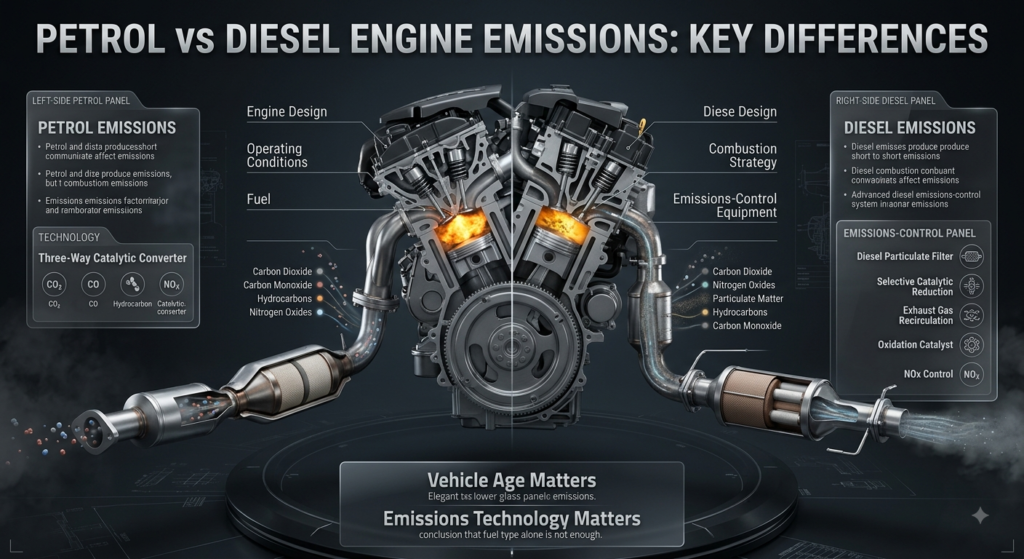
Both engine types produce emissions.
The exact emission profile depends on engine design, operating conditions, fuel, combustion strategy, and emissions-control equipment.
Petrol engines can produce:
- Carbon dioxide
- Carbon monoxide
- Hydrocarbons
- Nitrogen oxides
Diesel engines can produce:
- Carbon dioxide
- Nitrogen oxides
- Particulate matter
- Hydrocarbons
- Carbon monoxide
Modern engines use sophisticated systems to control these emissions.
Petrol vehicles may use three-way catalytic converters.
Diesel vehicles can use combinations of:
- Diesel particulate filters
- Selective catalytic reduction
- Exhaust gas recirculation
- Oxidation catalysts
- NOx control systems
Therefore, comparing petrol and diesel emissions simply by looking at the fuel type isn’t enough.
Vehicle age and emissions technology matter enormously.
What Is the Role of the Diesel Particulate Filter?
A diesel particulate filter, commonly called a DPF, is designed to capture particulate matter from diesel exhaust.
Over time, soot accumulates in the filter.
The vehicle’s emissions-control system must manage this accumulated material through a process generally known as regeneration.
Operating conditions can influence how effectively this system works.
This is one reason modern diesel vehicles can be less ideal for drivers who only make very short journeys.
However, the exact behavior depends on the vehicle and its control strategy.
Always follow the manufacturer’s recommendations regarding DPF operation and maintenance.
Can a Diesel Engine Use Spark Ignition?
A conventional diesel engine isn’t designed to rely on spark ignition.
Simply installing spark plugs doesn’t convert a diesel engine into a petrol engine.
The entire engine has been designed around compression ignition, including:
- Compression ratio
- Combustion chamber shape
- Injector design
- Piston design
- Fuel characteristics
- Injection strategy
- Engine control software
Specialized engines can combine different combustion strategies, but that’s very different from simply adding spark plugs to a normal diesel engine.
The important lesson is that ignition type is part of the entire engine architecture.
Can a Petrol Engine Use Compression Ignition?
Specialized petrol engines and advanced combustion systems can use forms of controlled auto-ignition or compression-ignition-like combustion.
However, conventional petrol engines are designed around spark ignition.
Petrol fuel is generally formulated to resist uncontrolled auto-ignition, which is exactly why octane rating matters.
Engine designers can use advanced technologies to control combustion more precisely, but a standard petrol engine shouldn’t be thought of as a compression ignition engine.
Advantages of Spark Ignition Engines
Spark ignition engines offer several important advantages.
Smooth Operation
Petrol engines are often known for smooth operation, particularly during idle and light-load conditions.
Strong High-Speed Performance
Spark ignition engines can operate effectively at relatively high RPM.
This makes them particularly attractive for performance applications.
Responsive Acceleration
Many petrol engines offer quick throttle response.
Turbocharging can further improve low- and mid-range torque.
Easy Cold Starting
Petrol engines generally don’t need glow plugs to establish their normal ignition process.
Wide Range of Applications
Spark ignition engines are used in:
- Passenger cars
- Motorcycles
- Sports cars
- Small engines
- Hybrid vehicles
- Performance applications
Disadvantages of Spark Ignition Engines
Spark ignition technology also has limitations.
Lower Conventional Thermal Efficiency
Comparable conventional petrol engines generally achieve lower thermal efficiency than diesel engines.
Knock Limitations
Increasing compression ratio can increase the risk of knock, particularly under high load.
Fuel Economy Under Heavy Load
Petrol engines can consume significantly more fuel when operating under heavy loads or high power demands.
Ignition Components
Spark plugs, ignition coils, and associated systems require maintenance and can fail.
Advantages of Compression Ignition Engines
Compression ignition engines are particularly useful when efficiency and load handling are important.
High Thermal Efficiency
Diesel engines generally convert a larger portion of fuel energy into useful mechanical work.
Strong Low-Speed Torque
This makes them excellent for towing and heavy loads.
Long-Distance Efficiency
Diesel engines can be very efficient during sustained highway operation.
Heavy-Duty Applications
They are widely used in:
- Trucks
- Buses
- Construction equipment
- Agricultural machinery
- Generators
- Marine applications
Durability
Many diesel engines are built with robust components designed for long operating hours and demanding loads.
Disadvantages of Compression Ignition Engines
Diesel engines also have trade-offs.
More Complex Fuel Systems
Modern diesel injection systems operate at very high pressures and require precise control.
Expensive Components
Injectors, high-pressure pumps, turbochargers, and emissions systems can be expensive to repair.
Emissions-System Complexity
Modern diesel engines may use several systems to control particulate matter and nitrogen oxides.
Short-Trip Considerations
Some diesel emissions-control systems can be less suited to vehicles that are used almost exclusively for very short trips.
Greater Mechanical Stress
High compression and cylinder pressures can require stronger components.8
Spark Ignition vs Compression Ignition: Which Is Better?

There is no universal winner.
The better system depends on how you use the vehicle.
Spark ignition may be better suited to:
- Short trips
- Urban driving
- Light-duty applications
- High-RPM performance
- Smooth passenger-car operation
- Many hybrid applications
Compression ignition may be better suited to:
- Long-distance driving
- Heavy loads
- Towing
- Commercial transportation
- Highway use
- High annual mileage
- Applications where low-speed torque matters
This doesn’t mean every petrol vehicle is better for cities or every diesel is better for highways.
Modern engine technology has blurred some traditional differences.
The correct approach is to compare the specific vehicle, engine, transmission, fuel requirements, maintenance costs, and driving pattern.
How Should You Choose Between Petrol and Diesel?
If you’re choosing a vehicle, don’t start by asking which fuel is better.
Start by asking how you actually drive.
Question 1: How Long Are Your Typical Trips?
If most journeys are very short, a petrol engine may be more practical.
If you regularly drive long distances, diesel becomes more attractive.
Question 2: Do You Carry Heavy Loads?
If the answer is yes, the low-speed torque and efficiency of a diesel engine may be valuable.
Question 3: How Many Kilometers Do You Drive?
High annual mileage can make diesel fuel economy more valuable.
For low annual mileage, the additional complexity and purchase cost of a diesel may not always make sense.
Question 4: Do You Tow?
If towing is frequent, look carefully at the diesel options, but always compare official towing ratings.
Question 5: What Does the Manufacturer Recommend?
The manufacturer’s specification should always be your starting point.
Don’t choose fuel based solely on assumptions.
Common Mistakes About Spark Ignition and Compression Ignition
Mistake 1: “Diesel Engines Don’t Have Ignition Systems”
Diesel engines absolutely have a controlled combustion-initiation system.
They simply don’t use a conventional spark plug.
Fuel injection timing and compression are central to ignition.
How to avoid the mistake
Remember:
SI controls ignition with a spark.
CI creates ignition conditions through compression and fuel injection.
Mistake 2: “Glow Plugs Ignite Diesel Fuel Like Spark Plugs”
This is one of the most common misunderstandings.
Glow plugs primarily assist cold starting.
They don’t normally provide the spark-like ignition source during normal diesel operation.
How to avoid it
Think:
Spark plug = spark
Glow plug = heat
Mistake 3: “Diesel Is Always More Powerful”
Power and torque are different.
Diesel engines often produce strong low-speed torque, but a petrol engine can produce higher peak power depending on its design.
How to avoid it
Compare the complete torque and power curves rather than focusing on one number.
Mistake 4: “Higher Compression Always Means a Better Engine”
Higher compression can improve efficiency, but it also increases mechanical and combustion challenges.
How to avoid it
Engine design is always a balance between efficiency, performance, emissions, durability, and cost.
Mistake 5: “Premium Petrol Always Gives Better Performance”
Higher-octane fuel isn’t automatically beneficial for every engine.
If the engine is designed for regular petrol, using premium fuel may not produce a noticeable performance improvement.
How to avoid it
Follow the manufacturer’s recommended octane rating.
Mistake 6: “Diesel Is Better for Every Driver”
Diesel can be excellent for long-distance and heavy-duty use.
But someone who drives only short city trips may have different requirements.
How to avoid it
Match the engine to your actual driving pattern.
Mistake 7: “Petrol Engines Can’t Produce Strong Torque”
Modern turbocharged petrol engines can produce substantial torque.
Engine technology has changed significantly.
How to avoid it
Compare specific engines rather than relying on old petrol-versus-diesel stereotypes.
Expert Advice for Maintaining Spark Ignition Engines
If you own a petrol engine, pay attention to the entire ignition and fuel system.
Important maintenance areas include:
- Spark plugs
- Ignition coils
- Fuel injectors
- Air filters
- Oxygen sensors
- Engine oil
- Cooling system
- Intake system
A petrol engine that develops a recurring misfire should be diagnosed rather than ignored.
Continued misfiring can affect performance and may also damage emissions-control components.
Always use the correct spark plug specification.
Different engines may require different plug designs, heat ranges, electrode materials, and gaps.
Expert Advice for Maintaining Compression Ignition Engines
Diesel engines require equally careful maintenance.
Pay particular attention to:
- Fuel quality
- Fuel filters
- Injectors
- High-pressure fuel system
- Engine oil
- Turbocharger
- Air filter
- DPF
- EGR system
- AdBlue/SCR system where fitted
Using contaminated fuel can damage high-pressure injection components.
Fuel filters are particularly important because modern diesel injectors operate under extremely demanding conditions.
If a diesel engine develops poor starting, excessive smoke, rough operation, or reduced power, don’t assume the problem is simply the fuel.
Professional diagnosis may be needed.
Why Fuel Quality Matters in Both Engine Types
Fuel quality is important regardless of ignition type.
For petrol engines, fuel characteristics influence:
- Knock resistance
- Combustion quality
- Injector performance
- Deposits
For diesel engines, fuel quality can affect:
- Injector wear
- Pump lubrication
- Combustion quality
- Filter performance
- Water contamination
- Deposits
This is why using the correct fuel specification is an essential part of engine care.
For a broader overview of vehicle fuel choices, visit FuelDeliveryDubai.
Spark Ignition vs Compression Ignition: A Practical Example
Imagine two drivers.
Driver A
Driver A drives about 8 kilometers to work every day.
Most of the journey is through city traffic.
The vehicle rarely carries heavy loads.
Smooth operation and simple everyday driving are priorities.
A petrol spark ignition engine may be a sensible choice.
Driver B
Driver B drives 100 kilometers every day.
Most driving is on highways.
The vehicle regularly carries heavy equipment.
Fuel economy and low-speed pulling power are important.
A diesel compression ignition engine may be better suited.
The important point is that neither engine is universally superior.
The application determines the better choice.
Why Modern Engines Are Harder to Compare
Older petrol and diesel engines were relatively easy to distinguish.
Petrol engines were generally:
- Lower compression
- Spark ignition
- Smoother
- Higher-revving
Diesel engines were generally:
- High compression
- Compression ignition
- Torque-focused
- More economical
Modern engines have changed this picture.
Today, petrol engines can use:
- Turbocharging
- Direct injection
- Variable valve timing
- Cylinder deactivation
- Advanced knock control
- Hybrid assistance
Modern diesel engines can use:
- High-pressure common rail
- Multiple injection
- Variable geometry turbochargers
- EGR
- DPF
- SCR
- Advanced electronic control
As a result, there is more overlap between the performance and efficiency characteristics of the two technologies.
But their fundamental ignition principles remain different.
Spark Ignition vs Compression Ignition: Quick Decision Table
| Your Priority | More Commonly Suited Engine |
|---|---|
| Short urban trips | Spark ignition |
| Long highway journeys | Compression ignition |
| Heavy towing | Compression ignition |
| High-RPM performance | Spark ignition |
| Smooth petrol-car operation | Spark ignition |
| Heavy commercial use | Compression ignition |
| Strong low-speed torque | Compression ignition |
| Many short trips | Spark ignition |
| High annual highway mileage | Compression ignition |
| Hybrid passenger vehicle | Often spark ignition |
Again, this is a general guide, not a universal rule.
Specific vehicle technology can change the result.
What Is the Main Difference Between Spark Ignition and Compression Ignition?
The main difference is how combustion begins inside the cylinder. A spark ignition engine uses an electrical spark from a spark plug to start combustion, while a compression ignition engine compresses air to a high temperature and then injects fuel into that hot compressed air so it can ignite. Conventional petrol engines are typically SI, while conventional diesel engines are CI.
In a spark ignition engine, the engine prepares an air-fuel charge and then controls the exact moment of ignition using the spark plug. This gives the engine precise control over when combustion begins. In a compression ignition engine, the engine first compresses air strongly. Fuel is injected near the end of the compression stroke, and ignition begins because of the temperature created by compression.
Key points to remember:
SI engine: Spark plug starts combustion.
CI engine: Hot compressed air provides the conditions for ignition.
Petrol engines: Commonly use SI.
Diesel engines: Commonly use CI.
SI depends heavily on ignition timing.
CI depends heavily on compression, injection timing, fuel properties, and air-fuel mixing.
The difference is more important than simply saying “petrol uses a spark and diesel doesn’t.” It affects the entire engine design, including compression ratio, fuel injection system, combustion chamber, internal components, efficiency, emissions, and typical applications.
Professional insight: Think of SI and CI as two different combustion strategies rather than simply two different fuel types. The fuel and ignition method have been developed together, which is why petrol and diesel engines aren’t interchangeable just by changing the fuel.
Why Is a Compression Ignition Engine More Fuel Efficient Than a Spark Ignition Engine?
Compression ignition engines are generally more thermally efficient than comparable conventional spark ignition engines. Their efficiency advantage comes from several factors, including higher compression ratios, lean combustion, and reduced throttling losses. The National Academies identifies these as major reasons for the efficiency advantage of conventional CI diesel engines over SI gasoline engines.
A diesel engine compresses air to a high pressure before injecting fuel. This allows the engine to operate at a higher compression ratio than a conventional petrol engine. The compression process increases the temperature of the air, creating the conditions needed for diesel fuel to ignite.
Another important factor is that a diesel engine can operate with a relatively lean air-fuel mixture over many operating conditions. This allows it to avoid some of the intake throttling losses associated with conventional petrol engines.
Diesel fuel also contains more energy per unit of volume than petrol, which can contribute to lower volumetric fuel consumption.
Why CI engines can be more efficient:
Higher compression ratio
Leaner combustion operation
Reduced intake throttling losses
Efficient fuel injection
Strong low-speed torque
Higher energy content per unit volume of diesel fuel
However, “diesel is always more economical” isn’t a professional conclusion.
Modern turbocharged petrol engines, hybrids, advanced transmissions, vehicle weight, aerodynamics, driving conditions, and traffic can significantly change real-world fuel consumption.
Expert Tip: Compare complete vehicles rather than judging efficiency from engine type alone. A modern petrol hybrid may outperform an older diesel in real-world city driving, while a well-designed diesel can remain extremely efficient during long-distance highway use.
Why Do Diesel Engines Have Higher Compression Ratios Than Petrol Engines?
Diesel engines use higher compression ratios because compression is part of their ignition system. The piston compresses air strongly, increasing its pressure and temperature. Diesel fuel is then injected into this hot compressed air, allowing combustion to begin without a conventional spark plug.
A conventional petrol engine works differently. It generally compresses an air-fuel charge and then uses a spark plug to initiate combustion. If the compression ratio becomes too high for the fuel and operating conditions, unwanted auto-ignition can occur, producing knock.
Diesel engines don’t have the same requirement to compress a premixed air-fuel charge before ignition. They typically compress air first and inject fuel later, close to the end of the compression stroke.
This gives the diesel engine greater freedom to use a high compression ratio.
Higher compression helps a diesel engine by:
Raising compressed-air temperature
Supporting fuel auto-ignition
Improving thermal efficiency
Supporting strong cylinder pressures
Contributing to efficient combustion
But there is a trade-off.
Higher compression and cylinder pressure place greater mechanical demands on components such as the pistons, connecting rods, crankshaft, bearings, and cylinder block. That’s one reason diesel engines are often built more robustly than comparable petrol engines.
Common Mistake: Don’t assume that “higher compression ratio = automatically better engine.” Compression ratio is only one part of engine design. Engineers have to balance efficiency with durability, combustion noise, emissions, cost, and performance.
Why Do Diesel Engines Produce More Torque Than Petrol Engines?
Diesel engines are well known for producing strong torque at relatively low engine speeds, but saying that every diesel produces more torque than every petrol engine would be inaccurate. Torque depends on engine displacement, turbocharging, cylinder pressure, gearing, engine speed, and the specific design of the powertrain.
One important reason diesel engines are associated with strong torque is their combustion strategy.
The high compression ratio and high cylinder pressures used in diesel engines can produce substantial force on the piston. Turbocharging also allows modern diesel engines to push a large amount of air into the cylinders, supporting higher fuel delivery and strong torque output.
Diesel engines are also commonly designed around lower operating speeds and heavy-load applications.
That’s why they’re so common in:
Trucks
Buses
Pickup vehicles
Construction equipment
Agricultural machinery
Commercial vehicles
Generators
Why low-speed torque matters
Imagine a truck starting from a standstill while carrying several tons of cargo.
The engine needs substantial pulling force at low vehicle speed.
A diesel’s strong low-RPM torque makes this type of work easier and allows the transmission to keep the engine within an effective operating range.
A petrol engine, on the other hand, can be designed to operate at higher RPM and may produce excellent peak power. Modern turbocharged petrol engines can also produce impressive torque, so the old idea that “petrol means low torque and diesel means high torque” is too simplistic.
Professional advice: When comparing two vehicles, don’t look only at peak torque. Look at the torque curve, RPM range, transmission gearing, vehicle weight, and intended use. Those factors tell you much more about how the vehicle will actually feel on the road.
Which Is Better: Spark Ignition or Compression Ignition?
Neither spark ignition nor compression ignition is universally better. The right choice depends on how the vehicle will be used, how far it will travel, how much load it will carry, and what type of performance the driver needs.
Spark ignition is commonly a strong choice for passenger vehicles, urban driving, short trips, and applications where smooth operation and responsive high-RPM performance are important.
Compression ignition is particularly attractive for long-distance driving, heavy loads, commercial transportation, and applications where fuel efficiency and strong low-speed torque are priorities.
Spark ignition may be the better choice when you need:
Smooth everyday operation
Frequent short trips
Urban driving
High-RPM performance
Strong throttle response
A simpler conventional fuel and ignition system
Compression ignition may be the better choice when you need:
Strong low-speed torque
Frequent long-distance driving
Heavy-load operation
Towing capability
High annual mileage
Strong conventional fuel efficiency
Modern engine technology makes the decision more complicated than it used to be. Turbocharged petrol engines can now deliver strong torque, while modern diesel engines use sophisticated injection and emissions-control systems to improve refinement and emissions performance.
So the best question isn’t:
“Is petrol better than diesel?”
It’s:
“Which engine type matches my driving conditions and vehicle requirements?”
Expert Tip: If most of your driving consists of short city journeys, don’t automatically buy a diesel just because it has better fuel economy on paper. If you regularly drive long distances, tow loads, or cover high annual mileage, the advantages of a modern diesel may become much more valuable.
Quick Expert Summary
Question
Professional Answer
What separates SI and CI?
SI uses a spark to initiate combustion; CI relies on the heat of compressed air and injected fuel.
Why is CI generally more efficient?
Higher compression, lean operation, reduced throttling losses, and diesel’s higher energy per volume contribute to the advantage.
Why does CI use higher compression?
High compression raises air temperature enough to support diesel fuel ignition.
Why is diesel associated with high torque?
High cylinder pressure, turbocharging, engine design, and low-RPM operation contribute to strong torque delivery.
Which is better?
It depends on driving pattern, load, mileage, performance needs, and the specific vehicle.
Conclusion
Understanding spark ignition vs compression ignition is essential for knowing how petrol and diesel engines actually produce power. Although both engines convert fuel energy into mechanical movement, they begin combustion in very different ways. A spark ignition (SI) engine uses a spark plug to initiate combustion, while a compression ignition (CI) engine compresses air to a high temperature and then injects fuel so it can ignite without a conventional spark.
This fundamental difference affects almost every part of engine operation. SI engines are generally associated with petrol, smooth operation, quick response, and strong performance at higher engine speeds. CI engines, commonly used with diesel fuel, are known for higher compression ratios, strong low-speed torque, and generally better thermal efficiency.
Neither system is automatically better for every situation. The right choice depends on how the vehicle is used. Petrol spark ignition engines can be a practical option for short trips, urban driving, and everyday passenger vehicles, while diesel compression ignition engines can be particularly useful for long-distance driving, heavy loads, towing, and high-mileage applications.
The most important thing is to look beyond simple petrol-versus-diesel comparisons. Engine design, fuel quality, driving conditions, maintenance, emissions technology, transmission, and vehicle weight all influence real-world performance.
In simple terms:
- Spark ignition → spark plug starts combustion.
- Compression ignition → compressed air creates the heat needed for ignition.
- SI → commonly petrol engines.
- CI → commonly diesel engines.
- SI often favors smoothness and high-RPM performance.
- CI often favors efficiency, durability, and low-speed torque.
Once you understand this core difference, it becomes much easier to understand petrol and diesel fuel types, combustion processes, fuel injection, compression ratios, engine efficiency, and real-world vehicle performance. The best engine isn’t the one with the better reputation—it’s the one that matches your driving needs, operating conditions, and manufacturer’s specifications.
Leave a Reply