
Introduction
Dubai Travel Fuel Planning | Planning a journey in Dubai is not just about choosing a destination and checking the fastest route. Drivers also need to consider petrol expenses, traffic conditions, vehicle efficiency, journey distance and unexpected changes that may affect their travel budget. A journey that looks inexpensive initially can become more costly when additional stops, congestion and return travel are included.
This is why Dubai Travel Fuel Planning is important for motorists who want to manage their driving expenses and prepare properly before leaving. Whether you’re commuting to work, travelling between emirates, organising a family road trip or driving long distances, understanding your petrol requirements can help you avoid unnecessary interruptions.
A reliable travel plan starts with realistic fuel calculations and an understanding of your vehicle’s performance. It also considers the type of roads you’ll use, the time you expect to spend driving and the availability of refuelling options.
At Fuel Delivery Dubai, motorists can also explore petrol delivery assistance when arranging fuel becomes inconvenient.
In this complete guide, you’ll learn how to calculate petrol requirements, estimate journey costs, prepare a monthly fuel budget, manage unexpected travel situations and make more informed decisions before starting your next journey.
1. What Is Dubai Travel Fuel Planning?
Dubai travel fuel planning is the process of estimating how much petrol your vehicle needs for a particular journey and preparing an appropriate budget before departure. It involves calculating distance, checking vehicle fuel efficiency, understanding petrol prices and considering the road conditions that may influence consumption.
A proper plan covers more than the distance between two locations. It considers the complete journey, including the return trip, additional driving, possible diversions and a reasonable fuel reserve.
Why Is Travel Fuel Planning Important?
Dubai has a combination of busy urban roads, residential streets, expressways and long-distance highways. Each environment can affect how much petrol a vehicle consumes.
For example, a driver travelling 100 kilometres through congested city roads may experience different fuel consumption from someone covering the same distance on a relatively clear highway.
Fuel planning helps motorists:
- Estimate journey expenses before departure.
- Understand how much petrol they need.
- Avoid unnecessary refuelling interruptions.
- Prepare for longer journeys.
- Manage monthly driving budgets.
- Account for unexpected traffic delays.
- Identify suitable refuelling opportunities.
- Reduce avoidable fuel consumption.
Professional Tip: Don’t calculate your travel budget using distance alone. Your vehicle’s actual fuel efficiency and the conditions of your journey are equally important.
Who Needs a Travel Fuel Plan?
Fuel planning is useful for different types of motorists, including:
- Daily commuters travelling between home and work.
- Families planning weekend outings.
- Tourists exploring Dubai and other emirates.
- Business professionals attending multiple appointments.
- Drivers covering long distances regularly.
- Motorists travelling through unfamiliar areas.
Even a short journey becomes easier to manage when you understand its expected fuel requirements.
2. How to Calculate Petrol Requirements Before Travelling
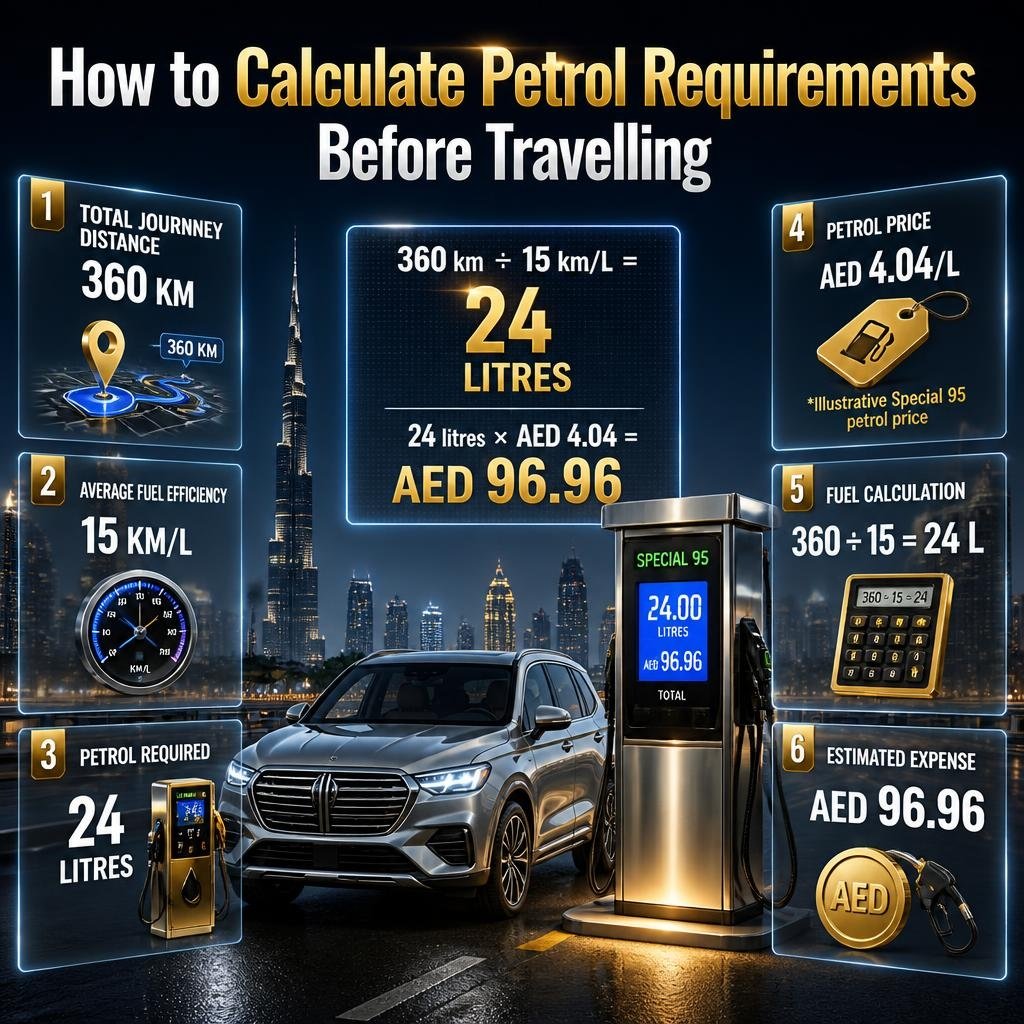
The most practical way to calculate petrol requirements is to divide the total journey distance by your vehicle’s average fuel efficiency. The result tells you approximately how many litres you’ll need.
Before calculating, collect three important details:
- Total journey distance.
- Average vehicle fuel consumption.
- Petrol price per litre for the recommended fuel grade.
The Basic Fuel Calculation Formula
If your vehicle displays fuel efficiency in kilometres per litre, use:
\[ \text{Fuel Required}=\frac{\text{Total Distance}}{\text{Average km/L}} \]
For example, suppose you’re planning a 360-kilometre journey and your vehicle averages 15 kilometres per litre.
\[ 360\div15=24\text{ litres} \]
Your vehicle would require approximately 24 litres under the assumed driving conditions.
How to Calculate the Total Petrol Expense
Once you know the required litres, multiply them by the petrol price.
\[ \text{Fuel Expense}=\text{Required Litres}\times\text{Price Per Litre} \]
For an illustrative calculation using Special 95 at AED 4.04 per litre:
\[ 24\times4.04=\text{AED }96.96 \]
Example: 360 km travel fuel calculation
Total distance
360 km
Average efficiency
15 km/L
Petrol required
24 litres
Estimated expense
AED 96.96
Illustrative calculation. Actual petrol consumption depends on vehicle condition, traffic, driving behaviour and road conditions.
What If Your Vehicle Displays L/100 km?
Some vehicles display fuel consumption in litres per 100 kilometres instead of kilometres per litre.
In this situation, use:
\[ \text{Fuel Required}=\frac{\text{Distance}\times\text{Consumption}}{100} \]
For example, a vehicle consuming 8 litres per 100 kilometres will require:
\[ (360\times8)\div100=28.8\text{ litres} \]
At AED 4.04 per litre, the estimated expense would be AED 116.35.
Why Should You Calculate the Return Journey?
One of the most common planning mistakes is calculating petrol for the outward journey only.
Suppose your destination is 160 kilometres from Dubai. Your return journey will add another 160 kilometres, even before considering local driving.
| Journey component | Distance |
|---|---|
| Outward journey | 160 km |
| Return journey | 160 km |
| Local driving | 30 km |
| Complete journey | 350 km |
At an average of 14 km/L, the estimated petrol requirement is 25 litres.
Always calculate the complete travel distance rather than preparing a budget for only one direction.
3. Understanding Petrol Grades and Their Impact on Travel Budgets
Petrol grade is an important consideration when estimating journey expenses. Different vehicles require different octane ratings, and motorists should follow the manufacturer’s recommendation rather than selecting fuel entirely on price.
The three commonly available petrol grades in the UAE are E-Plus 91, Special 95 and Super 98.
Which Petrol Grade Should You Choose?
| Petrol grade | General guidance |
|---|---|
| E-Plus 91 | For vehicles approved for 91 octane |
| Special 95 | For vehicles requiring or accepting 95 octane |
| Super 98 | For vehicles requiring or recommending 98 octane |
The correct choice depends on the engine design and manufacturer’s specifications.
Using a higher-octane petrol than required does not automatically improve fuel economy. Similarly, using a lower grade than recommended may cause engine performance problems in vehicles that require higher octane fuel.
How Do Petrol Prices Affect Travel Expenses?
Petrol prices are reviewed monthly in the UAE. Therefore, your travel budget should use the latest confirmed price rather than figures from an older calculation.
Consider a journey requiring 35 litres of petrol.
| Petrol grade | Illustrative price | Estimated expense |
|---|---|---|
| E-Plus 91 | AED 3.97/L | AED 138.95 |
| Special 95 | AED 4.04/L | AED 141.40 |
| Super 98 | AED 4.16/L | AED 145.60 |
These are illustrative November 2026 price calculations. The figures should be updated when monthly petrol prices change.
Expert Tip: A small difference in the price per litre may look insignificant, but repeated journeys can make it noticeable in your monthly budget. Always calculate expenses using the grade your vehicle actually requires.
4. Planning Fuel for Different Types of Dubai Journeys
Different journeys require different fuel calculations. A short city trip, regular commute and long-distance road trip should not all be planned using the same assumptions.
A. Short-Distance City Travel
City travel generally involves residential roads, traffic signals, shopping areas and frequent stops.
Even when the total distance is relatively small, fuel consumption can increase because of repeated acceleration and braking.
Example:
- Daily distance: 35 km.
- Average efficiency: 12 km/L.
- Daily fuel requirement: 2.92 litres.
- Illustrative petrol price: AED 4.04/L.
- Estimated daily expense: AED 11.78.
For 26 similar driving days, the estimated expense would be approximately AED 306.28.
The actual amount may vary depending on congestion and additional journeys.
B. Daily Commuting

Daily commuting can represent a major part of household fuel expenses.
Drivers should calculate the distance from home to work and back, then multiply it by the number of working days.
| Detail | Example |
|---|---|
| One-way distance | 22 km |
| Daily return distance | 44 km |
| Working days | 26 |
| Monthly distance | 1,144 km |
| Average efficiency | 14 km/L |
| Monthly fuel requirement | 81.71 litres |
| Estimated expense at AED 4.04/L | AED 330.11 |
This calculation provides a useful starting point for preparing a commuting budget.
For broader guidance on Dubai road conditions, everyday driving and fuel efficiency, explore Dubai Driving and Fuel Insights.
C. Highway Travel
Highway journeys often involve longer periods of continuous driving. When traffic is flowing smoothly, vehicles may achieve better fuel efficiency than during frequent city stops.
However, driving speed, vehicle load, air-conditioning demand and road conditions still affect consumption.
Before leaving, consider:
- Total highway distance.
- Expected traffic conditions.
- Suitable legal driving speed.
- Fuel availability along the route.
- Return journey requirements.
- Planned rest stops.
Drivers preparing for longer highway journeys can find additional practical guidance in Dubai Highway Driving.
D. Weekend and Family Road Trips
Family road trips often involve additional driving that isn’t included in the original route.
A family might travel to a destination, visit nearby attractions, stop for meals and then return to Dubai.
| Travel activity | Example distance |
|---|---|
| Outward journey | 130 km |
| Local sightseeing | 40 km |
| Additional stops | 20 km |
| Return journey | 130 km |
| Total distance | 320 km |
At 12 km/L, the vehicle would require approximately 26.67 litres.
At AED 4.04 per litre, the estimated expense would be AED 107.75.
For additional ideas and preparation advice, read Dubai Road Trips.
E. Intercity Travel
Intercity journeys need more careful preparation because motorists may travel through unfamiliar roads and spend longer periods away from their usual driving environment.
Before travelling, check the complete route, petrol requirements, return distance and suitable refuelling locations.
Don’t assume that the destination will have a convenient refuelling option immediately nearby.
Our Dubai Intercity Travel guide provides additional context for preparing journeys between emirates.
5. How Dubai Traffic Affects Fuel Consumption
Traffic conditions are among the most important factors to consider when preparing a travel fuel budget.
A vehicle moving through congestion may consume more petrol than the same vehicle travelling at a steady speed on a clear road.
Why Does Heavy Traffic Increase Petrol Consumption?
Stop-and-go driving requires repeated acceleration and braking. The engine must repeatedly respond to changes in vehicle speed, while extended idling can consume petrol without covering additional distance.
Fuel consumption may be affected by:
- Frequent stopping.
- Repeated acceleration.
- Extended waiting periods.
- Slow-moving traffic.
- Unnecessary lane changes.
- Congestion-related diversions.
For example, a journey that normally takes 30 minutes might take considerably longer during heavy traffic. The extra driving time can affect consumption, particularly if the vehicle spends extended periods idling.
How Should You Adjust Your Fuel Estimate?
Prepare two estimates rather than assuming ideal conditions.
| Planning scenario | Calculation approach |
|---|---|
| Normal conditions | Use your usual average consumption |
| Less favourable conditions | Allow for additional consumption based on similar past journeys |
There is no fixed percentage that accurately predicts extra petrol requirements for every vehicle.
A compact car, large SUV and hybrid vehicle may respond differently to the same traffic conditions.
Pro Tip: Use your own fuel-consumption records from similar routes. They provide a more useful estimate than a general assumption about how much traffic increases petrol consumption.
What Should You Check Before Departure?
- Review the current traffic situation.
- Compare alternative routes.
- Identify major congestion areas.
- Consider a more suitable departure time.
- Avoid unnecessary detours.
- Keep sufficient fuel for unexpected delays.
6. How to Plan Fuel for Long-Distance Travel From Dubai
Long-distance journeys require a more complete preparation strategy than everyday city driving.
The objective is to make sure that your vehicle has sufficient petrol for the planned distance while maintaining flexibility if your route or travel schedule changes.
Step 1: Calculate the Complete Distance
Include the outward journey, return journey and expected local driving.
For example, a destination 250 kilometres away may require 500 kilometres of driving for a return trip, before accounting for additional travel.
Step 2: Check Actual Fuel Efficiency
Use the average consumption recorded by your vehicle over comparable journeys.
Don’t automatically assume that your car will achieve its best advertised fuel economy.
Step 3: Estimate the Petrol Requirement
Suppose your complete journey is 550 kilometres and your vehicle averages 13 km/L.
\[ 550\div13=42.31\text{ litres} \]
Your estimated requirement is approximately 42.31 litres.
Step 4: Compare With Tank Capacity
If your vehicle has a 60-litre tank, compare the estimated requirement with the available petrol already inside it.
Remember that the tank’s total capacity and the amount of petrol currently available are different things.
Step 5: Identify Refuelling Opportunities
Check suitable petrol stations along the planned route.
Consider the distance between refuelling opportunities and avoid depending on a single station when travelling through unfamiliar areas.
Step 6: Keep an Appropriate Reserve
A practical reserve helps when traffic increases, a diversion becomes necessary or additional driving is required.
The amount should reflect your vehicle’s consumption and the availability of petrol stations rather than an arbitrary figure.
For further preparation advice, visit Dubai Long-Distance Driving.
7. How to Select a Fuel-Efficient Travel Route

The shortest route isn’t always the most economical route.
A slightly longer road with smoother traffic may sometimes produce more predictable fuel consumption than a shorter route involving congestion and repeated stopping.
What Should You Compare?
| Factor | Importance |
|---|---|
| Total distance | Determines basic fuel requirements |
| Traffic conditions | Affect driving time and consumption |
| Road type | Different roads create different driving patterns |
| Speed restrictions | Help determine appropriate driving speed |
| Diversions | Can increase total distance |
| Petrol availability | Supports refuelling preparation |
Example: Shorter Route Versus Smoother Route
Suppose two available routes lead to the same destination.
- Route A: 32 km through congested roads.
- Route B: 37 km with smoother traffic.
Route B covers more kilometres, but it may provide a more predictable journey. Whether it uses less petrol depends on the vehicle and actual traffic conditions.
How to Use Navigation Tools Properly
Before departure:
- Enter the correct destination.
- Review alternative routes.
- Check estimated travel times.
- Look for major traffic delays.
- Identify suitable refuelling locations.
- Recheck conditions when necessary.
Avoid repeatedly changing routes because of small estimated time savings. Unnecessary detours may increase distance and make fuel consumption harder to predict.
8. How Vehicle Type and Fuel Efficiency Affect Travel Expenses
Your vehicle’s fuel efficiency has a direct influence on your travel budget. Two motorists travelling the same distance may spend considerably different amounts because their vehicles consume different quantities of petrol.
A smaller vehicle may require fewer litres, while a heavier SUV or performance vehicle may consume more under comparable conditions.
Understanding Different Fuel-Efficiency Measurements
There are two common ways to measure vehicle fuel economy:
- Kilometres per litre (km/L): A higher figure generally indicates better fuel efficiency.
- Litres per 100 kilometres (L/100 km): A lower figure generally indicates better fuel efficiency.
For example:
| Average efficiency | Petrol needed for 300 km |
|---|---|
| 10 km/L | 30 litres |
| 12 km/L | 25 litres |
| 14 km/L | 21.43 litres |
| 16 km/L | 18.75 litres |
| 18 km/L | 16.67 litres |
This comparison shows why checking your vehicle’s actual fuel consumption is important before calculating journey expenses.
How Do Different Vehicle Categories Compare?
Small cars: Often require less petrol because of their lower weight and relatively smaller engines.
Sedans: Their consumption depends on engine size, vehicle weight, transmission and driving conditions.
SUVs: Larger vehicles may consume more petrol because of additional weight, size and engine requirements.
Hybrid vehicles: Can reduce petrol consumption in suitable conditions by combining an electric motor with a petrol engine.
Performance vehicles: May consume more petrol depending on engine design and how the vehicle is driven.
These are general observations rather than fixed rules. A modern, efficient SUV may consume less petrol than an older sedan with poor maintenance.
Why Should You Monitor Real-World Fuel Efficiency?
Manufacturer fuel-economy figures are useful when comparing vehicles, but they don’t guarantee the same results during everyday driving.
Actual consumption may change because of:
- Vehicle age and condition.
- Engine maintenance.
- Tyre pressure.
- Air-conditioning use.
- Passenger and luggage weight.
- Driving speed.
- Traffic conditions.
- Road gradients.
For more reliable travel estimates, use the average fuel consumption recorded by your own vehicle.
9. How Air Conditioning Affects Fuel Consumption in Dubai
Air conditioning is an important part of comfortable driving in Dubai, particularly during hot weather. However, operating the cooling system requires energy and can increase petrol consumption in conventional vehicles.
Does Car AC Increase Petrol Consumption?
Yes. In petrol vehicles, the air-conditioning compressor can increase engine workload. The actual effect depends on the vehicle’s design, outside temperature, cooling demand and driving conditions.
The effect may be more noticeable when:
- The cabin becomes extremely hot.
- The vehicle is stationary with AC operating.
- The cooling system runs continuously.
- Traffic conditions cause prolonged idling.
- The engine is already operating under heavy load.
How Can Drivers Manage AC Use?
You don’t need to avoid air conditioning to manage petrol expenses. Instead, use the system sensibly.
- Allow hot air to escape before starting your journey when safe.
- Choose a comfortable temperature rather than an unnecessarily low setting.
- Use cabin recirculation appropriately.
- Keep windows closed when using AC at normal highway speeds.
- Maintain the cooling system.
- Replace cabin filters according to the manufacturer’s maintenance schedule.
Professional Advice: Don’t compromise your comfort or concentration in Dubai’s heat just to save a small amount of petrol. A properly functioning air-conditioning system is important for comfortable driving.
10. How Tyre Pressure and Vehicle Maintenance Influence Fuel Planning
Vehicle maintenance is directly connected to fuel consumption. A vehicle with maintenance problems may consume more petrol than expected, making your original travel budget less accurate.
Tyre pressure, engine oil, air filters, wheel alignment and brake condition are among the factors worth checking before longer journeys.
Why Does Tyre Pressure Matter?
Underinflated tyres increase rolling resistance. This means the engine may need to work harder to move the vehicle.
Before departure:
- Check tyre pressure when tyres are cold.
- Follow the manufacturer’s recommended pressure.
- Inspect the tyres for visible damage.
- Check for uneven wear.
- Confirm that the spare tyre is suitable for use.
Avoid overinflating tyres in an attempt to improve fuel economy.
Important Vehicle Maintenance Checks
| Component | Why it matters |
|---|---|
| Engine oil | Supports lubrication and reduces internal friction |
| Air filter | Helps maintain proper airflow |
| Spark plugs | Support effective petrol-engine combustion |
| Tyres | Influence rolling resistance and handling |
| Wheel alignment | Helps prevent uneven tyre wear |
| Coolant | Supports engine temperature management |
| Brakes | Prevents unnecessary resistance from sticking components |
What Should You Inspect Before Long-Distance Travel?
Use this practical checklist:
- Check engine oil level.
- Inspect coolant when the engine is cold.
- Check tyre pressure and condition.
- Test headlights and indicators.
- Inspect windscreen wipers.
- Check brake operation.
- Review dashboard warning lights.
- Confirm that the fuel gauge is functioning properly.
Expert Tip: Don’t wait until the morning of a long journey to address a maintenance warning. An unresolved mechanical problem can affect vehicle performance, safety and fuel consumption.
11. How Much Petrol Should You Keep Before Starting a Journey?

There isn’t one fixed fuel level suitable for every journey. The amount depends on your route, vehicle efficiency, tank capacity, traffic conditions and availability of refuelling locations.
The best approach is to calculate the expected petrol requirement and keep an appropriate reserve.
Should You Start a Long Journey With a Full Tank?
Starting with sufficient petrol is useful, particularly when travelling through unfamiliar areas.
It can:
- Reduce the need for an immediate refuelling stop.
- Provide flexibility if the route changes.
- Help avoid unnecessary interruptions.
- Make unfamiliar sections easier to manage.
- Reduce pressure when traffic conditions change.
However, filling the tank completely isn’t necessary for every short trip. The objective is to have enough petrol for the journey and a sensible reserve.
How to Calculate a Fuel Reserve
Suppose your estimated journey requirement is 32 litres.
You decide to allow another 5 litres for unexpected driving.
\[ 32+5=37\text{ litres} \]
Your planning requirement becomes 37 litres.
This is an illustrative example, not a universal reserve recommendation. Drivers should adjust their reserve according to journey length, vehicle consumption and available refuelling options.
Why Should You Avoid Driving With Very Low Fuel?
Driving with critically low fuel can create unnecessary pressure, especially when congestion increases or the nearest suitable petrol station is farther away than expected.
The displayed remaining range is an estimate, not a guaranteed distance.
Quick Tip: Treat the low-fuel warning as a signal to arrange refuelling. Don’t depend on a specific number of remaining kilometres without considering your current driving conditions.
12. How to Prepare a Monthly Travel Fuel Budget
A monthly fuel budget helps regular motorists understand how much petrol their normal driving activities require.
Instead of estimating expenses separately for every trip, calculate your monthly distance and use your vehicle’s average fuel efficiency.
Step 1: Calculate Monthly Driving Distance
Include all regular activities:
- Daily commuting.
- Weekend journeys.
- Shopping trips.
- Family visits.
- Business appointments.
- Occasional long-distance travel.
Step 2: Calculate Monthly Petrol Consumption
Suppose your monthly distance is 1,800 kilometres and your vehicle averages 13 km/L.
\[ 1800\div13=138.46\text{ litres} \]
Your estimated monthly requirement is approximately 138.46 litres.
Step 3: Calculate Monthly Petrol Expenses
Using an illustrative Special 95 price of AED 4.04 per litre:
\[ 138.46\times4.04=\text{AED }559.38 \]
Your estimated monthly petrol expense is approximately AED 559.38.
Step 4: Add a Separate Contingency
Your budget should account for additional driving, unexpected journeys and changes in road conditions.
The amount depends on your personal travel pattern.
Example Monthly Fuel Budget
| Expense category | Estimated amount |
|---|---|
| Regular commuting | AED 350 |
| Weekend journeys | AED 100 |
| Additional local travel | AED 60 |
| Contingency | AED 50 |
| Monthly budget | AED 560 |
This is an illustrative household travel budget, not a standard expense for every Dubai motorist.
How to Track Actual Petrol Spending
Maintain a simple record of your refuelling activities.
| Record | Information |
|---|---|
| Date | When you purchased petrol |
| Odometer | Vehicle mileage |
| Litres | Petrol purchased |
| Price per litre | Applicable petrol rate |
| Total cost | Amount paid |
| Journey type | City, highway or intercity |
After several weeks, you’ll have a better understanding of your actual consumption and can adjust your monthly budget accordingly.
13. Practical Fuel Planning for Different Travel Situations
A useful fuel plan should adapt to your actual travel requirements. The same calculation method can support daily commuting, business appointments, family outings and unexpected situations.
Scenario 1: Multiple Business Appointments Across Dubai
Imagine a professional attending three appointments in different locations.
The planned distances are:
- Home to first appointment: 18 km.
- First to second appointment: 24 km.
- Second to third appointment: 16 km.
- Return home: 22 km.
Total distance:
\[ 18+24+16+22=80\text{ km} \]
At an average efficiency of 15 km/L:
\[ 80\div15=5.33\text{ litres} \]
At AED 4.04 per litre, the estimated petrol expense is approximately AED 21.73.
This example demonstrates why calculating the complete daily route is more useful than estimating each journey independently.
Scenario 2: Family Weekend Travel
Families often make additional stops for shopping, dining and sightseeing.
Before departure, estimate the complete distance rather than focusing only on the main destination.
If additional driving is likely, include it in your calculation so your fuel budget remains realistic.
Scenario 3: Travelling Between Emirates
Intercity travel requires preparation because drivers may be unfamiliar with the route and refuelling locations.
Before leaving Dubai:
- Check the complete distance.
- Calculate return fuel requirements.
- Review road and traffic conditions.
- Identify suitable petrol stations.
- Confirm that your vehicle is ready.
- Keep an appropriate fuel reserve.
Scenario 4: Unexpected Low-Fuel Situation
A driver may underestimate the distance, encounter unexpected congestion or discover that the fuel level is lower than expected.
In this situation:
- Stay calm and assess your surroundings.
- Check the nearest suitable refuelling option.
- Avoid unnecessary detours.
- Don’t continue driving when doing so is unsafe.
- Move to a safe location where possible if assistance is required.
- Arrange appropriate roadside support.
Good preparation reduces the likelihood of these situations, but knowing how to respond is equally important.
14. How Fuel Delivery Can Support Travel Planning in Dubai
Travel planning is not only about calculating petrol expenses. It’s also about knowing what to do when refuelling becomes inconvenient.
A petrol delivery service can provide an additional option when a driver cannot easily visit a petrol station or needs assistance at an accessible location.
When Can Petrol Delivery Be Useful?
Common situations include:
- Running low on petrol before reaching a convenient station.
- Experiencing an unexpected low-fuel situation.
- Having limited time to leave your current location.
- Needing petrol while your vehicle is parked at an accessible location.
- Avoiding an unnecessary interruption to your schedule.
What Should You Check Before Requesting Assistance?
Before arranging petrol delivery, confirm:
- Your exact vehicle location.
- The petrol grade required by your vehicle.
- Whether your location is accessible.
- Availability of the required petrol grade.
- The service provider’s confirmed delivery arrangements.
How Fuel Delivery Dubai Fits Into Travel Preparation
Fuel Delivery Dubai offers petrol delivery assistance for motorists in Dubai.
The available petrol grades are:
- E-Plus 91.
- Special 95.
- Super 98.
Drivers can explore the service and check available arrangements before requesting assistance.
It’s important to remember that fuel delivery is a support option, not a substitute for checking your fuel level before a journey. The most reliable approach is to plan refuelling in advance and understand what assistance may be available if circumstances change.
15. Common Mistakes People Make During Dubai Travel Fuel Planning
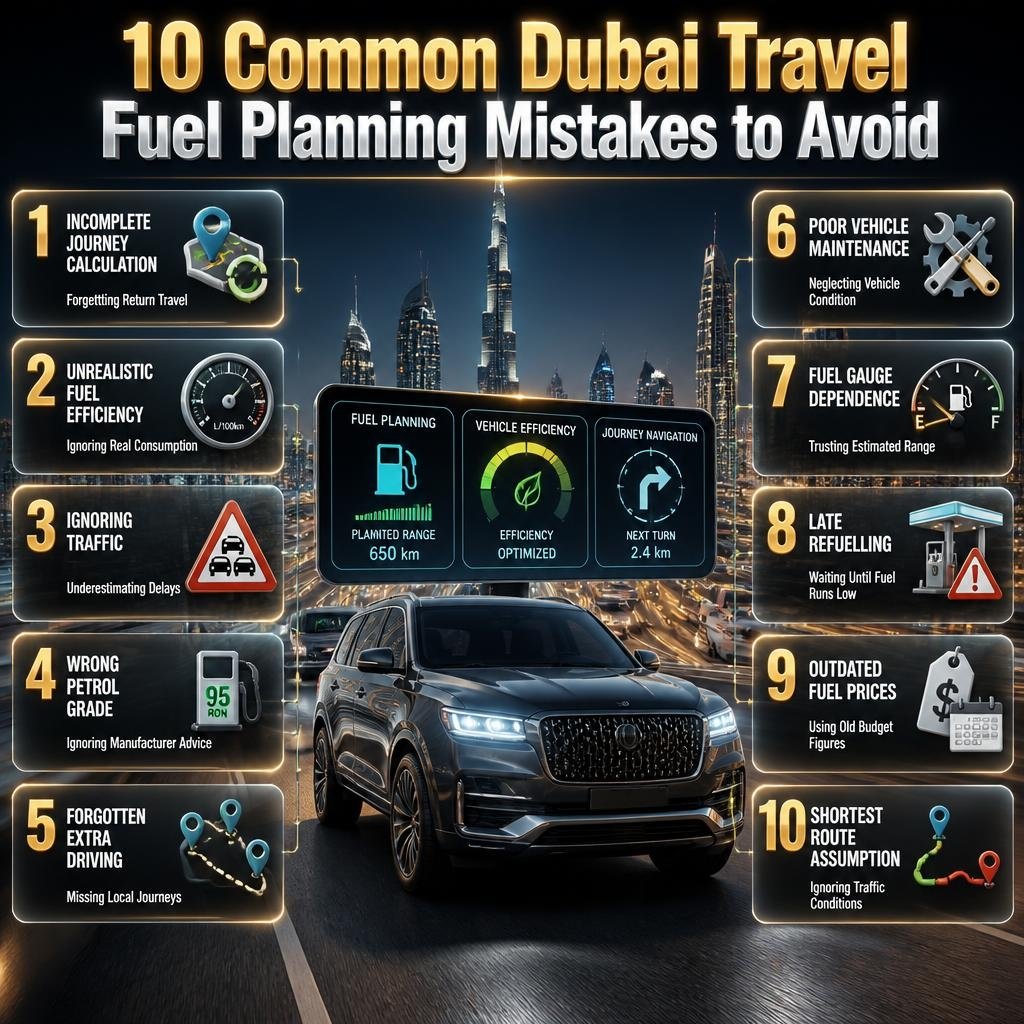
Many travel-related fuel problems happen because drivers underestimate their actual requirements. Avoiding a few common mistakes can make your journey more predictable and help you manage expenses.
Mistake 1: Calculating Only the Outward Journey
Why it happens: Drivers concentrate on reaching their destination.
Why it’s harmful: They forget the return distance and additional driving after arrival.
How to avoid it: Calculate the complete journey, including local travel and the return route.
Mistake 2: Depending Entirely on Advertised Fuel Efficiency
Why it happens: Drivers assume manufacturer fuel-economy figures represent their actual consumption.
Why it’s harmful: Real-world conditions can produce different results.
How to avoid it: Use your vehicle’s recent average consumption from similar journeys.
Mistake 3: Ignoring Traffic Conditions
Why it happens: Drivers calculate expenses using ideal road conditions.
Why it’s harmful: Congestion, idling and repeated acceleration can increase petrol consumption.
How to avoid it: Review traffic before departure and prepare a realistic estimate.
Mistake 4: Choosing Petrol Only by Price
Why it happens: Motorists want to reduce the cost of every litre.
Why it’s harmful: A cheaper petrol grade may not meet the vehicle manufacturer’s requirements.
How to avoid it: Follow the recommended octane rating.
Mistake 5: Forgetting Additional Driving
Why it happens: Drivers plan only the main route.
Why it’s harmful: Shopping, sightseeing, appointments and diversions increase the total distance.
How to avoid it: Include expected local driving in your calculations.
Mistake 6: Ignoring Vehicle Maintenance
Why it happens: Motorists assume petrol consumption depends only on the engine and fuel price.
Why it’s harmful: Underinflated tyres and mechanical problems can affect fuel efficiency.
How to avoid it: Inspect your vehicle and follow its maintenance schedule.
Mistake 7: Relying Entirely on the Fuel Gauge
Why it happens: The dashboard displays an estimated remaining range.
Why it’s harmful: The estimate can change according to driving conditions.
How to avoid it: Monitor actual fuel levels and arrange refuelling before they become critically low.
Mistake 8: Leaving Refuelling Until the Last Moment
Why it happens: Drivers assume a petrol station will always be nearby.
Why it’s harmful: Traffic and unfamiliar roads can make refuelling inconvenient.
How to avoid it: Identify suitable refuelling opportunities before starting a long journey.
Mistake 9: Not Updating the Travel Budget
Why it happens: Drivers continue using petrol prices from previous months.
Why it’s harmful: Their calculations may no longer reflect current expenses.
How to avoid it: Check the latest monthly petrol prices when preparing your budget.
Mistake 10: Assuming the Shortest Route Is Always the Cheapest
Why it happens: Drivers compare only the number of kilometres.
Why it’s harmful: A congested route may involve more stopping and additional driving time.
How to avoid it: Compare distance, traffic and expected driving conditions together.
16. Professional Recommendations for Smarter Fuel Planning
Effective fuel planning comes from using realistic information rather than making assumptions. The following recommendations can help Dubai motorists prepare better journeys and manage petrol expenses more confidently.
1. Maintain a Record of Actual Fuel Consumption
Don’t rely entirely on dashboard estimates or general vehicle specifications.
Record your odometer readings and petrol purchases over several journeys. This helps you understand how your vehicle performs during city, highway and intercity driving.
2. Prepare Normal and Contingency Estimates
For longer journeys, calculate two different fuel requirements.
- Normal estimate: Based on your usual driving conditions.
- Contingency estimate: Based on additional driving, congestion or possible diversions.
This makes your budget more flexible.
3. Plan Refuelling Before Departure
Identify suitable petrol stations along unfamiliar routes. Avoid depending on finding a station only when your fuel level becomes low.
4. Avoid Unnecessary Vehicle Weight
Carrying unnecessary luggage increases vehicle weight and may affect fuel consumption.
Before travelling, remove items you don’t need and distribute essential luggage safely.
5. Use Smooth Driving Techniques
Avoid unnecessary acceleration and sudden braking.
Maintain a safe following distance and anticipate traffic changes. Smooth driving helps reduce avoidable fuel consumption.
6. Review Your Monthly Fuel Spending
Compare estimated expenses with actual petrol purchases.
If your monthly spending increases, investigate possible reasons such as additional driving, congestion, vehicle condition or changes in petrol prices.
7. Keep Emergency Preparation Separate
Your regular travel budget should not depend on the assumption that every journey will go exactly as planned.
Maintain an appropriate reserve and understand the available roadside assistance options.
Professional Recommendation: Build every travel fuel plan around three important elements: accurate distance, realistic vehicle efficiency and a suitable contingency. Together, these provide a much stronger foundation than simply filling the tank and hoping it lasts.
How can drivers plan their petrol requirements before travelling across Dubai?
Drivers should consider the complete journey rather than focusing only on the distance to their destination. Daily traffic, road type, vehicle condition, air-conditioning use and driving habits can all influence petrol consumption.
Before leaving, check your fuel gauge and make sure you have enough petrol for the planned journey, including possible delays or unexpected route changes.
Important planning points:
Check your current fuel level before departure.
Consider whether your journey includes city roads, highways or both.
Allow extra fuel for traffic congestion and unexpected detours.
Avoid starting a long journey when your fuel level is already low.
Identify convenient petrol stations along your route.
A little preparation can help prevent unnecessary stops and make travelling across Dubai more convenient.
How much extra petrol should drivers keep for unexpected delays during a Dubai journey?
Keeping a reasonable fuel reserve is an important part of travel planning in Dubai. Traffic congestion, road diversions, unexpected stops and changes in destination can increase fuel consumption beyond what a driver initially expects.
There is no single reserve amount suitable for every vehicle. A small car travelling locally may have different requirements from an SUV travelling on highways. Drivers should consider their vehicle’s normal fuel consumption and the distance between convenient refuelling opportunities.
Practical recommendations:
Avoid planning a journey around the last few bars of the fuel gauge.
Keep additional fuel capacity available for unexpected delays.
Refuel before entering unfamiliar or less convenient routes.
Check your fuel level again before beginning the return journey.
Do not ignore the low-fuel warning light.
A sensible reserve gives drivers more flexibility when their travel plans change.
What factors increase petrol consumption during travel in Dubai?
Petrol consumption depends on several driving and vehicle-related conditions. Dubai’s combination of busy urban roads, high-speed highways, traffic signals and hot weather can make fuel planning particularly important.
Frequent acceleration, sudden braking and extended idling can increase fuel consumption. Using air conditioning is also an important consideration, particularly during hot weather when drivers depend on cooling throughout their journeys.
Common factors include:
Heavy traffic and repeated stop-and-go driving.
Excessive acceleration and unnecessary braking.
Extended engine idling.
Incorrect tyre pressure.
Poor vehicle maintenance.
Carrying unnecessary weight.
Driving at unsuitable speeds.
Continuous air-conditioning use.
Maintaining smooth driving habits and keeping the vehicle in good condition can help reduce unnecessary petrol consumption.
How should drivers prepare their vehicles for long-distance travel from Dubai?
Long-distance journeys require more preparation than ordinary city driving. Drivers should check their vehicle’s condition, fuel level and planned route before departure. This is especially important when travelling towards destinations outside Dubai, where refuelling opportunities may be less convenient on certain routes.
Vehicle preparation also helps reduce the possibility of unexpected problems during the journey.
Before departure, check:
Petrol level and expected refuelling opportunities.
Tyre pressure and visible tyre damage.
Engine oil and coolant condition.
Brake performance.
Battery condition and warning lights.
Air-conditioning performance.
Spare tyre and essential emergency equipment.
Drivers should also check traffic conditions and allow sufficient time for rest stops. A properly prepared vehicle makes long-distance travel more manageable and helps avoid preventable interruptions.
What should drivers do if their vehicle runs low on petrol during a journey in Dubai?
Running low on petrol during a journey can become stressful, particularly when travelling through busy roads or unfamiliar locations. Drivers should respond calmly and avoid continuing unnecessarily in the hope that the remaining fuel will last.
If the vehicle is still running normally, identify a safe and convenient refuelling option. If the fuel level is critically low, avoid unnecessary driving and follow appropriate roadside safety precautions.
Recommended steps:
Check the nearest suitable petrol station using navigation.
Avoid sudden acceleration and unnecessary detours.
Do not assume the remaining fuel will cover a particular distance.
If the vehicle stops, move to a safe location if possible.
Use hazard warning lights when appropriate.
Request roadside assistance if you cannot reach a petrol station safely.
If you need assistance, you can check the available options through Fuel Delivery Dubai. Service availability should be confirmed before relying on delivery during an urgent situation.
Conclusion
Effective Dubai travel fuel planning is not simply about keeping enough petrol in your vehicle. It involves understanding your travel requirements, preparing your vehicle, choosing suitable routes and developing driving habits that help manage fuel consumption. Whether you are travelling through busy city roads, using major highways or planning a longer journey outside Dubai, proper preparation can make every trip more convenient and predictable.
Drivers should avoid waiting until the fuel warning light appears before considering refuelling. Checking the fuel level before departure, allowing for unexpected traffic delays, maintaining correct tyre pressure and avoiding unnecessary idling can all contribute to better fuel management. Regular vehicle maintenance also helps keep the engine and other important components working efficiently.
Dubai’s changing traffic conditions and demanding summer weather make it especially important to plan ahead. A journey that appears straightforward can take longer because of congestion, diversions or unexpected stops. Keeping a reasonable fuel reserve and identifying suitable refuelling opportunities can help drivers handle these situations with greater confidence.
For motorists who need petrol assistance during their journey, Fuel Delivery Dubai provides a convenient option to explore when available. The most effective approach, however, is to combine sensible fuel planning with responsible driving and proper vehicle care.
Ultimately, good fuel planning helps Dubai motorists avoid unnecessary interruptions, manage travel expenses more effectively and enjoy safer, better-prepared journeys.
Leave a Reply