
Introduction
Dubai Long-Distance Travel | Planning a long-distance journey from Dubai can seem straightforward until unexpected traffic, changing weather, vehicle problems or an unplanned stop affects your schedule. A journey that looks simple on a navigation application may require considerably more preparation when you’re travelling with family, carrying luggage or heading towards an unfamiliar destination.
Whether you’re travelling from Dubai to Abu Dhabi, Al Ain, Ras Al Khaimah, Fujairah or another UAE destination, understanding how to organise your journey can make the entire experience easier.
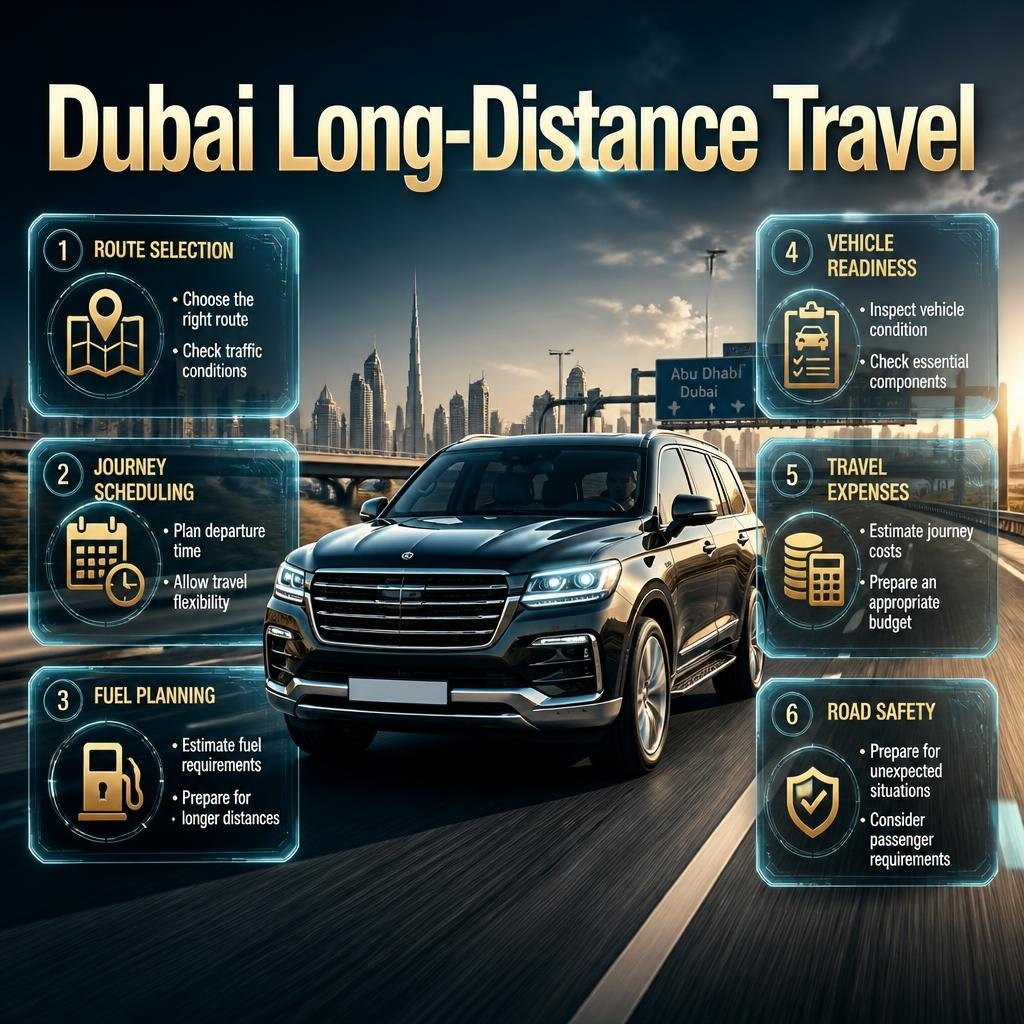
Dubai Long-Distance Travel involves more than choosing a destination and calculating the distance. It requires a practical understanding of travel schedules, route selection, fuel planning, vehicle readiness, passenger requirements, journey expenses and unexpected situations.
This guide explains how to organise longer journeys from Dubai, prepare for different travel situations, manage your travel budget and avoid common mistakes. It also provides practical recommendations to help individuals, families and regular travellers make informed decisions before leaving.
For motorists who need additional petrol assistance within the service coverage, Fuel Delivery Dubai provides another option to consider when planning their vehicle-related travel requirements.
1. Understanding Long-Distance Travel from Dubai
Long-distance travel from Dubai generally refers to journeys that take motorists beyond their immediate residential or commercial areas, often involving travel between different emirates or destinations across the UAE.
Unlike everyday local journeys, these trips may require additional planning because travellers spend more time away from home, encounter changing road conditions and may need to arrange several stops along the way.
For example, travelling from Business Bay to another nearby Dubai neighbourhood is different from travelling to Abu Dhabi or Fujairah. The second journey requires more attention to travel duration, passenger comfort, fuel requirements and the availability of suitable stopping locations.
What Makes a Journey Long-Distance?
There isn’t one universal distance that defines a long-distance journey. The difficulty depends on several factors rather than kilometres alone.
Consider these elements:
- Travel duration: A journey involving several hours of driving requires more preparation than a short trip.
- Destination familiarity: Unfamiliar destinations may require additional navigation and arrival planning.
- Road conditions: Different routes can involve varying traffic patterns and driving environments.
- Passenger requirements: Children, older passengers and families may need more frequent stops.
- Vehicle requirements: Longer journeys make pre-travel inspection particularly important.
- Travel arrangements: Accommodation, appointments, luggage and return schedules can influence the overall plan.
Why Should You Plan Before Leaving?
Proper preparation reduces uncertainty. It allows you to identify potential problems before they affect your journey.
For example, a traveller heading towards another emirate may discover that their destination has limited parking near the intended entrance. Checking this information beforehand can prevent unnecessary driving around unfamiliar streets.
A good travel plan should answer five basic questions:
- Where exactly am I going?
- How long is the complete journey likely to take?
- What arrangements are required before departure?
- What expenses should I expect?
- What will I do if something unexpected happens?
Expert Tip: Think about the complete travel experience, including departure, arrival, activities and return arrangements. Planning only the outward journey often leads to avoidable difficulties.
2. How to Choose the Right Destination and Travel Schedule
A successful journey begins with selecting a realistic destination and understanding what you need to accomplish there.
Some travellers have fixed appointments, while others travel for family visits, leisure, business meetings or personal commitments. Each situation requires a slightly different schedule.
Consider the Purpose of Your Journey
Before selecting your departure time, identify the main purpose of travelling.
For business travel, punctuality and predictable arrival times may be important. Family visits may require flexible schedules, while leisure journeys can allow additional time for sightseeing and meals.
Your purpose influences:
- Suitable departure time.
- Expected time at the destination.
- Number of passengers.
- Required luggage.
- Parking arrangements.
- Return journey planning.
Calculate Your Complete Travel Time
Don’t calculate your schedule using driving time alone.
Your complete travel duration may include:
- Time required to leave your residential area.
- Expected traffic delays.
- Refuelling stops.
- Restroom breaks.
- Meals and refreshments.
- Destination access and parking.
- Time spent completing your activities.
For example, suppose your navigation application estimates a three-hour outward journey. You should not automatically schedule an appointment immediately after those three hours.
Allow additional time for circumstances that are difficult to predict.
Plan the Return Journey
A common planning problem occurs when travellers concentrate entirely on reaching their destination.
The return journey may involve different traffic conditions, reduced daylight or driver fatigue.
Before leaving, consider:
- Whether you intend to return on the same day.
- How long you will remain at the destination.
- Whether the driver will have adequate rest.
- Expected traffic during the return period.
- Whether an overnight stay is more practical.
Quick Tip: If your destination involves a fixed appointment, work backwards from your required arrival time. This helps you choose a realistic departure schedule without rushing.
3. Understanding Major Destinations for Travel from Dubai

Dubai has road connections to all other UAE emirates, making it a convenient starting point for different types of journeys.
However, destinations differ in distance, accessibility, travel requirements and the type of preparation needed.
Dubai to Abu Dhabi
Abu Dhabi is a major destination for business meetings, family visits, government-related appointments and leisure activities.
Before travelling, identify your exact destination rather than entering only the emirate name.
Abu Dhabi city, Yas Island, Khalifa City and other locations can involve different access routes and arrival arrangements.
Consider:
- Your appointment or activity location.
- Expected arrival time.
- Parking availability.
- Return travel requirements.
- Fuel and toll expenses.
Dubai to Al Ain
Al Ain is another important destination for travellers leaving Dubai.
The journey may involve family visits, educational activities, business requirements and leisure travel.
Before departure, check the expected journey duration and identify suitable places for refreshments if needed.
If you’re visiting a specific attraction or residential location, save its exact address rather than relying on a general destination name.
Dubai to Sharjah
Although Dubai and Sharjah are neighbouring emirates, journeys between them can involve significant delays depending on the starting point and travel period.
Some motorists travel between the two emirates regularly for employment, education and family commitments.
Check traffic before leaving because a relatively short geographical distance doesn’t necessarily guarantee a short journey.
Dubai to Ras Al Khaimah
Ras Al Khaimah attracts visitors interested in mountain scenery, resorts, family activities and leisure destinations.
Travellers should identify whether their destination is within the main urban area or a location requiring additional travel beyond it.
If your journey includes mountainous surroundings, check weather conditions and follow applicable road instructions.
Dubai to Fujairah
Fujairah is a popular destination for coastal visits, family outings and leisure activities.
The route and travel duration depend on your starting point and final destination.
If you’re visiting a beach, hotel or residential area, confirm the entrance and parking arrangements before leaving.
Compare Your Destination Requirements
| Destination | Common travel purpose | Important planning consideration |
|---|---|---|
| Abu Dhabi | Business, family and leisure | Exact destination and appointment timing |
| Al Ain | Family visits and personal travel | Journey schedule and stopping arrangements |
| Sharjah | Work, education and family | Traffic conditions |
| Ras Al Khaimah | Leisure and resort visits | Destination access |
| Fujairah | Coastal and family travel | Route and weather conditions |
The best destination plan is one that matches your actual purpose rather than simply choosing the location with the shortest estimated journey.
Make Informed Travel Decisions with a Dubai Travel Fuel Planning Guide
Planning fuel requirements before travelling helps motorists avoid unnecessary delays, manage petrol expenses, and maintain better control over their journeys. Rather than relying solely on the fuel gauge, drivers should consider their vehicle’s petrol efficiency, total journey distance, traffic conditions, driving patterns, and possible route changes. Our Dubai Travel Fuel Planning Guide explains practical ways to assess fuel requirements, prepare for different journey distances, manage petrol consumption, and avoid common fuel planning mistakes. Whether you are commuting within Dubai, travelling between Emirates, or preparing for an extended road trip, this guide helps you organise your fuel requirements more effectively and make confident decisions before setting off.
4. Route Planning and Travel Information Before Departure
Route planning is an important part of organising a long-distance journey, but travellers should focus on more than selecting the first option shown by a navigation application.
The objective is to understand how you will reach your destination and what conditions may affect your journey.
Compare Available Routes
Different routes may offer different advantages.
One may provide a more direct connection, while another may help avoid a congested area.
Compare:
- Total estimated distance.
- Current travel time.
- Traffic congestion.
- Road closures.
- Construction activity.
- Destination access.
- Possible toll expenses.
A slightly longer route may be more suitable if it offers more predictable travel conditions.
Understand Your Destination’s Exact Location
Entering only a city or emirate name can create unnecessary confusion.
For example, travelling to Abu Dhabi city is not the same as travelling to a hotel on Yas Island.
Save the exact destination address, building name or approved location pin before leaving.
This becomes particularly useful when:
- Visiting a new business location.
- Attending an appointment.
- Travelling to a hotel.
- Visiting a residential community.
- Meeting someone at an unfamiliar location.
Check Travel Information Again Before Departure
Information reviewed several hours earlier may no longer reflect current road conditions.
Check your navigation application shortly before leaving and look for significant changes.
If your route becomes unavailable during travel, stop at a safe location before reviewing alternatives.
For additional information about road-related planning and general driving conditions, explore Dubai Driving and Fuel Insights.
5. Preparing Your Vehicle for a Longer Journey
A comfortable travel experience depends partly on the condition of your vehicle.
Even a car that performs normally during short everyday journeys should receive appropriate attention before extended use.
A pre-travel inspection helps identify problems that may otherwise interrupt your plans.
Inspect Tyres Before Departure
Tyres are essential for vehicle stability, braking and road contact.
Check:
- Tyre pressure against manufacturer recommendations.
- Tread depth and visible wear.
- Cuts, cracks or bulges.
- Uneven wear patterns.
- Spare tyre condition, where applicable.
Correct pressure is particularly important when travelling with passengers and luggage.
Follow the vehicle manufacturer’s loading and tyre-pressure recommendations rather than using an arbitrary pressure figure.
Check Engine Oil
Engine oil lubricates internal components and helps reduce friction.
Check the oil level according to the manufacturer’s instructions.
If the oil level is unusually low or you notice a warning indicator, investigate the issue before starting your journey.
Don’t assume that adding oil will automatically solve an underlying leak or mechanical problem.
Inspect the Cooling System
Dubai’s hot climate makes a properly functioning cooling system important.
Check the coolant level when the engine is cold and look for signs of leakage.
Pay attention to:
- Coolant warning indicators.
- Unusual temperature readings.
- Visible leaks.
- Unusual smells.
- Signs of previous overheating.
Never remove a hot cooling-system cap.
Check Brakes and Steering
Brakes and steering components directly affect your ability to control the vehicle.
Watch for:
- Unusual braking sounds.
- Vibrations.
- A soft brake pedal.
- Steering pulling to one side.
- Excessive steering play.
- Dashboard warning lights.
If you notice these symptoms, arrange a professional inspection before travelling.
Test Electrical Components
Electrical problems can create difficulties during a journey, particularly when visibility or weather conditions change.
Check headlights, indicators, brake lights, hazard lights and windscreen wipers.
Also confirm that your battery is in suitable condition and that the air-conditioning system operates properly.
Common Mistake: Many motorists focus only on engine performance before travelling. A vehicle also needs properly functioning brakes, tyres, lights, cooling equipment and electrical systems.
6. Fuel Planning and Managing Petrol Requirements

Fuel planning helps travellers understand how much petrol their vehicle may need and how to avoid unnecessary interruptions.
The correct estimate depends on the vehicle, engine condition, driving behaviour, traffic and total distance.
Calculate Expected Petrol Consumption
Use this simple formula:
Fuel required = Total distance ÷ Average kilometres per litre
For example:
Suppose your planned journey covers 300 kilometres and your vehicle averages 12 kilometres per litre.
300 ÷ 12 = 25 litres.
Your estimated fuel requirement is 25 litres.
This figure should be treated as a planning estimate. Actual consumption may be higher because of traffic, detours, additional stops or changes in driving conditions.
Estimate the Petrol Budget
After estimating the required litres, multiply them by the applicable petrol price.
Example:
- Estimated petrol requirement: 25 litres.
- Illustrative petrol price: AED 2.70 per litre.
- Estimated expense: AED 67.50.
The price used here is only an example, not a current UAE fuel-price quotation.
Check the applicable petrol price before preparing your actual budget.
Keep an Additional Fuel Reserve
Never plan a journey around the assumption that every part of your route will proceed exactly as expected.
Unexpected traffic or a road diversion may increase the distance.
A practical fuel plan should include:
- Sufficient petrol before departure.
- Awareness of suitable refuelling opportunities.
- An allowance for unexpected travel.
- Monitoring of the fuel gauge.
- Avoiding unnecessary delays after a low-fuel warning.
What If You Need Petrol During Your Journey?
If the fuel warning light appears, identify a suitable fuel station as soon as safely possible.
Avoid unnecessary acceleration and don’t continue towards an uncertain destination hoping that the remaining fuel will be sufficient.
If your vehicle becomes stranded, prioritise safety and arrange appropriate assistance.
Motorists travelling within Dubai may also consider Fuel Delivery Dubai when petrol assistance is needed and the service is available at their location.
The important point is to understand your fuel requirements before the journey rather than waiting until the vehicle approaches an empty tank.
7. Understanding Travel Expenses and Budget Planning
A realistic travel budget should include all major expenses rather than focusing exclusively on petrol.
Depending on your destination and travel arrangements, the total cost may include tolls, parking, refreshments, accommodation and other personal expenses.
Calculate Fuel Expenses
Start by estimating the total distance and your vehicle’s expected fuel consumption.
Use your own vehicle’s average consumption whenever possible because different models can produce significantly different results.
Include Salik Charges
Some routes may involve Salik toll gates.
Before travelling, review the applicable toll information and consider whether an alternative route is practical.
Don’t assume that avoiding a toll gate will always save money. A significantly longer route may increase fuel consumption and travel time.
Consider Parking and Destination Expenses
Parking arrangements can vary considerably between destinations.
For example, a business meeting in a commercial area may involve different parking requirements from a family visit or a hotel stay.
Check whether parking is available and whether charges apply.
Prepare an Emergency Allowance
A travel budget should also leave room for unexpected expenses.
These may include:
- Additional petrol.
- Unplanned parking.
- Meals and refreshments.
- Minor vehicle-related requirements.
- Unexpected accommodation.
- Assistance during a breakdown.
| Expense category | Planning method |
|---|---|
| Petrol | Estimate litres and applicable price |
| Salik | Check route-related toll charges |
| Parking | Review destination arrangements |
| Meals | Estimate passenger requirements |
| Accommodation | Include when an overnight stay is planned |
| Emergency allowance | Keep additional funds available |
Expert Tip: Compare the estimated total cost of your journey rather than choosing a route simply because it has fewer kilometres or fewer toll gates.
8. Choosing the Right Time to Travel
Departure timing affects journey duration, passenger comfort and the overall travel experience.
The same route can take different amounts of time depending on traffic conditions and the day of travel.
Understand Peak Travel Periods
Morning and evening commuting periods may create additional congestion on important routes.
Weekend travel, public holidays, school-related traffic and major events can also influence journey conditions.
Before departure, consider:
- Whether your route passes through busy urban areas.
- Whether your destination has a fixed arrival time.
- Whether your return journey overlaps with commuting traffic.
- Whether roadworks may affect your schedule.
Avoid Unrealistic Arrival Targets
A common problem is scheduling a destination appointment immediately after the navigation application’s estimated driving time.
This leaves no room for unexpected delays.
If your appointment begins at a specific time, include a reasonable arrival buffer.
You can use the additional time to park, locate the entrance and prepare for the appointment.
Consider Daylight and Driver Readiness
For unfamiliar destinations, daylight may make it easier to identify signs, entrances and surrounding landmarks.
However, the most important factor is driver readiness.
Don’t begin a long journey when tired simply because the selected departure time appears convenient.
9. Managing Weather and Seasonal Travel Conditions
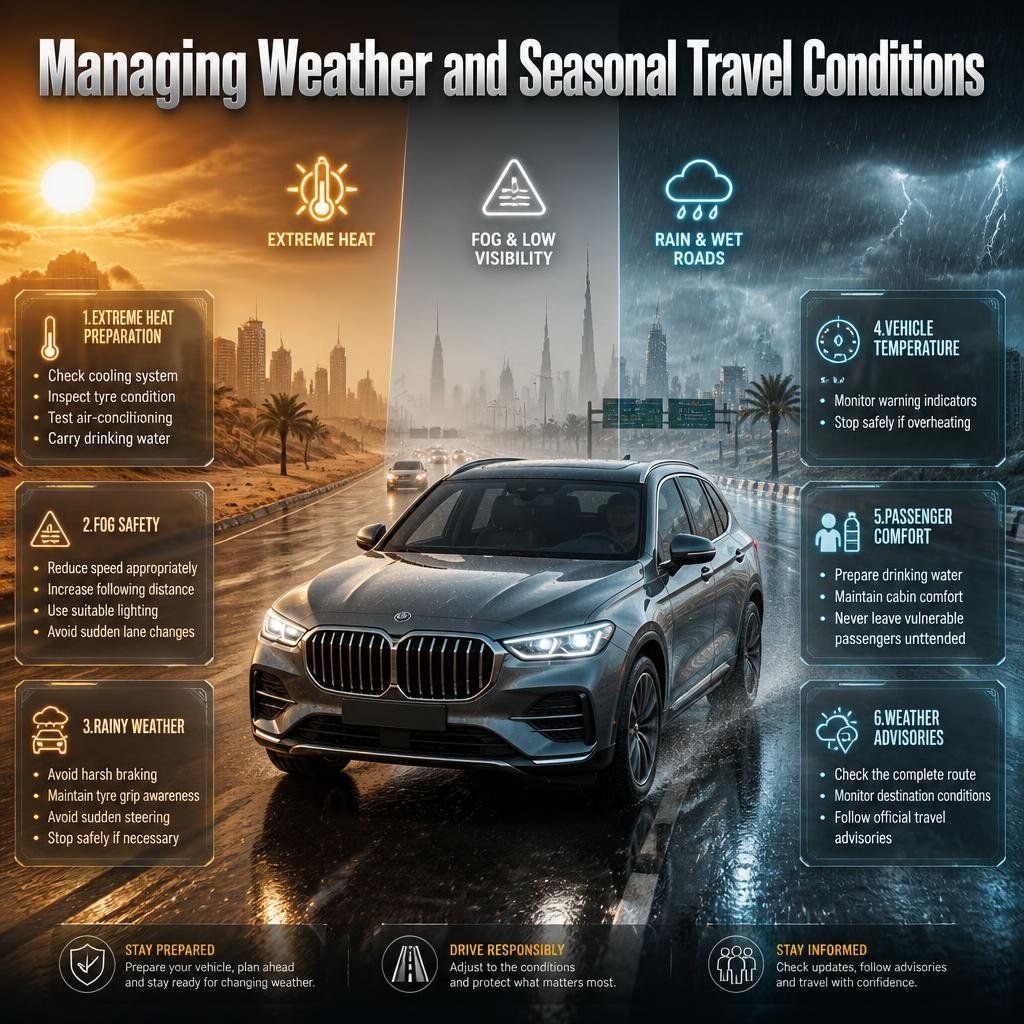
Weather conditions can affect road visibility, vehicle operation and passenger comfort.
Dubai experiences extended periods of high temperatures, while fog, rain and strong winds may influence travel conditions at different times.
Prepare for Extreme Heat
High temperatures can place additional demands on vehicle components and passenger comfort.
Before leaving:
- Check the cooling system.
- Inspect tyre condition.
- Confirm air-conditioning performance.
- Carry drinking water.
- Avoid leaving vulnerable passengers inside unattended vehicles.
- Monitor temperature warning indicators.
If the engine overheats, stop safely and follow the manufacturer’s instructions.
Understand Fog-Related Travel Risks
Fog reduces visibility and can make it difficult to judge the distance between vehicles.
When visibility becomes poor:
- Reduce speed appropriately.
- Increase following distance.
- Use suitable lighting.
- Avoid sudden lane changes.
- Follow official traffic instructions.
Don’t continue travelling at normal speed simply because the road appears familiar.
Take Extra Care During Rain
Wet roads may reduce tyre grip and increase stopping distances.
Avoid harsh braking and sudden steering movements.
If conditions become unsafe, delay your journey or stop at an appropriate safe location.
Monitor Official Travel Advisories
Weather conditions may differ between Dubai and your destination.
For this reason, checking conditions only at your starting point isn’t enough.
Consider the complete route and destination conditions before departure.
10. Planning Long-Distance Travel with Family
Family journeys require additional attention because passengers may have different needs and comfort requirements.
A successful family journey involves organising the vehicle, luggage, refreshments and stopping arrangements before departure.
Prepare Suitable Seating Arrangements
Every passenger should have an appropriate seating position and use the correct seat belt or child restraint.
Child seats should be selected and installed according to the child’s size and the manufacturer’s instructions.
Never allow passengers to travel without suitable restraints.
Organise Luggage Properly
Avoid placing loose bags or heavy objects where they could move around during sudden braking.
Keep luggage secure and ensure the driver’s visibility isn’t obstructed.
Frequently required items should be placed somewhere accessible without distracting the driver.
Prepare for Children’s Needs
Children may become uncomfortable during extended travel.
Pack:
- Drinking water.
- Suitable snacks.
- Tissues and wipes.
- Necessary personal medication.
- Age-appropriate entertainment.
- Spare clothing.
- Essential personal items.
Plan Family-Friendly Stops
Don’t expect children to remain comfortable throughout an extended journey without breaks.
Identify suitable stopping locations and allow time for refreshments and movement.
For families travelling with older passengers, consider accessibility and the availability of comfortable facilities.
Quick Tip: Prepare a separate small travel bag for essential passenger items. This avoids opening the main luggage whenever someone needs water, medicine or personal belongings.
11. Accommodation and Overnight Travel Arrangements
Not every journey from Dubai needs to be completed in one day.
Sometimes an overnight stay is more practical, especially when the destination is far away or your activities require a long period of time.
When Should You Consider an Overnight Stay?
Consider accommodation when:
- Your destination involves several activities.
- You have an early appointment the following morning.
- The return journey would create excessive fatigue.
- Family members need additional rest.
- You intend to spend more than one day at the destination.
Choose Accommodation According to Your Plans
Don’t select accommodation based only on the lowest price.
Consider:
- Distance from your actual destination.
- Parking availability.
- Check-in arrangements.
- Family requirements.
- Accessibility.
- Expected departure time.
A hotel that appears inexpensive may create additional travel expenses if it’s far from your intended activities.
Organise Your Return Arrangements
Before checking in, consider when you plan to return to Dubai.
Confirm the expected departure time, parking arrangements and any activities that may affect your schedule.
This prevents unnecessary last-minute decisions.
12. Essential Documents and Items for Your Journey
Carrying the correct documents and basic supplies helps avoid unnecessary difficulties during travel.
The requirements depend on your circumstances and the type of journey.
Vehicle and Personal Documents
Check that you have access to the required documents, including:
- Valid driving licence.
- Vehicle registration.
- Appropriate vehicle insurance.
- Personal identification.
- Any other documents required for your specific circumstances.
Ensure that your documents are valid and accessible.
Emergency Equipment
Consider carrying:
- First-aid supplies.
- Charged mobile phone.
- Power bank.
- Suitable warning equipment.
- Spare tyre equipment, where applicable.
- Drinking water.
- Basic vehicle information.
Know how to use the equipment safely.
Emergency Contact Information
In the UAE:
- Police emergency: 999
- Ambulance emergency: 998
Use the appropriate emergency service when there is an immediate threat to safety or a medical emergency.
For ordinary mechanical problems, contact suitable roadside assistance or recovery services.
13. Handling Unexpected Travel Problems
Even a well-organised journey can experience unexpected problems.
The best preparation is to understand how to respond without creating additional risks.
If You Experience a Vehicle Breakdown
First, move to a safe location if the vehicle remains controllable.
Use hazard lights where appropriate and follow official roadside-safety guidance.
Avoid attempting repairs in a location exposed to moving traffic.
Depending on the problem, you may require:
- Battery assistance.
- Tyre-related assistance.
- Mechanical support.
- Vehicle recovery.
- Petrol delivery, where available.
If Your Navigation Route Changes
Navigation applications may suggest alternative routes because of congestion, closures or changing road conditions.
Don’t make sudden manoeuvres to follow a new recommendation.
Continue driving safely and review the updated route when appropriate.
If You Experience Unexpected Delays
Inform anyone waiting for you if your arrival time changes.
Avoid increasing driving speed to recover lost time.
A delay is inconvenient, but rushing creates unnecessary risks.
If You Become Unwell During Travel
Stop at a safe location and assess the situation.
If you require medical attention, seek appropriate assistance.
Don’t continue driving when illness, dizziness or exhaustion affects your ability to control the vehicle.
14. Common Mistakes People Make During Dubai Long-Distance Travel

Many travel difficulties occur because motorists underestimate the amount of preparation required.
Understanding these mistakes helps travellers make better decisions.
Mistake 1: Planning Only the Outward Journey
Why it happens: Travellers concentrate on reaching their destination.
Why it’s harmful: They may underestimate the return distance, fuel requirements and driver fatigue.
How to avoid it: Calculate the complete travel schedule, including the return journey.
Mistake 2: Relying Completely on Navigation Estimates
Why it happens: Drivers assume the displayed arrival time will remain accurate.
Why it’s harmful: Unexpected congestion, roadworks and stops may increase journey duration.
How to avoid it: Allow additional time and review traffic conditions before departure.
Mistake 3: Ignoring Vehicle Warning Signs
Why it happens: Motorists postpone minor repairs because the vehicle still appears operational.
Why it’s harmful: Existing problems may become more serious during extended use.
How to avoid it: Arrange professional inspection when you notice unusual noises, warning lights or mechanical symptoms.
Mistake 4: Starting with Insufficient Petrol
Why it happens: Drivers depend too heavily on the estimated remaining range.
Why it’s harmful: Unexpected detours or traffic can increase fuel requirements.
How to avoid it: Start with adequate petrol and identify suitable refuelling options.
Mistake 5: Carrying Excessive Luggage
Why it happens: Travellers pack items they may not actually need.
Why it’s harmful: Excessive weight affects vehicle loading and may increase fuel consumption.
How to avoid it: Prepare a packing list and carry essential items only.
Mistake 6: Forgetting Destination Parking
Why it happens: Drivers concentrate on reaching the general destination.
Why it’s harmful: They may waste time locating suitable parking.
How to avoid it: Check parking arrangements before departure.
Mistake 7: Travelling Without Adequate Rest
Why it happens: Drivers want to complete their journey quickly.
Why it’s harmful: Fatigue reduces concentration and reaction time.
How to avoid it: Start well-rested and stop whenever you experience tiredness.
Mistake 8: Ignoring Weather Conditions Along the Route
Why it happens: Travellers check conditions only in Dubai.
Why it’s harmful: Weather may differ considerably at the destination.
How to avoid it: Review the complete route and destination conditions before leaving.
15. Professional Recommendations for a Better Travel Experience
Good travel preparation is based on practical decisions, not complicated arrangements.
The following recommendations can help you organise your next journey more effectively.
Prepare Everything Before Departure Day
Complete basic arrangements the evening before travelling.
Check your documents, charge your phone, organise luggage and inspect essential vehicle components.
This gives you more time to address unexpected issues.
Keep Your Travel Plan Flexible
A good plan should provide direction without forcing you to follow an unrealistic schedule.
Allow time for unexpected delays, passenger needs and additional stops.
Use Your Own Vehicle’s Fuel Records
Your vehicle’s actual fuel consumption is more useful than a general estimate for a similar model.
Review previous journeys to understand how much petrol your vehicle typically uses.
Organise Important Information in One Place
Save your destination, accommodation details, emergency contacts and travel arrangements somewhere accessible.
This reduces confusion when you need information during the journey.
Keep Passenger Comfort in Mind
Comfortable passengers contribute to a more organised journey.
Provide suitable refreshments, organise seating and plan appropriate breaks.
Understand the Limits of Your Vehicle
Don’t assume that every vehicle is suitable for every type of journey without checking its condition and manufacturer’s recommendations.
If the vehicle has unresolved mechanical issues, address them before travelling.
Review Your Journey After Returning
Consider what worked well and what could be improved.
For example, you may discover that an earlier departure, a different stopping arrangement or better luggage organisation would make your next journey easier.
Professional Recommendation: The most effective preparation combines realistic scheduling, a roadworthy vehicle, sufficient petrol, organised travel information and a willingness to adjust plans when conditions change.
What Should I Prepare Before Starting a Long-Distance Journey from Dubai?
Preparing for long-distance travel from Dubai requires more than checking your destination and departure time. You should make sure your vehicle is roadworthy, your route is suitable, and you have enough time and resources to complete the journey comfortably. Proper preparation helps reduce unexpected delays, avoid unnecessary expenses and make travel easier, particularly when travelling with family.
Before departure, pay attention to these important preparations:
Vehicle inspection: Check tyre pressure, tread condition, brakes, engine oil, coolant and battery condition.
Route planning: Confirm your destination, review available routes and check current traffic conditions.
Fuel requirements: Estimate petrol consumption according to your vehicle’s average fuel economy and total journey distance.
Travel documents: Ensure your driving licence, vehicle registration and insurance are valid.
Emergency preparation: Carry drinking water, a charged mobile phone, basic first-aid supplies and suitable emergency equipment.
Passenger arrangements: Organise luggage, refreshments and suitable seating before leaving.
It’s also important to consider your return journey, especially if you’re travelling for a business appointment or family activity. A realistic schedule should allow time for unexpected traffic, rest stops and changes in travel conditions.
How Much Petrol Do I Need for Long-Distance Travel from Dubai?
The petrol required for a long-distance journey depends on your vehicle’s average fuel consumption, total distance, engine condition and driving conditions. A vehicle that delivers better fuel economy will generally require fewer litres than a larger vehicle travelling the same distance. However, traffic congestion, excessive luggage, air-conditioning demand and driving habits can affect actual consumption.
You can estimate your petrol requirements using a simple calculation:
Petrol Required = Total Distance ÷ Average Kilometres Per Litre
For example, if your journey covers 360 kilometres and your vehicle averages 12 kilometres per litre:
360 ÷ 12 = 30 litres.
Your estimated petrol requirement would be 30 litres. However, it’s sensible to maintain an additional reserve rather than planning to use almost the entire tank.
Consider these practical recommendations:
Check your fuel level before starting the journey.
Use your vehicle’s actual average fuel consumption instead of relying on general estimates.
Identify suitable refuelling opportunities along your route.
Avoid unnecessary acceleration and excessive idling.
Monitor your fuel gauge during travel.
Keep enough fuel for unexpected detours or traffic delays.
Most importantly, don’t depend entirely on the remaining driving range displayed on your dashboard. It’s an estimate that can change according to driving conditions. Proper fuel planning helps prevent unnecessary interruptions and gives you greater flexibility throughout your journey.
How Can I Make Long-Distance Travel Safer and More Comfortable in the UAE?
Safe and comfortable long-distance travel depends on three important factors: vehicle condition, driver readiness and awareness of changing road conditions. Even a well-maintained vehicle cannot compensate for driver fatigue, poor visibility or careless decisions. Travellers should prepare for the complete journey rather than focusing only on reaching their destination.
Start by checking the essential vehicle components before departure. Make sure your tyres, brakes, lights, cooling system and windscreen wipers are functioning correctly. Adjust your driving position and mirrors, secure luggage and ensure every passenger uses an appropriate seat belt or child restraint.
To improve your travel experience, follow these practices:
Maintain a safe following distance: Leave enough space to react if the vehicle ahead suddenly slows down.
Follow posted speed limits: Adjust your speed according to road, weather and traffic conditions.
Take regular breaks: Stop when necessary to refresh yourself and manage fatigue.
Stay hydrated: Carry sufficient drinking water, particularly during hot weather.
Avoid distractions: Don’t use your mobile phone while driving.
Monitor weather conditions: Fog, rain, dust and strong winds may affect visibility and vehicle control.
Secure passenger belongings: Prevent loose luggage from moving around during sudden braking.
Comfort also depends on planning appropriate stopping arrangements. Travelling continuously without considering your physical condition can make the experience exhausting.
A well-organised journey should allow you to remain alert, maintain comfortable cabin conditions and respond calmly when unexpected situations occur.
What Are the Most Common Problems During Long-Distance Travel from Dubai, and How Can I Avoid Them?
Long-distance journeys can involve unexpected difficulties, even when travellers have prepared properly. Some problems develop because of insufficient vehicle maintenance, while others occur because motorists underestimate travel expenses, fuel requirements or changing road conditions.
Understanding potential problems before departure makes it easier to prevent unnecessary interruptions.
The following are some common situations and their practical solutions:
Running low on petrol: Estimate fuel consumption before leaving and identify suitable refuelling locations along your route.
Tyre damage: Inspect tyre pressure, tread and visible damage before departure. Make sure appropriate spare-tyre or repair equipment is available.
Engine overheating: Check the cooling system and coolant level when the engine is cold. Stop safely if the temperature warning indicates overheating.
Unexpected traffic: Review current traffic conditions and allow additional time instead of following an unrealistic arrival schedule.
Navigation difficulties: Save your exact destination and review alternative routes before travelling.
Driver fatigue: Start well-rested and stop when concentration begins to decrease.
Unexpected expenses: Prepare an emergency allowance for additional petrol, parking, refreshments or vehicle assistance.
One important mistake is continuing a journey despite noticing unusual vehicle behaviour. Warning lights, strange noises, overheating or braking problems should never be ignored simply because you want to reach your destination.
If a breakdown occurs, prioritise personal safety, move to a safe location where possible and arrange suitable roadside assistance.
How Can I Reduce the Total Cost of Long-Distance Travel from Dubai?
Reducing long-distance travel expenses requires a complete understanding of your vehicle’s operating costs and the additional expenses associated with the journey. Focusing only on petrol prices may overlook other important costs, including tolls, parking, meals and unexpected travel requirements.
A practical travel budget should be prepared before departure so you can understand the expected expenses and make better decisions.
Use these methods to manage your travel costs:
Calculate petrol consumption: Estimate the litres required using your vehicle’s average fuel economy and planned distance.
Compare available routes: Consider travel time, distance and applicable toll charges rather than selecting a route based only on kilometres.
Maintain correct tyre pressure: Properly inflated tyres support efficient vehicle operation and help avoid unnecessary tyre wear.
Avoid excessive luggage: Carrying unnecessary weight can increase fuel consumption.
Drive smoothly: Avoid unnecessary acceleration and harsh braking.
Combine travel activities: When practical, organise nearby appointments or activities into one journey.
Plan stopping expenses: Consider meals, refreshments and parking before departure.
Maintain your vehicle: Regular servicing helps identify mechanical issues before they become more expensive problems.
For example, if your vehicle requires 30 litres of petrol for a planned journey, you can estimate the fuel expense using the applicable price per litre. You should then add tolls, parking and other expected expenses to calculate the overall budget.
The objective isn’t simply to spend less on one part of the journey. It’s to manage the complete travel cost without compromising vehicle maintenance, passenger comfort or road safety.
Conclusion
Dubai long-distance travel becomes easier, safer and more manageable when every important part of the journey is planned in advance. From selecting a suitable departure time and checking road conditions to inspecting your vehicle, estimating petrol requirements and preparing a realistic travel budget, small decisions can make a significant difference to the overall experience.
Before setting off, make sure your vehicle is in good condition, your travel documents are valid, your route is clear and your passengers have everything they need. Allow enough time for rest stops, unexpected traffic and possible changes in travel conditions. Most importantly, never compromise on vehicle maintenance or road safety simply to reach your destination sooner.
Whether you’re travelling for business, visiting family or planning a personal journey from Dubai, a well-prepared travel plan helps reduce unnecessary delays, control expenses and make the experience more comfortable. Plan ahead, travel responsibly and stay prepared throughout the journey so you can reach your destination with greater confidence and peace of mind.
Leave a Reply