Introduction
Dubai Fuel Requirements | Choosing the wrong fuel can turn an ordinary journey into an expensive vehicle repair. Imagine stopping at a petrol station in Dubai, seeing three different petrol grades and wondering which one your car actually needs. The same confusion can happen when driving a rental vehicle, buying an imported car or arranging emergency roadside fuel assistance.
Understanding Dubai Fuel Requirements is therefore important for every motorist. The correct fuel depends on your vehicle’s engine, manufacturer’s recommendations, fuel-system design and operating requirements. Choosing the right grade is not simply about finding the cheapest option or selecting premium petrol.
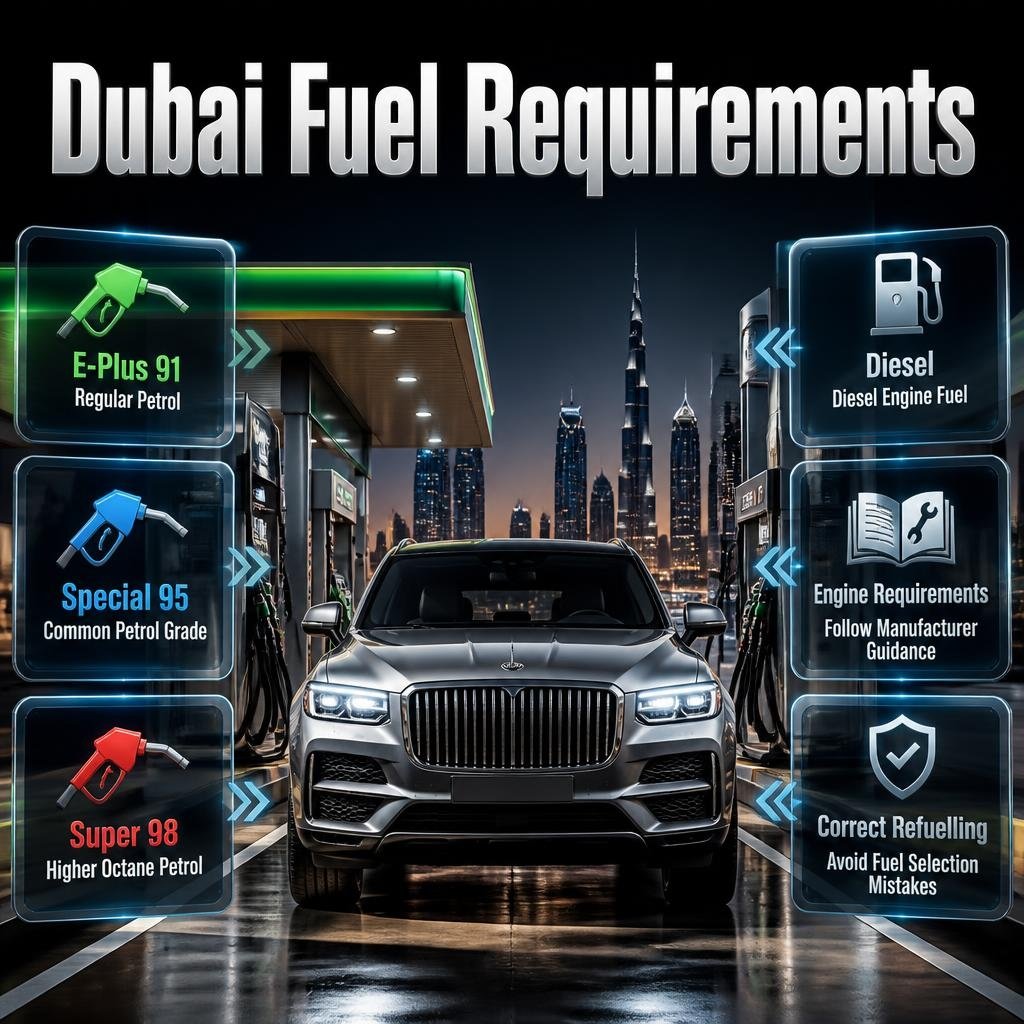
Dubai provides different automotive fuel options, including E-Plus 91, Special 95, Super 98 and diesel. Each serves particular engine requirements, and knowing the differences can help you avoid incorrect refuelling, unnecessary spending and preventable mechanical problems.
This comprehensive guide explains how petrol and diesel requirements work in Dubai, how to identify your vehicle’s correct fuel, what drivers should understand about local fuel regulations, and how to manage common refuelling situations.
Whether you are a new driver, resident, visitor, rental-car user or commercial vehicle operator, you will find practical guidance to make informed decisions. You can also explore Fuel Delivery Dubai for additional information about fuel-related assistance and services.
1. What Are Dubai Fuel Requirements?
Dubai fuel requirements cover the fuel types, technical specifications, vehicle compatibility and safety considerations involved in using petrol or diesel vehicles across the emirate.
These requirements help motorists select suitable fuel, maintain engine performance and understand the rules governing petroleum products.
There is no single petrol grade that every vehicle in Dubai must use. A small hatchback, a turbocharged sports car and a diesel delivery van can have completely different fuel requirements.
Understanding these differences is the first step towards responsible vehicle ownership.
What are the main elements of fuel requirements?
A vehicle’s fuel requirements generally involve the following:
1. Correct fuel type
The engine must receive the fuel it was designed to use. Petrol engines require compatible petrol, while diesel engines require automotive diesel.
2. Appropriate petrol octane rating
Petrol vehicles have manufacturer-specified octane requirements. The selected grade must meet the minimum rating required by the engine.
3. Fuel quality
Automotive fuel must comply with applicable technical specifications. Contaminated or unsuitable fuel can create problems for the engine and fuel-delivery system.
4. Vehicle compatibility
The correct fuel depends on the engine configuration, model year, regional specification and manufacturer’s instructions.
5. Safe fuel handling
Fuel must be purchased, transported, stored and supplied through appropriate and legally compliant channels.
Why should Dubai drivers understand these requirements?
Dubai motorists experience different driving conditions, including heavy traffic, long journeys, high temperatures and frequent air-conditioning use.
These conditions can influence vehicle operation and fuel consumption.
However, they do not automatically change the required petrol grade.
Understanding the manufacturer’s fuel specification helps drivers separate genuine engine requirements from common assumptions.
Expert Tip: Keep a photograph of your vehicle’s fuel specification on your phone. It can be particularly useful when someone else drives your car or when you use a rental vehicle.
2. Which Fuel Types Are Available in Dubai?
Dubai motorists can choose from several automotive fuel options supplied through established fuel retailers.
The four main categories relevant to conventional petrol and diesel vehicles are E-Plus 91, Special 95, Super 98 and diesel.
Each fuel serves a different purpose, so understanding the differences is more important than simply recognising the pump labels.
E-Plus 91 petrol
E-Plus 91 is an unleaded petrol grade with a Research Octane Number of 91.
It is generally intended for vehicles designed to operate on lower-octane petrol.
Common applications include compatible everyday passenger vehicles and certain commercial fleets.
Before choosing it, confirm that your vehicle’s manufacturer permits 91 RON.
When is E-Plus 91 appropriate?
- Your owner’s manual specifies 91 RON.
- The fuel-filler label permits E-Plus 91.
- The engine is designed for compatible lower-octane petrol.
- The manufacturer lists it as an approved fuel option.
A common mistake is assuming every older or smaller vehicle can use E-Plus 91. Engine size and vehicle age alone do not establish fuel compatibility.
Special 95 petrol
Special 95 is an unleaded petrol grade with a 95 RON rating.
It is suitable for vehicles whose manufacturers specify or permit 95 RON petrol.
Many ordinary passenger vehicles use this grade, but the correct choice still depends on the individual engine.
For drivers whose cars require 95 RON, Special 95 provides the required octane rating without paying extra for an unnecessarily higher grade.
Professional recommendation: If your manufacturer’s documentation specifies a minimum of 95 RON, do not switch to 91 RON just because it is cheaper.
Super 98 petrol
Super 98 is a higher-octane petrol grade designed for engines that require or recommend 98 RON.
It is commonly associated with high-performance vehicles, certain turbocharged engines and some luxury cars.
However, not every luxury vehicle requires Super 98.
A vehicle’s actual requirements depend on its engine design and manufacturer specifications.
Using Super 98 in a vehicle designed for 91 RON does not automatically increase horsepower, improve mileage or extend engine life.
Automotive diesel
Diesel is designed for compression-ignition engines.
Unlike petrol engines, which generally use spark plugs to ignite the air-fuel mixture, diesel engines rely on the heat generated by compressing air.
Diesel vehicles include:
- Diesel passenger cars.
- Certain SUVs.
- Pickup trucks.
- Commercial vans.
- Delivery vehicles.
- Heavy-duty transport vehicles.
Diesel engines require the correct automotive diesel specification. Never use petrol as a substitute.
Comparison of Dubai’s main fuel options
| Fuel type | Rating or specification | General application |
|---|---|---|
| E-Plus 91 | 91 RON | Compatible lower-octane petrol engines |
| Special 95 | 95 RON | Compatible 95 RON petrol engines |
| Super 98 | 98 RON | Compatible higher-octane petrol engines |
| Diesel | Automotive diesel specification | Diesel-powered engines |
These are general applications, not a substitute for the manufacturer’s fuel recommendations.
3. Understanding Petrol Octane Ratings in Dubai
Petrol octane ratings are one of the most misunderstood parts of vehicle fuel requirements.
Some drivers believe higher-octane petrol always provides better performance. Others assume that lower-octane petrol is suitable for every ordinary car.
Both assumptions can lead to unnecessary expenses or incorrect fuel selection.
What does RON mean?
RON stands for Research Octane Number.
It measures a petrol fuel’s resistance to knocking under a standardised test.
Engine knocking occurs when the air-fuel mixture burns abnormally rather than following the intended combustion process.
This can affect engine operation and, under certain conditions, contribute to mechanical damage.
Higher-octane petrol provides greater resistance to knocking, which is important for engines designed to operate under higher compression or boost pressures.
Does higher octane mean better fuel quality?
Not necessarily.
Octane rating measures knock resistance, not every aspect of petrol quality.
A 98 RON petrol grade is not automatically better for an engine designed for 91 RON.
Likewise, using 91 RON in an engine that requires 98 RON is not a sensible way to reduce running costs.
The correct grade is the one that meets the manufacturer’s minimum specification.
What happens if you use lower-octane petrol?
The result depends on the engine and its electronic control systems.
Some modern engines can adjust ignition timing when knocking is detected. However, this ability should not be treated as permission to ignore the manufacturer’s fuel requirements.
Possible consequences include:
- Reduced engine performance.
- Ignition timing adjustments.
- Engine knocking.
- Increased thermal stress under demanding conditions.
- Potential engine damage in severe or repeated cases.
Can you use higher-octane petrol than recommended?
In many conventional petrol vehicles, using a higher-octane unleaded grade is compatible, but it may provide no practical benefit.
Always follow the manufacturer’s instructions, particularly where specific fuel formulations or additional restrictions are mentioned.
Common Mistake: Paying more for Super 98 without checking whether the vehicle actually needs it. A higher price does not guarantee better results.
4. How to Identify the Correct Fuel for Your Vehicle

Before visiting a petrol station, establish exactly what your vehicle needs.
This is especially important if you have recently purchased a used car, imported a vehicle or started driving a rental car.
The following process helps remove guesswork.
Step 1: Read the owner’s manual
The owner’s manual is the primary reference for fuel compatibility.
Look for the fuel and refuelling section.
You may find details about:
- Petrol or diesel requirements.
- Minimum RON rating.
- Recommended petrol grade.
- Approved alternative grades.
- Fuel-system restrictions.
- Special instructions for particular engine versions.
Do not rely on information for a different engine variant.
Step 2: Inspect the fuel-filler flap
Many manufacturers display fuel information near the fuel-filler opening.
The label might state:
- Unleaded petrol only.
- Minimum 95 RON.
- Premium 98 RON recommended.
- Diesel fuel only.
This is often the quickest way to identify the required fuel when using an unfamiliar vehicle.
Step 3: Check the exact vehicle model
The same vehicle model may have different engines.
For example, a particular SUV could be available with a naturally aspirated petrol engine, a turbocharged petrol engine and a diesel option.
Their fuel requirements may differ.
Check the following information:
- Model year.
- Engine size.
- Engine code, where available.
- Original market specification.
- Manufacturer’s recommended fuel.
Step 4: Contact an authorised dealership if necessary
If the fuel label is missing or the manual is unclear, contact the manufacturer or authorised dealership.
Provide the vehicle identification details so that the correct engine specification can be confirmed.
This is particularly useful for imported vehicles.
Step 5: Match the fuel at the pump
Once you have confirmed the required grade, check the pump label carefully.
Never identify petrol by pump colour alone.
Fuel-pump layouts and labels can vary between service stations.
Step 6: Maintain a record
For regular vehicle use, record fuel purchases and mileage.
This allows you to compare consumption over time and identify unexpected changes.
Quick Tip: If someone else regularly fills your vehicle, tell them the exact fuel grade instead of simply saying to use petrol.
5. Fuel Requirements for Different Vehicles in Dubai
Different vehicle categories have different engine designs and operating demands.
Understanding these differences helps drivers avoid applying general fuel advice to vehicles with specific technical requirements.
Small petrol cars
Small petrol cars generally use conventional unleaded petrol.
Depending on their engine design, they may require 91 RON or 95 RON.
Some modern small engines are turbocharged and may have higher octane requirements than their engine size suggests.
Therefore, never assume a small engine always needs the lowest petrol grade.
Family sedans
Family sedans are available with different petrol and diesel engine configurations.
Their requirements depend on the engine rather than the vehicle’s body style.
A sedan designed for 95 RON should receive compatible 95 RON petrol, while a diesel sedan requires automotive diesel.
Luxury vehicles
Luxury vehicles may feature advanced turbocharging, high compression ratios and sophisticated engine-management systems.
Some require 98 RON, while others operate according to a 95 RON specification.
Drivers should check the manufacturer’s exact instructions rather than automatically choosing the most expensive fuel.
Sports and performance cars
Performance engines can operate under demanding combustion conditions.
Their manufacturers may specify a minimum premium petrol grade to maintain intended performance and knock resistance.
If a sports car specifies 98 RON, using a lower grade simply to save money is not recommended.
SUVs and four-wheel-drive vehicles
SUVs can use petrol, diesel or hybrid powertrains.
Their fuel requirements depend on the engine and model.
Drivers who frequently travel with passengers, luggage or additional equipment should also monitor fuel consumption because increased vehicle load can affect mileage.
Pickup trucks and commercial vehicles
Pickup trucks and commercial vehicles are frequently used for transporting goods, tools and equipment.
Some are petrol-powered, while others use diesel engines.
Fleet operators should maintain clear fuel records and ensure that every vehicle receives its specified fuel.
Hybrid vehicles
Hybrid vehicles combine an internal combustion engine with an electric motor.
A conventional petrol hybrid still requires the correct petrol grade.
Plug-in hybrids also require appropriate charging practices, but their petrol requirements remain determined by the combustion engine.
Fully electric vehicles
Fully electric vehicles do not require petrol or diesel.
Instead, they use electrical energy stored in a battery.
Drivers should follow the manufacturer’s charging recommendations, including approved charging equipment and battery-care instructions.
6. How Dubai’s Climate Influences Fuel Requirements and Consumption
Dubai’s climate creates particular operating conditions for petrol and diesel vehicles. High temperatures, extended air-conditioning use and heavy traffic can affect how much fuel a vehicle consumes.
However, it is important to distinguish between fuel compatibility and fuel consumption.
Your vehicle’s fuel grade is determined by its manufacturer’s specification. Your actual fuel consumption is influenced by driving conditions and vehicle operation.
These are two different considerations.
High temperatures and engine operation
During hot weather, vehicles depend heavily on their cooling systems to maintain suitable operating temperatures.
The cooling system helps prevent excessive engine heat and supports reliable operation.
Drivers should pay attention to:
- Coolant levels and condition.
- Radiator performance.
- Cooling fans.
- Coolant hoses.
- Engine temperature warnings.
- Scheduled cooling-system maintenance.
A vehicle that repeatedly overheats needs professional inspection. Changing to a higher petrol grade is not a solution for a cooling-system problem.
Air-conditioning requirements
Air-conditioning is an important part of everyday driving in Dubai.
In conventional petrol and diesel vehicles, operating the air-conditioning system can increase engine load and fuel consumption.
The effect depends on the vehicle, outside temperature, cooling demand and driving conditions.
To manage unnecessary consumption:
- Park in shaded areas when practical.
- Avoid leaving the engine running unnecessarily.
- Maintain the air-conditioning system.
- Replace cabin filters according to the maintenance schedule.
- Avoid excessively low temperature settings when they are not needed.
Traffic and frequent stopping
Dubai’s urban roads can experience heavy traffic, particularly during busy commuting periods.
Repeated acceleration and braking can increase fuel consumption.
For example, a driver covering 15 kilometres in uninterrupted traffic may consume less fuel than someone travelling the same distance through prolonged stop-and-go congestion.
The distance is identical, but the driving conditions are different.
Understanding these patterns can help motorists make better journey decisions. Our guide to Dubai Driving and Fuel Insights explains the relationship between everyday road conditions, vehicle operation and fuel use.
Does summer require a different petrol grade?
No. Normal seasonal temperature changes do not automatically require a different petrol octane grade.
Use the manufacturer’s recommended fuel throughout the year unless the manufacturer provides specific alternative instructions.
7. UAE Fuel Quality and Standards: What Drivers Should Know

Fuel compatibility is only one part of responsible refuelling. The quality and technical suitability of the fuel also matter.
Automotive petrol and diesel are produced according to technical specifications that address important fuel characteristics.
These specifications help ensure that fuel is appropriate for the intended engine applications.
Why are fuel specifications important?
Fuel specifications help control characteristics such as:
- Octane performance for petrol.
- Ignition quality for diesel.
- Sulphur content.
- Volatility.
- Distillation characteristics.
- Contamination limits.
- Other technical and environmental properties.
Not every characteristic is relevant to every fuel type.
For example, petrol octane rating and diesel cetane rating describe different aspects of combustion behaviour. They should not be treated as interchangeable measurements.
What are the applicable UAE fuel standards?
Fuel standards in the UAE are based on applicable national and Gulf technical requirements.
The Gulf Standardization Organization’s relevant standards include GSO 2196 for unleaded gasoline and GSO 477 for diesel.
Drivers do not need to perform technical fuel testing themselves. Their practical responsibility is to purchase the correct automotive fuel through legitimate supply channels.
How can you reduce the risk of contaminated fuel?
Use established fuel retailers and avoid fuel from unknown sources.
Follow these precautions:
- Do not purchase fuel from unidentified sellers.
- Avoid fuel stored in unsuitable containers.
- Do not use fuel with visible contamination.
- Stop refuelling if you notice unusual leakage.
- Keep the receipt if you suspect a fuel-related problem.
- Arrange professional inspection if the engine develops unusual symptoms after refuelling.
Can poor-quality fuel damage a vehicle?
Yes. Contaminated or unsuitable fuel can affect the fuel system and engine operation.
Possible problems include:
- Fuel-filter blockage.
- Injector malfunction.
- Irregular combustion.
- Reduced engine performance.
- Fuel-system corrosion.
- Increased maintenance requirements.
However, not every engine problem that occurs after refuelling is necessarily caused by fuel quality.
A qualified technician should diagnose the actual fault rather than immediately replacing components.
Expert Tip: If a vehicle develops sudden rough running after a refuelling stop, record the fuel station, grade and purchase time. This information may help a technician investigate the problem.
8. Dubai Fuel Regulations: What Vehicle Owners Need to Understand
Dubai has a regulatory framework governing activities involving petroleum products.
For ordinary motorists, the most relevant distinction is between purchasing fuel for personal vehicle use and conducting commercial petroleum-product activities.
The two should not be confused.
What does Dubai’s petroleum regulation cover?
Executive Council Resolution No. 85 of 2025 establishes a framework for regulating dealings in petroleum products in Dubai.
It covers activities including:
- Importing petroleum products.
- Manufacturing.
- Storing.
- Transporting.
- Distributing.
- Marketing.
- Selling and purchasing.
- Supplying petroleum products to others.
The resolution assigns regulatory responsibilities to the Dubai Supreme Council of Energy and establishes a permit and compliance framework for relevant businesses.
Do ordinary drivers need a petroleum permit?
Ordinary motorists purchasing fuel for their personal vehicles do not generally need a commercial petroleum-product permit simply to refuel.
The licensing and permit requirements apply to regulated commercial activities.
This distinction is important because the rules governing a private vehicle owner are different from those governing a company that transports, distributes or sells fuel.
What should fuel-delivery businesses understand?
Businesses commercially dealing in petroleum products must examine the relevant licensing, permits, approved sources and technical requirements.
Under the 2025 resolution, conducting regulated petroleum-product activities requires the relevant commercial licence and permit.
The framework also addresses:
- Approved product sources.
- Vehicle and transportation requirements.
- Storage and handling conditions.
- Safety and environmental compliance.
- Recordkeeping.
- Regulatory inspections.
The exact requirements depend on the activity being conducted.
Why does authorised fuel delivery matter to motorists?
When a vehicle runs out of fuel, drivers may look for an alternative to travelling to a petrol station.
However, convenience should never come at the expense of fuel safety or regulatory compliance.
Before arranging roadside fuel assistance, drivers should confirm that the service provider is authorised to conduct the relevant activity and can supply the correct fuel.
This helps protect the vehicle and reduces the risks associated with unverified fuel sources.
9. Understanding Fuel Expenses Without Choosing the Wrong Grade
Fuel prices influence everyday driving expenses, particularly for people who commute regularly or operate commercial vehicles.
However, saving money should never mean ignoring the vehicle’s fuel requirements.
A sensible fuel budget starts with two separate questions:
- Which fuel grade does the vehicle require?
- How much of that fuel does the vehicle consume?
The first protects compatibility. The second helps manage spending.
How to calculate your fuel requirement
Use the following formula:
\[ \text{Fuel Required}=\frac{\text{Distance Travelled}}{\text{Mileage}} \]
For example, suppose a car:
- Travels 1,800 kilometres per month.
- Achieves 12 kilometres per litre.
- Uses Special 95.
Its estimated monthly fuel requirement is:
\[ 1800\div12=150\text{ litres} \]
If the illustrative petrol price is AED 4.04 per litre:
\[ 150\times4.04=\text{AED }606 \]
The estimated monthly fuel expense is AED 606.
This is an example, not a fixed Dubai fuel budget. Actual consumption and retail prices can change.
What are the main factors affecting fuel expenses?
Several factors influence the amount drivers spend:
Vehicle efficiency: A vehicle that travels more kilometres per litre generally needs less fuel for the same distance.
Traffic conditions: Congestion can increase fuel consumption.
Driving habits: Aggressive acceleration and unnecessary braking can waste fuel.
Vehicle maintenance: Incorrect tyre pressure, mechanical faults and neglected filters can affect efficiency.
Vehicle load: Carrying unnecessary weight can increase fuel demand.
Air-conditioning: Extended cooling demand can increase consumption in conventional vehicles.
For a more structured approach to estimating monthly requirements, read our dedicated guide to Dubai Fuel Planning.
How should you prepare a realistic monthly fuel budget?
A useful budget should reflect actual driving rather than advertised vehicle mileage alone.
Start with your monthly distance, calculate your average fuel consumption and apply the current price of your approved fuel grade.
Then consider an additional allowance for unexpected journeys and traffic-related consumption.
Our Dubai Fuel Budget guide covers the budgeting side in more detail, while Dubai Fuel Costs explores the expenses associated with everyday vehicle operation.
For a wider understanding of recurring motoring expenses, see Dubai Fuel Expenses.
November 2026 petrol and diesel prices
For a dated reference, the UAE’s announced November 2026 retail prices are:
| Fuel | November 2026 price |
|---|---|
| E-Plus 91 | AED 3.97/litre |
| Special 95 | AED 4.04/litre |
| Super 98 | AED 4.16/litre |
| Diesel | AED 4.75/litre |
These prices were announced on 31 October 2026 and apply to November 2026. They should not be treated as permanent rates.
Professional recommendation: Calculate your budget using the actual fuel grade your vehicle requires. Do not build a budget around an incompatible cheaper grade.
10. Fuel Requirements for Rental and Imported Vehicles
Dubai has a large market for rental vehicles and imported cars. Both situations require additional attention because drivers may be unfamiliar with the exact vehicle specification.
What should you check before refuelling a rental car?
Before driving away from a rental company, confirm:
- Whether the vehicle uses petrol or diesel.
- The minimum recommended petrol octane rating.
- The location of the fuel-filler opening.
- The fuel-return policy.
- Whether the vehicle has any special refuelling instructions.
Do not assume that a vehicle uses the same fuel grade as your personal car.
Even vehicles from the same manufacturer can have different requirements.
Why do imported vehicles need additional checks?
Imported vehicles may have been manufactured for different fuel markets.
Their engine calibration, fuel specifications and manufacturer recommendations may vary.
For example, a vehicle imported from another market may have a fuel recommendation that is not immediately obvious from its model name.
The correct process is to confirm the engine variant and obtain the manufacturer’s instructions for that specific vehicle.
What if the fuel specification is written differently?
Some international manuals use RON, while others may refer to AKI or other fuel-rating conventions.
These rating systems are not identical.
Do not directly compare the numerical values without understanding the measurement system.
If a manual specifies an octane rating using a different system, ask an authorised dealer to confirm the equivalent approved petrol grade available in Dubai.
Common Mistake: Assuming a foreign vehicle’s 91-octane recommendation automatically means E-Plus 91 is suitable. First establish which octane-rating system the manual uses.
11. What Happens When You Put the Wrong Fuel in Your Vehicle?
Incorrect refuelling can create serious mechanical problems.
The severity depends on the type of mistake, the amount of incorrect fuel and whether the engine has been started.
The most important rule is to stop before the incorrect fuel circulates through the system.
Petrol in a diesel vehicle
Petrol and diesel have different combustion and lubrication properties.
Diesel fuel systems, particularly modern high-pressure common-rail systems, depend on the appropriate properties of diesel fuel.
Petrol contamination can reduce lubrication and damage expensive fuel-system components.
If petrol is accidentally added to a diesel vehicle:
- Do not start the engine.
- Do not attempt to drive the vehicle.
- Avoid unnecessary ignition activation.
- Contact a qualified recovery or repair service.
- Arrange professional fuel removal and inspection.
If the engine has already been started, stop safely and obtain professional advice immediately.
Diesel in a petrol vehicle
Diesel is not formulated for petrol-engine combustion systems.
It can cause starting problems, rough running, smoke and fuel-system contamination.
If you accidentally add diesel to a petrol vehicle, do not start the engine.
Arrange professional draining and inspection before restarting.
What if you select the wrong petrol octane grade?
Using petrol below the manufacturer’s minimum octane requirement may cause knocking or engine-management adjustments.
The risk depends on the engine design and operating conditions.
If the wrong grade has been used, avoid demanding acceleration and consult the manufacturer’s guidance or a qualified technician.
Can you correct a fuel mistake by adding the correct petrol afterwards?
Do not assume that topping up with the correct fuel will solve the problem.
This may not make an incompatible fuel mixture safe.
The correct action depends on the vehicle and the type of contamination. Professional assessment is the safer approach.
12. Emergency Fuel Requirements and Roadside Assistance in Dubai
Running out of fuel is one of the most avoidable roadside problems, but it can happen to any driver.
Unexpected traffic, a longer-than-planned journey, inaccurate fuel-range estimates or a missed refuelling stop can leave a vehicle stranded.
The important thing is knowing what to do and ensuring that the correct fuel reaches your vehicle.
What should you do when the low-fuel warning appears?
A low-fuel warning indicates that the remaining fuel has reached a level set by the vehicle manufacturer.
It does not guarantee a specific remaining driving distance.
The available range can change according to traffic, engine load, road conditions and fuel consumption.
When the warning appears:
- Identify a safe and convenient refuelling opportunity.
- Avoid unnecessary journeys.
- Do not depend entirely on the estimated remaining range.
- Consider unexpected traffic delays.
- Refuel before beginning a longer journey.
What if your vehicle completely runs out of fuel?
If your engine stops because the tank is empty, concentrate on roadside safety.
- If possible, move the vehicle to a safe position.
- Activate the hazard warning lights.
- Follow applicable roadside safety procedures.
- Avoid standing in active traffic.
- Contact roadside assistance or an authorised fuel-delivery provider.
- Confirm the required fuel type and grade.
Never attempt to walk across a busy road to obtain fuel.
What information should you provide when requesting fuel delivery?
Correct information helps the service provider understand your requirements.
Prepare the following details:
| Information | Why it is required |
|---|---|
| Vehicle make and model | Helps identify the vehicle |
| Fuel type | Confirms petrol or diesel |
| Petrol grade | Identifies the required octane rating |
| Current location | Helps arrange assistance |
| Contact number | Supports communication |
| Approximate fuel requirement | Helps establish the requested quantity |
Can fuel be delivered to a stranded vehicle?
Roadside fuel assistance may be available through authorised providers, subject to their service coverage, operating conditions and regulatory permissions.
The provider should confirm the correct fuel grade and the delivery arrangements before dispatch.
Why should you avoid carrying emergency petrol in unsuitable containers?
Petrol is highly flammable and produces vapours that can ignite.
Household bottles, ordinary plastic containers and open storage vessels are not appropriate substitutes for approved fuel containers.
Fuel transportation and supply must follow applicable safety and regulatory requirements.
This is especially important in Dubai, where commercial petroleum-product activities are regulated.
Quick Tip: Save your vehicle’s exact fuel specification and keep a roadside assistance contact available before you need emergency help.
13. Fuel Requirements and Maintenance: What Should Vehicle Owners Check?
Correct fuel selection is important, but maintaining the systems that store, filter and deliver that fuel is equally necessary.
A vehicle can receive the correct petrol or diesel and still experience problems because of neglected maintenance.
Fuel filters
Fuel filters help prevent contaminants from reaching sensitive fuel-system components.
A restricted filter may affect fuel delivery and engine performance.
Follow the manufacturer’s replacement interval rather than waiting for a noticeable problem.
Fuel injectors
Injectors deliver fuel into the engine in controlled quantities.
Their operation influences combustion quality, engine smoothness and performance.
If you experience persistent rough idling, misfiring or unusual fuel consumption, arrange a professional inspection.
Do not automatically assume that changing petrol grades will correct an injector problem.
Fuel tank condition
The fuel tank stores the vehicle’s fuel supply and must remain in suitable condition.
Potential problems include contamination, leakage and damaged components.
Any suspected leak should be inspected promptly because fuel leakage creates a safety risk.
Engine air filters
The air filter protects the engine’s intake system from dust and other airborne particles.
Dubai’s environmental conditions make regular air-filter inspection important.
A severely restricted air filter can affect engine operation and fuel efficiency.
Fuel-system warning signs
Pay attention to these symptoms:
- Difficulty starting the engine.
- Unusual engine hesitation.
- Unexpected loss of power.
- Persistent rough idling.
- Unusual exhaust smoke.
- Fuel leakage or strong fuel odours.
- Sudden changes in fuel consumption.
These symptoms can have several causes, so proper diagnosis is necessary.
Expert Tip: Follow the maintenance schedule for your exact vehicle rather than applying one universal servicing interval to every petrol or diesel engine.
14. Common Mistakes Drivers Make About Dubai Fuel Requirements
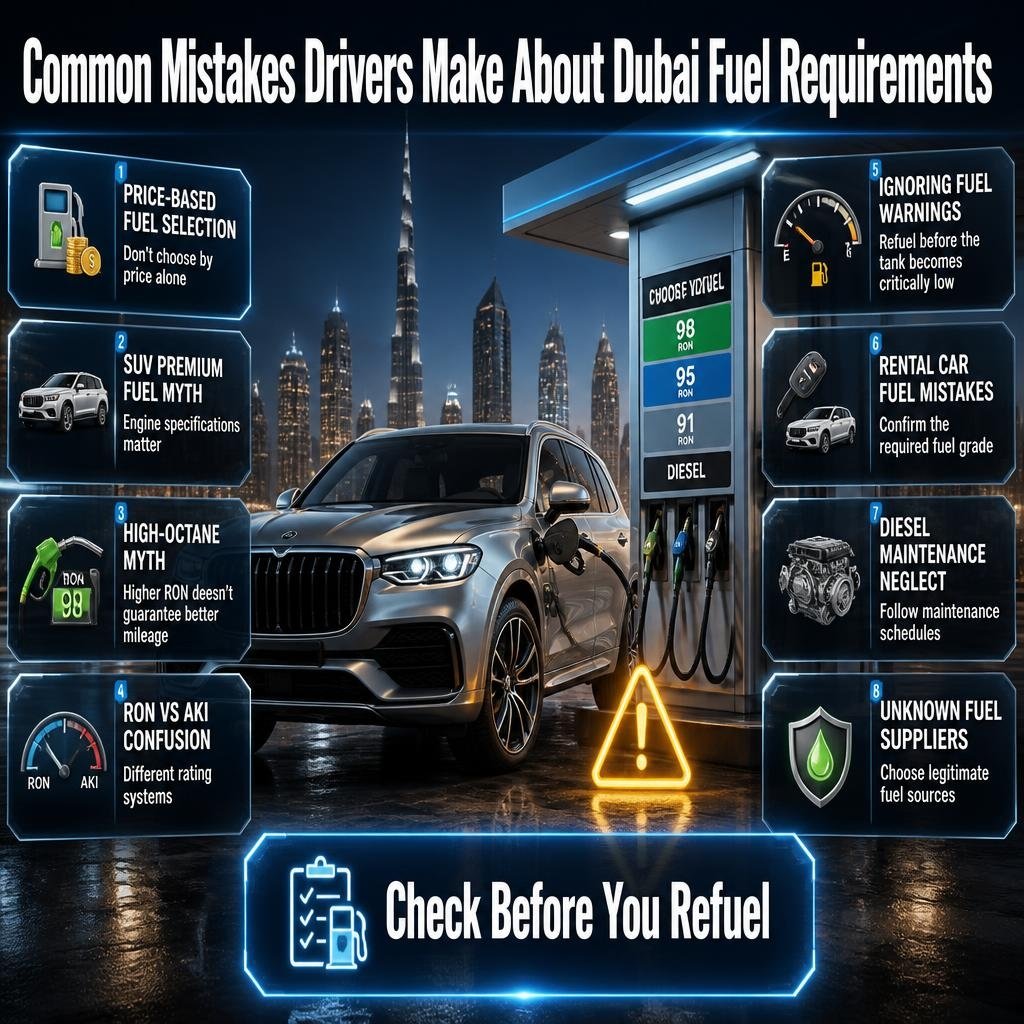
Understanding the fuel available in Dubai is relatively straightforward. The difficulty often comes from incorrect assumptions about compatibility and performance.
Here are some mistakes that drivers should avoid.
Mistake 1: Choosing petrol according to price alone
Drivers sometimes select the cheapest available grade without checking the vehicle’s minimum octane requirement.
This approach can create unnecessary engine risks.
Better approach: Confirm the manufacturer’s required grade first, then compare the available prices of compatible options.
Mistake 2: Assuming every SUV needs premium petrol
An SUV’s size does not determine its octane requirement.
Some SUVs use 91 RON, others require 95 RON, and certain performance models specify 98 RON.
Better approach: Identify the exact engine variant and follow its fuel specification.
Mistake 3: Believing premium fuel always increases mileage
Higher-octane petrol does not automatically contain more usable energy or produce better fuel economy.
Better approach: Use the approved grade and investigate maintenance or driving-related reasons if consumption increases.
Mistake 4: Ignoring the difference between RON and AKI
Imported vehicles may display petrol requirements using a different rating system.
The numerical value of one system cannot automatically be treated as the equivalent value of another.
Better approach: Confirm the correct rating conversion through the manufacturer or an authorised dealer.
Mistake 5: Relying on the fuel gauge until the tank is empty
A fuel gauge provides an estimate, not a guaranteed remaining driving distance.
Traffic and changing driving conditions can reduce the available range.
Better approach: Refuel before the warning becomes an emergency.
Mistake 6: Forgetting to check rental-car fuel requirements
A driver may assume a rental vehicle uses the same petrol grade as their personal vehicle.
Better approach: Confirm the required grade before leaving the rental location.
Mistake 7: Ignoring diesel maintenance
Diesel engines have specific filtration and fuel-system requirements.
Neglecting servicing can contribute to performance problems.
Better approach: Follow the diesel manufacturer’s maintenance schedule and address warning signs promptly.
Mistake 8: Purchasing fuel from unknown suppliers
Unverified fuel can create contamination and safety risks.
Better approach: Use authorised sources and properly regulated fuel services.
15. Professional Recommendations for Better Fuel Management in Dubai
Experienced vehicle owners do not depend on assumptions when managing fuel requirements.
They establish the correct specification, monitor consumption and maintain the vehicle according to its operating conditions.
The following recommendations provide a practical approach.
Recommendation 1: Keep one confirmed fuel specification for each vehicle
If your household has multiple vehicles, maintain a separate fuel record for each one.
For example:
| Vehicle | Fuel type | Required grade |
|---|---|---|
| Family sedan | Petrol | As specified by manufacturer |
| Diesel SUV | Diesel | Approved automotive diesel |
| Performance car | Petrol | As specified by manufacturer |
This simple record can prevent mistakes when family members or drivers use different vehicles.
Recommendation 2: Avoid unnecessary fuel-grade changes
If your vehicle operates correctly on its approved grade, there is generally no reason to experiment with different grades.
Changing grades does not automatically solve mechanical problems.
Recommendation 3: Monitor consumption over several refuelling cycles
A single fuel purchase cannot always reveal a meaningful consumption pattern.
Record several consecutive refuelling transactions and compare the distance travelled with the litres purchased.
This provides a more realistic picture of fuel efficiency.
Recommendation 4: Investigate sudden changes instead of masking them
If consumption increases unexpectedly, consider:
- Tyre pressure.
- Air-filter condition.
- Engine faults.
- Fuel-system performance.
- Traffic patterns.
- Additional vehicle load.
- Air-conditioning use.
A proper inspection is more useful than switching to a more expensive petrol grade without a technical reason.
Recommendation 5: Prepare before long journeys
Before travelling outside familiar areas, check your fuel level, vehicle condition and available refuelling opportunities.
Do not begin a long journey with an uncertain fuel supply.
Recommendation 6: Understand the difference between normal use and emergency assistance
Regular refuelling should remain part of your journey planning.
Emergency assistance is a backup when circumstances prevent you from reaching a suitable petrol station.
Both situations require correct fuel identification and safe handling.
Recommendation 7: Review your fuel records monthly
A monthly review helps identify unusual spending or changes in consumption.
It can also help commercial operators identify vehicles that require maintenance or further investigation.
Recommendation 8: Keep vehicle maintenance and fuel decisions connected
Fuel efficiency is influenced by the condition of the complete vehicle.
Tyres, engine operation, cooling systems, filters and driving behaviour all contribute to overall performance.
Treating fuel selection as an isolated decision can cause drivers to overlook the real reason behind increased fuel consumption.
Which Petrol Grade Should I Use for My Car in Dubai: E-Plus 91, Special 95 or Super 98?
The correct petrol grade depends on your vehicle’s engine design and the manufacturer’s recommended octane rating. E-Plus 91 is suitable for vehicles designed to operate on 91 RON, Special 95 is intended for engines requiring 95 RON, and Super 98 is designed for vehicles requiring or recommending 98 RON. Choosing the correct grade helps maintain proper combustion and avoid unnecessary engine stress. A higher octane rating does not automatically mean better performance or fuel economy.
Before choosing a petrol grade, consider these points:
Check the minimum RON requirement in your owner’s manual.
Inspect the fuel recommendation displayed inside the fuel-filler flap.
Follow the manufacturer’s instructions for turbocharged and high-performance engines.
Avoid using a lower-octane grade simply because it is cheaper.
Do not pay extra for premium petrol unless your vehicle benefits from or requires it.
What Are the Main Fuel Requirements for Petrol and Diesel Vehicles in Dubai?
Petrol and diesel vehicles have different combustion systems, so they cannot use the same type of fuel. Petrol engines generally require unleaded petrol with a suitable octane rating, whereas diesel engines require automotive diesel that meets the relevant fuel specifications. Selecting the correct fuel is essential for proper combustion, reliable starting and protection of sensitive fuel-system components. Drivers should also consider the manufacturer’s requirements, particularly when using imported or commercial vehicles.
Important requirements for vehicle owners include:
Use E-Plus 91, Special 95 or Super 98 according to petrol-engine specifications.
Use automotive diesel only in compatible diesel engines.
Check manufacturer recommendations before refuelling unfamiliar vehicles.
Purchase fuel through established and authorised suppliers.
Follow the recommended fuel-filter and fuel-system maintenance schedule.
Does Dubai’s Hot Weather Affect Petrol Requirements and Fuel Consumption?
Dubai’s high temperatures can influence vehicle operation and real-world fuel consumption, particularly during summer. Extended air-conditioning use, traffic congestion and frequent idling can increase engine workload. However, hot weather does not automatically mean that a vehicle needs higher-octane petrol. The correct fuel grade remains determined by the manufacturer’s specifications. Drivers should focus on vehicle maintenance and efficient driving practices rather than changing petrol grades without a technical reason.
Practical ways to manage fuel consumption in Dubai include:
Maintain the recommended tyre pressure.
Inspect the cooling system regularly.
Avoid unnecessary engine idling.
Keep air and cabin filters in suitable condition.
Use air-conditioning sensibly.
Maintain smooth acceleration and avoid unnecessary braking.
Investigate sudden increases in fuel consumption.
What Happens If I Accidentally Put the Wrong Fuel in My Car in Dubai?
Using the wrong fuel can cause fuel-system contamination, starting difficulties and potentially expensive mechanical damage. Petrol in a diesel vehicle is particularly concerning because it can reduce the lubrication needed by sensitive diesel fuel-system components. Similarly, diesel in a petrol vehicle can interfere with normal combustion and engine operation. The consequences depend on the vehicle, the amount of incorrect fuel and whether the engine has been started.
If incorrect fuel enters your vehicle, take these precautions:
Do not start the engine.
Avoid switching on the ignition unnecessarily.
If the engine is running, stop safely as soon as possible.
Contact a qualified recovery or repair service.
Arrange professional fuel removal and inspection.
Do not attempt to correct the problem by simply adding more of the correct fuel.
What Should I Do If My Car Runs Out of Fuel on a Dubai Road?
Running out of fuel can happen because of unexpected traffic, inaccurate remaining-range estimates or an unplanned journey. If your vehicle stops, roadside safety should be your first priority. Move to a safe location if possible, activate the hazard warning lights and arrange appropriate assistance. An authorised fuel-delivery provider may be able to supply the required fuel, depending on its coverage and available services. Providing accurate vehicle and fuel information helps avoid another refuelling mistake.
Before requesting emergency fuel assistance, prepare these details:
Vehicle make and model.
Correct fuel type: petrol or diesel.
Required petrol grade, if applicable.
Your precise roadside location.
Approximate fuel quantity required.
A working contact number.
Professional advice: Never assume that every roadside fuel provider supplies every petrol grade. Confirm fuel availability and vehicle compatibility before arranging delivery.
Conclusion
Understanding Dubai fuel requirements helps drivers make safer, more informed decisions about vehicle compatibility, fuel selection and everyday driving. Whether your vehicle uses E-Plus 91, Special 95, Super 98 petrol or diesel, the most important rule is to follow the manufacturer’s recommended fuel specification rather than choosing a grade based only on price or performance assumptions.
Dubai’s hot climate, busy roads, frequent traffic and long-distance journeys can also influence fuel consumption. Checking your fuel level before travelling, using the correct fuel grade, maintaining your vehicle and avoiding unnecessary idling can help reduce preventable problems and make daily journeys more efficient.
Drivers should also understand their vehicle’s fuel capacity, warning indicators and basic refuelling requirements. If the fuel level becomes critically low or the vehicle runs out of fuel, stop somewhere safe and arrange appropriate roadside assistance instead of taking unnecessary risks.
For more practical guidance on fuel planning, driving conditions and roadside support, explore Fuel Delivery Dubai. Making informed fuel decisions can help protect your vehicle, manage running costs and keep you better prepared for driving across Dubai.
Leave a Reply