Introduction
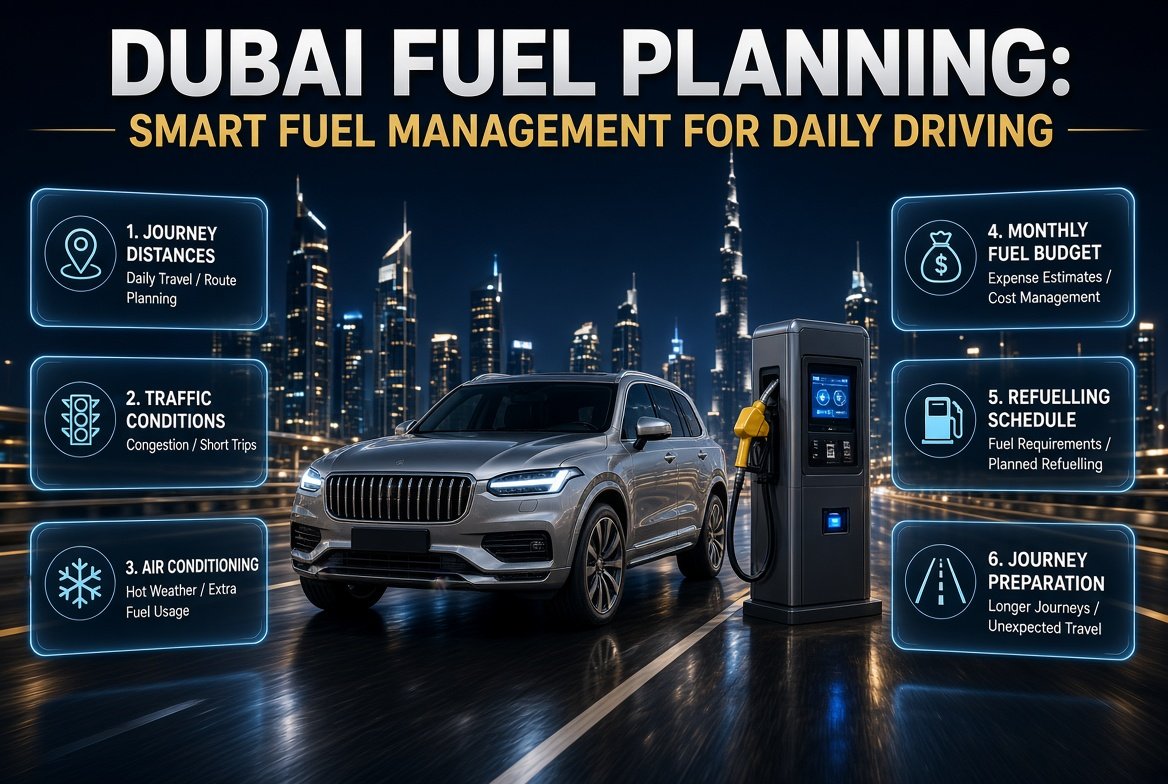
Dubai Fuel Planning | Running out of fuel is not always the result of forgetting to visit a petrol station. Sometimes, it happens because a driver underestimates journey distances, spends more time in traffic than expected, makes frequent short trips or fails to account for the additional fuel consumed by air conditioning during Dubai’s hot weather.
Fuel expenses can also become difficult to manage when daily driving routines change. Someone travelling between home and work may have predictable fuel requirements, while a person regularly driving between Dubai Marina, Downtown Dubai, Business Bay, Deira and other areas may experience very different consumption patterns.
This is where effective Dubai Fuel Planning becomes important. It helps motorists estimate their fuel requirements, organise refuelling schedules, manage monthly budgets and prepare for unexpected journeys without unnecessary stress.
Whether you drive a petrol car, diesel vehicle, SUV, family car or commercial vehicle, having a practical fuel plan can make everyday driving more organised.
For drivers who need additional assistance with fuel-related services, Fuel Delivery Dubai provides information about fuel delivery solutions across Dubai.
This guide explains how to calculate fuel requirements, estimate monthly expenses, choose suitable refuelling intervals, prepare for longer journeys and avoid common planning mistakes. It also considers Dubai’s traffic conditions, driving distances, weather and everyday road situations so you can make sensible decisions based on your actual driving habits.
1. What Is Dubai Fuel Planning and Why Does It Matter?
Dubai fuel planning is the process of estimating how much fuel your vehicle needs, organising refuelling according to your driving routine and managing the money allocated to petrol or diesel.
It involves more than checking the fuel gauge before leaving home. A useful plan considers journey distance, average fuel consumption, traffic conditions, vehicle condition, fuel prices and the possibility of unexpected travel.
For example, a driver travelling 30 kilometres each way to work has different requirements from someone who covers 150 kilometres across several locations every day.
Without planning, both drivers may visit petrol stations unnecessarily or underestimate their weekly requirements.
Why should drivers plan their fuel requirements?
Fuel planning provides several practical advantages:
- Better budget control: You can estimate your weekly and monthly fuel expenses instead of relying on guesswork.
- Fewer unnecessary refuelling stops: Knowing your approximate fuel requirements helps you choose convenient refuelling times.
- Reduced risk of running out: You can maintain an appropriate reserve for delays and unexpected journeys.
- Improved journey preparation: Longer trips become easier to organise when fuel requirements are considered beforehand.
- Better driving awareness: Tracking fuel consumption can help identify unusual changes in vehicle performance.
Fuel planning does not guarantee that every journey will use the same amount of petrol or diesel. It gives you a realistic starting point and helps you adjust when driving conditions change.
2. Understand Your Vehicle’s Fuel Consumption Before Planning
The first step in creating a useful fuel plan is understanding how much fuel your vehicle normally consumes.
Two vehicles travelling the same distance may require different quantities of fuel. Engine size, vehicle weight, transmission, tyre condition, maintenance and driving behaviour all influence consumption.
A large SUV, for example, will generally require a different fuel budget from a small economical sedan.
What does fuel consumption mean?
Fuel consumption describes how much fuel a vehicle uses to travel a particular distance.
In the UAE, vehicle fuel economy is commonly expressed in litres per 100 kilometres (L/100 km).
A lower figure generally means the vehicle uses less fuel to cover the same distance.
Consider these examples:
| Vehicle consumption | Fuel needed for 100 km |
|---|---|
| 6 L/100 km | 6 litres |
| 8 L/100 km | 8 litres |
| 10 L/100 km | 10 litres |
| 12 L/100 km | 12 litres |
| 15 L/100 km | 15 litres |
These figures are examples, not guaranteed consumption rates for particular vehicles.
How can you find your vehicle’s actual consumption?
You can use the vehicle’s onboard fuel economy display as an initial reference. However, calculating consumption from actual refuelling records can provide a useful independent check.
Follow these steps:
- Fill the tank and record the odometer reading.
- Drive normally for a reasonable distance.
- Refill the tank and record how many litres were added.
- Note the distance travelled since the previous fill.
- Divide the fuel added by the distance travelled, then multiply by 100.
Formula:
\[ \text{Fuel Consumption} = \frac{\text{Litres Used}}{\text{Kilometres Driven}}\times100 \]
For example, if your vehicle covers 500 kilometres using 45 litres:
\[ \frac{45}{500}\times100=9 \]
Your estimated fuel consumption is 9 L/100 km.
This figure becomes more useful when calculated across several refuelling cycles rather than relying on one journey.
Pro Tip
Use consistent refuelling conditions when comparing consumption. Filling at a similar point, recording the odometer accurately and tracking several tanks can reduce misleading variations.
3. How to Calculate Your Daily Fuel Requirements in Dubai
Daily fuel planning becomes easier when you understand your regular travel distance.
Instead of guessing how much petrol you need, estimate your daily kilometres and multiply them by your vehicle’s average consumption.
Calculate your daily driving distance
Start by identifying the journeys you normally make.
These might include:
- Travelling from home to work.
- Returning home after work.
- Taking children to school.
- Visiting supermarkets or shopping centres.
- Attending appointments.
- Making additional personal or business trips.
Suppose your daily routine involves:
| Journey | Distance |
|---|---|
| Home to workplace | 20 km |
| Workplace to home | 20 km |
| Shopping and other errands | 10 km |
| Total daily distance | 50 km |
If your vehicle consumes 9 litres per 100 kilometres, the estimated daily requirement is:
\[ \frac{50\times9}{100}=4.5\text{ litres} \]
Your vehicle would use approximately 4.5 litres for this daily distance under conditions similar to those reflected in the consumption estimate.
Why should you include additional journeys?
A common planning error is calculating only the distance between home and work.
Real driving routines often include additional stops, detours, appointments and unexpected travel.
A more realistic estimate should include:
- Regular commuting.
- Shopping and personal errands.
- School or family transport.
- Weekend activities.
- Occasional business journeys.
Adding these distances gives you a more practical estimate of daily fuel requirements.
Create a daily fuel record
You do not need complicated software to track consumption.
A simple notebook or spreadsheet can record:
- Date.
- Odometer reading.
- Daily kilometres.
- Fuel added.
- Estimated consumption.
- Fuel expenditure.
After two or three weeks, you may begin to recognise your normal driving pattern and identify days when fuel use is unusually high.
4. How to Plan Weekly Fuel Requirements
Weekly fuel planning is useful because daily driving requirements are not always consistent.
Some motorists travel mainly between home and work during weekdays, while others make longer trips on weekends.
Planning for the entire week provides a clearer picture of how much fuel you are likely to need.
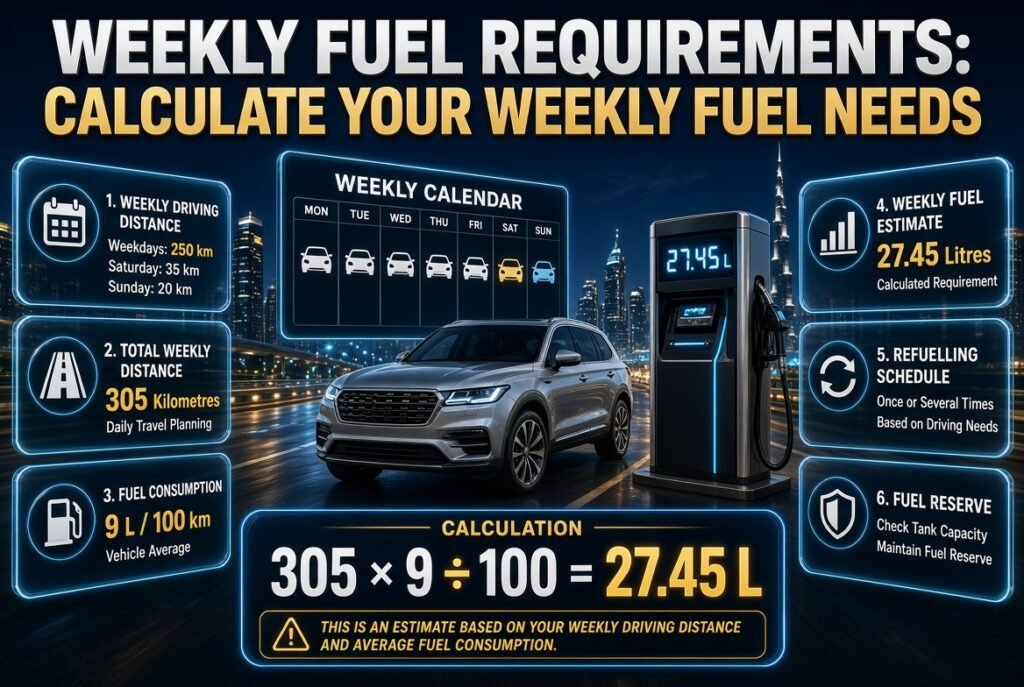
Calculate your weekly distance
Suppose your estimated driving distance is:
- Monday to Friday: 50 kilometres daily.
- Saturday: 35 kilometres.
- Sunday: 20 kilometres.
Your weekly distance becomes:
\[ (50\times5)+35+20=305\text{ km} \]
If your vehicle averages 9 L/100 km:
\[ \frac{305\times9}{100}=27.45\text{ litres} \]
Your estimated weekly fuel requirement is approximately 27.45 litres.
This is a planning estimate, not a guarantee. Traffic, air conditioning, additional journeys and vehicle condition can change the actual amount.
Should you refuel once or several times a week?
There is no single refuelling schedule that suits every driver.
The right approach depends on:
- Your tank capacity.
- Average daily distance.
- Fuel consumption.
- Availability of convenient petrol stations.
- Your normal driving schedule.
- The reserve you prefer to maintain.
A driver covering relatively short distances may refuel once a week. Someone travelling extensively for business may need to refuel more frequently.
Quick Tip: Review your fuel level before beginning a busy week. This helps you avoid having to reorganise an important journey around an unexpected refuelling stop.
5. How to Create a Monthly Fuel Budget in Dubai
A monthly fuel budget helps you understand how much money your regular driving requires. It also makes it easier to prepare for changes in fuel prices, additional journeys and unexpected travel.
The most reliable approach is to calculate your monthly distance first and then apply your vehicle’s actual fuel consumption.
Step 1: Estimate your monthly driving distance
If you drive approximately 50 kilometres every day for 26 days:
\[ 50\times26=1,300\text{ km} \]
Your estimated monthly driving distance is 1,300 kilometres.
Step 2: Calculate monthly fuel consumption
Assume your vehicle consumes 9 litres per 100 kilometres.
\[ \frac{1,300\times9}{100}=117\text{ litres} \]
You will need approximately 117 litres for the month.
Step 3: Calculate the monthly fuel expense
Multiply the required litres by the current price of your vehicle’s recommended fuel grade.
For illustration, if the price is AED 3.50 per litre:
\[ 117\times3.50=\text{AED }409.50 \]
Your estimated monthly fuel expense would be AED 409.50.
This is an example calculation, not a statement of the current UAE pump price.
Monthly fuel budget examples
The following table illustrates how consumption affects your monthly requirements. It assumes 1,300 kilometres of driving and an illustrative fuel price of AED 3.50 per litre.
| Consumption | Monthly fuel | Estimated cost |
|---|---|---|
| 6 L/100 km | 78 litres | AED 273 |
| 8 L/100 km | 104 litres | AED 364 |
| 10 L/100 km | 130 litres | AED 455 |
| 12 L/100 km | 156 litres | AED 546 |
| 15 L/100 km | 195 litres | AED 682.50 |
The comparison shows why vehicle selection and actual fuel consumption matter when calculating monthly running costs.
Should you keep a separate fuel allowance?
Yes, allocating fuel money separately from other vehicle expenses can make budgeting easier.
You can divide your estimated monthly amount into four weekly allowances.
For example, a monthly budget of AED 480 can be divided into approximately AED 120 per week.
If one week requires more fuel because of additional journeys, you can adjust the remaining weekly allowance instead of losing track of the overall budget.
Expert Tip: Do not calculate your budget using the manufacturer’s best advertised fuel economy alone. Use your actual driving records, especially if you regularly experience congestion or make short journeys.
6. How UAE Fuel Prices Affect Your Fuel Planning
Fuel prices are an important part of vehicle ownership in Dubai. Even when your driving distance remains unchanged, a change in the price per litre can increase or reduce your monthly expenses.
The UAE adjusts petrol and diesel prices through a monthly pricing system linked to international market conditions. This means motorists should avoid assuming that the previous month’s fuel cost will remain the same. U.ae
Understand the available fuel grades
Drivers generally encounter the following petrol categories at UAE service stations:
- E-Plus 91.
- Special 95.
- Super 98.
- Diesel for compatible diesel vehicles.
The correct grade depends on the vehicle manufacturer’s specifications.
A higher-priced petrol grade is not automatically better for every vehicle. Some engines require a particular octane rating, while others permit more than one grade.
How can you manage monthly price changes?
A practical approach includes:
- Check the latest official fuel prices at the beginning of each month.
- Identify the grade recommended for your vehicle.
- Update your monthly fuel budget.
- Compare actual expenditure with the previous month.
- Adjust your savings or travel allowance if necessary.
Example: The effect of a price increase
Imagine that your vehicle uses 120 litres each month.
If the price increases by AED 0.20 per litre:
\[ 120\times0.20=\text{AED }24 \]
You would spend AED 24 more per month without changing your driving distance.
This simple calculation shows why reviewing fuel prices is useful for household and business budgeting.
Common Mistake: Choosing a lower petrol grade simply because it is cheaper can be unsuitable for an engine that requires a higher octane rating. Always follow the manufacturer’s recommendation.
7. How Dubai Traffic Conditions Influence Fuel Planning
Traffic conditions can make fuel consumption less predictable, particularly for motorists who travel during busy periods.
A journey that normally takes 25 minutes may take considerably longer when roads become congested. During this additional time, repeated acceleration, braking and stationary idling can increase fuel consumption.
This is especially relevant for people who regularly travel through Business Bay, Downtown Dubai, Deira, Dubai Marina and major connecting roads.
Why does stop-and-go traffic affect fuel requirements?
In moving traffic, a vehicle can maintain a relatively consistent speed for some distance.
In congested conditions, the driver may repeatedly:
- Accelerate after a vehicle moves forward.
- Apply the brakes.
- Stop at traffic signals.
- Wait behind queues.
- Move forward slowly.
- Restart the engine after longer stops.
These conditions can reduce fuel efficiency compared with steady driving.
Plan journeys around your normal traffic patterns
You do not need to avoid every busy road. Instead, understand which routes and travel periods regularly affect your schedule.
Consider:
- Morning commuting periods.
- Evening return journeys.
- Weekend shopping trips.
- School-related traffic.
- Roadworks and temporary diversions.
- Major events and busy commercial areas.
For a broader understanding of how congestion affects everyday journeys, read the guide to Dubai Traffic Patterns.
Should you add extra fuel for traffic delays?
Your normal fuel estimate should account for the conditions in which you actually drive.
If your daily commute regularly involves heavy congestion, calculate consumption using records from those journeys rather than relying on a highway-only average.
If a particular day involves an unusual delay or an additional journey, consider that extra demand before starting the next trip.
For practical information about road congestion, travel disruptions and changing traffic situations, the Dubai Road and Traffic guide provides useful additional reading.
8. How to Plan Fuel for Different Types of Dubai Journeys
Not every journey requires the same fuel calculation. A short city trip, regular commute and long-distance highway journey can produce different consumption patterns.
Planning according to journey type helps you estimate requirements more accurately.
Daily city driving
City driving often involves traffic signals, lower speeds, parking searches and frequent stops.
For example, a driver travelling between residential areas and nearby shopping destinations may cover only 20–30 kilometres but spend a considerable amount of time on the road.
When calculating fuel requirements for these journeys:
- Include return distances.
- Account for additional stops.
- Consider congestion.
- Use your actual city-driving consumption.
- Avoid assuming that short distances always mean low fuel use.
Highway driving
Longer journeys on Sheikh Zayed Road, Emirates Road or other major highways require a different approach.
Although traffic may move more consistently, high speeds, vehicle loading and air resistance can influence consumption.
Before leaving:
- Estimate the total distance.
- Include the return journey where applicable.
- Check your fuel level.
- Consider possible diversions.
- Allow a reasonable reserve.
- Check road conditions before travelling.
Family journeys
Family trips may involve additional luggage, passengers, air-conditioning demand and multiple destinations.
These factors can change the amount of fuel required.
A vehicle carrying several passengers and a full luggage compartment may consume more than the same vehicle travelling with one person.
Business and commercial journeys
Business drivers often have less predictable travel requirements.
A delivery vehicle, service car or company SUV may visit several locations in a single day.
A useful plan should include:
- Scheduled appointments.
- Estimated distance between locations.
- Return or depot travel.
- Additional customer visits.
- Vehicle load.
- Fuel records for individual working days.
Separating personal and business fuel expenditure also makes expense reporting more straightforward.
9. How Weather and Air Conditioning Affect Fuel Planning in Dubai
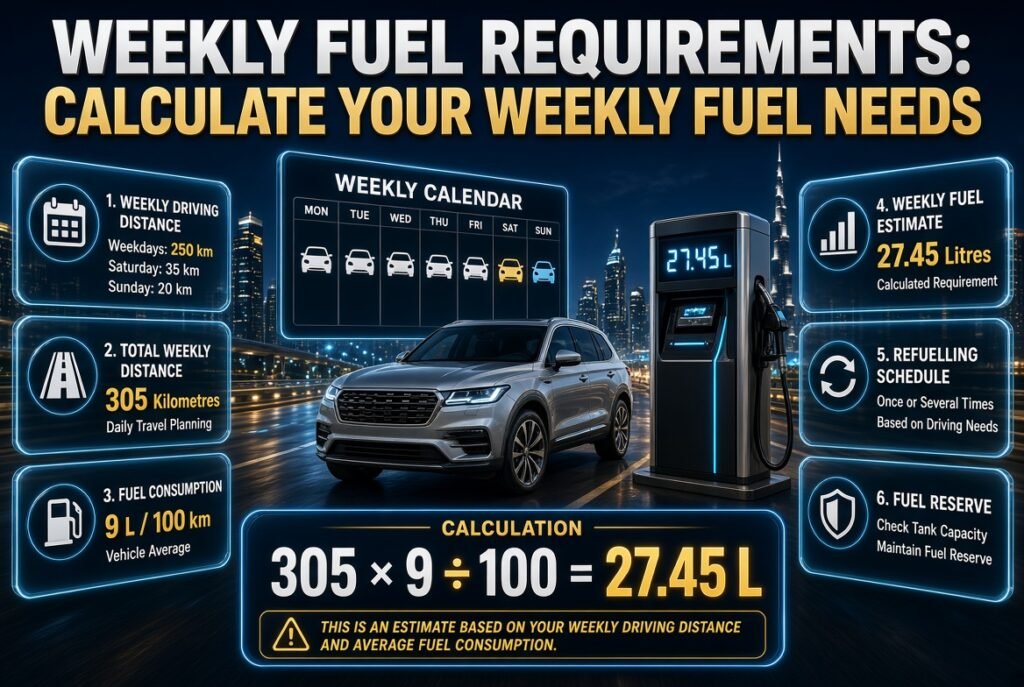
Dubai’s climate makes air conditioning an important part of everyday driving.
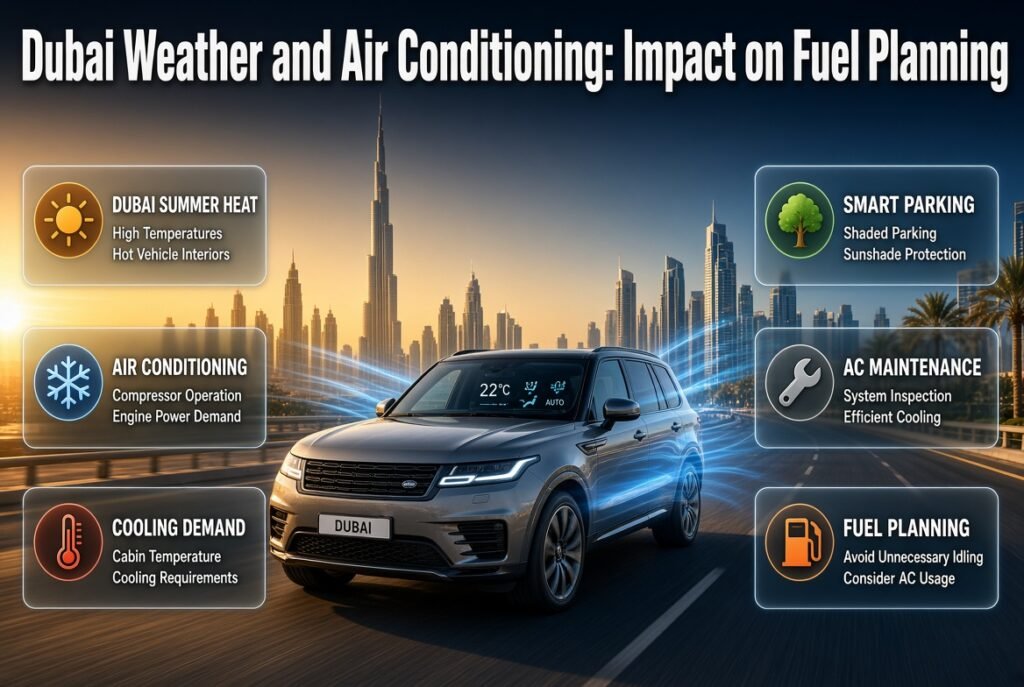
During hotter months, motorists often operate the cooling system for most of their journey. The air-conditioning compressor requires engine power in conventional vehicles, which can increase fuel consumption.
The actual effect varies according to vehicle design, outside temperature, cooling settings, journey duration and operating conditions.
Why should summer driving receive additional attention?
A vehicle parked in direct sunlight can become extremely hot.
When you enter, the cabin may require substantial cooling before reaching a comfortable temperature.
During this period, the air-conditioning system may work harder, particularly when the vehicle has been exposed to high temperatures for several hours.
For better planning:
- Park in shaded areas where possible.
- Use sunshades when appropriate.
- Allow hot air to escape before setting off when safe.
- Maintain the air-conditioning system.
- Avoid unnecessary engine idling.
- Keep the cabin cooling system in good condition.
Does running the AC always mean significantly higher fuel use?
Not necessarily.
Modern vehicles have different compressor designs and climate-control systems. Some regulate cooling demand more efficiently than others.
Rather than switching off the air conditioning during extreme heat, use it sensibly while maintaining a comfortable and safe cabin temperature.
Driver comfort and concentration are important, particularly during longer journeys.
For a detailed understanding of this subject, explore Dubai City Driving.
10. How Much Fuel Should You Keep in Your Vehicle?
Maintaining an appropriate fuel reserve is one of the most important parts of practical fuel planning.
There is no universal reserve level suitable for every vehicle. Tank capacity, fuel consumption, driving distance and access to refuelling facilities all matter.
However, allowing the fuel level to become extremely low before searching for a petrol station is an unnecessary risk.
Why should you avoid regularly driving on a nearly empty tank?
A low fuel level can create problems when:
- You encounter unexpected congestion.
- A road closure forces a longer route.
- You need to travel to an unfamiliar destination.
- A planned petrol station is unavailable.
- An emergency requires immediate travel.
Some vehicles also rely on fuel for cooling and lubrication of components within the fuel system. Repeatedly operating at very low fuel levels may increase the risk of problems, depending on vehicle design.
What is a sensible refuelling approach?
Instead of waiting until the warning light appears, establish a personal refuelling point based on your vehicle’s normal consumption.
For example, if your daily driving distance is 50 kilometres and your vehicle consumes 10 L/100 km, it requires approximately 5 litres per day.
If you regularly drive longer distances, you should consider refuelling earlier.
Understand your fuel warning light
The low-fuel warning light indicates that the vehicle has reached a predefined reserve threshold.
It is not an invitation to continue driving until the tank is empty.
The remaining range shown by a dashboard display is an estimate. It can change according to speed, traffic, driving behaviour and vehicle conditions.
Expert Tip: Learn how your vehicle’s fuel gauge behaves after refuelling. Some gauges move gradually while others may remain relatively stable before dropping more noticeably. Never use an assumed universal reserve distance.
11. How to Plan Fuel for Long-Distance Travel from Dubai
Long-distance journeys require more preparation than ordinary city driving because the driver may spend extended periods away from familiar refuelling locations.
Trips towards Abu Dhabi, Sharjah, Ras Al Khaimah, Fujairah or other emirates should be planned according to distance, vehicle condition and expected travel conditions.
Even when a journey appears straightforward on a navigation application, roadworks, traffic changes or unexpected stops can affect the total distance.
Calculate the complete journey distance
Always calculate the full journey rather than considering only the distance to your destination.
For example, suppose you plan a 200-kilometre one-way journey.
Your estimated return distance is:
\[ 200\times2=400\text{ km} \]
If your vehicle consumes 9 litres per 100 kilometres:
\[ \frac{400\times9}{100}=36\text{ litres} \]
Your estimated requirement is 36 litres for the return journey.
This does not include additional detours, local driving or unusual traffic conditions.
Pre-journey fuel checklist
Before leaving Dubai, consider the following:
- Check the current fuel level.
- Estimate the total journey distance.
- Confirm the vehicle’s average consumption.
- Identify suitable refuelling opportunities.
- Check tyre pressure.
- Inspect for visible fluid leaks.
- Confirm that the engine is operating normally.
- Review traffic and weather conditions.
- Carry essential emergency contact information.
What if your destination is unfamiliar?
Do not assume that the nearest petrol station will always be available when you need it.
Identify potential refuelling locations along your route before departure. This is particularly useful when travelling late at night, through less familiar areas or on longer journeys.
You should also avoid planning to arrive at your destination with almost no fuel remaining.
A comfortable reserve provides flexibility if the journey takes longer than expected.
12. How to Choose the Right Refuelling Schedule
A refuelling schedule is a simple routine that helps you maintain an appropriate fuel level without making unnecessary trips to petrol stations.
The best schedule depends on your daily distance, tank capacity, consumption and personal preferences.
Daily refuelling
Daily refuelling may suit commercial vehicles or drivers covering extensive distances.
However, it is usually unnecessary for motorists with short and predictable journeys.
Its main advantage is that the driver can begin each working day with a known fuel level.
Weekly refuelling
Weekly refuelling can work well for people with consistent commuting routines.
You can estimate the week’s consumption and choose a convenient time to refill.
This approach also makes weekly expense tracking easier.
Refuelling when required
Some motorists prefer checking their fuel level regularly and refuelling whenever it reaches a predetermined threshold.
This approach provides flexibility because it does not depend on a fixed day.
However, it requires attention to the dashboard and a reasonable understanding of the vehicle’s fuel requirements.
Which schedule should you choose?
| Driving pattern | Suitable planning approach |
|---|---|
| Short daily commuting | Regular fuel-level checks |
| Consistent weekly journeys | Weekly refuelling review |
| Extensive business travel | Frequent fuel monitoring |
| Long-distance driving | Pre-journey fuel calculation |
| Irregular driving | Refuel according to actual requirements |
There is no need to fill the tank completely every time if doing so does not suit your budget or driving routine. What matters is maintaining enough fuel for planned journeys and a sensible reserve.
13. How to Plan Fuel When Your Driving Routine Changes
A fuel budget based on an old driving routine may become inaccurate when your circumstances change.
For example, changing workplaces, moving to another residential area or taking on additional responsibilities can increase your monthly mileage.
Your fuel plan should change whenever your regular travel requirements change.
When changing your workplace
Calculate the new return distance and compare it with your previous commute.
A difference of 15 kilometres each way may seem small, but across 26 working days it adds 780 kilometres to your monthly driving distance.
At 9 L/100 km, this represents:
\[ \frac{780\times9}{100}=70.2\text{ litres} \]
That is an additional 70.2 litres per month.
During holidays and weekends
Holiday periods may involve fewer commuting journeys but more family travel.
Your fuel consumption may therefore remain similar or even increase despite having fewer working days.
Plan according to the actual journeys rather than assuming that holidays always reduce fuel expenditure.
When travelling more frequently
If your job or personal commitments suddenly require additional driving, review your weekly fuel allowance.
Do not continue using an outdated monthly estimate.
A quick recalculation can prevent budget shortages later in the month.
14. How Vehicle Maintenance Supports Better Fuel Planning
Fuel planning is not only about how much you drive. It also involves understanding whether your vehicle is operating efficiently.
Mechanical problems can increase fuel consumption and make your normal calculations unreliable.
A vehicle that previously covered 500 kilometres using a particular amount of fuel may start covering less distance if a mechanical issue develops.
Important vehicle checks
Tyre pressure
Incorrect tyre pressure can increase rolling resistance and affect fuel economy.
Check pressures according to the manufacturer’s recommendations, including any different requirements for heavy loads.
Engine air filter
A dirty or restricted air filter can affect engine operation. Follow the vehicle manufacturer’s inspection and replacement schedule.
Engine oil
Using the correct engine oil specification and maintaining suitable oil levels supports proper lubrication and engine operation.
Spark plugs and ignition components
In petrol vehicles, worn ignition components can contribute to inefficient combustion, misfires and poor performance.
Fuel system
Fuel leaks, damaged components or other fuel-system faults require proper inspection.
Wheel alignment and brakes
Incorrect alignment or dragging brakes can create additional resistance while driving.
These issues should be investigated rather than treated as normal fuel consumption.
Why should you monitor unusual fuel consumption?
An unexpected increase in fuel use may indicate:
- A change in driving conditions.
- Incorrect tyre pressure.
- Additional vehicle loading.
- A mechanical fault.
- A change in route or journey length.
- An issue with the engine management system.
Do not immediately assume that higher consumption is caused by expensive fuel. First compare your actual kilometres, fuel purchases and driving conditions.
For a structured approach to vehicle upkeep, read the Vehicle Maintenance Guides only if you have that page available on your site?
15. How to Use Technology for Better Fuel Planning
Modern vehicles and navigation tools can make fuel planning easier by providing information that was previously difficult to track.
You do not need expensive equipment or a complicated application. A few simple digital features can provide most of the information required for an effective routine.
Use the vehicle’s trip computer
Many modern cars display:
- Average fuel consumption.
- Current fuel consumption.
- Estimated remaining range.
- Distance travelled.
- Average driving speed.
- Journey time.
These figures can help you compare different journeys.
However, the remaining range is an estimate rather than a guaranteed distance. Treat it as guidance, not permission to delay refuelling.
Use navigation tools
Navigation applications can help you estimate journey distances and identify potential route changes.
Before starting a trip:
- Enter your destination.
- Check the suggested route.
- Review expected delays.
- Consider alternative routes.
- Estimate the complete journey distance.
- Include additional stops where necessary.
For road-related information, the Dubai Road Conditions guide can help readers understand why checking the road situation should be part of journey preparation.
Maintain a digital fuel spreadsheet
A simple spreadsheet can contain these columns:
| Date | Distance | Litres purchased | Fuel expense |
|---|---|---|---|
| Week 1 | 280 km | 25 L | AED 87.50 |
| Week 2 | 310 km | 28 L | AED 98 |
| Week 3 | 250 km | 23 L | AED 80.50 |
| Week 4 | 300 km | 27 L | AED 94.50 |
Illustrative figures using AED 3.50 per litre.
This record makes it easier to understand how much you spend and whether your vehicle’s consumption is changing.
16. What Should You Do If You Run Low on Fuel in Dubai?
Even drivers with good planning habits can experience unexpected situations.
A sudden change of route, prolonged congestion, an incorrect fuel estimate or an unexpected journey may leave you with less fuel than expected.
The important thing is to respond calmly and safely.
Recognise the warning signs
Depending on the vehicle, low-fuel situations may involve:
- The fuel warning light appearing.
- A rapidly decreasing estimated range.
- An inaccurate or fluctuating fuel gauge.
- Difficulty maintaining normal engine operation in some circumstances.
If the engine begins losing power or behaves abnormally, do not assume that fuel is the only possible cause.
Follow a safe response
- Stay calm and avoid sudden driving manoeuvres.
- Look for a safe place to stop if the vehicle cannot continue.
- Do not stop in an active traffic lane unless unavoidable.
- Use hazard lights when appropriate.
- Follow local road-safety requirements.
- Contact suitable roadside assistance if you cannot reach a petrol station safely.
Never attempt to walk along a busy highway to find fuel.
When can fuel delivery assistance be useful?
Fuel delivery can be a practical option when a vehicle runs low on fuel and travelling to a petrol station is inconvenient or unsafe.
It may be particularly useful when:
- Your car is parked in a residential building’s designated parking area.
- You are at an accessible workplace parking location.
- You have miscalculated your fuel requirements.
- Your vehicle cannot conveniently reach a petrol station.
- You need assistance at an eligible roadside location.
For additional guidance about fuel-related support, you can visit Fuel Delivery Dubai services.
Availability depends on the service provider, vehicle location, access conditions and applicable safety requirements. A delivery service should not be assumed to be available at every highway or restricted location.
17. Common Dubai Fuel Planning Mistakes and How to Avoid Them
Many fuel-planning problems happen because drivers rely on assumptions instead of actual consumption records.
Understanding these mistakes can help you create a more reliable routine.
Mistake 1: Planning only according to commuting distance
Why it happens: Drivers often calculate the distance between home and work but forget shopping, school runs and other journeys.
Why it causes problems: The actual weekly distance becomes higher than the original estimate.
How to avoid it: Include all regular journeys when calculating your weekly and monthly requirements.
Mistake 2: Ignoring traffic conditions
Why it happens: Drivers assume that fuel consumption remains constant regardless of travel time.
Why it causes problems: Congestion, repeated acceleration and idling can increase fuel use.
How to avoid it: Maintain separate consumption estimates for typical city and highway driving where practical.
Mistake 3: Depending entirely on the dashboard range
Why it happens: The remaining-range display appears to provide an exact distance.
Why it causes problems: The estimate changes with driving conditions and recent consumption.
How to avoid it: Use the display as supporting information while maintaining your own refuelling routine.
Mistake 4: Forgetting monthly fuel price changes
Why it happens: Motorists continue using last month’s budget.
Why it causes problems: Their actual expenditure may become higher than expected.
How to avoid it: Review the applicable fuel price at the beginning of every month.
Mistake 5: Refuelling only when the warning light appears
Why it happens: Drivers postpone refuelling to save time or avoid making another stop.
Why it causes problems: Unexpected journeys and delays can leave very little flexibility.
How to avoid it: Establish a suitable refuelling threshold based on your vehicle’s consumption and normal travel requirements.
Mistake 6: Using unrealistic fuel economy figures
Why it happens: Drivers depend entirely on manufacturer specifications.
Why it causes problems: Official test figures may not represent actual Dubai driving conditions.
How to avoid it: Calculate your consumption from real refuelling records.
Mistake 7: Choosing fuel based only on price
Why it happens: A lower-priced grade appears to offer immediate savings.
Why it causes problems: The selected grade may not meet the engine manufacturer’s requirements.
How to avoid it: Follow the recommended fuel specification.
Mistake 8: Forgetting to include return journeys
Why it happens: Drivers estimate the fuel required to reach a destination but forget the return distance.
Why it causes problems: The vehicle may have insufficient fuel for the complete journey.
How to avoid it: Calculate total distance before departure, including planned stops and diversions.
18. Expert Recommendations for More Reliable Fuel Planning
An effective fuel plan should be simple enough to follow consistently. It should also be flexible enough to reflect changing travel conditions.
The following practices can help motorists improve the accuracy of their estimates.
Build your plan around actual consumption
Start with your real driving records rather than generic vehicle averages.
Record at least several refuelling cycles and compare the results.
If your vehicle consumes more fuel in city traffic than on highways, account for that difference when estimating monthly requirements.
Separate fixed and variable journeys
Fixed journeys include commuting and regular appointments.
Variable journeys include weekend activities, shopping, family visits and unexpected travel.
Calculate these separately so you can understand which activities create additional fuel expenditure.
Review your budget every month
Your monthly review should consider:
- Total kilometres driven.
- Total litres purchased.
- Average consumption.
- Fuel price changes.
- Unexpected journeys.
- Changes in commuting distance.
- Any unusual increase in fuel expenditure.
This makes it easier to adjust your next month’s allowance.
Do not compromise vehicle safety to save fuel
Fuel economy should never become more important than safe driving.
Do not drive at an unsuitable speed, switch off essential cooling during extreme heat or ignore maintenance requirements simply to reduce fuel expenditure.
Follow traffic regulations and your vehicle manufacturer’s recommendations.
Keep an emergency allowance
Your normal fuel budget should not use every available amount without flexibility.
Unexpected travel, road diversions and additional family requirements can increase fuel costs.
A small separate allowance can help you manage these situations without disturbing your regular monthly budget.
19. How to Build a Practical Fuel Planning Routine
The best fuel-planning system is one that fits naturally into your normal driving routine.
You should not need to calculate every journey from the beginning. Once you understand your vehicle’s consumption and regular travel distance, most estimates become straightforward.
Your daily routine
Before leaving:
- Check the dashboard fuel level.
- Consider the day’s planned destinations.
- Review any additional journeys.
- Check whether your normal route has changed.
- Make sure the vehicle is operating normally.
At the end of the day, record your distance if you are tracking fuel consumption.
Your weekly routine
Once a week:
- Review your total driving distance.
- Check the remaining fuel.
- Compare actual and estimated consumption.
- Consider upcoming appointments or longer journeys.
- Decide whether refuelling is required.
Your monthly routine
At the beginning or end of each month:
- Check the latest fuel prices.
- Review your total fuel expenditure.
- Calculate average monthly consumption.
- Identify changes in driving habits.
- Update your next month’s fuel allowance.
This simple routine can prevent many common budgeting and refuelling problems.
20. How Businesses and Fleet Operators Can Plan Fuel More Effectively
Fuel planning is particularly important for businesses operating several vehicles in Dubai.
A company that manages delivery vans, service vehicles, sales cars or commercial transport cannot rely on individual drivers making informal refuelling decisions.
Poor fuel management can make operating expenses difficult to monitor and may create unnecessary interruptions to daily operations.
Establish a fuel allowance for each vehicle
Different vehicles should have different fuel budgets.
For example, a small service car, a large SUV and a commercial delivery vehicle will not have identical consumption requirements.
Consider:
- Vehicle type and engine specifications.
- Average monthly distance.
- Typical operating conditions.
- Number of daily assignments.
- Vehicle load.
- Actual fuel consumption.
Monitor fuel purchases against kilometres travelled
Recording only the amount spent on fuel does not provide a complete picture.
Businesses should compare litres purchased with the kilometres covered by each vehicle.
This helps identify unusual changes that may require investigation.
Reduce unnecessary vehicle movement
Businesses can also improve fuel planning by organising daily assignments more efficiently.
Useful practices include:
- Grouping nearby appointments.
- Avoiding unnecessary return journeys.
- Coordinating delivery schedules.
- Reviewing vehicle routes.
- Keeping vehicles properly maintained.
- Monitoring excessive idling.
Prepare for unexpected operational requirements
Commercial vehicles sometimes need to complete additional assignments without much notice.
A suitable fuel reserve and clear refuelling procedure can reduce the risk of interruptions.
For fleet operators, the objective is not simply to purchase less fuel. It is to use available fuel efficiently while maintaining reliable service and safe vehicle operation.
21. A Complete Dubai Fuel Planning Checklist
Use this checklist to review your fuel requirements and make sure your planning process covers the most important areas.
Before creating your fuel budget
- Identify your vehicle’s recommended fuel grade.
- Check the tank capacity.
- Understand the average fuel consumption.
- Estimate daily kilometres.
- Calculate weekly travel distance.
- Include weekend and personal journeys.
For monthly budgeting
- Check the applicable fuel price.
- Calculate expected monthly litres.
- Estimate total fuel expenditure.
- Set a weekly allowance.
- Keep a small emergency budget.
- Review previous fuel expenses.
Before longer journeys
- Check the fuel level.
- Calculate the return distance.
- Review the route.
- Consider possible delays.
- Identify suitable refuelling opportunities.
- Check tyre pressure and vehicle condition.
For ongoing monitoring
- Record kilometres travelled.
- Keep fuel purchase receipts.
- Compare actual consumption.
- Investigate unusual changes.
- Review your plan whenever your routine changes.
A complete fuel plan should cover both normal driving requirements and unexpected situations. You do not need a complicated system; consistent records and sensible decisions are usually enough.
How Can I Calculate My Monthly Fuel Budget for Driving in Dubai?
Calculating a monthly fuel budget starts with understanding how far you drive and how much fuel your vehicle consumes. Rather than using a general estimate, consider your actual commuting distance, weekend travel, additional stops and average fuel consumption.
For example, if you drive 1,500 kilometres per month and your vehicle consumes 10 litres per 100 kilometres, your estimated monthly requirement is 150 litres. Multiply this amount by the current price of your recommended fuel grade to calculate your expected expenditure.
Important factors to consider:
Your average monthly driving distance.
Your vehicle’s actual fuel consumption.
Current UAE petrol or diesel prices.
Additional journeys and unexpected travel.
Changes in traffic and driving conditions.
Review your expenses every month so your budget reflects your actual driving habits rather than outdated estimates.
How Much Fuel Should I Keep in My Car for Daily Driving in Dubai?
The amount of fuel you should maintain depends on your vehicle’s consumption, daily travel distance, tank capacity and access to refuelling facilities. Drivers covering long distances or regularly travelling through congested areas should maintain a more comfortable reserve than motorists making occasional short journeys.
For example, a vehicle travelling 60 kilometres daily with an average consumption of 10 L/100 km requires approximately 6 litres for that distance. However, additional journeys, traffic delays and unexpected diversions can increase the requirement.
For better fuel management:
Establish a regular refuelling threshold.
Check the fuel gauge before longer journeys.
Avoid depending entirely on the dashboard’s remaining-range estimate.
Consider unexpected travel when deciding when to refuel.
Do not regularly wait for the low-fuel warning light.
Maintaining an appropriate reserve gives you greater flexibility and reduces the risk of being stranded because of an incorrect fuel estimate.
How Do Dubai Traffic and Weather Conditions Affect Fuel Planning?
Dubai’s traffic and weather conditions can significantly influence how much fuel a vehicle uses. Frequent acceleration, braking, stationary idling and slow-moving traffic can increase consumption compared with consistent driving.
High temperatures also make air conditioning an important consideration. In conventional petrol and diesel vehicles, operating the air-conditioning compressor can require additional engine power.
Drivers travelling through busy areas such as Downtown Dubai, Business Bay, Deira and Dubai Marina should consider these conditions when estimating their fuel requirements.
Practical planning recommendations:
Use realistic city-driving consumption figures.
Allow for regular congestion during commuting hours.
Include air-conditioning use in your estimates.
Check traffic conditions before longer journeys.
Monitor changes in fuel consumption during hotter months.
A fuel budget based on actual Dubai driving conditions is generally more reliable than one calculated using ideal highway consumption figures.
How Can I Plan Fuel for Long-Distance Journeys from Dubai to Other Emirates?
Long-distance fuel planning requires calculating the complete journey, including return travel, local driving and possible diversions. Drivers should check their current fuel level before departure and identify suitable refuelling opportunities along the route.
For example, if your planned return journey covers 400 kilometres and your vehicle consumes 8 litres per 100 kilometres, the estimated fuel requirement is 32 litres.
However, this estimate should be adjusted if your vehicle will carry additional passengers or luggage, encounter heavy traffic or travel through unfamiliar routes.
Before starting your journey:
Calculate the complete travel distance.
Check your vehicle’s actual fuel consumption.
Confirm the available fuel level.
Identify convenient refuelling locations.
Inspect tyre pressure and general vehicle condition.
Allow a reasonable reserve for unexpected changes.
Good preparation helps you avoid unnecessary interruptions and makes longer journeys more predictable.
What Should I Do If My Car Runs Out of Fuel in Dubai?
Running out of fuel can happen even when you normally follow a refuelling routine. Unexpected traffic, additional journeys, inaccurate fuel-range estimates or changes in your route can leave you with insufficient fuel.
Your first priority should be safety. If the vehicle begins losing power, move towards a safe stopping location if possible. Avoid stopping in an active traffic lane unless unavoidable, switch on hazard lights when appropriate and follow local road-safety requirements.
If you cannot safely reach a petrol station, appropriate roadside assistance or a fuel delivery service may help, depending on your location and accessibility.
Recommended actions:
Keep your vehicle in a safe location.
Avoid walking along busy roads to find fuel.
Contact suitable roadside assistance.
Provide your accurate vehicle location.
Explain the vehicle’s fuel requirements.
Follow the service provider’s safety instructions.
Professional recommendation: Do not wait until an emergency occurs to think about refuelling. Establishing a sensible fuel reserve and reviewing your planned journeys regularly are much better ways to prevent unexpected fuel shortages.
Conclusion
Effective Dubai Fuel Planning is not just about knowing when to refill your tank—it’s about making smarter driving decisions that save time, improve budgeting and help you avoid unnecessary stress on the road. When you understand your vehicle’s actual fuel consumption, calculate your weekly and monthly driving needs and account for Dubai’s traffic, weather and longer journeys, fuel management becomes far more predictable.
The most practical approach is to build a simple routine: monitor your fuel level regularly, review your monthly fuel expenses, plan ahead for longer trips and maintain a comfortable fuel reserve instead of relying on the warning light. Small habits like tracking your kilometres, considering traffic delays and adjusting your budget when fuel prices change can make a noticeable difference over time.
Whether you’re a daily commuter, a family driver or someone who travels across Dubai for business, a well-planned fuel strategy helps you stay prepared for both routine journeys and unexpected situations. By combining smart budgeting, sensible refuelling habits and proper vehicle maintenance, you can drive with greater confidence, reduce avoidable fuel-related problems and enjoy a smoother driving experience throughout Dubai.
Leave a Reply