
Introduction
Petrol vs Diesel Emission Standards in Dubai | Buying a petrol or diesel car in Dubai is not only about engine performance, fuel economy, or servicing expenses. The vehicle must also meet the applicable technical and emissions requirements for its category and intended registration. This becomes especially important when purchasing a used imported car, registering a vehicle for the first time, or checking whether an older vehicle remains suitable for continued use.
Petrol vs diesel emission standards in Dubai help buyers understand the regulatory requirements that apply to different engine types and vehicle specifications. These standards establish requirements for controlling exhaust pollutants, while conformity procedures help demonstrate that a vehicle meets the relevant technical specifications.
Dubai drivers also need to understand an important distinction: a vehicle’s original emissions certification is not the same as its routine technical inspection. A car may have documentation identifying its approved emission standard, while its current mechanical condition determines whether its emission-control equipment is operating properly.
This guide explains the relevant standards, the UAE’s Euro 6b implementation framework, the differences between petrol and diesel compliance, vehicle import considerations, inspection preparation, and common mistakes to avoid.
If you need assistance with fuel-related issues during everyday driving, Fuel Delivery Dubai provides a starting point for understanding fuel assistance services. However, fuel delivery, mechanical maintenance, emissions testing, and regulatory conformity are separate matters and should be handled accordingly.
2. What Are Petrol and Diesel Emission Standards?
Vehicle emission standards are regulatory requirements that specify how vehicles must control the pollutants released through their exhaust systems. These requirements influence engine design, fuel management, exhaust treatment, and the technical evidence manufacturers provide when seeking vehicle approval.
For petrol and diesel vehicles, the standards address pollutants such as carbon monoxide, hydrocarbons, nitrogen oxides, and particulate matter. The precise limits and testing procedures depend on the applicable regulatory stage and vehicle category.
Why do emission standards exist?
Emission standards provide a consistent framework for assessing whether a vehicle’s design meets defined pollution-control requirements. Without common technical requirements, vehicles manufactured for different markets could have significantly different emissions specifications, making conformity assessment more complicated.
They also give manufacturers a basis for designing engines and exhaust-treatment systems that meet the requirements of the markets where their vehicles will be sold.
The main purposes include:
- Establishing technical requirements for controlling regulated exhaust pollutants.
- Providing a basis for vehicle type approval and conformity assessment.
- Encouraging the development of more effective engine and exhaust technologies.
- Supporting consistent evaluation of vehicles manufactured for different markets.
- Helping regulators distinguish approved vehicle specifications from unsuitable or undocumented configurations.
Do petrol and diesel vehicles follow identical emission requirements?
Not necessarily. Both fuel types are subject to applicable vehicle-emission requirements, but the technical limits, testing methods, and relevant engine characteristics can differ.
For example, diesel engines require particular attention to nitrogen oxides and particulate matter. Petrol engines have their own regulated pollutants and may use different technologies to control them.
The relevant standard must therefore be interpreted according to the vehicle’s category, engine type, approval documentation, and the rules applicable to its intended use.
What does compliance actually mean?
Compliance means satisfying the applicable regulatory requirements. It is not simply a description of how clean a car appears or how efficiently it uses fuel.
A vehicle’s compliance assessment may involve its approved technical specification, conformity documentation, and any additional procedures required for importation or registration.
For an individual owner, this distinction matters because replacing a damaged component may restore the vehicle’s operating condition, but it does not necessarily resolve a separate documentation or approval issue.
3. Which Emission Standards Apply to Petrol and Diesel Vehicles in Dubai?
The UAE uses vehicle technical regulations that reference recognised emissions requirements, including Euro standards. These standards identify different regulatory stages, with later stages generally introducing tighter or more comprehensive controls for relevant pollutants.
For buyers considering a new or imported vehicle in 2026, the Euro 6b-equivalent framework is particularly important.
Understanding the UAE’s Euro 6b implementation framework
The GCC Standardization Organization’s published guidance on the UAE’s implementation framework identifies Euro 6b as the required emissions level for relevant new vehicle types under the applicable implementation schedule. The schedule has also been subject to clarification and changes, so the precise effective date must be checked against the current rules.
The key practical point for a buyer in October 2026 is that the implementation arrangements distinguish between vehicle categories and application dates. Published industry guidance concerning the UAE’s 2026 changes indicates that a transition period was provided for passenger and heavy-duty vehicles, with Euro 6b requirements applying to newly submitted applications from 1 October 2026 under that reported update.
Because implementation notices and formal regulations may differ in scope, do not treat one general date as proof of eligibility for every vehicle. Confirm the latest requirement for the specific vehicle category and application with the relevant UAE authority or authorised importer before making a purchase.
What is Euro 6b?
Euro 6b is a particular stage within the broader Euro 6 family of emissions requirements. It specifies requirements for controlling regulated pollutants under the applicable approval procedures.
The term is more precise than simply saying that a vehicle is “Euro 6 compliant.” Different Euro 6 stages can involve different testing procedures and technical requirements.
A seller who advertises a car as Euro 6 should therefore be able to identify the precise standard or provide accepted conformity evidence.
How do Euro 4, Euro 5, and Euro 6 differ?
| Standard | General description | Practical consideration for Dubai buyers |
|---|---|---|
| Euro 4 | An earlier generation of European emissions requirements | Check the vehicle’s age, original specification, and applicable eligibility rules |
| Euro 5 | A later generation with more demanding requirements for relevant pollutants | Verify whether its conformity status is acceptable for the intended transaction |
| Euro 6 | A family of standards with further emissions controls | Identify the precise stage rather than relying on the broad label |
| Euro 6b | A specific stage within the Euro 6 family | Confirm the applicable UAE requirement and accepted documentation |
This is a general explanation, not a complete table of regulatory pollutant limits. Different limits may apply to different vehicle classes, engine types, and testing procedures.
Does a newer standard automatically make a used car compliant?
No. A newer standard may represent more demanding requirements, but the individual vehicle must still have the appropriate specification and evidence of conformity.
A car may have been modified, incorrectly advertised, or imported with documentation that does not establish its eligibility for the intended UAE registration.
Professional recommendation: Before buying an imported vehicle, establish its exact emission classification and confirm its eligibility using the applicable official process. Do not rely solely on the model year, seller description, or country where the car was previously registered.
4. Petrol vs Diesel Emission Standards: Are the Requirements Different?
Petrol and diesel vehicles are both subject to applicable emissions regulations, but their combustion characteristics and pollution-control systems differ. This means that the technical requirements for demonstrating compliance can involve different equipment and test considerations.
The key question is not whether petrol or diesel is automatically exempt from a particular requirement. It is whether the exact vehicle meets the rules applicable to its engine type and category.
Petrol vehicle compliance
Petrol engines generally use spark ignition. Their emissions-control systems may include a three-way catalytic converter, oxygen sensors, evaporative-emissions controls, and electronic engine management.
Depending on the model, a petrol vehicle may also have a gasoline particulate filter.
These components work together to control exhaust pollutants and manage fuel vapour emissions. Their design and performance contribute to the vehicle’s approved emissions specification.
When purchasing a petrol car, buyers should verify its original market specification and ensure that relevant emissions equipment has not been removed or improperly modified.
Diesel vehicle compliance
Diesel engines use compression ignition and may employ several exhaust-treatment technologies to meet their applicable emissions requirements.
Depending on the vehicle, these can include:
- Diesel oxidation catalysts.
- Diesel particulate filters.
- Exhaust gas recirculation.
- Selective catalytic reduction systems.
- Electronic sensors and engine-management controls.
Not every diesel engine uses the same combination of components. The equipment depends on the engine design, vehicle category, and approved specification.
A diesel vehicle’s conformity documents should identify the applicable standard, while a mechanical inspection can help establish whether its emissions equipment remains in suitable working condition.
Why the distinction matters when importing a vehicle
A petrol vehicle and a diesel vehicle from the same manufacturer may have different engine variants, emissions equipment, and approval documents.
Even two vehicles with the same model name may have been manufactured for different markets. Their specifications may therefore differ in ways that affect conformity assessment.
Before importing either type, check the precise engine variant, model year, vehicle category, and accepted emissions evidence. This is more reliable than assuming that every vehicle sold under the same model name meets identical requirements.
For a broader explanation of the underlying engineering differences, see Petrol Engine vs Diesel Engine Technology in Dubai.
5. What Is the Difference Between Emission Standards and Vehicle Inspection?
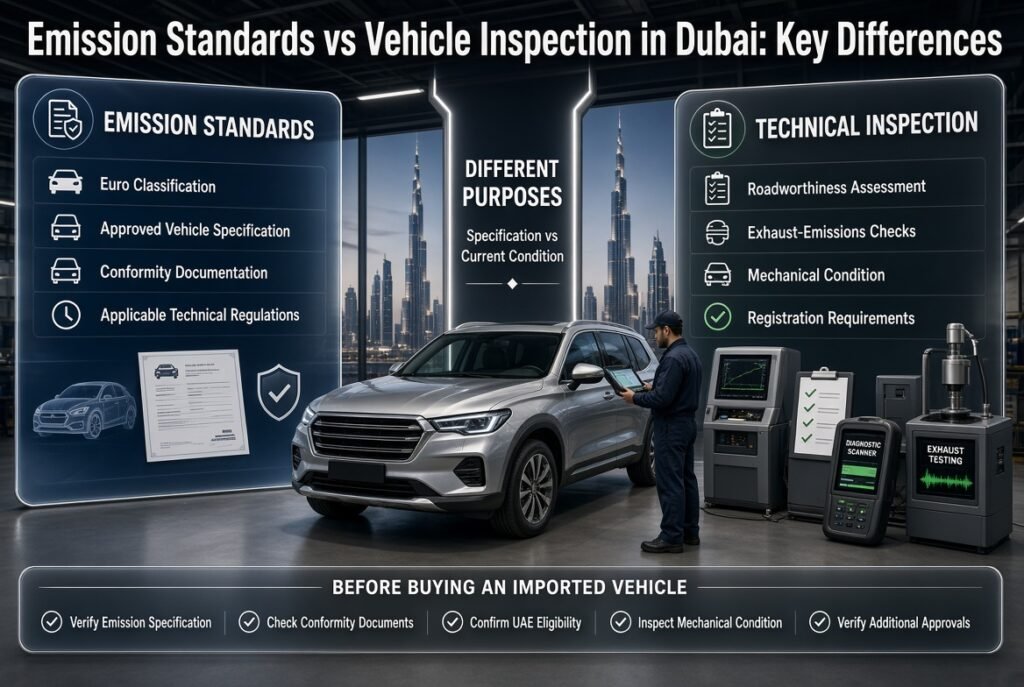
One of the most common misunderstandings is treating a vehicle’s Euro classification and its routine technical inspection as interchangeable.
They are related, but they answer different questions.
An emissions standard describes the technical requirements applicable to a vehicle’s approved specification. A technical inspection assesses the vehicle against the requirements relevant to the inspection being performed. Passing one process does not automatically prove that every requirement of the other has been satisfied.
What does conformity assessment establish?
Conformity assessment helps demonstrate that a vehicle meets the applicable technical regulations or approved specifications.
Depending on the process, the evidence may include manufacturer documentation, a certificate of conformity, a recognised approval, or other documents accepted by the responsible authority.
For imported vehicles, this evidence can be particularly important because the original vehicle may have been designed for a different market.
What does a technical inspection establish?
Dubai’s Roads and Transport Authority provides vehicle technical inspection services for relevant registration, renewal, and export transactions.
Its inspection framework addresses roadworthiness and applicable technical requirements. Exhaust-emissions checks form part of the relevant inspection arrangements for vehicles to which they apply.
The inspection process does not automatically establish that the car’s original Euro classification is the one required for every import or approval procedure.
A practical example
Suppose a buyer finds a used diesel SUV that has passed a previous roadworthiness inspection in another country.
That inspection may provide useful information about the vehicle’s condition, but it does not necessarily establish that the SUV satisfies the current UAE requirements for the intended import or registration transaction.
The buyer should separately verify:
- The vehicle’s original emission specification.
- The conformity documents accepted for the UAE.
- The vehicle’s eligibility for the intended registration.
- Its current mechanical and emissions-system condition.
- Any additional inspection or approval required.
Common mistake: Assuming that a vehicle can be made eligible for any registration process simply by passing a local technical inspection. Documentation and mechanical condition are separate considerations.
6. Which Documents Should You Check Before Buying an Imported Car?
Vehicle documentation can determine whether an otherwise attractive purchase is suitable for the intended registration process. Checking these details before paying a deposit can help prevent avoidable financial losses.
Manufacturer’s conformity documentation
Request the manufacturer’s certificate of conformity or another document accepted for the relevant approval process.
The document should relate to the exact vehicle specification rather than merely the general model name. Check whether it identifies the relevant emissions requirements or references an approved vehicle type.
Vehicle identification number
The vehicle identification number, or VIN, helps identify the specific vehicle and connect it with relevant records.
Compare the VIN on the vehicle with the information shown on its documents. If the records do not match, pause the transaction until the discrepancy has been explained and resolved.
For vehicles covered by the relevant GSO systems, conformity and vehicle-identification records can be important parts of the verification process.
Country-of-origin specification
A vehicle originally manufactured for Europe, North America, Japan, or another market may have a different configuration from a comparable vehicle supplied for the Gulf region.
The country where the car was first sold does not, on its own, establish whether the vehicle meets the applicable UAE requirements.
Check the actual engine variant, emissions specification, and conformity evidence.
Import and registration eligibility
Before completing the purchase, establish whether the vehicle can be registered through the intended route.
This is particularly important for privately imported used cars, vehicles with extensive modifications, and cars with incomplete technical documentation.
Service and repair history
Service records do not replace conformity documents, but they help assess the vehicle’s condition.
Review previous repairs to the catalytic converter, DPF, SCR system, sensors, engine management, and exhaust components where fitted.
Look for repeated warnings or recurring faults that may indicate an unresolved problem.
A practical pre-purchase checklist
- Confirm the exact make, model, engine variant, and vehicle category.
- Obtain the applicable conformity documents.
- Match the VIN across the vehicle and its records.
- Verify the current import and registration requirements.
- Check for unauthorised engine or exhaust modifications.
- Review the maintenance and diagnostic history.
- Arrange a suitable mechanical inspection.
- Confirm any outstanding approval requirements before paying a non-refundable deposit.
The purpose of this process is to establish both regulatory eligibility and the vehicle’s current condition. Neither should be assumed from the other.
7. How Does Dubai’s Vehicle Inspection Process Work?
Vehicle inspection is an important part of vehicle ownership because it assesses the vehicle against the technical requirements relevant to the inspection category. Drivers should understand when an inspection is required, what it can establish, and what they should do if the vehicle does not pass.
When is a technical inspection required?
The inspection required depends on the vehicle and the transaction. Dubai’s RTA provides a technical inspection service for relevant registration, renewal, and export procedures.
For an ordinary driver, the first step is to identify the correct inspection type rather than booking a generic test without checking the vehicle’s circumstances.
For example, a vehicle being registered for the first time through a particular route may have different documentary requirements from a vehicle undergoing routine registration renewal.
What happens during an inspection?
The vehicle is presented at an approved technical inspection centre for the relevant assessment. Depending on the category and procedure, checks may cover roadworthiness, safety-related components, vehicle identification, and applicable emissions requirements.
The result helps determine whether the vehicle meets the requirements relevant to that inspection.
Drivers should not assume that every inspection involves identical equipment, pollutant measurements, or acceptance criteria. These details depend on the vehicle and applicable test procedure.
How should you prepare?
A sensible preparation routine begins with identifying known faults and ensuring that the vehicle is in suitable working condition.
Before the appointment:
- Check for illuminated engine-management or emissions warning lights.
- Arrange repairs for known engine or exhaust faults.
- Check for exhaust leaks or evidence of unauthorised modifications.
- Review any previous inspection report.
- Bring the documents required for the relevant transaction.
- Confirm the appointment and inspection category through the current RTA process.
If an emissions-related fault is present, diagnose it before the inspection rather than attempting to conceal it.
What if the vehicle fails?
A failed inspection should be treated as information about a problem that needs to be addressed. Review the inspection findings and have the relevant defect diagnosed.
The correct repair depends on the cause. Excessive emissions could result from an engine-management fault, damaged exhaust equipment, or another mechanical issue. A single symptom does not identify the cause with certainty.
After repairs, follow the applicable retesting procedure.
Professional tip: Keep the inspection result and repair invoice together. This makes it easier to understand whether the same fault returns and gives a technician useful information during a later diagnosis.
8. Can an Older Petrol or Diesel Car Still Meet Dubai’s Requirements?
An older vehicle’s eligibility cannot be determined from its age alone. Its original specification, registration history, category, condition, and the rules governing the intended transaction all matter.
This distinction is especially important when comparing an existing registered vehicle with an imported used car.
Existing registered vehicles
Owners should follow the technical inspection and registration requirements applicable to their vehicles. An older car should not automatically be assumed prohibited merely because it was manufactured before a newer emissions stage was introduced.
At the same time, its age does not guarantee exemption from relevant inspection, maintenance, or other legal requirements.
Where the question concerns a particular vehicle, verify its registration status and applicable requirements rather than relying on a general statement about all older petrol or diesel cars.
Used vehicles imported into the UAE
Imported used vehicles require additional care because their original approval may relate to another country’s regulatory system.
A car that was legally sold and driven in its previous market may still require specific documentation or conformity assessment before it can be registered in the UAE.
Before committing to an import, establish:
- Whether the vehicle category is covered by the applicable import requirements.
- Which emission standard applies to the relevant application date.
- Whether its existing conformity documentation is accepted.
- Whether a separate technical inspection is required.
- Whether modifications have affected its original approval or emission-control equipment.
Modified older vehicles
Older vehicles sometimes have replacement engines, aftermarket exhaust systems, or altered engine-management software.
These changes may affect the vehicle’s original specification. Whether a modification is permitted depends on the applicable rules and approval requirements.
Do not assume that a vehicle’s original conformity certificate automatically covers every later modification.
What should owners do if documentation is incomplete?
Start by identifying precisely what is missing. A missing service invoice is different from a missing conformity certificate, and the solutions may be completely different.
Contact the seller, importer, manufacturer, or relevant authority as appropriate. Avoid purchasing a vehicle on the promise that missing documents can always be obtained later.
9. How Do Petrol and Diesel Emission-Control Systems Affect Compliance?
A vehicle’s approved emissions specification depends partly on the technologies used to control exhaust pollutants. These systems are designed for particular engines and regulatory requirements, so their presence, condition, and correct operation matter.
The aim of this section is not to rank petrol and diesel engines by pollution levels. It is to explain why maintaining the correct equipment is important for compliance.
Petrol catalytic converters
A three-way catalytic converter helps control carbon monoxide, hydrocarbons, and nitrogen oxides under suitable operating conditions.
Its effectiveness depends on the correct operation of the engine and associated controls. Misfires, unsuitable fuel mixtures, and certain mechanical faults can damage the catalyst or prevent it from working as intended.
If a petrol vehicle develops a recurring engine warning, the underlying cause should be diagnosed instead of replacing parts without evidence.
Oxygen sensors and engine management
Oxygen sensors provide information that helps the engine control unit regulate combustion and monitor emissions-system operation.
Faulty sensors or wiring can affect fuel management and trigger warning lights. However, a sensor warning does not necessarily mean the sensor itself has failed; another engine or exhaust fault may be responsible.
A proper diagnosis helps avoid unnecessary parts replacement.
Diesel particulate filters
A diesel particulate filter captures soot from the exhaust. Depending on the system, accumulated soot is removed through a process known as regeneration.
Repeated interrupted regeneration, unsuitable operating patterns, or underlying engine faults can contribute to excessive soot accumulation.
If the vehicle displays a DPF warning, follow the manufacturer’s instructions. Do not ignore repeated warnings or attempt a procedure that conflicts with the vehicle’s safety guidance.
Selective catalytic reduction
Some diesel vehicles use selective catalytic reduction to reduce nitrogen oxides. These systems commonly rely on a specified exhaust fluid and electronic monitoring equipment.
Incorrect fluid, low fluid levels, or faults within the system can affect its operation. The correct fluid and maintenance procedure should be confirmed from the manufacturer’s instructions.
Evaporative-emissions controls
Petrol vehicles may also use systems designed to control fuel vapours from the tank and fuel system.
A damaged fuel cap, leaking connection, or faulty evaporative-emissions component can cause a fault even when the engine appears to run normally.
Drivers should not assume that emissions compliance concerns only the visible exhaust pipe.
Why removing emission equipment is a serious mistake
Removing or disabling required equipment may increase pollution, affect engine management, and compromise the vehicle’s conformity with its approved specification.
It can also create problems during inspection or subsequent resale.
The appropriate response to a damaged emissions component is to diagnose the fault and restore the vehicle in accordance with its specifications and applicable requirements.
For a separate discussion of engine faults that may affect ownership, see Common Petrol vs Diesel Engine Problems in Dubai.
10. How Can Dubai’s Climate and Driving Patterns Affect Emission-System Maintenance?
Dubai’s hot weather, frequent air-conditioning use, traffic congestion, and occasional short journeys can influence vehicle operation. These conditions do not automatically make a car non-compliant, but they can make appropriate maintenance particularly important.
Heat and engine-management faults
Modern vehicles are designed to operate within defined temperature ranges. High ambient temperatures increase the demands placed on cooling systems, particularly when vehicles operate in heavy traffic.
If the cooling system is faulty or the engine repeatedly overheats, combustion and engine-management performance may be affected.
Owners should address overheating promptly instead of treating it as a normal consequence of Dubai’s climate.
Short journeys and diesel regeneration
Some diesel vehicles need particular operating conditions to complete DPF regeneration. Repeated short journeys or frequent interruptions can make it harder for certain systems to complete the process.
The effect depends on the vehicle’s design and driving pattern. Not every short trip creates a DPF problem, and owners should follow the manufacturer’s instructions rather than applying a universal driving rule.
Traffic congestion and idling
Stop-start driving can affect fuel consumption and engine operating conditions. Prolonged idling may also be relevant when assessing certain engine and exhaust-system problems.
Drivers should avoid unnecessary idling where practical and follow safe, lawful driving practices.
Dust and air-intake maintenance
Dust exposure makes inspection of the air-intake system sensible, especially when the vehicle is regularly driven in dusty environments.
However, air-filter replacement should follow the manufacturer’s schedule and the vehicle’s actual operating conditions. Replacing components without checking their condition is not a substitute for proper maintenance.
What should drivers monitor?
Pay attention to changes in:
- Fuel consumption.
- Engine starting and idling.
- Dashboard warning lights.
- Exhaust smoke or unusual smells.
- Engine temperature.
- DPF regeneration warnings, where applicable.
- Frequency of recurring diagnostic faults.
These signs can help identify a developing problem, but none alone proves that a vehicle has failed an emissions standard.
For related guidance on real-world operation, see Petrol vs Diesel Driving Performance in Dubai.
11. How Should You Compare Petrol and Diesel Vehicles Before Buying?

When comparing petrol and diesel cars, separate regulatory compliance from the practical questions of fuel consumption, emissions performance, maintenance, and driving suitability.
A vehicle may have excellent fuel economy but lack the documentation needed for a particular registration process. Another may have appropriate conformity documents but require expensive repairs because its emission-control equipment is damaged.
A sound purchase decision evaluates both.
Compare the exact engine variant
Do not compare vehicles based solely on their model names. Confirm the engine code or variant, model year, fuel type, and original market specification.
Manufacturers can offer different engine configurations for different markets. These may use different emission-control systems and have different conformity documentation.
Compare certified emissions data
Where reliable manufacturer data is available, review the figures for the pollutants relevant to the vehicle’s approval standard.
Make sure the figures relate to the exact engine and vehicle category. Different testing procedures can produce figures that are not directly comparable.
For a wider explanation of the different pollutants and how their emissions are assessed, read Petrol vs Diesel Emissions Comparison in Dubai.
Consider the intended use
A vehicle used for daily urban commuting may have different operating requirements from one used for regular long-distance travel or commercial duties.
Consider your usual trip length, expected annual mileage, passenger and luggage needs, and the vehicle’s maintenance requirements.
Do not choose a diesel engine simply because diesel vehicles are often associated with efficiency, or select petrol solely because it is perceived as cleaner. The particular vehicle matters more than a broad assumption about fuel type.
Evaluate the total ownership cost
Include fuel expenses, routine servicing, likely repairs, and any maintenance associated with emissions equipment.
The lowest purchase price does not necessarily produce the lowest overall cost. A vehicle with incomplete service records or evidence of neglected emissions equipment may create expenses that are not apparent during a short test drive.
Use a structured decision process
| Question | What to verify |
|---|---|
| Is the vehicle eligible for registration? | Applicable conformity evidence and registration requirements |
| Does it meet the relevant emissions standard? | Exact standard and accepted documentation |
| Is its emission-control equipment functioning? | Mechanical assessment and diagnostic findings |
| Does it suit your driving pattern? | Journey length, annual mileage, and vehicle requirements |
| Is the ownership cost reasonable? | Fuel consumption, maintenance, and potential repairs |
For a broader overview of choosing between the two engine types, see Petrol vs Diesel Comparisons Dubai.
12. Common Mistakes When Interpreting Emission Regulations
Emission requirements can be confusing when buyers rely on informal advice, incomplete documents, or general statements about particular engine types. The following mistakes are worth avoiding.
Mistake 1: Treating Euro 6 as a single, interchangeable specification
Euro 6 includes different stages and technical arrangements. A broad Euro 6 label does not necessarily establish compliance with a specific requirement referring to Euro 6b.
Better approach: Obtain the exact classification and confirm which evidence is accepted for the intended transaction.
Mistake 2: Assuming every imported car follows the same rules
Import requirements may depend on vehicle category, application date, conformity status, and the relevant approval process.
Better approach: Confirm the rules for the exact vehicle before paying a deposit. Do not rely on the experience of someone who imported a different model under different circumstances.
Mistake 3: Confusing a technical inspection with conformity approval
A vehicle inspection assesses relevant technical conditions, while conformity documentation establishes the vehicle’s approved specification or provides evidence for the applicable approval process.
Better approach: Treat the documents and the physical inspection as separate parts of your due diligence.
Mistake 4: Assuming that petrol is always cleaner
Petrol engines have different emission characteristics from diesel engines, but neither fuel type automatically performs better for every pollutant.
Better approach: Compare the actual vehicle’s certified emissions, technology, and condition.
Mistake 5: Ignoring modifications
Changes to the engine, exhaust system, or engine-management software can affect the original approved configuration.
Better approach: Ask for details of modifications and establish whether they are permitted and appropriately approved.
Mistake 6: Ignoring the vehicle’s repair history
A car can appear to drive normally while having recurring emissions-system faults.
Better approach: Review diagnostic reports and service records. Investigate recurring warning lights before completing the purchase.
Mistake 7: Assuming a newer vehicle cannot have emissions problems
Newer vehicles may use more advanced technology, but components can still fail because of wear, damage, or maintenance problems.
Better approach: Verify both the approved specification and current mechanical condition.
Mistake 8: Relying on the seller’s verbal assurance
Statements such as “the car is fully compliant” are not a replacement for relevant documents.
Better approach: Ask for evidence and confirm its acceptability through the appropriate process.
13. Professional Recommendations for Long-Term Emission Compliance
Maintaining compliance involves more than buying a vehicle with an appropriate emissions specification. Owners should preserve the systems that allow the vehicle to operate as designed and address faults before they develop into larger problems.
Keep the manufacturer’s specifications available
Retain the owner’s manual, maintenance schedule, and relevant technical documentation. These records help identify the correct service procedures and components for the exact vehicle.
This is particularly useful when a vehicle has a complex exhaust-treatment system or has been imported from another market.
Diagnose faults rather than replacing parts blindly
A warning light can have several possible causes. Replacing a catalytic converter, sensor, or DPF without diagnosing the underlying problem can waste money and leave the original fault unresolved.
Use appropriate diagnostic procedures and repair the confirmed cause.
Maintain the fuel and engine systems correctly
Use the fuel and maintenance specifications recommended for the vehicle. Address engine misfires, fuel-system problems, and cooling faults promptly.
The purpose is to preserve normal engine operation and reduce the likelihood of avoidable emissions-system damage.
Keep conformity and inspection records organised
Maintain a record of the vehicle’s original specification, relevant conformity documentation, inspection results, and significant repairs.
These records can help when the vehicle is sold, transferred, imported, or assessed for a technical problem.
Recheck requirements when importing or changing a vehicle’s status
Regulations and implementation arrangements can change. A vehicle that was eligible under an earlier process should not automatically be assumed eligible under a later one.
If the intended transaction involves importation or first registration, verify the applicable requirements at that time.
Consider environmental performance separately from legal compliance
A vehicle can meet its applicable emissions standard without having identical real-world emissions to every other compliant vehicle.
Driving conditions, maintenance, engine load, and fuel consumption influence actual performance. Legal conformity is essential, but it does not eliminate every environmental effect.
For a wider discussion of these issues, read Petrol vs Diesel Environmental Impact in Dubai.
14. How Emission Standards Connect with Air Pollution and Carbon Emissions
Emission standards, air pollution, and carbon emissions are related topics, but they are not interchangeable. Understanding the distinction helps drivers interpret vehicle specifications without confusing legal requirements with broader environmental comparisons.
Regulated pollutants and carbon dioxide
Vehicle emissions regulations address specific pollutants under defined testing procedures. Carbon monoxide, hydrocarbons, nitrogen oxides, and particulate matter are examples of pollutants that may be covered by the applicable requirements.
Carbon dioxide is different in its environmental role. It is primarily relevant to climate change rather than the same direct toxic effects associated with carbon monoxide or certain other pollutants.
Fuel consumption is an important factor when estimating a vehicle’s operational CO₂ emissions, but it does not reveal the full amount of every exhaust pollutant.
Why does passing an emissions requirement not settle every environmental question?
A vehicle’s compliance establishes that it meets the applicable requirements. It does not mean the vehicle produces no emissions, nor does it mean every compliant petrol and diesel model has identical environmental performance.
Two vehicles can satisfy their respective standards yet differ in fuel use, pollutant output, and maintenance condition.
This is why environmental comparisons should use appropriate data for the exact vehicle and pollutant rather than relying only on the fuel type or regulatory label.
How should buyers use environmental information?
When environmental performance is an important purchase factor, consider:
- The exact vehicle’s emissions specification.
- Published fuel-consumption data.
- The pollutants relevant to your comparison.
- The condition of the engine and exhaust-treatment equipment.
- How the vehicle will normally be driven.
- Whether a comparable alternative meets your needs with lower resource use.
For further reading, see Petrol vs Diesel Carbon Emissions in Dubai and Diesel vs Petrol Air Pollution in Dubai.
These subjects complement an emission-standards guide but answer different questions: one focuses on regulatory conformity, while the others examine environmental outcomes.
What are the latest petrol and diesel emission standards in Dubai for 2026?
Petrol and diesel vehicles in Dubai must meet the emissions and conformity requirements applicable to their vehicle category and registration circumstances. Euro standards are important reference points, and Euro 6b-equivalent requirements are particularly relevant to the UAE’s vehicle-import framework in 2026. However, the applicable requirements and implementation dates can differ according to the vehicle type and approval process. Buyers should verify the latest rules before importing a car or applying for first registration.
Important points to consider:
Check the exact Euro classification rather than relying on a general “Euro 6” description.
Request the manufacturer’s conformity certificate or other accepted technical documentation.
Confirm the applicable requirements with the relevant UAE authority or authorised importer before purchasing an imported vehicle.
Do not assume that a new import requirement automatically means every older vehicle already registered in Dubai must be replaced.
What is the difference between petrol and diesel emission standards in Dubai?
Petrol and diesel vehicles are both subject to applicable emission requirements, but their engine designs and pollution-control systems differ. Petrol vehicles commonly use three-way catalytic converters and oxygen sensors, while modern diesel vehicles may use diesel particulate filters (DPF) and selective catalytic reduction (SCR) systems. These technologies help control different pollutants and contribute to compliance with the relevant standard.
The main consideration when buying a vehicle is whether its exact engine specification meets the applicable requirements. The fuel type alone cannot establish regulatory compliance or determine which vehicle has the lowest emissions in every category.
Key factors to compare:
Petrol vehicles: Check the catalytic converter, oxygen sensors, and other fitted emission-control equipment.
Diesel vehicles: Check the DPF, SCR system, and associated sensors where fitted.
Conformity documentation: Verify the vehicle’s approved emissions classification.
Mechanical condition: Investigate warning lights, exhaust faults, or unauthorised modifications before purchasing.
Can I register an imported petrol or diesel car in Dubai if it does not meet Euro 6b standards?
Registration eligibility depends on the applicable UAE regulations, the vehicle’s category, its import or approval date, and the conformity evidence available. An imported vehicle that meets the requirements of its original market may not automatically qualify for registration in the UAE. Similarly, a vehicle with an older emissions classification should not automatically be considered prohibited without checking the rules applicable to its specific circumstances.
Before paying a deposit, establish whether the vehicle qualifies under the intended import and registration process. This is particularly important for used vehicles imported privately, vehicles manufactured for different markets, and cars with modified engines or exhaust systems.
Before importing, make sure you:
Obtain the vehicle’s exact emissions specification and supporting documents.
Confirm the current requirements for the relevant vehicle category.
Verify whether the conformity evidence is accepted for the intended registration.
Check for modifications that may affect the original approved specification.
Confirm eligibility before making a non-refundable payment.
Does passing a vehicle inspection in Dubai prove that a petrol or diesel car meets Euro emission standards?
Passing a technical vehicle inspection does not automatically prove that a car has a particular Euro emissions classification. A technical inspection assesses the vehicle against the requirements relevant to that inspection, while conformity documentation establishes evidence of the vehicle’s approved technical specification. Both may be important, but they serve different purposes.
For example, a used diesel car might pass a relevant inspection while the buyer still needs to verify its original emissions classification for an import or approval procedure. Likewise, a vehicle with the correct conformity documents can develop mechanical faults that affect the performance of its emission-control systems.
What vehicle owners should do:
Keep the manufacturer’s conformity documents where available.
Follow the applicable RTA inspection and registration procedures.
Diagnose engine or emissions warning lights before inspection.
Have the relevant exhaust-treatment equipment checked if a fault is suspected.
Retain inspection reports and repair records for future reference.
How can I keep my petrol or diesel vehicle compliant with emission standards in Dubai?
Maintaining compliance starts with choosing a vehicle that meets the applicable requirements and preserving its approved emissions-control systems. Routine maintenance can help prevent mechanical faults that increase exhaust pollution, but servicing alone cannot correct an underlying conformity or import-approval problem. Owners should therefore treat regulatory documentation and mechanical maintenance as two separate responsibilities.
Dubai’s hot climate, traffic congestion, and frequent short journeys can also influence vehicle operation. For example, repeated interrupted journeys may affect DPF regeneration in certain diesel vehicles. Petrol vehicles can also experience emissions problems when catalytic converters, oxygen sensors, or engine-management components malfunction.
Professional maintenance recommendations:
Follow the manufacturer’s servicing schedule and use the specified fluids and replacement parts.
Investigate recurring warning lights, unusual exhaust smoke, or sudden changes in fuel consumption.
Maintain diesel DPF and SCR systems according to the vehicle manufacturer’s instructions.
Avoid removing or disabling required emission-control equipment.
Keep service invoices, diagnostic reports, conformity documents, and inspection records.
Confirm current regulatory requirements whenever importing a vehicle or changing its registration status.
The most reliable approach is to combine correct vehicle documentation, appropriate maintenance, and compliance with the applicable UAE regulations. This helps protect your investment while supporting the proper operation of your vehicle’s emissions-control systems.
Conclusion
Understanding petrol vs diesel emission standards in Dubai is essential for choosing, maintaining, and operating a vehicle that meets applicable environmental and regulatory requirements. Although petrol and diesel engines use different combustion processes and emission-control technologies, compliance depends on more than the fuel type alone. The vehicle’s model year, approved emissions category, engine condition, exhaust-treatment systems, and applicable UAE registration requirements all play an important role.
For Dubai drivers, the most practical approach is to verify the vehicle’s official specifications before purchasing or importing it, maintain the engine according to the manufacturer’s recommendations, and ensure that essential emission-control components remain functional. Diesel vehicles may require particular attention to diesel particulate filters (DPF), exhaust gas recirculation (EGR), and selective catalytic reduction (SCR) systems where fitted. Petrol vehicles also need properly functioning catalytic converters, oxygen sensors, and engine-management systems to control emissions effectively.
Before making a purchase, compare the vehicle’s documented compliance status rather than relying solely on claims such as Euro 5, Euro 6, or Euro 6b. The applicable requirements can vary according to the vehicle category, import circumstances, and current UAE regulations, so official verification is important.
Ultimately, the best vehicle is one that meets the applicable standards, suits your driving needs, and can be maintained in proper working condition. By combining informed vehicle selection with responsible maintenance and timely inspections, Dubai motorists can support cleaner air, reduce avoidable emissions, and enjoy more dependable everyday driving.
Leave a Reply