
Introduction
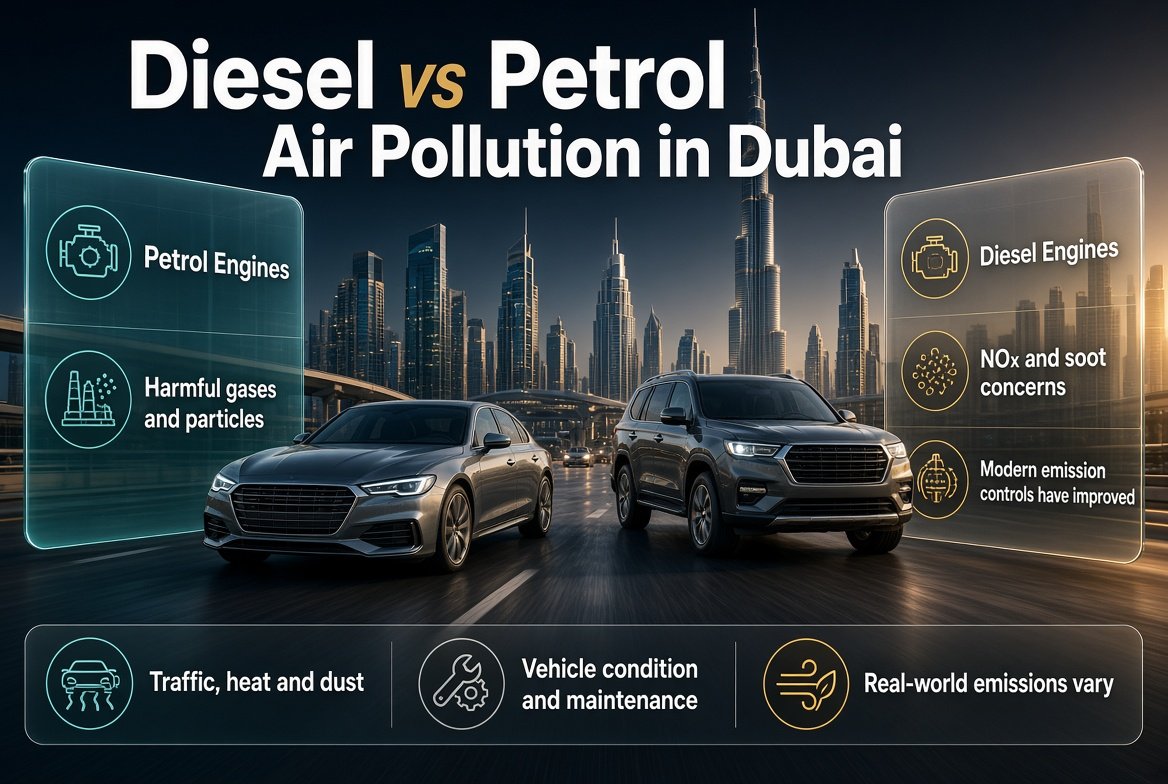
Diesel vs Petrol Air Pollution in Dubai | Choosing between a petrol car and a diesel vehicle in Dubai is not only about fuel economy, engine power, or maintenance costs. The type of engine you drive can also affect the air around busy roads, residential areas, parking facilities, and commercial districts. Understanding diesel vs petrol air pollution in Dubai helps drivers make informed decisions about vehicle ownership, everyday driving, and environmental responsibility.
Dubai’s driving conditions make this comparison particularly relevant. Heavy traffic, high temperatures, frequent air-conditioning use, dust, and long-distance highway journeys can influence vehicle fuel consumption and exhaust emissions. However, petrol and diesel engines do not produce exactly the same pollutants, and their environmental performance depends on more than the fuel used.
Diesel engines have historically been associated with higher nitrogen oxide emissions and soot, particularly in older vehicles without effective exhaust-treatment systems. Petrol engines generally have an advantage in some local air-pollution categories, but they still release harmful gases and can produce fine particles. Modern diesel technology has also improved substantially, making it important to compare individual vehicles rather than rely on outdated assumptions.
For drivers looking for practical fuel and vehicle guidance, Fuel Delivery Dubai provides a starting point for exploring related information about fuel use and driving needs.
This article explains how petrol and diesel engines contribute to air pollution, which emissions matter most, how Dubai’s driving environment affects performance, and what vehicle owners can do to reduce avoidable pollution. It also examines emissions-control technology, vehicle maintenance, used-car buying decisions, and practical ways to choose a suitable engine without confusing local air quality with climate change.
1. What Is the Difference Between Diesel and Petrol Air Pollution?
Diesel and petrol engines both release exhaust pollutants, but their combustion processes and emissions-control systems differ. Diesel engines have traditionally produced more nitrogen oxides and soot than comparable petrol engines, while petrol engines can produce more carbon monoxide under certain operating conditions. The actual emissions depend on vehicle design, engine condition, driving patterns, and pollution-control technology.
How petrol engines produce air pollution
Most conventional petrol engines use spark ignition. The engine mixes petrol with air, compresses the mixture, and ignites it with a spark plug. The resulting combustion generates the energy that moves the vehicle.
Combustion is not perfectly clean. Petrol engines can release several pollutants through the exhaust, including:
- Carbon monoxide (CO): A poisonous gas formed when fuel does not burn completely.
- Nitrogen oxides (NOx): Gases formed during high-temperature combustion.
- Hydrocarbons (HC): Fuel compounds that remain unburned or are only partially burned.
- Particulate matter (PM): Tiny particles that can be produced by some petrol combustion systems, particularly certain direct-injection engines.
- Carbon dioxide (CO2): A greenhouse gas released when carbon in the fuel is burned.
A catalytic converter reduces several harmful exhaust pollutants when it reaches its intended operating temperature and functions correctly. Modern engine-management systems also adjust fuel delivery and combustion to improve performance and control emissions.
However, a petrol vehicle with a faulty catalytic converter, damaged oxygen sensor, or engine misfire may produce considerably more pollution than intended.
How diesel engines produce air pollution
Diesel engines use compression ignition rather than spark plugs for normal combustion. Air is compressed until it becomes hot, and diesel fuel is injected into the cylinder. This process can deliver strong pulling power and good fuel efficiency, but it can also create conditions that favour nitrogen oxide and soot formation.
Diesel exhaust may contain:
- Nitrogen oxides, which contribute to respiratory pollution and atmospheric chemical reactions.
- Soot and fine particles, especially when combustion or particle filtration is ineffective.
- Carbon monoxide and unburned hydrocarbons.
- Carbon dioxide from burning fuel.
Modern diesel vehicles may use diesel particulate filters, selective catalytic reduction, exhaust gas recirculation, and other systems to control these emissions.
When these systems are correctly designed and maintained, modern diesel vehicles can be substantially cleaner than older diesel models. Nevertheless, performance varies, and a diesel vehicle with damaged or disabled emissions equipment can become a significant source of avoidable pollution.
Why the distinction matters in Dubai
The important question is not simply which fuel burns more efficiently. Drivers should consider which pollutants a vehicle produces, how much it emits during real journeys, and whether its exhaust-treatment systems work correctly.
For example, a diesel SUV might consume less fuel per kilometre than a comparable petrol SUV, but that does not automatically mean it produces less nitrogen oxide. Similarly, a petrol car with a faulty catalytic converter is not necessarily cleaner than a well-maintained modern diesel.
A meaningful comparison therefore separates three issues:
- Local air pollutants that affect the air people breathe.
- Greenhouse gases that contribute to climate change.
- Fuel consumption and operating efficiency.
These categories are related, but they are not interchangeable.
2. Which Is Worse for Air Pollution in Dubai: Diesel or Petrol?
For comparable conventional passenger vehicles, diesel engines have historically presented greater concerns regarding nitrogen oxides and soot. Petrol engines often perform better in these categories, although the difference depends on the specific vehicle and emissions technology. Modern diesel exhaust treatment can significantly reduce pollution, while direct-injection petrol engines can also produce fine particles.
Comparing the main emissions
| Emission category | Petrol engines | Diesel engines |
|---|---|---|
| Nitrogen oxides (NOx) | Often lower in comparable conventional cars | Historically higher, particularly in older vehicles |
| Soot and particulate matter | Can be produced, especially by some direct-injection engines | Can be substantial without an effective particulate filter |
| Carbon monoxide | Can increase with incomplete combustion or faults | Often lower in comparable operating conditions, but still possible |
| Unburned hydrocarbons | Can escape during combustion and other operating conditions | Also produced; quantities vary by engine and after-treatment |
| Carbon dioxide per litre | Generally lower than diesel | Generally higher per litre of fuel |
| Fuel use per kilometre | Often higher in comparable conventional vehicles | Often lower in comparable vehicles |
| Overall air-pollution performance | Depends on the vehicle and its condition | Depends on the vehicle and its condition |
This comparison describes general tendencies, not guaranteed outcomes. A small petrol car and a heavy diesel SUV, for example, are not equivalent vehicles. Their weight, power, engine size, and intended use can all affect the result.
Why nitrogen oxides deserve attention
Nitrogen oxides are important because they contribute to roadside pollution and participate in chemical reactions that form other pollutants. Nitrogen dioxide can irritate the respiratory system, and exposure is particularly relevant around busy roads.
Diesel engines can produce relatively high NOx levels because of their combustion characteristics. Selective catalytic reduction and other technologies can reduce these emissions, but effectiveness depends on the system’s condition and operating conditions.
Drivers should therefore avoid assuming that a vehicle is environmentally clean merely because it is fuel-efficient or relatively new.
Why soot and fine particles matter
Soot is associated with incomplete combustion and is a major concern in diesel exhaust when particle-control systems are absent or ineffective.
A diesel particulate filter can capture a substantial proportion of exhaust particles. However, a blocked, damaged, removed, or malfunctioning filter may not provide its intended protection.
Petrol vehicles can also emit fine particles, particularly some direct-injection engines. Their emissions depend on combustion design and whether a suitable particulate filter is fitted.
Practical recommendation: When comparing vehicles, look for actual emissions information and confirm which pollution-control systems are fitted. Do not use visible smoke, engine noise, or fuel economy as the sole measure of cleanliness.
3. Which Air Pollutants Are Most Important for Dubai Residents?
Air pollution includes a mixture of gases and airborne particles. Understanding the differences helps drivers recognise why a vehicle may affect air quality even when its exhaust appears clean.
Nitrogen oxides and nitrogen dioxide
Nitrogen oxides form during combustion. Nitrogen dioxide is particularly important because it can irritate the airways and contribute to respiratory problems.
Road traffic can be a source of NOx, although the amount present in the air depends on the number and type of vehicles, their emissions, weather, and other pollution sources.
In diesel vehicles, NOx control is an important reason for using exhaust gas recirculation and selective catalytic reduction.
PM2.5 and PM10
Particulate matter consists of tiny airborne particles. PM2.5 refers to particles with a diameter of 2.5 micrometres or less, while PM10 includes particles up to 10 micrometres.
Fine particles are particularly concerning because they can penetrate deep into the respiratory system. Some particles also originate from sources other than exhaust, including road dust, construction, tyre wear, and brake wear.
This distinction matters in Dubai because reducing exhaust emissions alone does not eliminate every source of airborne particles.
For example, a modern vehicle with an effective particulate filter may produce relatively little exhaust soot, but surrounding roads can still contain dust generated by traffic and other activities.
Carbon monoxide
Carbon monoxide forms when fuel does not burn completely. It is dangerous at elevated concentrations because it interferes with the body’s ability to transport oxygen.
Both petrol and diesel engines can produce carbon monoxide. The quantity depends on combustion, engine load, temperature, and emissions-control performance.
A damaged catalytic converter, incorrect fuel delivery, or engine fault can increase emissions. Carbon monoxide is invisible, so the absence of smoke does not indicate that a vehicle’s exhaust is harmless.
Hydrocarbons and ground-level ozone
Unburned hydrocarbons and other volatile organic compounds can react with nitrogen oxides in sunlight to form ground-level ozone.
Ground-level ozone differs from the ozone layer high in the atmosphere. At ground level, it is an air pollutant that can irritate the lungs and worsen breathing difficulties.
Strong sunlight makes these atmospheric reactions relevant to Dubai’s air-quality conditions. However, ozone formation depends on a mixture of pollutants and meteorological conditions, not simply on the number of petrol or diesel vehicles.
Carbon dioxide and climate change
Carbon dioxide is important for a different reason. It contributes to global warming, but it is not a direct indicator of the amount of harmful local roadside pollution a vehicle produces.
Diesel generally releases more CO2 per litre than petrol. Because diesel engines often consume less fuel per kilometre, however, a comparable diesel vehicle may release less CO2 over a particular journey.
Drivers should assess climate emissions separately from NOx, soot, and other local pollutants.
For a focused explanation of this distinction, see Petrol vs Diesel Carbon Emissions in Dubai.
4. How Does Dubai’s Climate Affect Petrol and Diesel Emissions?
Dubai’s climate creates demanding conditions for vehicles. High temperatures, heavy air-conditioning use, dust, and traffic congestion can influence fuel consumption and emissions-control performance. However, hot weather does not automatically make one engine type cleaner than the other. The effect depends on the pollutant, engine design, operating conditions, and vehicle maintenance.
High temperatures and air-conditioning use
During hot weather, vehicle air-conditioning systems can place additional demands on the engine or hybrid system. In conventional vehicles, the compressor generally requires additional energy, which can increase fuel consumption.
When a vehicle burns more fuel to complete the same journey, its CO2 emissions will generally increase. Changes in NOx, carbon monoxide, and particulate emissions are less straightforward because they depend on combustion and exhaust-treatment conditions.
Consider two vehicles travelling across Dubai during summer. One has an efficient engine and properly functioning emissions systems. The other has poor fuel economy and a faulty emissions component. Even if both use the same fuel, their emissions can differ considerably.
Dust and engine air filters
Dust is an important maintenance consideration for vehicles operating in the UAE. An engine air filter helps prevent airborne particles from entering the engine.
When a filter becomes excessively restricted, it can affect airflow and performance. The precise emissions effect depends on the vehicle’s engine-management system and the degree of restriction.
Cabin air filters have a separate purpose. They help reduce dust and other airborne particles entering the passenger compartment, but they do not control the vehicle’s exhaust emissions.
Drivers should inspect both types of filters according to the manufacturer’s schedule and the conditions in which the vehicle operates.
Traffic congestion and short journeys
Stop-and-go driving can increase fuel consumption because the vehicle repeatedly accelerates, slows down, and stops. Long periods of idling also burn fuel without covering any distance.
Some diesel vehicles face an additional challenge during repeated short journeys. Their diesel particulate filters may need specific operating conditions to complete regeneration, which burns accumulated soot. If regeneration is repeatedly interrupted, the vehicle may eventually display warnings or require attention.
This does not mean every diesel vehicle is unsuitable for city driving. It means that the vehicle’s design, journey pattern, and maintenance requirements should be considered together.
Does hot weather reduce exhaust pollution?
Not automatically. An engine and its emissions systems must operate within their intended conditions to control pollutants effectively. High ambient temperatures can affect some operating processes, but they do not eliminate NOx, soot, or other exhaust pollutants.
Expert tip: During Dubai’s summer, prioritise correct servicing, suitable engine oil, clean filters, and prompt diagnosis of warning lights. These measures support reliable operation without relying on assumptions about which fuel performs best in hot weather.
5. How Do Dubai’s Road and Traffic Conditions Influence Air Pollution?
The same car can produce different emissions on different journeys. A steady trip on a highway is not equivalent to repeatedly stopping in congestion or leaving the engine running while waiting for passengers.
Driving in heavy traffic
Congestion can reduce fuel efficiency because drivers spend more time accelerating, braking, and idling. This can increase fuel use per kilometre and contribute to higher emissions per journey.
The effect differs by pollutant. A vehicle may consume more fuel in traffic without experiencing an identical percentage increase in every exhaust emission.
Diesel vehicles with particulate filters may also encounter problems if their normal driving patterns repeatedly prevent the required regeneration conditions from being achieved.
Unnecessary idling
Idling burns fuel while the vehicle remains stationary. Drivers may do this while waiting outside buildings, collecting passengers, or sitting in parking areas.
Unnecessary idling can create avoidable exhaust pollution near pedestrians, building entrances, and other vehicles. It also increases fuel consumption without providing useful travel distance.
When safely parked, switch off the engine if it is not needed. Follow the vehicle manufacturer’s instructions, and never leave a running engine in an enclosed or poorly ventilated space.
Highway driving and urban driving
Steady highway driving often allows vehicles to operate more efficiently than repeated stop-and-go travel. However, fuel consumption can rise at high speeds because aerodynamic resistance increases.
For diesel vehicles, sustained driving under suitable conditions may help some DPF systems complete regeneration. The correct operating requirements vary by model, so drivers should follow the manufacturer’s guidance rather than attempt a particular speed or distance without checking the manual.
For more information about how engine choice affects acceleration, overtaking, and everyday road use, read Petrol vs Diesel Driving Performance in Dubai.
Practical ways to reduce emissions in traffic
- Anticipate traffic changes and avoid unnecessary acceleration.
- Maintain a safe following distance to reduce repeated braking.
- Avoid extended idling when the engine is not required.
- Plan journeys sensibly to reduce unnecessary trips.
- Keep tyres correctly inflated to the manufacturer’s recommended pressures.
- Investigate sudden changes in fuel consumption or engine performance.
These practices can improve fuel efficiency and often reduce emissions per journey. They cannot eliminate pollution, but they help prevent avoidable fuel use.
6. Are Modern Diesel Engines Cleaner Than Older Diesel Engines?
Modern diesel vehicles can produce considerably less exhaust pollution than older designs because of improvements in fuel injection, combustion control, and emissions-treatment technology. Nevertheless, a newer model is not automatically cleaner in every real-world situation. Its emissions depend on the technology fitted, how it is maintained, and whether the systems work correctly.
Improvements in diesel technology
Modern diesel vehicles may include:
- More precise electronic fuel injection.
- Improved combustion management.
- Diesel particulate filters.
- Selective catalytic reduction systems.
- Exhaust gas recirculation.
- Sensors that monitor engine operation and emissions-system performance.
Together, these technologies can reduce soot and nitrogen oxides substantially compared with older diesel designs.
However, the effectiveness of emissions-control systems depends on their condition. A damaged sensor, blocked filter, malfunctioning injector, or disabled system can undermine the vehicle’s intended performance.
Why older diesel vehicles can emit more pollution
Older diesel vehicles may have been manufactured before modern emissions controls became widespread. Others may have deteriorated through years of operation or inadequate maintenance.
Possible problems include worn fuel injectors, restricted air intake, leaking exhaust components, faulty EGR valves, and ineffective particulate filtration.
Persistent black smoke can indicate excessive soot, but not every emissions problem produces visible smoke. NOx and carbon monoxide, for example, cannot be reliably assessed by looking at the exhaust.
Are modern petrol vehicles always cleaner?
No. Petrol engines also depend on effective emissions controls. A damaged catalytic converter, engine misfire, faulty oxygen sensor, or incorrect fuel delivery can increase harmful emissions.
Some petrol direct-injection engines also produce fine particles and may use gasoline particulate filters to control them.
The fairest comparison is between vehicles of similar size and purpose, using their emissions data, model specifications, and actual mechanical condition.
What should used-car buyers check?
Before purchasing a used petrol or diesel vehicle in Dubai, review its service history and arrange an independent inspection.
Ask the technician to check emissions-related diagnostic codes, warning lights, and relevant exhaust-treatment components. For a diesel, this may include the DPF, EGR, and SCR systems where fitted. For a petrol car, it may include the catalytic converter, oxygen sensors, and ignition system.
Do not assume that a vehicle is in good condition simply because it starts easily, accelerates normally, or has a clean-looking exhaust.
7. How Do DPF, EGR, SCR, and Catalytic Converters Control Pollution?
Emissions-control systems are designed to reduce different pollutants before exhaust gases leave the vehicle. They work in different ways, so no single component eliminates every harmful substance.
Diesel particulate filter (DPF)
A diesel particulate filter captures soot and other particles from the exhaust. Over time, accumulated soot must be removed through regeneration.
Regeneration involves raising the exhaust temperature to burn off the collected soot under controlled conditions. Depending on the vehicle, regeneration may occur automatically during normal driving or require specific conditions.
If a DPF warning appears, follow the instructions in the owner’s manual. Repeated warnings, reduced engine power, or frequent regeneration problems warrant professional diagnosis.
A blocked filter may be a symptom of an underlying problem, such as faulty injectors or an engine that is not operating correctly. Replacing the filter without addressing the cause may not provide a lasting solution.
Exhaust gas recirculation (EGR)
An EGR system returns a controlled amount of exhaust gas to the engine intake. This reduces peak combustion temperatures and helps control nitrogen oxide formation.
Carbon deposits can affect EGR valve movement or restrict passages. A malfunctioning system may contribute to rough running, reduced performance, increased emissions, or engine warning lights.
Cleaning or replacing components should be based on a proper diagnosis rather than guesswork.
Selective catalytic reduction (SCR)
SCR systems reduce nitrogen oxides by introducing a suitable urea-based fluid into the exhaust stream. AdBlue is commonly used in vehicles equipped with this technology.
The system requires the correct fluid and functioning components. Low fluid levels, contamination, or system faults can trigger warnings and may affect vehicle operation.
Use only the fluid specified by the manufacturer and follow the vehicle’s refill instructions.
Petrol catalytic converters
Petrol vehicles commonly use three-way catalytic converters to reduce nitrogen oxides, carbon monoxide, and unburned hydrocarbons.
These converters require appropriate operating conditions to work effectively. Engine misfires, sensor faults, contamination, and other mechanical problems can reduce their effectiveness.
A catalytic converter should not be replaced without investigating the cause of a suspected failure, especially if an engine fault may have damaged it.
Why emissions equipment should not be removed
Removing a DPF, disabling an EGR system, or bypassing emissions controls can increase pollution and conceal the original mechanical problem. It can also create vehicle-compliance and inspection difficulties.
For a closer look at the differences between engine designs and their control systems, read Petrol Engine vs Diesel Engine Technology in Dubai.
8. How Does Vehicle Maintenance Affect Petrol and Diesel Air Pollution?
Regular maintenance helps a vehicle operate as intended and prevents certain faults from increasing avoidable emissions. It cannot make an engine pollution-free, but it can help maintain fuel efficiency and the performance of the equipment designed to control exhaust pollutants.
Follow the manufacturer’s maintenance schedule
A sensible maintenance routine should cover the engine, fuel system, intake, ignition components where applicable, and emissions-control equipment.
Important checks include:
- Engine oil and filter replacement at the specified intervals.
- Air-filter inspection and replacement when required.
- Spark plugs and ignition components in petrol engines.
- Diesel fuel-system and injector checks when indicated.
- Inspection of relevant sensors and exhaust components.
- DPF, EGR, SCR, and catalytic converter diagnosis where fitted.
- Prompt investigation of warning lights and unusual engine behaviour.
Use the correct engine oil specification. Certain oils are specifically formulated for engines with particulate filters, and using an unsuitable product can contribute to emissions-system problems.
Investigate unusual exhaust smoke
Exhaust colour can provide useful clues, but it cannot replace proper diagnosis.
| Symptom | Possible explanation | Recommended response |
|---|---|---|
| Persistent black smoke | Excess soot or fuel and air-system problems | Arrange a diagnostic inspection |
| Blue or blue-grey smoke | Engine oil entering the combustion process | Check oil consumption and engine condition |
| Persistent white smoke | Depending on conditions, condensation, unburned fuel, or a coolant-related fault | Investigate if it continues after normal warm-up |
| No visible smoke | Normal operation or pollutants that cannot be seen | Do not assume emissions are zero |
A brief cloud during a cold start may have a different explanation from persistent smoke after the engine has warmed up.
If heavy smoke accompanies overheating, severe power loss, or other serious warnings, stop in a safe place and arrange professional assistance.
Maintain the fuel and ignition systems
Fuel injectors influence how fuel enters the engine and how effectively it burns. Faulty injectors can affect performance, fuel consumption, and emissions.
Petrol engines also rely on their ignition systems to burn the air-fuel mixture correctly. Misfires can increase unburned hydrocarbons and may damage the catalytic converter.
Drivers should avoid replacing expensive components based only on symptoms. Diagnostic information and appropriate testing help identify the actual cause.
For a dedicated guide to typical faults and their prevention, see Common Petrol vs Diesel Engine Problems in Dubai.
Keep tyres correctly inflated
Tyres do not directly treat exhaust gases, but underinflated tyres can increase rolling resistance and fuel consumption.
Check tyre pressures when the tyres are appropriately cool and use the manufacturer’s recommended settings. The maximum pressure printed on the tyre sidewall is not a substitute for the vehicle manufacturer’s recommendation.
Correct tyre maintenance can help improve efficiency, although it does not directly resolve high NOx or particulate emissions caused by a faulty exhaust system.
9. How Can Dubai Drivers Reduce Air Pollution in Everyday Use?
Drivers do not need to replace their vehicles immediately to make more responsible choices. Everyday habits, preventive maintenance, and sensible vehicle selection can reduce avoidable fuel use and emissions.
Choose a vehicle that matches your driving pattern
Before buying a car, consider how far you normally travel, how often you drive in congestion, and whether most journeys are short or long.
A modern petrol vehicle may suit someone who mainly drives short urban routes. A modern diesel may be practical for drivers who regularly cover longer distances and need strong pulling power.
These are starting points rather than universal rules. A petrol hybrid may be particularly suitable for certain urban journeys, while a diesel with effective emissions controls may perform well on longer routes.
Compare the actual vehicles rather than relying on fuel type alone.
Drive smoothly and anticipate traffic
Unnecessary acceleration and sudden braking waste energy. Looking ahead and maintaining a safe following distance can help drivers respond gradually to changing traffic conditions.
Smooth driving can reduce fuel consumption in both petrol and diesel vehicles. It should never mean driving below a safe speed, obstructing traffic, or compromising the required following distance.
Reduce unnecessary idling
When parked safely for an extended period, switch off the engine if it is not needed and the manufacturer’s instructions permit it.
Avoid leaving an unattended vehicle running. Never operate an engine in an enclosed or poorly ventilated space where exhaust gases could accumulate.
Respond to warning lights promptly
An engine warning light may relate to a sensor, ignition fault, fuel-delivery problem, catalytic converter, or diesel emissions-control system.
Not every warning means the vehicle is producing excessive pollution at that moment. However, ignoring persistent warnings can allow a manageable problem to become more serious.
Read the owner’s manual and arrange diagnosis when required, especially if fuel consumption, engine power, or exhaust behaviour changes unexpectedly.
Use the correct fuel and fluids
Follow the manufacturer’s fuel-grade requirements and use suitable fluids. Diesel vehicles equipped with SCR require the specified AdBlue fluid.
Do not assume that an unapproved additive or premium fuel automatically reduces emissions. Benefits depend on the vehicle, the product, and the manufacturer’s specifications.
Combine journeys where practical
Combining errands can reduce the number of separate trips and unnecessary cold starts. For suitable journeys, public transport, shared travel, walking, or cycling can reduce individual vehicle use.
Dubai’s heat means alternative transport should be chosen according to the weather, route, and personal safety.
Monitor fuel consumption over time
A sudden increase in fuel use can indicate a maintenance issue, although traffic, air-conditioning demand, driving speed, and journey length also influence consumption.
Keep service records and investigate persistent changes. The objective is to identify faults early rather than assume every increase in fuel use means the engine is damaged.
For further guidance on choosing an efficient vehicle for Dubai’s conditions, see Fuel-Efficient Petrol vs Diesel Engines in Dubai.
10. Common Mistakes When Comparing Diesel and Petrol Air Pollution
A poor comparison can lead to an unsuitable vehicle purchase or cause drivers to overlook preventable emissions. The following mistakes are particularly important to avoid.
Mistake 1: Judging pollution by visible smoke
Some drivers assume that an exhaust producing no visible smoke is clean. This is incorrect because nitrogen oxides, carbon monoxide, and many other harmful gases are invisible.
A vehicle can appear to run smoothly while an emissions-control component is malfunctioning.
How to avoid it: Check maintenance records, respond to warning lights, and use appropriate diagnostic or emissions testing when necessary.
Mistake 2: Assuming every diesel car is dirtier than every petrol car
Diesel engines have historically presented greater concerns about NOx and soot, but modern diesel technology has improved considerably.
A well-maintained modern diesel with effective exhaust treatment may have low emissions. A petrol vehicle with a damaged catalytic converter may emit excessive pollutants.
How to avoid it: Compare similar vehicle models and examine their emissions performance, age, technology, and mechanical condition.
Mistake 3: Confusing fuel economy with air quality
A vehicle that consumes less fuel may produce less CO2 per kilometre, but this does not establish that it releases less NOx or particulate matter.
These pollutants have different sources and require different control technologies.
How to avoid it: Compare local air pollutants, greenhouse gases, and fuel consumption separately.
Mistake 4: Ignoring emissions-control maintenance
Drivers may replace engine oil and filters but overlook a faulty DPF, EGR valve, SCR component, or catalytic converter.
These systems are important because they treat pollutants that would otherwise leave the exhaust.
How to avoid it: Include emissions-related checks in the maintenance plan and investigate repeated warnings instead of repeatedly clearing diagnostic codes.
Mistake 5: Believing hot weather eliminates pollution concerns
Dubai’s high temperatures do not make exhaust emissions harmless. Weather affects engine operation and atmospheric chemistry, but pollutants can still accumulate under suitable conditions.
How to avoid it: Maintain the vehicle, reduce unnecessary idling, and follow official air-quality advice when relevant.
Mistake 6: Removing emissions-control equipment to save money
Removing a DPF or disabling an emissions-control system may appear to address a recurring repair problem. However, it can increase pollution and conceal the underlying fault.
How to avoid it: Have the original cause diagnosed and repair the system according to the manufacturer’s specifications.
Mistake 7: Buying a used vehicle without checking its history
A used diesel may have unresolved DPF or injector problems. A used petrol vehicle may have a damaged catalytic converter or a history of engine misfires.
How to avoid it: Obtain an independent inspection, review service records, and check for emissions-related faults before committing to the purchase.
11. Expert Advice for Choosing a Lower-Pollution Vehicle in Dubai
The most suitable vehicle is one that meets your transport needs while maintaining effective emissions controls and reasonable operating efficiency. A professional comparison should consider journey patterns, vehicle size, technology, servicing requirements, and real-world performance.
If most of your journeys are short
Compare modern petrol cars and petrol hybrids with vehicles of similar size and purpose.
Some diesel vehicles may be less suitable for repeated short journeys because their particulate filters require appropriate conditions for regeneration. A petrol hybrid may also reduce fuel consumption during stop-and-go driving, depending on the model.
However, neither petrol nor hybrid technology eliminates every pollutant. The vehicle’s actual emissions and maintenance condition remain important.
If you regularly travel long distances
A modern diesel may be a practical option for frequent highway journeys, especially if fuel efficiency and pulling power are important.
Check the vehicle’s emissions equipment and service requirements before buying. Make sure your intended use is compatible with the manufacturer’s guidance for particulate-filter operation.
Do not select a diesel simply because it consumes less fuel. Consider local pollutant emissions and potential maintenance requirements as well.
If you are buying a used car
Review the vehicle’s service history and arrange a professional diagnostic inspection.
For diesel vehicles, ask about DPF condition, regeneration problems, EGR operation, and SCR equipment where fitted. For petrol vehicles, check the ignition system, catalytic converter, oxygen sensors, and engine-management system where appropriate.
A vehicle’s age alone cannot tell you whether its emissions are acceptable.
If you operate a commercial fleet
Businesses using delivery vehicles can reduce avoidable pollution through better vehicle selection, route planning, and maintenance.
Useful measures include:
- Selecting vehicles of an appropriate size for their workload.
- Monitoring fuel use and investigating unusual changes.
- Combining deliveries when operationally sensible.
- Maintaining tyres, engines, and emissions systems correctly.
- Reducing unnecessary idling.
- Reviewing high-emitting vehicles when planning fleet replacement.
Fleet managers should compare actual operating costs and emissions performance rather than assume that one fuel type is always the best choice.
Understand the difference between emissions and environmental impact
Local air pollution and the broader environmental impact of a vehicle are related, but they are not identical. Air-pollution comparisons focus on pollutants such as NOx, particulate matter, carbon monoxide, and hydrocarbons. Environmental assessments may also consider greenhouse gases, fuel production, manufacturing, and vehicle use over time.
For a broader discussion of these wider considerations, read Petrol vs Diesel Environmental Impact in Dubai.
Consider long-term reliability and servicing
A vehicle that is affordable to buy may become expensive if it develops recurring engine or emissions-system problems. Diesel and petrol engines have different maintenance requirements, and repair costs depend on the model, parts, labour, and nature of the fault.
When comparing vehicles, look beyond the purchase price. Consider the manufacturer’s service schedule, parts availability, fuel consumption, expected usage, and the condition of major components.
Related guides include Petrol vs Diesel Engine Reliability in Dubai and Petrol vs Diesel Servicing Costs in Dubai.
These topics help with ownership decisions, while the main question in this article remains the effect of each engine type on air pollution.
12. How Should You Compare Two Cars Before Buying?
A reliable comparison uses information from the exact vehicles being considered. Comparing a large diesel SUV with a small petrol hatchback can be misleading because the vehicles differ in weight, performance, engine size, and intended use.
Use the following checklist to make a more informed decision.
Vehicle comparison checklist
- Compare similar vehicles: Look at cars in the same size and performance category.
- Check NOx emissions: Review published figures where available, and consider real-world performance.
- Check particulate emissions: Find out whether the vehicle has an effective particle-control system.
- Compare fuel consumption: Use realistic figures for the journeys you expect to make.
- Review emissions technology: Identify the catalytic converter, DPF, SCR, or other equipment fitted.
- Inspect maintenance records: Look for unresolved engine or emissions-related problems.
- Consider journey length: Check whether your regular driving pattern suits the vehicle’s design.
- Estimate ownership costs: Include routine servicing and potential emissions-system repairs.
- Arrange an independent inspection: Particularly important when buying a used vehicle.
Where should you find emissions information?
Start with the manufacturer’s technical specifications and the relevant vehicle emissions standard. Where available, examine real-world emissions data rather than relying exclusively on laboratory certification results.
Laboratory and on-road emissions can differ, and the size of that difference varies between models and operating conditions. This is especially important when comparing NOx emissions from diesel vehicles.
A published emissions figure is useful, but it should be considered alongside the vehicle’s age, technology, and condition.
For a more focused breakdown of exhaust pollutants and their comparison, read Petrol vs Diesel Emissions Comparison in Dubai.
Why maintenance history matters as much as specifications
A vehicle’s original specifications describe how it was designed to perform, not necessarily how it performs today.
An older car with a damaged catalytic converter or a diesel vehicle with a malfunctioning DPF may no longer achieve its intended emissions performance. A complete service history and appropriate inspection help identify these risks before purchase.
The same principle applies throughout ownership. Regular checks can reveal developing problems before they cause significant performance changes or more expensive repairs.
Is diesel or petrol better for reducing air pollution in Dubai?
Petrol vehicles generally have an advantage over comparable conventional diesel vehicles for certain local air pollutants, particularly nitrogen oxides (NOx). Diesel engines can produce more NOx and soot, especially when they are older or have faulty emissions-control systems. However, modern diesel vehicles equipped with effective diesel particulate filters (DPF) and selective catalytic reduction (SCR) systems can significantly reduce these emissions.
For Dubai drivers, the better choice depends on the vehicle’s technology, condition, and typical driving pattern rather than fuel type alone.
What drivers should consider:
Compare real-world NOx and particulate emissions for similar vehicle models.
Check whether the vehicle has a functioning catalytic converter, DPF, or other relevant emissions-control equipment.
Consider a modern petrol hybrid if your regular journeys involve frequent stops and heavy urban traffic.
Evaluate fuel economy separately from local air-pollution performance.
Why do diesel cars produce more nitrogen oxides and soot than petrol cars?
Diesel engines use compression ignition, which creates combustion conditions that can encourage nitrogen oxide formation. They can also produce soot when fuel does not burn completely. Petrol engines generally produce less soot in many comparable applications, although some direct-injection petrol engines also emit fine particles.
Modern diesel technology addresses these problems through systems such as DPF, EGR, and SCR. When maintained correctly, these systems can substantially reduce harmful emissions. However, faulty injectors, blocked filters, or malfunctioning exhaust-treatment equipment can undermine their effectiveness.
Important points to understand:
NOx: Contributes to roadside air pollution and the formation of ground-level ozone.
Soot and PM2.5: Fine particles that can penetrate deep into the respiratory system.
DPF: Captures soot but does not eliminate every harmful exhaust gas.
SCR: Reduces nitrogen oxides in diesel vehicles equipped with this technology.
Drivers should compare the actual emissions performance of the vehicle rather than assume that every diesel car produces the same amount of pollution.
Does Dubai’s hot weather increase air pollution from petrol and diesel vehicles?
Dubai’s high temperatures can affect vehicle operation, but they do not automatically increase every type of exhaust pollutant. Heavy air-conditioning use can increase fuel consumption, while traffic congestion and repeated acceleration can increase fuel use per kilometre. The effects on NOx, carbon monoxide, and particulate matter depend on the engine, its operating conditions, and the performance of its emissions-control systems.
Dust is another consideration for vehicles operating in the UAE. Engine air filters help protect the engine, while cabin filters help reduce airborne particles entering the passenger compartment. Neither filter should be confused with an exhaust emissions-control system.
Practical ways to manage these conditions:
Follow the manufacturer’s maintenance schedule and replace filters when required.
Avoid unnecessary idling, especially during extended stops.
Investigate unusual exhaust smoke, warning lights, or sudden changes in fuel consumption.
Maintain correct tyre pressure to help reduce unnecessary fuel use.
Keep emissions-control equipment in good working condition throughout the year.
Can a modern diesel car produce less air pollution than an older petrol car?
A modern diesel car can produce less of certain pollutants than an older petrol car, depending on the specific vehicles and their condition. For example, a diesel vehicle with effective NOx and particulate controls may perform better than a petrol vehicle with a damaged catalytic converter or serious engine faults. However, this does not mean modern diesel cars are universally cleaner than older petrol vehicles.
The comparison must account for different pollutants, including nitrogen oxides, particulate matter, carbon monoxide, and hydrocarbons. Vehicle age alone is not a reliable measure of actual emissions.
Before buying a used vehicle, check:
Its emissions standard and available technical specifications.
The service history and any unresolved engine faults.
The condition of the catalytic converter or diesel emissions systems, where fitted.
Diagnostic warning lights and relevant fault codes.
Whether the vehicle’s maintenance history supports its claimed condition.
An independent inspection can help identify problems that are not visible during an ordinary test drive.
How can drivers reduce petrol and diesel air pollution in Dubai?
Drivers can reduce avoidable vehicle emissions by maintaining their engines, using efficient driving techniques, and addressing mechanical faults promptly. These measures do not eliminate all exhaust pollution, but they help vehicles operate as intended and can reduce unnecessary fuel consumption.
The most effective approach combines preventive maintenance with sensible everyday driving. Replacing a vehicle is not always necessary if its existing engine and emissions systems can be maintained properly.
Recommended actions for Dubai drivers:
Drive smoothly and avoid unnecessary hard acceleration when traffic permits.
Switch off the engine during extended stops when safe and appropriate.
Follow the manufacturer’s servicing schedule and use the specified engine oil and fluids.
Repair faulty injectors, sensors, catalytic converters, DPFs, or other emissions components as needed.
Choose a vehicle that suits your usual journey length and driving conditions.
Consider public transport or shared journeys when practical to reduce individual vehicle use.
Professional recommendation: Do not judge a car’s pollution level by exhaust smoke or fuel economy alone. A vehicle may consume relatively little fuel and still produce significant nitrogen oxide emissions if its emissions-control systems are not working correctly. Comparing actual emissions data and maintaining the vehicle properly are more reliable ways to make an environmentally responsible decision.
Conclusion
The comparison between diesel and petrol air pollution in Dubai shows that neither engine type is automatically the cleaner choice in every situation. Petrol engines generally produce lower direct nitrogen oxide (NOx) and particulate emissions than traditional diesel engines, while diesel engines often offer better fuel economy and can produce less carbon dioxide (CO₂) per kilometre when comparing similar vehicles. However, their overall environmental performance depends on engine design, emission-control technology, vehicle condition, fuel consumption, and driving habits.
Dubai’s hot climate, heavy traffic, frequent stop-and-go driving, and long-distance journeys can influence vehicle emissions and fuel consumption. A poorly maintained vehicle may release more pollutants regardless of whether it uses petrol or diesel. Modern emission-control systems can significantly reduce harmful exhaust emissions, but they must be maintained correctly and allowed to operate as designed.
For drivers choosing between petrol and diesel, the most practical approach is to compare vehicles with similar size, performance, and intended use. Consider fuel efficiency, real-world emissions, maintenance requirements, and the effectiveness of the vehicle’s emission-control systems rather than relying on fuel type alone. Regular servicing, correct tyre pressure, smooth acceleration, reduced unnecessary idling, and timely repairs can also help limit avoidable pollution.
Ultimately, reducing vehicle-related air pollution in Dubai requires informed vehicle choices and responsible driving practices. Understanding the differences between petrol and diesel emissions helps drivers make decisions that support both everyday driving needs and better environmental performance.
Leave a Reply