Introduction
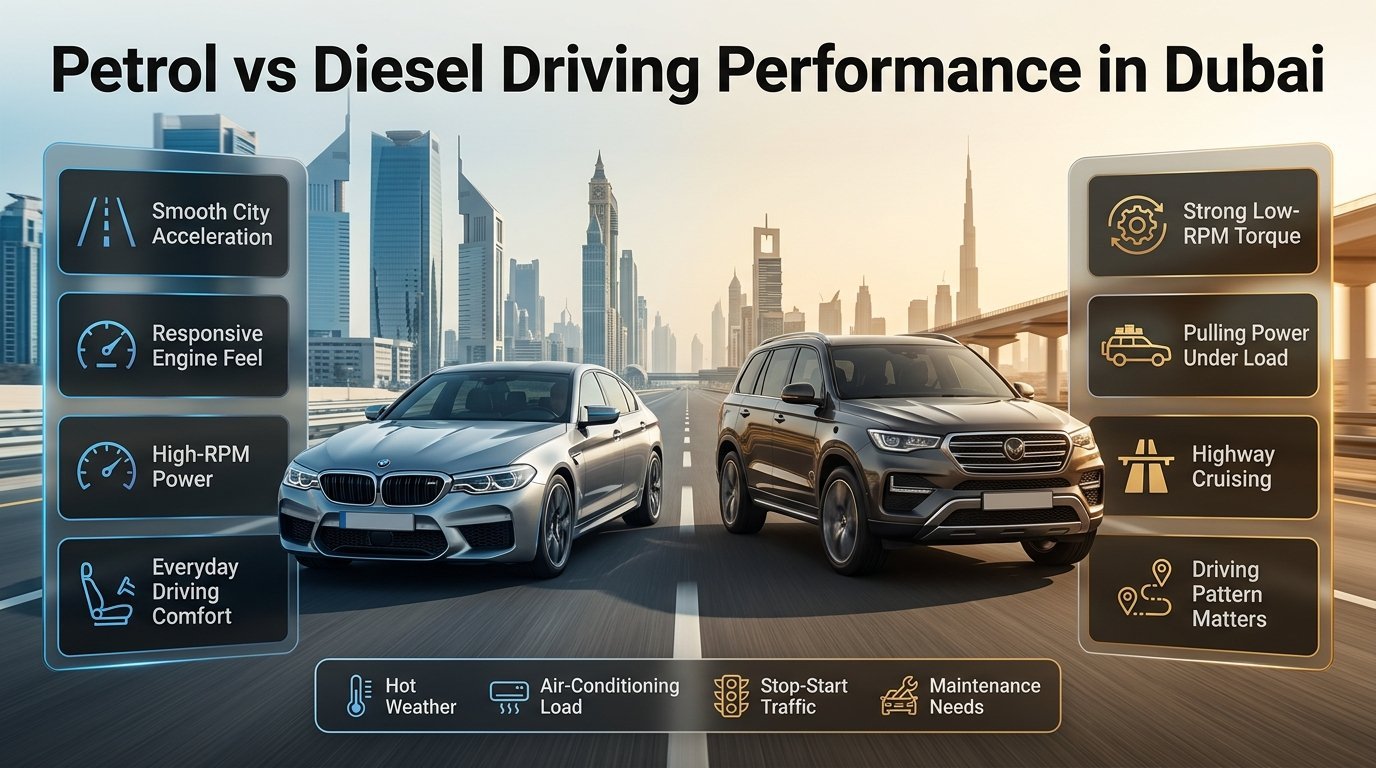
Petrol vs Diesel Driving Performance in Dubai | Choosing between a petrol and diesel vehicle in Dubai can be difficult when both options appear suitable on paper. One car may offer smooth acceleration in city traffic, while another may feel stronger when carrying passengers or travelling at highway speeds. Add Dubai’s hot weather, air-conditioning use, busy roads, and frequent stop-start journeys, and the decision becomes more complicated.
Understanding petrol vs diesel driving performance in Dubai helps drivers choose an engine that matches their daily routine rather than relying on assumptions about speed, power, or fuel economy. Petrol engines often provide smooth acceleration and responsive performance at higher engine speeds, while diesel engines commonly deliver stronger low-RPM torque and relaxed pulling power under load. However, the exact result depends on the engine, transmission, vehicle weight, and manufacturer tuning.
For drivers comparing vehicles or looking for practical guidance about fuel and driving, Fuel Delivery Dubai provides the starting point for exploring the site’s fuel-related information and services.
This guide explains how petrol and diesel engines behave in Dubai’s city traffic, on Sheikh Zayed Road, during highway overtaking, and in hot weather. It also covers acceleration, torque, engine response, air-conditioning load, fuel consumption, maintenance requirements, common buying mistakes, and practical ways to choose the right engine for your driving needs.
The goal is simple: help you understand which engine is likely to deliver the best combination of performance, comfort, efficiency, and long-term practicality for your particular driving conditions.
1. What Does Driving Performance Mean for Dubai Drivers?
Driving performance describes how a vehicle responds to the driver’s inputs and handles real-world road conditions. It includes acceleration, engine response, pulling power, overtaking ability, cruising stability, transmission behaviour, and the ability to maintain comfortable performance when carrying passengers or luggage.
For Dubai drivers, performance also needs to be considered alongside high temperatures, air-conditioning demand, congestion, and the distance covered during a typical journey.
Acceleration and engine response
Acceleration describes how quickly a vehicle increases its speed. Engine response refers to how promptly the vehicle reacts when the driver presses the accelerator.
These characteristics are related but not identical. A car may respond immediately to a small accelerator input without being particularly powerful. Another vehicle may produce substantial acceleration once its turbocharger and transmission deliver the required power.
Petrol engines often offer smooth acceleration across a broad range of driving situations. Diesel engines commonly provide substantial torque at lower engine speeds, which can make them feel strong when moving away from a stop or accelerating under load.
The result depends on the specific vehicle rather than fuel type alone.
Pulling power and cruising ability
Pulling power matters when accelerating with passengers, carrying luggage, climbing gradients, or towing within the vehicle’s approved limits.
Diesel engines frequently perform well in these situations because of their low-RPM torque. However, turbocharged petrol engines can also provide strong pulling power, and some petrol vehicles outperform diesel alternatives in overall acceleration.
Cruising ability is different. It depends on the engine’s available power, transmission ratios, vehicle aerodynamics, and stability at the intended speed.
Practical advice: When comparing two cars, evaluate their complete performance rather than focusing on a single specification. Horsepower, torque, kerb weight, transmission behaviour, and measured acceleration together provide a clearer picture.
2. Petrol vs Diesel Driving Performance in Dubai City Traffic
City driving often involves repeated acceleration, braking, traffic signals, parking manoeuvres, and periods of slow movement. These conditions make low-speed smoothness and predictable throttle response particularly important.
For many drivers who mainly travel within Dubai, a petrol vehicle can be a convenient choice because it commonly provides quiet operation and smooth performance during short urban journeys. A diesel vehicle can also perform well in city traffic, especially when its engine and transmission are designed for frequent low-speed operation.
Petrol engines in stop-start traffic
Petrol engines are often comfortable in urban environments because they can provide progressive acceleration without requiring the driver to operate at high engine speeds during normal driving.
This can be useful when travelling through areas such as Downtown Dubai, Al Barsha, Business Bay, and Deira, where traffic conditions may change repeatedly.
Common advantages include:
- Smooth acceleration during ordinary commuting.
- Quiet operation at idle and under light acceleration.
- Comfortable low-speed manoeuvring in suitable vehicles.
- Good suitability for frequent short journeys.
- A wide choice of compact cars, sedans, SUVs, and hybrids.
Consider a driver travelling from Al Barsha to Business Bay during a busy weekday. The journey may include several slow sections, traffic signals, and short periods of faster movement. A well-calibrated petrol vehicle can make these transitions comfortable without needing strong pulling power throughout the journey.
However, petrol vehicles are not identical. Some small naturally aspirated engines need higher RPM to accelerate briskly, while certain turbocharged models can experience a brief delay before producing their strongest response.
Diesel engines in stop-start traffic
Diesel engines often produce substantial torque at relatively low RPM. This can help heavier vehicles move away from a stop without requiring as much engine speed.
The benefit can be noticeable in large SUVs, pickups, and vehicles carrying passengers or equipment.
However, repeated short journeys can create challenges for some modern diesel vehicles fitted with diesel particulate filters. These systems collect soot and periodically need suitable operating conditions to complete regeneration.
If a vehicle is used mainly for short trips, the exhaust system may not consistently reach the conditions required by its manufacturer.
This does not mean every diesel vehicle is unsuitable for urban driving. It means buyers should understand the specific engine’s emissions-system requirements before choosing it for a short-trip routine.
Common mistake: Choosing diesel because it offers strong torque without considering journey length, servicing requirements, or the vehicle’s emissions equipment.
For drivers who mostly make short school runs, shopping trips, and brief commutes, a petrol car may be the simpler option. Drivers who regularly combine city driving with longer journeys may find a suitable diesel equally practical.
3. Petrol vs Diesel Performance on Sheikh Zayed Road
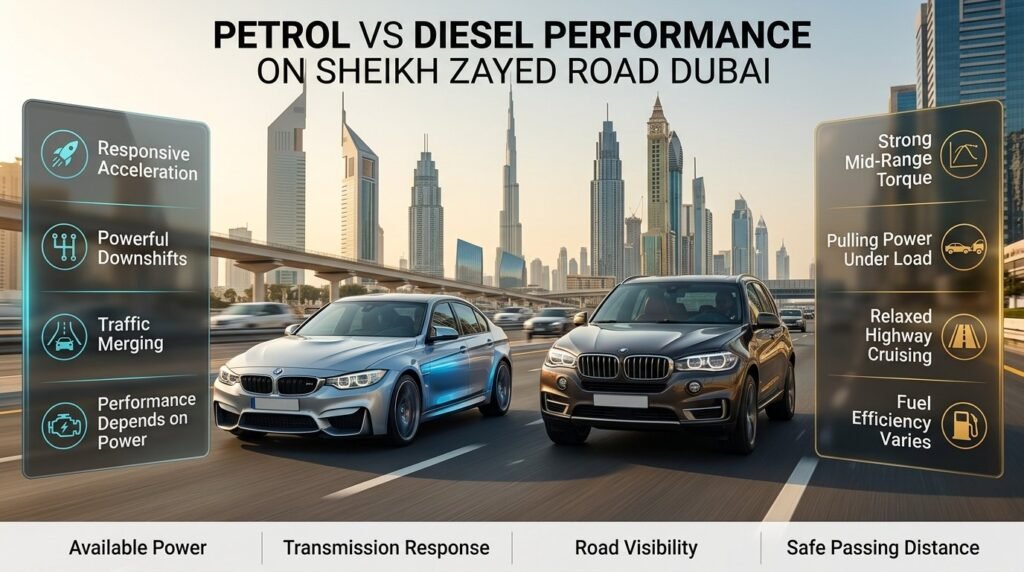
Sheikh Zayed Road is an important part of Dubai’s driving network, connecting business districts, residential communities, and routes towards other emirates. Driving on this road requires predictable acceleration, stable cruising, and the ability to adjust speed safely as traffic changes.
Both petrol and diesel vehicles can provide these qualities. The difference comes down to how the particular engine delivers power and how effectively the transmission uses it.
Petrol performance on major roads
A petrol engine with sufficient horsepower can provide strong acceleration when joining moving traffic or increasing speed after slowing down.
Many petrol engines perform well when the automatic transmission selects a lower gear and allows the engine to operate within its effective power range.
This can be beneficial when:
- Joining a faster-moving lane.
- Accelerating after congestion clears.
- Maintaining speed with changing traffic flow.
- Driving a performance-oriented sedan.
- Carrying a moderate load in a suitably powered vehicle.
A larger petrol engine may provide effortless acceleration, while a smaller engine in a heavy SUV may need more time to gain speed. Engine size alone is not a reliable indicator of performance because turbocharging and modern engine management can substantially change the outcome.
Diesel performance on major roads
Diesel engines often deliver useful torque through the middle of their operating range. This can help a vehicle accelerate from cruising speed without requiring very high engine RPM.
For drivers who frequently travel between Dubai and Abu Dhabi, a suitable diesel vehicle may provide a relaxed driving experience, particularly when carrying passengers and luggage.
Potential benefits include:
- Strong mid-range pulling power.
- Comfortable acceleration under load.
- Good suitability for sustained highway journeys.
- Potentially lower fuel consumption than a comparable conventional petrol vehicle.
Nevertheless, not every diesel engine has better highway performance. A petrol vehicle with more horsepower, favourable gearing, or a more responsive transmission may accelerate faster.
Which engine is better for highway overtaking?
Neither petrol nor diesel automatically wins.
Safe overtaking depends on the vehicle’s available power at the current speed, transmission response, road conditions, visibility, vehicle load, and the distance available to complete the manoeuvre.
Before buying a vehicle for regular highway travel, compare acceleration measurements for the exact engine and transmission version. During everyday driving, maintain safe distances and obey posted speed limits rather than relying on the engine’s pulling power to compensate for insufficient space.
4. Petrol vs Diesel Acceleration: Which Feels Faster?
Petrol vehicles are often associated with lively acceleration, particularly when their engines produce strong power at higher RPM. Diesel vehicles frequently feel forceful at low engine speeds because they deliver substantial torque early in the rev range.
However, the sensation of acceleration is not the same as measured acceleration. A vehicle that feels strong at low speeds may not be the quickest vehicle when accelerating from one road speed to another.
Understanding horsepower and torque
Horsepower describes how quickly an engine can perform work, while torque measures rotational force. Both contribute to vehicle performance, but they describe different characteristics.
| Performance factor | Petrol engines | Diesel engines |
|---|---|---|
| Low-RPM pulling power | Varies by engine design | Often strong |
| Higher-RPM operation | Often supports a wider high-rev range | Usually has a lower practical rev range |
| Acceleration feel | Can feel progressive and lively | Can feel forceful at low RPM |
| Peak horsepower | Depends on engine design | Depends on engine design |
| Heavy-load suitability | Depends on output and gearing | Often well suited to pulling demands |
| Overall acceleration | Vehicle-specific | Vehicle-specific |
Why vehicle weight changes the result
Imagine two SUVs travelling on Al Khail Road. The diesel SUV produces substantial torque at low RPM, making it feel strong when accelerating gently from cruising speed. The petrol SUV produces more peak horsepower and has a responsive transmission, allowing it to achieve quicker acceleration under suitable conditions.
Both outcomes are realistic.
The difference depends on how much power reaches the wheels, the vehicle’s mass, the gear ratios, and the engine’s power delivery across the operating range.
For a more detailed explanation of real-world acceleration, see Petrol vs Diesel Acceleration in Dubai.
5. How Does Dubai’s Hot Weather Affect Petrol and Diesel Performance?
Dubai’s summer temperatures place additional demands on engine cooling, intake-air management, air-conditioning systems, and vehicle maintenance. Both petrol and diesel engines must operate within their designed temperature limits to deliver reliable performance.
There is no universal rule that petrol engines always handle heat better or that diesel engines always maintain their performance in extreme temperatures. The cooling system, turbocharger design, intercooler, engine-management calibration, and overall condition are more important than a simple petrol-versus-diesel label.
Petrol engine performance in summer
Hot intake air is less dense than cooler air, so it contains less oxygen per unit volume. Depending on the engine design and operating conditions, this can reduce available power.
Turbocharged petrol engines may adjust boost pressure or ignition timing to protect against excessive temperatures and abnormal combustion. These adjustments can affect acceleration, although the extent varies considerably between vehicles.
Air-conditioning can add further load, especially during low-speed acceleration or when the engine is relatively small for the vehicle’s weight.
To maintain reliable performance:
- Follow the manufacturer’s engine-oil specifications.
- Check coolant levels and investigate leaks.
- Maintain the radiator, cooling fans, and associated components.
- Replace air filters at the recommended intervals.
- Address engine-temperature warnings immediately.
- Use the fuel grade specified by the manufacturer.
Diesel engine performance in summer
Diesel engines also depend on effective cooling and intake-air management. Turbocharged diesel engines may experience reduced performance when operating conditions require the engine-management system to limit output.
The cooling system must manage heat from the engine, while the turbocharger and intercooler, where fitted, must operate correctly to deliver the expected performance.
Modern diesel exhaust systems also need appropriate operating conditions to manage emissions. Their requirements vary according to the model and emissions technology.
Expert tip: If a vehicle suddenly loses power during hot weather, do not automatically blame the temperature. Reduced acceleration, repeated overheating, unusual smoke, or warning lights may indicate a cooling, intake, fuel-delivery, or emissions-system problem that requires diagnosis.
6. Petrol vs Diesel Performance With Air Conditioning On
Air-conditioning is essential for comfortable driving in Dubai. However, operating the system can increase energy demand and may influence engine response during acceleration.
The effect depends on the compressor design, engine output, cooling-system condition, vehicle weight, and control strategy.
Petrol cars with air-conditioning
In some petrol vehicles, the additional compressor load is noticeable when moving away from a stop or accelerating at low RPM. Small engines may require more throttle to maintain the same acceleration, especially when the vehicle is fully loaded.
Modern vehicles often manage air-conditioning demand electronically, so the effect can be relatively subtle.
Drivers can improve comfort and efficiency by maintaining the cooling system, avoiding unnecessary aggressive acceleration, and ensuring that the air-conditioning system is serviced correctly.
Diesel cars with air-conditioning
A diesel engine’s low-speed torque may help it feel less affected by additional load in certain circumstances. However, a small diesel engine in a heavy vehicle may still feel less responsive than a larger or more powerful petrol engine.
The quality of the transmission calibration also matters. An automatic gearbox that selects an appropriate gear promptly can make a significant difference to perceived performance.
How to compare both engines fairly
During a test drive, use the air-conditioning under normal conditions and evaluate:
- Acceleration from a complete stop.
- Response when moving slowly through traffic.
- Smoothness during moderate acceleration.
- Engine noise and vibration.
- Cooling performance while the vehicle is stationary.
- Behaviour with passengers or luggage, where practical.
A comparison without air-conditioning may not reflect how the car will actually be used in Dubai.
7. Which Performs Better: Petrol or Diesel SUVs, Sedans, and Pickups?
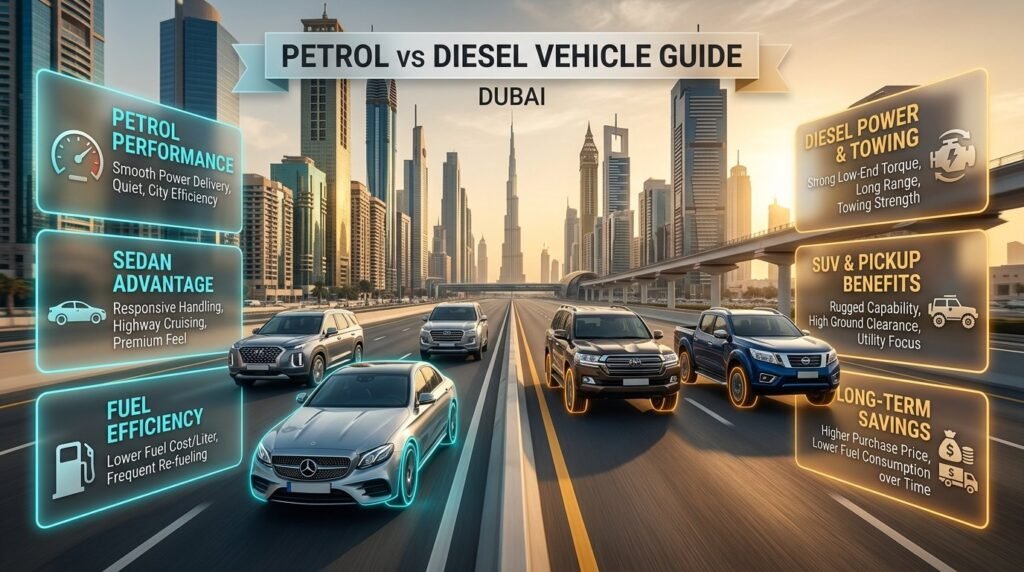
The vehicle category often matters as much as the fuel type. A compact sedan, family SUV, and commercial pickup have different weight, performance, and operating requirements.
Petrol sedans for everyday driving
Petrol sedans are often suitable for drivers who prioritise comfortable commuting, predictable acceleration, and quiet operation.
They can be practical for:
- Daily office journeys.
- Short urban trips.
- Family transportation.
- Parking and manoeuvring in busy areas.
- Drivers who do not regularly carry heavy loads.
A well-powered petrol sedan can provide more than enough acceleration for normal Dubai driving without requiring the additional pulling capability that some diesel vehicles offer.
However, buyers should still compare the engine output and vehicle weight. Not every petrol sedan will feel responsive when fully loaded.
Diesel SUVs for long-distance driving
Diesel SUVs may suit drivers who frequently travel long distances, carry substantial luggage, or need strong pulling power.
Their torque characteristics can make them feel capable when accelerating under load. Some diesel SUVs also achieve favourable fuel economy over longer journeys.
However, their suitability depends on the specific engine, service history, emissions equipment, and expected ownership period.
A diesel SUV used almost exclusively for brief urban trips may not be the most convenient choice, especially if the model’s emissions system requires operating conditions that are rarely achieved.
Petrol SUVs for families
Petrol SUVs can be a practical option for families whose journeys mainly take place within Dubai.
Modern turbocharged petrol engines can produce substantial torque, while larger naturally aspirated engines may provide predictable acceleration and smooth power delivery.
Fuel consumption can be relatively high in a large petrol SUV, particularly in congested traffic. However, overall ownership costs depend on the purchase price, service requirements, actual fuel consumption, and vehicle condition.
Diesel pickups and work vehicles
Diesel pickups are commonly designed for load-carrying and demanding work. Strong torque can be useful when transporting equipment, carrying goods, or towing within the manufacturer’s permitted limits.
Before selecting a pickup, review its payload rating, towing capacity, transmission specifications, and intended operating conditions. A high torque figure cannot compensate for exceeding the vehicle’s approved load limits.
8. Petrol vs Diesel Driving Comfort: Noise, Vibration, and Smoothness
Performance isn’t just about acceleration. Noise, vibration, gearbox behaviour, and cabin refinement can affect how enjoyable a vehicle feels during daily commuting and long-distance travel.
Petrol engines are often quieter at idle and under light acceleration than comparable diesel engines. Modern diesel vehicles can nevertheless be highly refined, especially when they have effective sound insulation and well-designed engine mounts.
Engine noise and vibration
Diesel engines use compression ignition, which produces different combustion characteristics from petrol engines. This can create more noticeable engine noise and vibration, although the difference depends on the vehicle.
Older diesel models may sound louder at idle or transmit more vibration through the cabin. Modern diesel engines can reduce these effects through improved injection systems, engine design, and sound insulation.
Petrol engines commonly provide quieter operation during ordinary city driving. This may be appealing to drivers who spend long periods in traffic or frequently make short trips.
Transmission response
Transmission behaviour can influence performance more than drivers initially expect.
An automatic gearbox that shifts smoothly and selects an appropriate gear quickly can make a vehicle feel responsive. A slow or poorly calibrated transmission may make even a powerful engine feel hesitant.
During a test drive, assess:
- How smoothly the vehicle moves away from a stop.
- Whether acceleration is delayed after pressing the pedal.
- How quickly the gearbox responds to moderate acceleration.
- Whether gear changes create unwanted vibration.
- Engine noise during normal and stronger acceleration.
- Comfort when the air-conditioning is operating.
A vehicle should feel suitable for your actual driving routine, not simply impressive during a brief showroom demonstration.
9. Petrol vs Diesel Fuel Economy and Performance in Dubai
Fuel economy and driving performance are connected, but they are not interchangeable. A vehicle can accelerate strongly while consuming more fuel, while another can provide adequate performance with less fuel.
Diesel engines often achieve better fuel economy than comparable conventional petrol engines, particularly during regular longer journeys. However, the difference depends on engine technology, vehicle size, transmission, aerodynamics, and driving conditions.
Why diesel engines often consume less fuel
Diesel engines generally operate with higher compression ratios and can convert fuel energy efficiently under many operating conditions. Their torque characteristics can also help move heavier vehicles without requiring frequent high engine speeds.
These characteristics can make diesel attractive for drivers who cover substantial distances throughout the year.
However, a diesel vehicle’s purchase price, servicing requirements, and potential emissions-system maintenance must also be considered. Better fuel economy does not automatically guarantee lower total ownership costs.
Why petrol can still be more practical
Petrol vehicles may be more convenient for drivers who mostly make short journeys and drive in congested urban conditions.
A petrol car might also cost less to purchase or maintain, depending on the model. The final financial comparison should include:
- Purchase price.
- Real-world fuel consumption.
- Applicable petrol or diesel prices.
- Scheduled maintenance.
- Potential emissions-system servicing.
- Annual driving distance.
- Expected resale value.
- Planned ownership period.
Drivers should calculate their likely annual fuel expense rather than assuming that the engine with better advertised fuel economy will always cost less to own.
For a dedicated comparison of operating efficiency, read Petrol vs Diesel Fuel Economy in Dubai.
How to measure real-world fuel consumption
Use a consistent method to estimate your vehicle’s actual fuel economy.
- Fill the tank using the correct fuel specification.
- Reset the trip meter.
- Drive normally under your usual conditions.
- Refill the tank and record the amount of fuel added.
- Divide the distance travelled by the fuel consumed to calculate kilometres per litre.
Repeat the process across several tanks to reduce the influence of individual trips. Traffic congestion, temperature, tyre pressure, passenger load, and driving style can all affect the results.
10. How Driving Style Affects Petrol and Diesel Performance
The way a vehicle is driven influences acceleration, fuel consumption, comfort, and component wear. A well-designed engine can feel inefficient or unresponsive when it is driven in a way that does not suit its operating characteristics.
Use smooth acceleration
Progressive acceleration can reduce unnecessary speed changes and improve passenger comfort. It also gives the transmission an opportunity to select suitable gears without repeated aggressive inputs.
This approach benefits both petrol and diesel vehicles.
When traffic begins moving, accelerate smoothly while maintaining an appropriate distance from the vehicle ahead. Avoid repeatedly accelerating hard only to brake moments later.
Anticipate traffic conditions
Looking ahead helps drivers identify slowing traffic, traffic signals, and changes in road conditions before they become immediate obstacles.
In congested Dubai traffic, this can reduce unnecessary acceleration and braking while supporting safer driving.
Maintaining a safe following distance is essential. Fuel economy should never take priority over safe spacing or a driver’s ability to stop when required.
Allow the engine to operate in a suitable range
Petrol engines may need higher RPM to deliver their strongest acceleration, depending on their design. Diesel engines commonly provide useful pulling power at lower RPM.
However, excessively low engine speeds under heavy load can cause vibration, poor response, or unnecessary strain in either engine type.
For automatic vehicles, allow the transmission to select appropriate gears during ordinary driving. Follow the manufacturer’s guidance instead of trying to keep the engine at an arbitrarily low RPM.
Maintain tyres and essential components
Incorrect tyre pressure, restricted air filters, dragging brakes, and neglected servicing can reduce performance and increase fuel consumption.
Check tyre pressure against the vehicle manufacturer’s recommendation, usually displayed on a label inside the driver’s door or fuel-filler area.
Do not use the maximum pressure printed on the tyre sidewall as the normal target unless the vehicle manufacturer specifically directs it.
For additional guidance on the broader differences between engine types, see Petrol vs. Diesel Comparisons Dubai.
11. How Engine Torque Influences Real-World Driving in Dubai

Torque is particularly important when evaluating low-speed response and the ability to accelerate under load. Diesel engines commonly produce substantial torque at lower RPM, while petrol engines vary considerably according to their design.
Why torque matters in city driving
Strong low-RPM torque can help a vehicle move away from a stop without needing to reach high engine speeds. This can be useful in larger SUVs and pickups.
However, smooth city driving also depends on throttle calibration, transmission behaviour, vehicle weight, and the way the engine responds to small accelerator inputs.
A high torque figure does not necessarily mean that a vehicle will be easier to control in every traffic situation.
Why torque matters on highways
When a driver needs to accelerate from cruising speed, torque available at the wheels can influence how readily the vehicle gains speed.
The transmission plays a major role because it determines how engine torque is multiplied through the selected gear.
A petrol engine with lower peak torque may still accelerate quickly if it produces greater horsepower and the transmission keeps it within its effective operating range.
Compare the complete torque curve
Peak torque is only one part of the picture. The RPM range over which torque is available also matters.
When evaluating two vehicles, review:
- Peak torque and the RPM at which it occurs.
- Maximum horsepower and its operating range.
- Transmission ratios and shift behaviour.
- Vehicle kerb weight.
- Acceleration measurements at relevant speeds.
- How the vehicle responds under a realistic load.
For a deeper technical explanation, read Petrol vs Diesel Torque Comparison in Dubai.
12. Understanding Petrol and Diesel Power Delivery
Power delivery describes how an engine produces and supplies usable power as engine speed and load change. It influences whether a vehicle feels progressive, forceful, responsive, or relaxed.
Petrol and diesel engines can both provide strong performance, but their typical operating characteristics differ.
Petrol power delivery
Many petrol engines provide their strongest power at higher RPM than comparable diesel engines. This can support lively acceleration when the transmission selects a suitable gear.
Naturally aspirated petrol engines generally build power according to their design and engine speed, while turbocharged petrol engines can provide strong torque at lower RPM.
Turbocharger response, throttle calibration, and transmission programming can all influence how immediate the vehicle feels.
Diesel power delivery
Diesel engines commonly deliver strong torque at lower RPM and maintain useful pulling power through the middle of their operating range.
This can help the vehicle accelerate under load without requiring the same engine speed as some petrol alternatives.
However, diesel engines generally have a lower practical rev range, and their maximum horsepower may be lower or higher depending on the specific engine.
Why power delivery matters more than labels
Two engines with similar peak horsepower can feel different when driven on the same road.
One may respond quickly at low speeds, while the other may deliver its strongest acceleration after a downshift. Neither behaviour is inherently better in every situation.
Your preference should depend on whether you prioritise smooth urban response, heavy-load pulling power, highway acceleration, or a particular driving experience.
Explore Petrol vs Diesel Power Delivery for Dubai Drivers for a closer look at these differences.
13. Common Mistakes When Choosing Petrol or Diesel in Dubai
A sensible decision requires more than comparing fuel type, engine size, or advertised specifications. The following mistakes can lead to an unsuitable purchase or unrealistic expectations about performance.
Mistake 1: Assuming diesel always has more power
Diesel engines often produce more low-RPM torque than comparable petrol engines, but torque and horsepower measure different characteristics.
Why it matters: A vehicle with greater peak torque may not achieve faster acceleration.
How to avoid it: Compare horsepower, torque curves, vehicle weight, gearing, and independent acceleration measurements.
Mistake 2: Assuming petrol is always faster
Some petrol engines provide excellent high-RPM performance, but a powerful diesel can outperform a less powerful petrol vehicle.
Why it matters: Engine design and vehicle specifications vary substantially.
How to avoid it: Compare vehicles in the same category and evaluate their exact engine and transmission combinations.
Mistake 3: Ignoring short-trip requirements
Modern diesel vehicles may need suitable operating conditions to complete DPF regeneration.
Why it matters: A vehicle used almost exclusively for brief journeys may experience emissions-system problems if the required conditions are rarely achieved.
How to avoid it: Review the manufacturer’s operating instructions and choose an engine suited to your normal journey length.
Mistake 4: Comparing different vehicle categories
A compact petrol sedan and a heavy diesel SUV differ in weight, aerodynamics, gearing, and intended purpose.
Why it matters: Any performance difference may result from the vehicles themselves rather than the fuel type.
How to avoid it: Compare similar models and specifications before drawing conclusions.
Mistake 5: Ignoring maintenance history
A neglected engine may suffer from restricted airflow, cooling problems, fuel-delivery faults, or transmission issues.
Why it matters: These problems can reduce performance regardless of whether the engine uses petrol or diesel.
How to avoid it: Review service records and arrange an independent inspection before buying a used vehicle.
Mistake 6: Treating all summer performance changes as normal
High temperatures can influence performance, but repeated overheating or severe hesitation should not be dismissed.
Why it matters: An unresolved fault may lead to further damage or unsafe operation.
How to avoid it: Investigate unusual performance changes, warning lights, and cooling-system problems promptly.
14. Expert Advice for Choosing the Right Engine for Dubai Driving
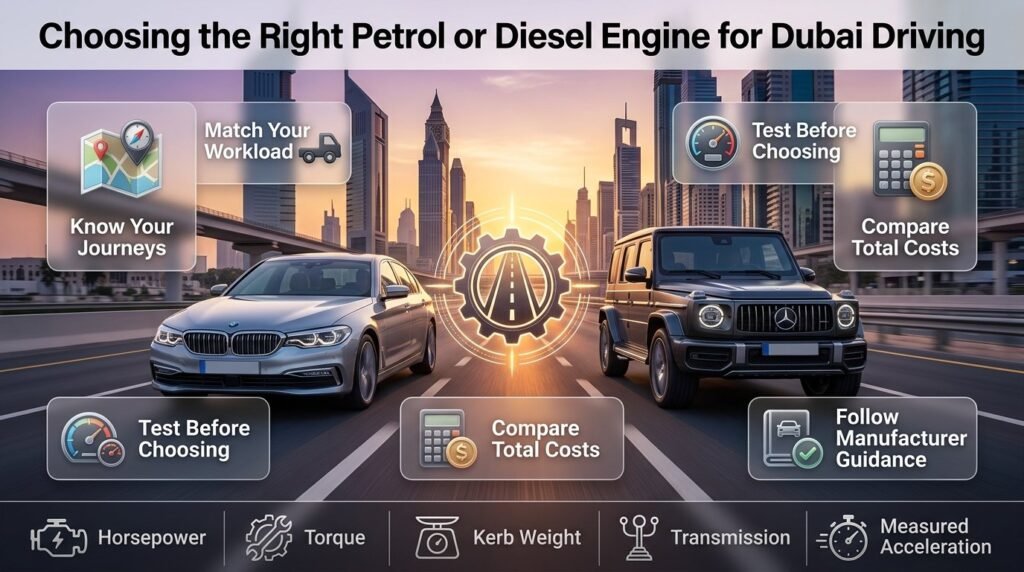
The most useful engine-selection process begins with your driving habits. Instead of asking which fuel type is universally superior, consider what you expect the vehicle to do every day.
Step 1: Identify your usual journeys
Estimate how much time you spend in city traffic compared with longer highway journeys.
Frequent short trips may favour a petrol vehicle, while regular long-distance travel may make a suitable diesel worth considering.
Step 2: Consider your vehicle’s workload
A family sedan, large SUV, and work pickup have different requirements.
Think about the number of passengers, typical luggage, equipment, and any approved towing needs. Strong low-RPM torque may be particularly useful for heavier workloads.
Step 3: Test the exact vehicle
Drive the actual engine and transmission combination you intend to purchase.
Assess low-speed response, moderate acceleration, transmission behaviour, cabin noise, and comfort with the air-conditioning operating.
Step 4: Compare long-term costs
Calculate realistic fuel expenses and compare them with purchase price, servicing, potential emissions-system maintenance, and resale considerations.
A vehicle that uses less fuel may still cost more overall if its purchase or maintenance costs are substantially higher.
Step 5: Follow manufacturer requirements
Confirm the recommended fuel specification, service intervals, oil requirements, and emissions-system operating guidance.
Avoid selecting a vehicle based on assumptions that conflict with its manufacturer’s instructions.
Professional tip: Record the horsepower, torque, kerb weight, transmission type, and measured acceleration figures for each vehicle you’re considering. These specifications provide a much more reliable basis for comparison than general statements such as “diesel is stronger” or “petrol is faster.”
For a broader understanding of engine characteristics, explore Petrol vs Diesel Engine Performance in Dubai.
Is petrol or diesel better for driving performance in Dubai?
Petrol and diesel engines offer different performance advantages, and the better option depends on your driving conditions. Petrol engines often provide smooth acceleration, quieter operation, and responsive performance for everyday city driving. Diesel engines typically deliver stronger low-RPM torque, which can be useful when driving larger SUVs, carrying heavy loads, or travelling long distances on Dubai’s highways.
Dubai drivers should consider traffic congestion, summer temperatures, air-conditioning use, and the length of their regular journeys before choosing an engine. A petrol sedan may be suitable for frequent short trips, while a diesel SUV may suit someone who regularly travels between Dubai and Abu Dhabi.
Important factors to consider:
City driving: Petrol is often convenient for short trips and stop-start traffic.
Highway driving: Diesel can offer strong mid-range pulling power and favourable fuel economy.
Vehicle type: Engine size, horsepower, torque, and vehicle weight influence actual performance.
Maintenance: The manufacturer’s servicing and emissions-system requirements should match your driving routine.
The most practical choice is the engine that delivers the required performance without creating unnecessary fuel or maintenance costs.
Which engine provides better acceleration on Dubai roads, petrol or diesel?
Neither petrol nor diesel is always faster. Petrol engines often deliver strong acceleration at higher engine speeds, particularly in performance-oriented vehicles. Diesel engines commonly provide substantial torque at lower RPM, helping them feel powerful when moving away from a stop or accelerating with passengers and luggage.
On roads such as Sheikh Zayed Road and Al Khail Road, actual acceleration depends on how much power is available at the current speed, how quickly the transmission responds, and how much the vehicle weighs. A powerful petrol SUV may accelerate faster than a diesel SUV, while a suitably designed diesel vehicle may provide stronger low-speed pulling power.
What determines real-world acceleration?
Horsepower: Influences how quickly the vehicle can perform work, particularly as speed increases.
Torque delivery: Affects pulling force and how the engine responds across its operating range.
Transmission: Appropriate gear selection can improve acceleration and responsiveness.
Vehicle weight: A heavier vehicle generally requires more power to achieve the same acceleration under comparable conditions.
When comparing vehicles, review their measured acceleration figures and test-drive the exact engine and transmission combination. Do not choose solely on the basis of peak torque or engine size.
Does Dubai’s hot weather affect petrol and diesel engine performance?
Yes, high ambient temperatures can influence both petrol and diesel engine performance. Hot intake air is less dense than cooler air, which can reduce the amount of oxygen entering the engine. Depending on the vehicle, engine-management systems may adjust output to protect components and maintain safe operating conditions.
Dubai’s summer heat also places additional demands on the cooling system and air-conditioning. A poorly maintained radiator, restricted airflow, coolant leak, or faulty cooling fan can contribute to overheating and reduced performance. Turbocharged vehicles may also be affected by intake-air temperature and intercooler performance.
How to maintain performance in Dubai’s summer:
Check coolant levels and investigate leaks promptly.
Follow the manufacturer’s engine-oil and servicing recommendations.
Keep the radiator, cooling fans, and air filters in good condition.
Monitor temperature warnings and unusual changes in acceleration.
Arrange professional diagnosis if the vehicle repeatedly overheats or loses power.
Neither fuel type is automatically better in extreme heat. Proper maintenance and the vehicle’s cooling-system design are more important than general petrol-versus-diesel assumptions.
Is a diesel engine more fuel-efficient than a petrol engine for Dubai driving?
Diesel engines often consume less fuel than comparable conventional petrol engines, particularly during regular long-distance driving. Their engine design and strong low-RPM torque can support efficient operation when cruising or carrying heavier loads. However, actual fuel consumption depends on the vehicle, transmission, driving conditions, and engine technology.
For example, a diesel SUV used regularly for highway journeys may achieve better fuel economy than a comparable petrol SUV. A driver making frequent short trips in congested Dubai traffic may find that a petrol vehicle is more convenient, especially if the diesel model has emissions-system requirements that are difficult to satisfy during short journeys.
Compare these factors before making a decision:
Real-world fuel consumption rather than advertised figures alone.
Annual kilometres driven and the proportion of highway travel.
Applicable petrol or diesel prices.
Purchase price and routine servicing costs.
Potential diesel particulate filter and other emissions-system maintenance.
Expected ownership period and resale value.
A vehicle that consumes less fuel does not automatically cost less to own. Calculate expected annual fuel expenses and consider maintenance costs alongside performance before choosing.
Should I choose a petrol or diesel car for daily driving in Dubai?
Your daily driving pattern should guide the decision. Petrol vehicles are often practical for short commutes, frequent stops, shopping trips, and family journeys within Dubai. They commonly provide quiet operation and smooth acceleration under ordinary driving conditions.
Diesel vehicles may be more suitable for drivers who regularly cover long distances, travel between emirates, carry substantial loads, or operate vehicles designed for demanding work. Their low-RPM torque can provide useful pulling power, while many models also deliver favourable highway fuel economy.
Before purchasing, consider whether the vehicle will spend most of its time in congestion or regularly complete longer journeys. Modern diesel engines equipped with diesel particulate filters may require specific operating conditions for regeneration, so frequent short trips deserve particular attention.
Use this practical checklist:
Choose petrol if: You mainly drive short urban routes and prioritise smooth, quiet operation.
Consider diesel if: You regularly travel long distances or need strong pulling power.
Compare both if: You drive a large SUV, cover substantial annual mileage, or carry heavy loads.
Test-drive before deciding: Evaluate acceleration, gearbox response, cabin noise, and air-conditioning performance.
Check ownership costs: Include servicing, fuel consumption, and any model-specific emissions-system requirements.
Ultimately, the best engine is the one that matches your normal driving conditions and provides dependable performance at a reasonable long-term cost.
Conclusion: Petrol vs Diesel Driving Performance in Dubai
Choosing between petrol and diesel driving performance in Dubai depends on your daily driving routine, vehicle type, traffic conditions, and long-term ownership priorities. Both engine types can perform well in the UAE, but they deliver power differently and offer distinct advantages on city roads and highways.
Petrol engines are often a practical choice for drivers who regularly travel through busy urban areas, make short trips, and prefer responsive acceleration with smoother, quieter operation. Diesel engines can be particularly suitable for drivers who cover long highway distances, operate heavier vehicles, or need strong low-RPM torque for carrying loads and maintaining steady performance.
Dubai’s driving conditions also influence the decision. Heavy traffic, frequent stops, air-conditioning use, high ambient temperatures, and extended highway journeys can affect real-world performance and fuel consumption. Therefore, comparing engine specifications alone is not enough. Consider the complete vehicle, including its weight, transmission, cooling system, maintenance requirements, and the manufacturer’s recommendations.
Before making a decision, evaluate these key factors:
- Daily driving pattern: Petrol may suit frequent short trips, while diesel can be advantageous for consistent long-distance driving.
- Acceleration and power delivery: Compare real-world responsiveness, horsepower, torque, and transmission performance rather than relying on one specification.
- Fuel economy: Assess expected consumption based on your actual driving conditions, not just official mileage figures.
- Maintenance and reliability: Follow the recommended service schedule and consider the additional requirements of modern diesel emissions systems.
- Driving comfort: Evaluate engine noise, vibration, cabin refinement, and performance in stop-and-go traffic.
Ultimately, there is no single winner for every Dubai driver. The best option is the vehicle that matches your routine, budget, and performance expectations while remaining reliable under local driving conditions. By understanding the differences between petrol and diesel engines, you can make a more informed decision and enjoy a comfortable, efficient, and dependable driving experience across Dubai’s city streets and highways.
Leave a Reply