
Introduction
Petrol vs Diesel Acceleration in Dubai | When you’re driving on Sheikh Zayed Road, joining fast-moving traffic, or overtaking a slower vehicle on a Dubai highway, your car’s acceleration matters. You need an engine that responds predictably when you press the accelerator, delivers enough power when required, and performs reliably in hot weather and demanding traffic conditions.
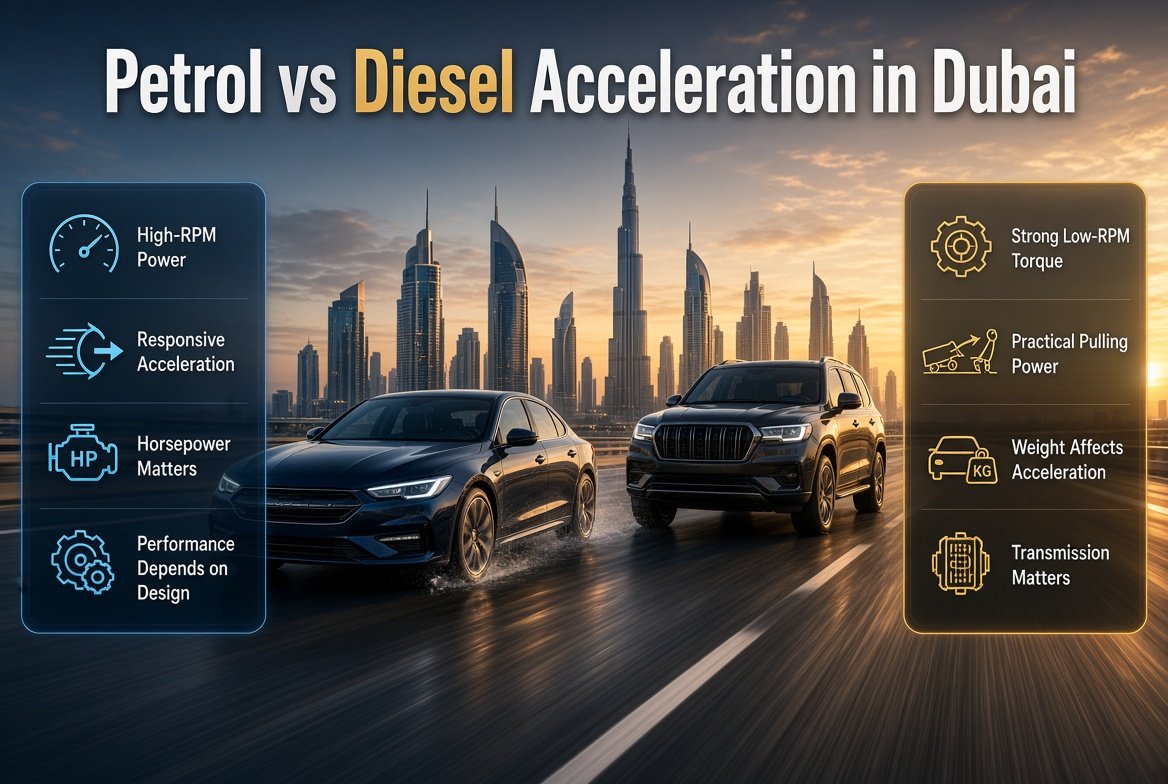
This is where the debate about petrol vs diesel acceleration in Dubai becomes important. Both engine types have advantages, but they deliver power differently. Petrol engines often provide strong high-RPM performance, while diesel engines commonly produce substantial torque at lower engine speeds. However, neither fuel type is automatically faster in every situation.
A powerful diesel SUV can accelerate more quickly than a low-powered petrol sedan, while a lightweight petrol car may outperform a heavier diesel vehicle with a higher torque rating. The actual result depends on horsepower, engine design, transmission, vehicle weight, traction, and the speed at which acceleration begins.
If you’re comparing vehicles for daily commuting, highway driving, family use, or performance, understanding these differences will help you make a better decision. You can also explore the broader engine and fuel differences through Fuel Delivery Dubai.
This guide explains how petrol and diesel acceleration compare, what affects real-world performance in Dubai, how to evaluate overtaking ability, and which engine characteristics matter most before purchasing a vehicle.
1. What Does Acceleration Mean in Petrol and Diesel Cars?
Acceleration is the rate at which a vehicle increases its speed. In petrol and diesel cars, acceleration depends on how effectively the engine produces power, how the transmission transfers that power to the wheels, and how much resistance the vehicle must overcome.
For drivers in Dubai, acceleration isn’t only about reaching 100 km/h quickly. It also includes moving away from traffic lights, merging onto highways, increasing speed when a traffic gap appears, and maintaining responsive performance when carrying passengers.
Understanding acceleration in everyday driving
Imagine you’re travelling at 60 km/h and need to increase your speed to match the flow of traffic. A responsive vehicle should build speed without excessive delay, uncomfortable vibration, or repeated hesitation.
The engine must produce enough power, while the transmission selects a suitable gear. The tyres must also maintain sufficient grip to transfer the available force to the road.
Petrol and diesel engines can both achieve this, but their characteristics often differ.
A petrol engine may deliver stronger acceleration as engine speed rises, especially when it has a powerful turbocharger or a high-revving design. A diesel engine may feel particularly strong at low and medium RPM because it often produces substantial torque within that range.
Neither characteristic guarantees a quicker result in every situation.
The difference between initial response and overall acceleration
Initial response describes how quickly the vehicle reacts when you press the accelerator. Overall acceleration describes how effectively the vehicle continues gaining speed.
These are related but different qualities.
A diesel car may feel powerful immediately because its engine produces useful torque at relatively low RPM. However, a petrol car with more horsepower may continue accelerating more strongly as speeds increase.
The transmission can change the experience significantly. If an automatic gearbox takes time to downshift, a powerful engine may feel less responsive than expected. A well-calibrated gearbox can help either petrol or diesel engines deliver their available performance efficiently.
Practical example: During a short acceleration burst in city traffic, a diesel engine’s low-speed torque may feel impressive. During a longer acceleration run, a petrol engine with greater power may gradually pull ahead.
The only reliable way to determine the winner is to compare the actual vehicles under comparable conditions.
2. How Do Petrol and Diesel Engines Produce Acceleration?
Petrol and diesel engines convert fuel energy into mechanical energy, but their combustion processes differ. These differences influence engine speed, torque delivery, and power characteristics, which ultimately affect acceleration.
How petrol engines deliver power
A conventional petrol engine uses spark plugs to ignite the air-fuel mixture inside its cylinders. The resulting combustion pushes the pistons, which turn the crankshaft and ultimately provide power to the wheels through the transmission.
Many petrol engines are designed to operate across a relatively broad range of engine speeds. Performance-oriented versions can produce substantial power at higher RPM, allowing the vehicle to continue accelerating strongly when the transmission selects an appropriate gear.
Petrol engines are available in naturally aspirated and turbocharged configurations.
Naturally aspirated engines draw air into the cylinders without a turbocharger. Their acceleration depends on displacement, engine design, vehicle weight, and other factors.
Turbocharged petrol engines force additional air into the cylinders, allowing the engine to produce more power from a given displacement when appropriately designed and calibrated.
Common petrol acceleration advantages include:
- Strong high-RPM power in many performance-oriented engines.
- Smooth acceleration across a useful range of engine speeds.
- Potentially rapid throttle response in well-calibrated vehicles.
- Wide availability of engines designed for sporty performance.
- Strong acceleration when sufficient horsepower is combined with suitable gearing.
However, small petrol engines may struggle to accelerate heavier vehicles quickly, particularly when carrying passengers or luggage.
How diesel engines deliver power
A conventional diesel engine compresses air until its temperature becomes high enough for injected diesel fuel to ignite. This is known as compression ignition.
Diesel engines commonly operate at lower maximum RPM than comparable petrol engines and often produce substantial torque at low and medium engine speeds.
That torque can help a vehicle pull away confidently without needing to reach very high RPM.
Modern turbocharged diesel engines can deliver strong acceleration in SUVs, pickups, and other heavier vehicles. Their performance depends on the engine’s power output, boost response, transmission gearing, and overall vehicle design.
Typical diesel acceleration advantages include:
- Strong pulling power at low and medium RPM.
- Useful response in many heavy vehicles.
- Confident acceleration when carrying passengers or equipment.
- Effective mid-range performance in many turbocharged models.
- The ability to deliver substantial power without consistently using high engine speeds.
Nevertheless, diesel engines aren’t always quicker from a standstill or during high-speed acceleration. Their lower maximum engine speed and available horsepower can limit performance compared with a more powerful petrol alternative.
Which combustion system is better for acceleration?
Neither combustion system is universally superior.
Petrol engines often suit drivers seeking high-RPM performance, while diesel engines frequently suit drivers who value strong low-speed pulling power.
The engine’s actual design matters more than the fuel label. A modern turbocharged diesel may outperform a small naturally aspirated petrol engine, while a powerful turbocharged petrol engine may outperform a diesel vehicle with a similar price or body style.
The correct comparison considers the complete vehicle rather than one engine characteristic.
3. Petrol vs Diesel Acceleration: Which Engine Is Faster?
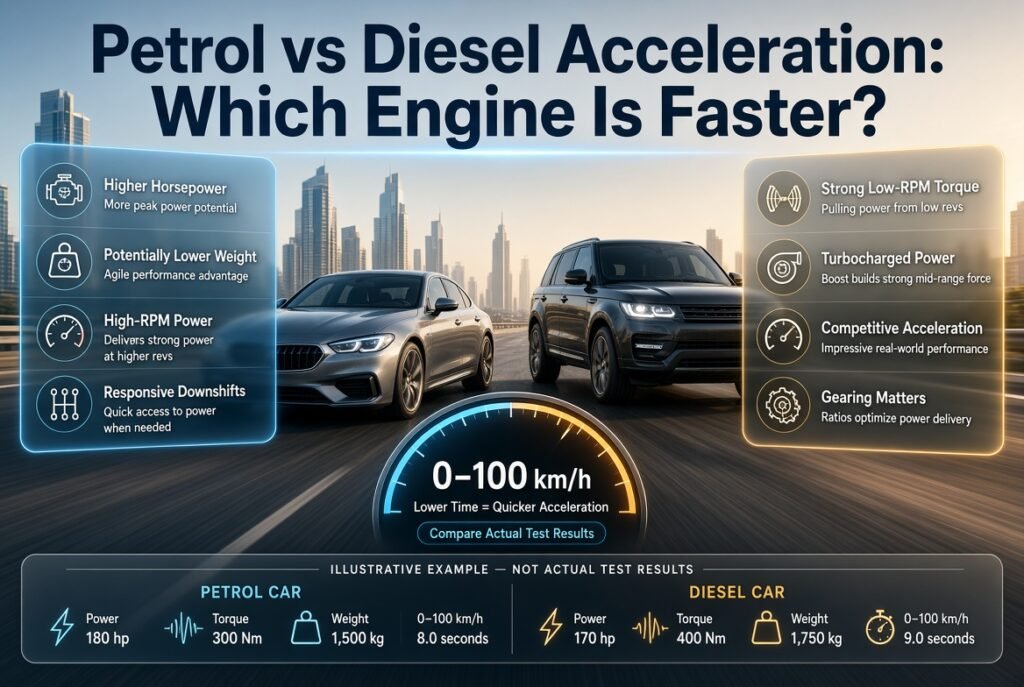
Petrol cars are often quicker in performance-focused comparisons, particularly when they have higher horsepower and lower vehicle weight. Diesel cars can be very competitive because of their strong low-RPM torque. The fastest option depends on the specific engine, transmission, vehicle weight, and measured acceleration time.
Comparing 0–100 km/h acceleration
The 0–100 km/h figure measures the time a vehicle takes to accelerate from a standstill to 100 km/h.
A lower time indicates quicker acceleration under the relevant test conditions.
For example, consider two hypothetical vehicles:
| Specification | Petrol car | Diesel car |
|---|---|---|
| Maximum power | 180 hp | 170 hp |
| Maximum torque | 300 Nm | 400 Nm |
| Vehicle weight | 1,500 kg | 1,750 kg |
| Transmission | Automatic | Automatic |
| Illustrative 0–100 km/h time | 8.0 seconds | 9.0 seconds |
These figures are illustrative, not test results for actual cars.
In this example, the diesel vehicle produces more torque, but the petrol vehicle has more horsepower and weighs less. Those differences could help the petrol car achieve a quicker 0–100 km/h time.
The example also demonstrates why maximum torque cannot be used as the sole measure of acceleration.
Actual performance depends on the full power curve, gear ratios, traction, launch strategy, and other vehicle characteristics.
Does petrol always win at higher speeds?
No. Petrol engines often have an advantage when their power output remains strong at higher RPM, but diesel engines can also provide impressive high-speed acceleration.
A high-output turbo-diesel with suitable gearing may outperform a less powerful petrol car. Likewise, a powerful petrol engine may accelerate more rapidly when the transmission downshifts and allows the engine to produce more power.
Aerodynamic drag becomes increasingly important as vehicle speed rises. The vehicle needs sufficient power to overcome that resistance while continuing to accelerate.
Consequently, a car’s performance at 100 km/h may differ substantially from its performance when accelerating from 40 km/h.
Why official acceleration figures matter
Manufacturer specifications can help you compare vehicles, but make sure the figures relate to the exact model, engine, and transmission.
Different variants of the same vehicle may have significantly different acceleration performance.
When comparing two cars, examine:
- Official 0–100 km/h acceleration times.
- Maximum horsepower and the RPM at which it is produced.
- Maximum torque and the engine-speed range in which it is available.
- Kerb weight and power-to-weight ratio.
- Transmission type and gear ratios.
- Independent performance tests, where available.
For a broader comparison of the strengths and limitations of each fuel type, read Petrol vs. Diesel Comparisons Dubai.
4. Why Horsepower and Torque Both Matter
Horsepower and torque describe different aspects of engine performance. Torque measures rotational force, while horsepower measures the rate at which work is performed. Both influence acceleration, and neither should be evaluated independently of engine speed, gearing, and vehicle weight.
What torque tells you
Torque is measured in newton-metres (Nm). It represents the rotational force produced by the engine.
Diesel engines commonly generate more peak torque than comparable petrol engines, particularly at lower RPM.
This can make a diesel vehicle feel strong when moving away from a stop, climbing a gradient, or accelerating with a load.
However, engine torque isn’t delivered directly to the road without modification. The transmission and final-drive gearing multiply or reduce the torque delivered to the wheels, while drivetrain losses affect the final result.
A vehicle with lower engine torque may still generate substantial wheel force if its gearing is suitable.
What horsepower tells you
Horsepower indicates how quickly an engine can perform work. It is closely related to torque and rotational speed.
In simplified terms, an engine can produce substantial power by generating torque at a sufficiently high RPM.
This helps explain why a petrol engine with a higher operating speed may produce more horsepower than a diesel engine with a similar peak torque figure.
When the vehicle continues accelerating, available power becomes increasingly important because the engine must overcome growing aerodynamic resistance as speed rises.
Why torque alone can mislead buyers
Imagine comparing a diesel SUV with 450 Nm of torque and a petrol sedan with 320 Nm.
The diesel has the higher peak torque figure, but the petrol sedan might have more horsepower, weigh less, and use a transmission better suited to acceleration.
The sedan could therefore reach 100 km/h sooner.
The diesel SUV may still feel stronger during low-speed driving or when carrying heavy luggage.
These are different performance qualities, and both can be useful depending on the driver’s needs.
For a detailed explanation of how pulling force differs between engine types, see Petrol vs Diesel Torque Comparison in Dubai.
Expert Tip: When choosing a car, compare both the peak figures and the engine’s torque and power curves. The RPM range in which an engine produces useful output can be more informative than its highest advertised number.
5. How Does Petrol vs Diesel Acceleration Compare in Dubai Traffic?
Dubai traffic frequently involves short acceleration bursts, frequent braking, traffic signals, junctions, and periods of slow movement. Petrol cars can provide responsive everyday performance, while diesel cars often offer strong low-speed pulling power. The best choice depends on the specific vehicle and driving pattern.
Stop-and-go driving in busy areas
In areas such as Downtown Dubai, Business Bay, and Deira, drivers may repeatedly move from a standstill to low speeds before stopping again.
A petrol engine with smooth throttle response can make this type of driving comfortable. Many modern petrol cars also provide refined operation at low speeds.
A diesel vehicle can perform well in the same conditions, especially when its engine and transmission are calibrated for urban driving. However, some models may feel less refined during low-speed manoeuvres because of their engine characteristics or transmission behaviour.
For certain modern diesel vehicles, repeated short journeys may also create challenges for diesel particulate filter regeneration. The exact requirements depend on the vehicle, emissions system, and operating conditions.
If most of your journeys are short, review the manufacturer’s guidance before choosing a diesel model.
Acceleration from traffic lights
Moving away from a traffic light requires a combination of engine response, transmission engagement, and tyre grip.
A diesel engine may deliver strong initial pulling power because of its low-RPM torque. A petrol engine may accelerate equally quickly or faster if it has greater power, suitable gearing, and sufficient traction.
Turbo lag can affect both types of engine. The transmission may also need to select a lower gear before the vehicle responds strongly.
Drivers should avoid judging performance from aggressive launches. Wheelspin, sudden acceleration, and unsafe gaps can compromise control without providing a meaningful benefit during ordinary commuting.
Driving through congested roads
In heavy traffic, smooth acceleration and predictable response are often more useful than maximum engine output.
Consider the following factors:
- How smoothly the car moves away from a stop.
- Whether the transmission hesitates during low-speed acceleration.
- How easily the vehicle maintains a steady speed.
- Whether the engine responds consistently when the air conditioning is operating.
- Whether the vehicle suits your typical journey length.
A well-maintained petrol car can be a practical choice for frequent short urban trips. A diesel vehicle may suit someone who combines city driving with regular longer journeys.
Neither option should be selected without considering the vehicle’s maintenance requirements and ownership costs.
Common Mistake: Assuming that a diesel car will always feel quicker in city traffic because it produces more torque. Transmission calibration, turbo response, vehicle weight, and the engine’s actual power output can change the result significantly.
6. Which Engine Provides Better Highway Acceleration?
For highway driving, petrol engines often appeal to drivers seeking strong high-RPM performance, while diesel engines can provide useful mid-range pulling power. The better option depends on how quickly each vehicle accelerates from the speed at which the driver begins the manoeuvre.
Merging onto Sheikh Zayed Road
Joining a busy highway requires the vehicle to accelerate predictably and reach an appropriate speed without creating a hazard for surrounding traffic.
A petrol car with adequate horsepower can provide strong acceleration when its transmission selects the right gear.
A diesel car with substantial low- and mid-range torque can also merge confidently, particularly when the engine responds quickly and the transmission keeps it within its effective operating range.
Imagine two cars entering a highway at 60 km/h.
The petrol vehicle may downshift and build speed as engine RPM rises. The diesel vehicle may accelerate strongly without needing to rev as high.
Which vehicle completes the manoeuvre first depends on its actual power delivery, weight, gearing, and available traction.
Drivers should assess the available gap carefully rather than relying on the engine type to compensate for insufficient space.
Overtaking between 80 and 120 km/h
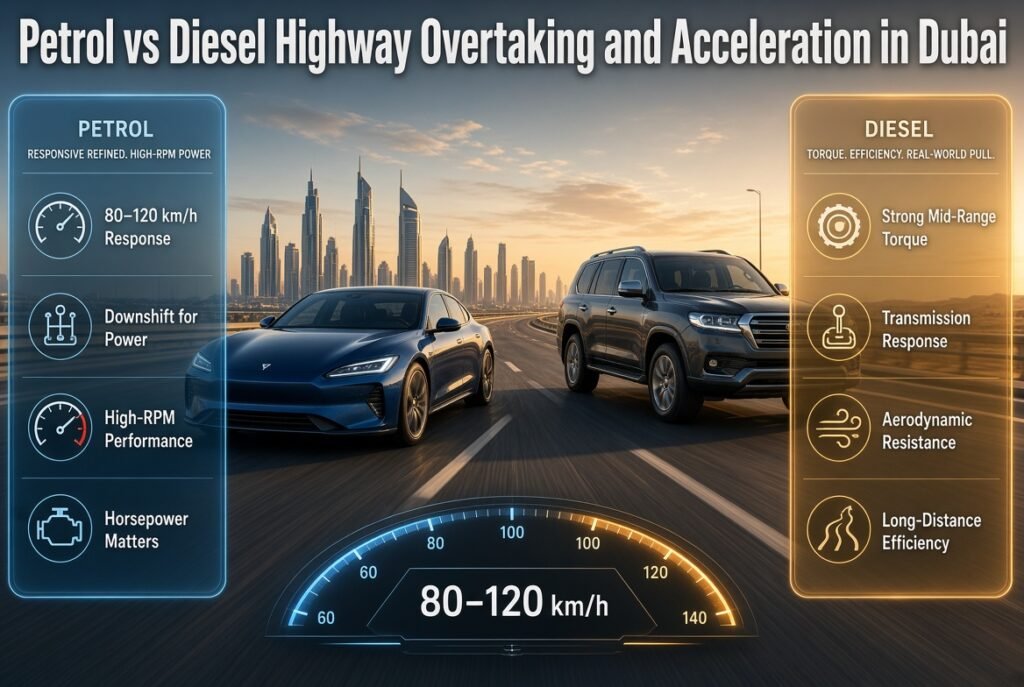
Intermediate-speed acceleration is particularly useful when evaluating highway performance.
A vehicle may have an impressive 0–100 km/h time but respond less strongly when accelerating from 80 km/h in a higher gear.
The transmission’s ability to downshift, the engine’s available horsepower, and the vehicle’s aerodynamic resistance all influence this behaviour.
A diesel car may deliver strong mid-range acceleration, while a petrol vehicle may benefit from a downshift that brings the engine into a higher-power range.
Neither is guaranteed to be quicker.
When available, compare published 80–120 km/h acceleration figures or independent rolling-acceleration tests. Make sure the tests use comparable conditions and transmission settings.
Long-distance driving between Dubai and Abu Dhabi
Drivers who regularly travel between Dubai and Abu Dhabi may value smooth cruising, predictable acceleration, and efficient operation over long distances.
Diesel engines can be attractive because they often combine strong mid-range torque with good fuel economy.
Petrol engines can also provide excellent highway performance, particularly in vehicles with sufficient horsepower and effective transmissions.
The best choice depends on annual mileage, the vehicle’s actual fuel consumption, maintenance costs, comfort, and the driver’s performance expectations.
For a long-distance commuter, it is sensible to compare acceleration and fuel economy together rather than treating them as unrelated decisions.
7. How Do Turbochargers Affect Petrol and Diesel Acceleration?
A turbocharger increases the amount of air supplied to an engine, allowing it to produce more power when the fuel system, engine management, and supporting components are designed for that output. Both petrol and diesel engines can use turbocharging, so the presence of a turbocharger alone does not determine which vehicle accelerates faster.
Turbocharged petrol engines
Turbocharged petrol engines can combine strong mid-range torque with high-RPM power.
The turbocharger uses exhaust energy to drive a compressor, which forces additional air into the engine. The engine management system adjusts fuel delivery and other operating parameters to achieve the required output within safe limits.
This arrangement allows relatively small engines to produce substantial power.
However, turbo lag can occur when the turbocharger needs time to build boost. The severity depends on the turbocharger’s design, engine speed, load, and control systems.
Modern turbocharged petrol engines may use technologies such as direct injection, variable valve timing, and electronically controlled boost systems to improve response.
Turbocharged diesel engines
Turbocharging is common in modern diesel SUVs, pickups, and passenger vehicles.
A turbo-diesel can produce strong torque at relatively low engine speeds, making it useful for vehicles that need to pull a heavy load or accelerate without frequent high-RPM operation.
Some diesel engines use variable-geometry turbochargers to improve response across a wider operating range.
However, diesel turbochargers can also experience lag, and their performance depends on the condition of the intake system, boost controls, intercooler, and other components.
A turbocharged diesel isn’t automatically quicker than a naturally aspirated petrol engine. The complete powertrain must be compared.
Which turbo setup is better?
| Engine setup | Common acceleration characteristic |
|---|---|
| Naturally aspirated petrol | Predictable response in many designs; power depends on displacement and engine speed |
| Turbocharged petrol | Can combine strong mid-range response with high-RPM power |
| Naturally aspirated diesel | Less common in modern passenger cars; performance varies by design |
| Turbocharged diesel | Often delivers strong low- and mid-range torque |
These are general tendencies, not guarantees.
A powerful naturally aspirated petrol engine can outperform a small turbocharged engine, while a well-designed turbo-diesel can outperform a petrol alternative with lower power.
When evaluating acceleration, compare the specific vehicles rather than assuming one turbo setup is inherently superior.
8. Does Vehicle Weight Affect Petrol and Diesel Acceleration?
Vehicle weight has a major influence on acceleration because a heavier vehicle requires more force to achieve the same change in speed under otherwise comparable conditions. This is why a vehicle with a high torque figure may still accelerate more slowly than a lighter car with less torque.
Comparing a sedan and an SUV
A petrol sedan may weigh considerably less than a diesel SUV.
Even if the SUV produces more torque, it must move a greater mass. Its larger body may also create greater aerodynamic resistance at higher speeds.
The petrol sedan may therefore accelerate more quickly, especially if it also has higher horsepower relative to its weight.
However, a powerful diesel SUV can outperform a lower-powered petrol sedan. Body style alone doesn’t establish the result.
Understanding power-to-weight ratio
Power-to-weight ratio compares engine power with vehicle weight. It can help identify which vehicle has greater power available for each unit of mass.
The basic calculation is:
Power-to-weight ratio = power in kW ÷ vehicle weight in tonnes
For example, a car producing 150 kW and weighing 1.5 tonnes has a power-to-weight ratio of 100 kW per tonne.
Another vehicle producing 180 kW and weighing 2 tonnes has a ratio of 90 kW per tonne.
The first vehicle has the higher power-to-weight ratio, although the second may still accelerate faster under particular conditions because of gearing, traction, and power delivery.
Power-to-weight ratio is a useful comparison tool, not a complete substitute for measured acceleration.
How passengers and luggage affect performance
Carrying additional weight increases the force required to accelerate.
A vehicle that feels responsive with only the driver may respond more slowly when carrying several passengers and luggage.
The difference can be especially noticeable in a low-powered vehicle travelling uphill or accelerating from a low speed.
If you regularly travel with family members or equipment, assess the vehicle’s performance and permitted payload for that use case.
Practical Advice: Compare vehicles in the same general category and consider their kerb weight, power output, and transmission. This provides a more meaningful comparison than comparing the engine’s peak torque alone.
9. How Does Dubai’s Hot Weather Affect Acceleration?
Dubai’s hot weather can influence engine performance, especially when high intake-air temperatures or cooling-system limitations cause the engine management system to reduce output. Both petrol and diesel engines can be affected, although the extent depends on the engine design and vehicle condition.
High ambient temperatures and engine output
Hot air is less dense than cooler air at the same pressure. Naturally aspirated engines may therefore receive less oxygen per intake volume under hot conditions, potentially reducing maximum power.
Turbocharged engines can compensate to some extent by compressing intake air. However, compression also increases air temperature, making intercooler performance important.
When intake temperatures rise significantly, the engine management system may adjust boost, ignition timing, fuelling, or other parameters to protect the engine.
These adjustments can affect acceleration.
Air conditioning and acceleration
Air conditioning adds load to the vehicle’s systems. Depending on the engine and compressor design, this can affect acceleration, particularly when cooling demand is high.
A small petrol engine may feel less responsive when accelerating a heavily loaded vehicle with the air conditioning running. A diesel engine may retain strong low-speed pulling power, but it can also be affected by additional load and high temperatures.
The difference depends on the specific vehicle and its available power.
Drivers should not disable essential cooling systems or compromise comfort and safety simply to gain a small amount of performance.
Cooling-system maintenance
A healthy cooling system helps the engine operate within its intended temperature range.
Important maintenance items include:
- Checking coolant level and using the manufacturer’s specified coolant.
- Inspecting hoses, connections, and the radiator for leaks.
- Ensuring the cooling fans operate correctly.
- Keeping the radiator and condenser airflow paths clear.
- Inspecting the intercooler and intake system where fitted.
- Investigating warning lights or abnormal temperature readings.
An overheating engine may reduce power to protect itself. Continued operation while overheating can cause serious mechanical damage.
If your vehicle suddenly loses acceleration in Dubai’s heat, don’t assume the fuel type is responsible. Arrange a diagnosis if the problem persists or appears alongside unusual temperatures, warning lights, or noises.
10. Which Is Better for Different Types of Drivers in Dubai?
The best engine depends on the driver’s daily routes, performance priorities, vehicle requirements, and maintenance budget. Petrol is often attractive for performance-focused commuting, while diesel can suit heavier vehicles and drivers who regularly need strong pulling power or cover long distances.
Daily commuters
For drivers making regular journeys between home, work, shopping centres, and school, smooth low-speed performance can be more important than maximum acceleration.
A petrol car may suit this pattern because many models provide refined urban driving and responsive acceleration.
However, a diesel vehicle can also work well in city conditions if its engine and emissions system are suited to the journey pattern.
Before deciding, consider how often you make short trips, how long the engine typically runs, and whether the manufacturer specifies particular operating requirements.
Highway commuters
Drivers who regularly use Sheikh Zayed Road or travel between Dubai and neighbouring emirates may benefit from either engine type.
A diesel vehicle can offer strong mid-range torque and relaxed cruising. A petrol vehicle may provide stronger high-RPM acceleration and a wider choice of performance-oriented configurations.
Compare the exact models’ intermediate-speed acceleration, fuel consumption, service requirements, and comfort.
SUV and pickup owners
Diesel engines are common in vehicles designed for carrying loads or towing because they often produce substantial low-RPM torque.
This can be useful when accelerating with passengers, equipment, or luggage.
Nevertheless, petrol SUVs and pickups can also deliver strong performance. A powerful petrol engine with suitable gearing may outperform a heavier or lower-powered diesel alternative.
Check the manufacturer’s payload and towing ratings if those requirements apply to your vehicle.
Performance-focused drivers
Drivers who prioritize rapid acceleration and sporty performance will often find suitable petrol vehicles.
Turbocharged petrol engines can offer strong power delivery across a broad range of engine speeds. Performance diesel vehicles also exist, but their characteristics and availability vary by category.
For these buyers, the most useful measures are official acceleration times, power-to-weight ratio, transmission behaviour, braking performance, and vehicle handling.
Choosing according to your priorities
| Driving priority | What to compare |
|---|---|
| Quick acceleration from a standstill | 0–100 km/h time, traction, and gearing |
| Strong low-speed response | Torque delivery and transmission behaviour |
| Highway overtaking | Intermediate-speed acceleration and available horsepower |
| Heavy loads | Torque, payload rating, and transmission suitability |
| Frequent short trips | Urban drivability and diesel emissions-system requirements |
| Long-distance commuting | Fuel consumption, comfort, maintenance, and highway performance |
| Sporty driving | Power delivery, gear changes, handling, and braking |
No single engine type wins every category. Choose the vehicle that best fits your actual driving needs.
11. How Can Fuel Economy Influence Your Acceleration Decision?
Fuel economy and acceleration are related to engine design, but they measure different things. A vehicle that accelerates quickly may consume more fuel when driven aggressively, while an efficient vehicle can still provide sufficient acceleration for everyday use.
Petrol acceleration and fuel consumption
Petrol engines are available in a wide range of configurations, from small naturally aspirated units to powerful turbocharged engines.
A smaller petrol engine may use relatively little fuel during gentle driving, but its consumption can increase when it repeatedly operates under heavy load.
A powerful petrol engine may provide strong acceleration but consume more fuel when that performance is used frequently.
Actual consumption depends on vehicle weight, gearing, speed, air conditioning, traffic, maintenance, and driving style.
Diesel acceleration and fuel consumption
Diesel engines often offer good fuel economy, especially during longer journeys and steady-speed driving.
Their combustion process and operating characteristics can help them deliver useful power efficiently.
However, a diesel vehicle’s overall cost advantage depends on its purchase price, fuel prices, maintenance requirements, annual mileage, and emissions-system condition.
A diesel car that mainly makes short urban trips may not deliver the same benefits as one used for regular long-distance driving.
Balancing acceleration with ownership costs
Before purchasing a vehicle, estimate how many kilometres you drive annually and compare the fuel consumption of the exact models.
Also consider:
- Scheduled servicing costs.
- Tyre replacement and other routine maintenance.
- The cost of repairing age-related faults in a used vehicle.
- Diesel emissions-system maintenance, where applicable.
- Insurance and registration costs.
- The additional purchase cost, if any, of a particular engine variant.
For a deeper look at everyday consumption differences, read Petrol vs. Diesel Fuel Economy in Dubai.
The goal is to choose an engine that meets your performance expectations without creating unnecessary ownership expenses.
12. Common Mistakes When Comparing Petrol and Diesel Acceleration
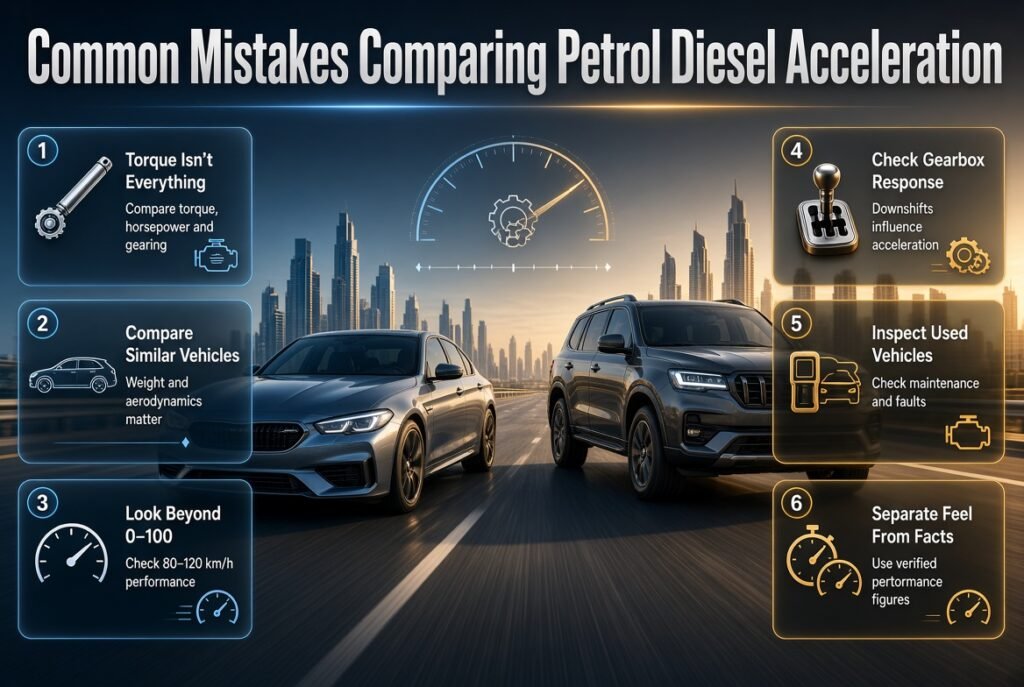
Many buyers misunderstand acceleration because they focus on one specification instead of evaluating the complete vehicle. Avoiding the following mistakes can help you compare vehicles more accurately.
Mistake 1: Assuming higher torque always means faster acceleration
Diesel engines commonly produce high torque, but torque alone doesn’t determine how quickly a vehicle accelerates.
Why it happens: Buyers see a larger Nm figure on a specification sheet and assume it guarantees superior performance.
Why it matters: A petrol vehicle may have more horsepower, less weight, and better gearing for acceleration.
How to avoid it: Compare torque, horsepower, vehicle weight, transmission, and official acceleration times together.
Mistake 2: Comparing different vehicle categories
Comparing a lightweight petrol sedan with a heavy diesel SUV can produce misleading conclusions.
Why it happens: The vehicles may have similar prices or meet different family and commuting needs.
Why it matters: Weight, aerodynamics, tyres, and drivetrain design affect acceleration independently of engine fuel type.
How to avoid it: Compare similar body styles and engine variants wherever possible.
Mistake 3: Relying only on 0–100 km/h figures
A car’s acceleration from a standstill doesn’t describe every real-world situation.
Why it happens: The figure is widely published and easy to understand.
Why it matters: Highway overtaking depends on how quickly a vehicle gains speed from an intermediate starting point.
How to avoid it: Check rolling-acceleration data, such as 80–120 km/h times, when reliable figures are available.
Mistake 4: Ignoring transmission behaviour
Two vehicles with similar power can feel very different because their transmissions respond differently.
Why it happens: Buyers focus on engine specifications and overlook the gearbox.
Why it matters: Slow downshifts or unsuitable gear selection can delay acceleration.
How to avoid it: Test-drive the exact engine and transmission combination rather than relying on the model name alone.
Mistake 5: Forgetting vehicle condition
A used vehicle may not deliver its original performance if components are worn or faulty.
Why it happens: Buyers assume factory specifications still apply regardless of maintenance history.
Why it matters: Restricted air filters, boost leaks, fuel-delivery faults, sensor problems, or transmission issues can reduce power.
How to avoid it: Review service records and arrange a professional inspection before buying.
Mistake 6: Confusing a strong sensation with measured speed
A vehicle that produces a noticeable push at low RPM may feel faster than another car even when it takes longer to reach 100 km/h.
Why it happens: Drivers naturally notice changes in force and engine sound.
Why it matters: Driving sensation isn’t a substitute for measured acceleration.
How to avoid it: Combine a test drive with verified performance figures and a comparison of the vehicle’s specifications.
13. Expert Advice for Maintaining Strong Acceleration in Dubai
Consistent acceleration depends on choosing the right vehicle, following the manufacturer’s maintenance requirements, and addressing performance changes early. Unnecessary modifications or replacement parts are rarely the best first response to a vehicle that feels slower than usual.
Follow the correct service schedule
Use the manufacturer’s recommended maintenance schedule and follow any additional requirements specified for severe operating conditions.
Dubai’s heat, dust, traffic, and air-conditioning demand make correct maintenance particularly important.
Pay attention to:
- Engine oil grade and replacement intervals.
- Air-filter condition.
- Cooling-system condition and coolant specification.
- Transmission servicing requirements.
- Spark plugs and ignition components in petrol engines.
- Fuel filters and emissions-system requirements in diesel engines.
- Correct tyre pressures and tyre condition.
Do not replace parts without establishing whether they are actually causing the problem.
Use smooth, controlled acceleration
Smooth acceleration helps maintain passenger comfort and control while avoiding unnecessary fuel consumption.
When merging onto a highway, use the available space appropriately and accelerate decisively when safe. Avoid following another vehicle too closely or attempting to force your way into a small gap.
Repeated aggressive acceleration in congested traffic is unlikely to save meaningful journey time and can increase fuel use and component stress.
Maintain correct tyre pressure
Tyres affect grip, rolling resistance, and handling.
Incorrect pressure can affect how effectively a vehicle transfers power to the road. Underinflated tyres can also increase rolling resistance and contribute to uneven wear.
Check cold tyre pressures against the manufacturer’s recommended values, usually found on the driver’s door placard or in the owner’s manual.
Never reduce tyre pressure arbitrarily in an attempt to improve acceleration.
Investigate sudden power loss
If acceleration becomes noticeably weaker, pay attention to warning lights, unusual noises, overheating, and changes in transmission behaviour.
Possible causes include:
- Restricted air intake.
- Turbocharger or boost-control faults.
- Fuel-delivery problems.
- Ignition or sensor faults.
- Transmission issues.
- Excessive engine temperature.
- Diesel emissions-system problems, where applicable.
A qualified technician can scan fault codes, inspect live engine data, and carry out appropriate tests.
Prompt diagnosis is generally more useful than guessing which part needs replacement.
Avoid unsafe acceleration tests
Don’t test maximum acceleration in busy public traffic or while distracted.
Use manufacturer specifications, reputable independent tests, or a suitable controlled environment to evaluate performance. On public roads, obey speed limits and maintain safe following distances.
Reliable acceleration should support safe driving, not encourage unnecessary risks.
Is a petrol car faster than a diesel car in Dubai?
Petrol cars are often faster in comparable performance-focused models because they may produce more horsepower and deliver strong acceleration at higher engine speeds. Diesel cars, however, typically provide substantial low-RPM torque, which can make them feel powerful when moving away from a standstill or accelerating in city traffic. The actual winner depends on the vehicle’s engine output, weight, transmission, and traction.
For drivers in Dubai, it’s important to compare how a vehicle performs in both urban traffic and highway conditions rather than relying on its fuel type alone.
For quick acceleration: Compare official 0–100 km/h times and horsepower.
For low-speed response: Examine torque delivery and transmission behaviour.
For highway driving: Consider intermediate-speed acceleration, particularly when comparing overtaking performance.
Why do diesel engines feel stronger at low speeds than petrol engines?
Diesel engines commonly produce high torque at relatively low engine speeds. This allows many diesel vehicles to deliver strong pulling power without needing to rev as high as a typical performance-oriented petrol engine. As a result, a diesel SUV or pickup may feel powerful when moving away from traffic lights, climbing a gradient, or carrying passengers and luggage.
However, feeling stronger at low RPM doesn’t necessarily mean a diesel car accelerates faster throughout the entire speed range. A petrol engine with greater horsepower may continue building speed more rapidly at higher RPM.
Low-speed driving: Diesel torque can provide confident pulling power.
Higher-speed acceleration: Available horsepower and gearing become particularly important.
Buying advice: Compare both the torque curve and the vehicle’s measured acceleration rather than judging performance by peak torque alone.
Which engine is better for highway overtaking in Dubai: petrol or diesel?
Both petrol and diesel engines can provide excellent highway overtaking performance. A petrol car with sufficient horsepower may accelerate strongly when the transmission downshifts, while a turbocharged diesel can deliver impressive mid-range pulling power. The better option depends on how quickly the specific vehicle gains speed from the point where overtaking begins.
For drivers using Sheikh Zayed Road or travelling between Dubai and Abu Dhabi, intermediate-speed acceleration can be more informative than the standard 0–100 km/h figure alone.
Check acceleration figures: Look for reliable 80–120 km/h performance data when available.
Evaluate transmission response: Delayed downshifts can make a powerful vehicle feel less responsive.
Prioritise safety: Overtake only when visibility, road conditions, available space, and legal speed limits allow it.
Does Dubai’s hot weather affect petrol and diesel acceleration?
Dubai’s high temperatures can affect both petrol and diesel engine performance. Hot air is less dense than cooler air at the same pressure, potentially reducing the power available from naturally aspirated engines. Turbocharged engines can compensate to some extent, but high intake temperatures and intercooler limitations may still affect performance. Engine management systems may also reduce output to protect components under demanding conditions.
Maintaining the cooling system and intake components is therefore important for consistent acceleration, particularly during summer driving and heavy traffic.
Maintain the cooling system: Check coolant levels, hoses, radiator airflow, and cooling fans according to the manufacturer’s guidance.
Inspect intake components: Keep the air filter and intercooler in suitable condition.
Investigate sudden power loss: Persistent hesitation, warning lights, or abnormal engine temperatures require professional diagnosis rather than assumptions about the weather.
How can I choose between petrol and diesel if acceleration is my main priority?
The best way to choose is to compare the exact petrol and diesel vehicles you are considering. Petrol engines often appeal to drivers who want strong high-RPM performance, while diesel engines commonly offer substantial low-RPM torque. However, a lighter petrol vehicle may outperform a heavier diesel vehicle, even when the diesel produces more torque.
Your decision should also account for the type of driving you do in Dubai, because city commuting, highway travel, and carrying heavy loads place different demands on an engine.
Compare performance: Review 0–100 km/h times, horsepower, torque, vehicle weight, and transmission specifications.
Consider your driving pattern: Frequent short trips, long-distance commuting, and heavy-load driving may favour different vehicles.
Calculate ownership costs: Include fuel consumption, routine servicing, and any diesel emissions-system maintenance requirements.
Test-drive both options: Assess throttle response, gear changes, smoothness, and acceleration from moderate speeds under safe, legal conditions.
Final recommendation: Don’t choose a car based on petrol or diesel alone. Compare its real-world acceleration, mechanical condition, and running costs to find the vehicle that best suits your driving needs in Dubai.
Conclusion: Petrol vs Diesel Acceleration in Dubai
Choosing between petrol and diesel acceleration in Dubai depends on your driving style, vehicle type, and daily travel requirements. Petrol engines are often a suitable choice for drivers who prefer quick throttle response, smooth acceleration, and responsive performance in city traffic. Diesel engines, on the other hand, generally deliver stronger low-speed torque, making them useful for heavier vehicles, SUVs, pickups, and drivers who frequently travel longer distances.
Dubai’s driving conditions also play an important role in real-world acceleration. Heavy traffic, frequent stops, high temperatures, air-conditioning use, vehicle weight, and maintenance condition can all influence how quickly a car responds. Therefore, comparing engine specifications alone is not enough to determine which option will perform better for your needs.
Before making a decision, consider these important factors:
- Choose petrol if you prioritise responsive acceleration, smooth city driving, and everyday personal use.
- Consider diesel if you need strong low-speed pulling power, regularly carry heavy loads, or drive a suitable diesel vehicle over long distances.
- Compare the complete vehicle, including horsepower, torque delivery, transmission, weight, and manufacturer-rated acceleration.
- Maintain your engine properly to support consistent performance in Dubai’s demanding climate.
- Drive smoothly and safely, especially when merging onto highways or overtaking other vehicles.
Ultimately, neither petrol nor diesel is automatically better for every driver. The right choice is the vehicle that provides the acceleration, comfort, efficiency, and reliability you need for your regular journeys. By understanding the differences between petrol and diesel acceleration, you can make a more informed decision that suits your driving habits and the conditions of Dubai’s roads.
Leave a Reply