
Introduction
Petrol vs. Diesel Engine Differences | Choosing between a petrol and diesel engine isn’t just about fuel economy. It can affect how much you spend on fuel, how your vehicle accelerates, how often it needs servicing, and how much you pay for repairs over time. A car that looks economical at the fuel pump may not be the cheapest option to own.
Understanding petrol vs diesel engine differences helps you make a practical decision based on your daily commute, highway driving, annual mileage, and maintenance budget. For drivers in Dubai, hot weather, air-conditioning use, heavy traffic, and long-distance journeys can also influence how efficiently a vehicle operates.
This guide explains how petrol and diesel engines work, compares their performance and running costs, explores maintenance requirements, and helps you determine which engine is better suited to your circumstances.
For more information about vehicle-related services and driving support, visit Fuel Delivery Dubai.
2. What Is the Difference Between Petrol and Diesel Engines?
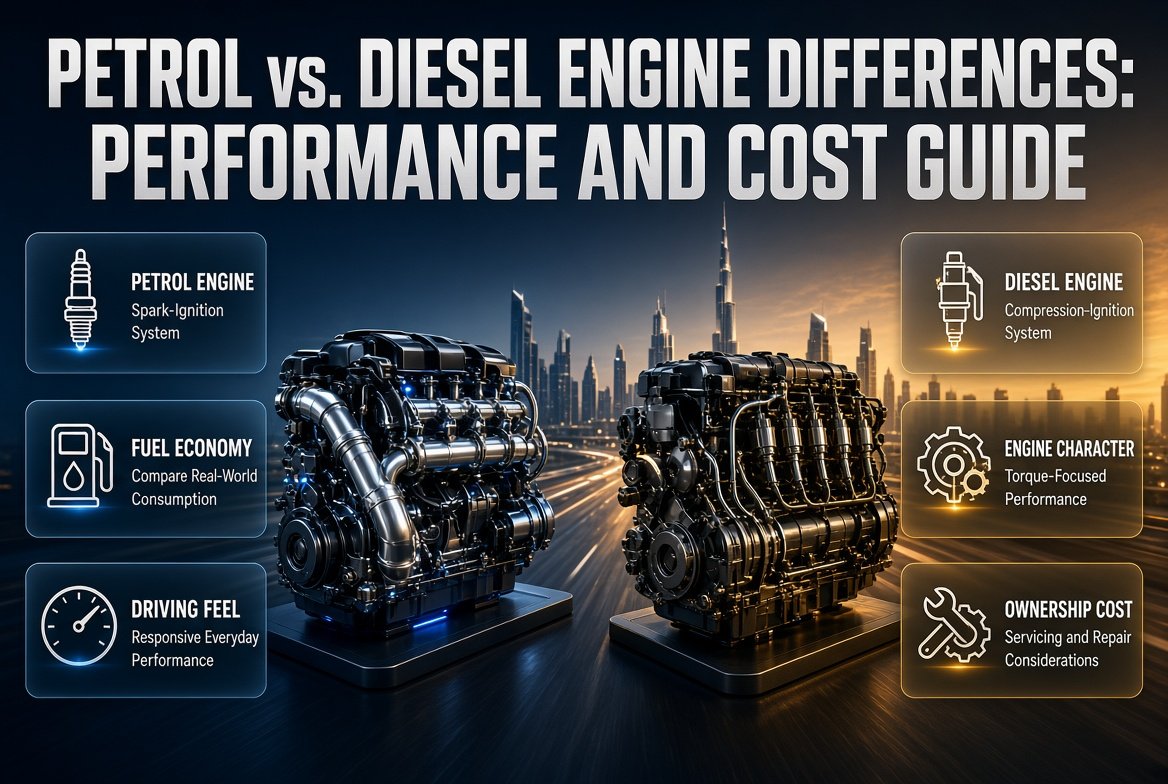
The main difference between petrol and diesel engines is how they ignite fuel. A petrol engine generally uses a spark plug to ignite an air-fuel mixture, whereas a diesel engine compresses air until it becomes hot enough to ignite injected diesel fuel. This difference affects fuel efficiency, torque, noise, maintenance, and overall driving characteristics.
Both engines use combustion to produce mechanical power, but they are designed around different ignition methods.
- Petrol engines: Generally provide smooth operation, responsive acceleration, and comfortable everyday driving.
- Diesel engines: Commonly deliver better fuel economy and stronger low-speed torque.
- Best choice: Depends on your mileage, driving conditions, budget, vehicle model, and expected maintenance costs.
Neither type is automatically superior. A modern petrol hybrid may be particularly efficient in urban traffic, while a diesel vehicle may offer better economy on frequent long journeys.
3. How Does a Petrol Engine Work?
A petrol engine is an internal combustion engine that typically uses a spark plug to ignite fuel mixed with air. The resulting combustion creates expanding gases that push a piston, rotate the crankshaft, and ultimately provide power to the vehicle’s wheels.
Most conventional petrol engines use a four-stroke process.
The four strokes of a petrol engine
- Intake: Air or an air-fuel mixture enters the cylinder, depending on the engine’s fuel-injection design.
- Compression: The piston moves upward and compresses the charge.
- Power: The spark plug ignites the mixture, creating expanding gases that push the piston downward.
- Exhaust: The piston moves upward again, forcing combustion gases out through the exhaust valve.
The cycle repeats continuously while the engine operates.
Modern petrol engines may use direct injection, turbocharging, variable valve timing, or hybrid assistance. These technologies improve power and fuel efficiency, meaning a newer petrol engine can behave very differently from an older model.
What are the advantages of petrol engines?
Petrol engines are popular in passenger cars because they can offer a useful balance of comfort, performance, and everyday practicality.
Their main advantages include:
- Generally quieter operation than comparable traditional diesel engines.
- Smooth response during normal acceleration.
- Suitability for many short and medium-length journeys.
- Often lower purchase prices in comparable vehicle categories.
- No diesel-style particulate-filter regeneration requirement in conventional petrol models, although some petrol vehicles have particulate filters of their own.
What are the limitations of petrol engines?
Conventional petrol engines often use more fuel than comparable diesel engines under similar conditions. Some petrol vehicles also deliver less low-speed torque than comparable diesel models.
Turbocharged and direct-injection petrol engines can have complex fuel systems and may require expensive repairs. Therefore, petrol should not automatically be considered the cheaper engine to maintain.
4. How Does a Diesel Engine Work?
A diesel engine uses compression ignition. It draws air into the cylinder and compresses it until the temperature rises sufficiently for injected diesel fuel to ignite. The expanding combustion gases push the piston down and rotate the crankshaft, generating power.
Unlike a conventional petrol engine, a diesel engine doesn’t rely on a spark plug to ignite the fuel during normal operation.
The four strokes of a diesel engine
- Intake: Air enters the cylinder.
- Compression: The piston compresses the air, raising its temperature.
- Power: The injector sprays diesel into the hot compressed air, initiating combustion.
- Exhaust: Burned gases leave the cylinder.
Modern diesel engines use electronically controlled high-pressure injection systems to deliver precise amounts of fuel at carefully timed intervals.
What are the advantages of diesel engines?
Diesel engines can be particularly effective for vehicles that cover long distances or regularly carry heavy loads.
Their advantages often include:
- Lower fuel consumption than comparable conventional petrol vehicles.
- Strong torque at relatively low engine speeds.
- Good efficiency during sustained highway driving.
- Suitability for many commercial vehicles, pickups, and towing applications.
- Potentially high service life when correctly maintained.
What are the limitations of diesel engines?
Diesel vehicles may cost more to purchase in some markets and vehicle categories. Their high-pressure injection equipment, turbochargers, and emissions-control systems can also be expensive to repair.
Certain modern diesel vehicles are poorly suited to repeated short trips if their emissions systems cannot complete regeneration as intended. This makes driving patterns an important part of the buying decision.
5. Petrol vs Diesel Engine Differences: Complete Comparison
The table below summarises the most important differences between the two engine types.
| Feature | Petrol engine | Diesel engine |
|---|---|---|
| Ignition method | Spark ignition | Compression ignition |
| Fuel | Petrol or gasoline | Diesel |
| Compression ratio | Generally lower | Generally higher |
| Fuel economy | Often lower in comparable conventional vehicles | Often higher in comparable conventional vehicles |
| Low-speed torque | Depends on engine design; often lower in traditional comparisons | Often stronger |
| Noise and vibration | Generally quieter | Often more noticeable |
| Acceleration | Often responsive at higher engine speeds | Often strong at low engine speeds |
| Fuel system | Port injection or direct injection, depending on model | Commonly high-pressure direct injection |
| Routine maintenance | Includes spark plugs on applicable engines | Includes diesel fuel-filter servicing |
| Emissions equipment | Catalytic converter and other systems as fitted | May include DPF, EGR and SCR systems |
| Short urban journeys | Often a practical choice | Some models may be less suitable |
| Long highway journeys | Can be efficient | Often highly efficient |
| Heavy loads | Depends on engine and vehicle specification | Often well suited |
| Repair costs | Vary by engine and model | Can be higher where specialised components are involved |
| Overall ownership cost | Depends on fuel, repairs, and purchase price | Depends on fuel savings and ownership expenses |
These are general comparisons. Turbocharging, hybrid technology, vehicle weight, transmission design, and emissions regulations can significantly change the result.
6. Which Engine Has Better Fuel Economy?
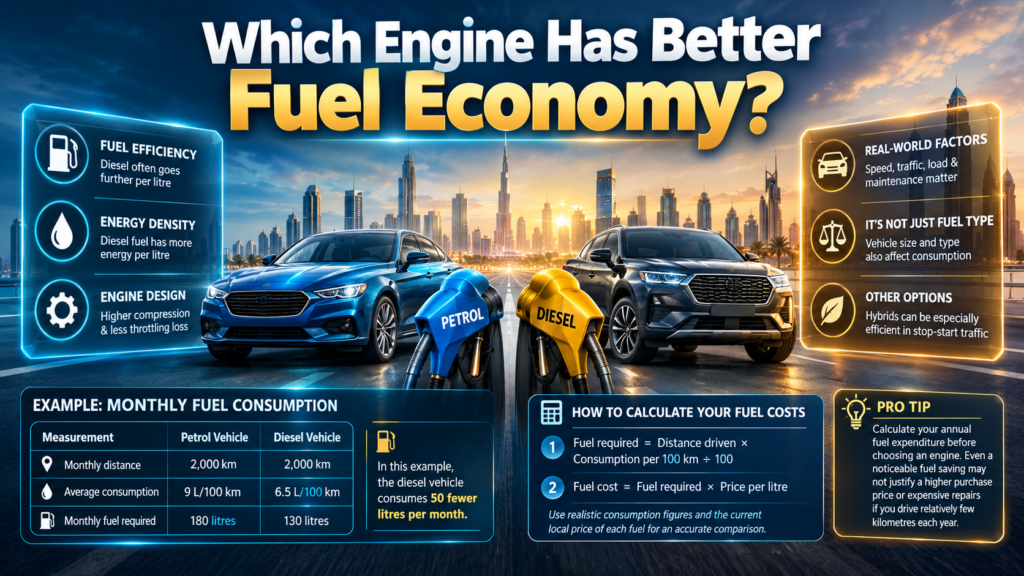
Diesel engines generally deliver better fuel economy than comparable conventional petrol engines because diesel fuel contains more energy per litre and diesel engines commonly convert a larger share of fuel energy into useful work. However, actual consumption depends on vehicle design, speed, traffic, load, and maintenance.
Why diesel engines often consume less fuel
Diesel engines generally use higher compression ratios and operate without the same throttling losses as conventional petrol engines. These characteristics improve efficiency in many operating conditions.
Diesel fuel is also denser than petrol and contains more energy per litre. As a result, a diesel vehicle may travel farther on a litre of fuel.
However, fuel economy is not determined by fuel type alone. A small petrol car can consume less fuel than a large diesel SUV, and a petrol hybrid can be especially efficient in stop-start traffic.
Example: Comparing monthly fuel consumption
Suppose two vehicles travel 2,000 kilometres per month.
| Measurement | Petrol vehicle | Diesel vehicle |
|---|---|---|
| Monthly distance | 2,000 km | 2,000 km |
| Average consumption | 9 L/100 km | 6.5 L/100 km |
| Monthly fuel required | 180 litres | 130 litres |
In this example, the diesel vehicle consumes 50 fewer litres per month.
These figures are illustrative, not guaranteed real-world results. The actual difference depends on the particular vehicles and driving conditions.
How to calculate your fuel costs
Use this formula to estimate fuel consumption:
Fuel required = Distance driven × Consumption per 100 km ÷ 100
Then calculate your expenditure:
Fuel cost = Fuel required × Price per litre
For a meaningful comparison, use realistic consumption figures and the current local price of each fuel.
Pro tip: Calculate your annual fuel expenditure before choosing an engine. Even a noticeable fuel saving may not justify a higher purchase price or expensive repairs if you drive relatively few kilometres each year.
7. Which Engine Produces More Power and Torque?
Petrol and diesel engines can both produce high power, but they often deliver it differently. Petrol engines commonly provide responsive acceleration across a broad range of engine speeds, while diesel engines often deliver strong torque at lower RPM.
What is horsepower?
Horsepower measures the rate at which an engine performs work. It helps describe a vehicle’s ability to accelerate and maintain performance at speed.
Many petrol engines produce their peak power at relatively high engine speeds. This can make them attractive to drivers who prefer responsive acceleration.
However, modern turbocharged diesel engines can also produce substantial horsepower, so the engine’s actual specifications matter more than a simple petrol-versus-diesel label.
What is torque?
Torque is the rotational force produced by an engine. In everyday driving, it helps a vehicle move away from a standstill, climb hills, and pull loads.
Diesel engines commonly produce strong torque at relatively low engine speeds. This characteristic can reduce the need for frequent downshifting when carrying heavy loads or towing.
Which engine accelerates faster?
There is no universal winner.
- A lightweight petrol car may accelerate faster than a heavier diesel vehicle.
- A turbocharged diesel may feel stronger at low speeds.
- A powerful diesel SUV may outperform a smaller petrol SUV.
- A hybrid or electric vehicle may provide quicker initial acceleration than either conventional engine.
Compare horsepower, torque, vehicle weight, gearing, and manufacturer acceleration figures before deciding.
8. Which Engine Is Quieter and Smoother?
Petrol engines generally produce less noticeable combustion noise and vibration than comparable traditional diesel engines. Diesel combustion involves high compression and rapid heat release, which can create a characteristic knocking sound.
Modern diesel engines have become quieter through improved injection systems, engine mounts, and cabin insulation, but differences may remain.
Why petrol engines often feel smoother
Petrol engines generally use spark ignition and operate with different compression and combustion characteristics. These features often contribute to smoother idling and less noticeable vibration.
This can be beneficial for drivers who spend substantial time commuting or frequently drive in congested areas.
Are modern diesel engines still noisy?
Many modern diesel vehicles offer excellent cabin comfort. However, diesel combustion noise may be more noticeable when the engine is cold or idling.
A sudden increase in knocking, rough running, or vibration should not automatically be dismissed as normal diesel behaviour. Worn engine mounts, injector problems, or other faults may require inspection.
Common mistake: Assuming that every unusual engine sound is caused by the fuel type. Changes in noise or vibration deserve attention, especially when accompanied by smoke, warning lights, or reduced performance.
9. Which Engine Is Cheaper to Buy and Maintain?
The total cost of owning a vehicle includes the purchase price, fuel, routine servicing, repairs, insurance, and resale value. Petrol vehicles are often less expensive to purchase in comparable categories, while diesel vehicles may offset some costs through lower fuel consumption.
The outcome depends on the exact model and how it is used.
Petrol engine maintenance costs
Typical maintenance requirements include:
- Engine oil and oil-filter changes.
- Spark-plug replacement at the specified interval.
- Ignition-system inspections where necessary.
- Air-filter replacement.
- Fuel-system and cooling-system checks.
- Diagnosis of warning lights or rough running.
Turbocharged petrol engines and direct-injection models may require specialised repairs. Their maintenance costs can differ significantly from those of simpler naturally aspirated engines.
Diesel engine maintenance costs
Typical diesel maintenance includes:
- Engine oil and filter servicing.
- Diesel fuel-filter replacement.
- Inspection of fuel injectors and the high-pressure fuel system.
- Turbocharger checks where fitted.
- Monitoring emissions-control equipment.
- Investigation of smoke, difficult starting, or power loss.
Modern diesel vehicles may use a diesel particulate filter (DPF), exhaust gas recirculation (EGR), and selective catalytic reduction (SCR). Depending on the vehicle, these components can add to maintenance complexity.
Not every diesel engine has the same equipment, and repair costs vary by model, age, parts availability, and workshop expertise.
How to compare total ownership costs
| Cost factor | What to investigate |
|---|---|
| Purchase price | Price difference between comparable versions |
| Fuel | Expected annual mileage and real-world consumption |
| Servicing | Scheduled maintenance and local labour rates |
| Repairs | Model-specific mechanical and emissions-system risks |
| Insurance | Actual quotations for each vehicle |
| Resale value | Local demand, age, condition, and mileage |
Don’t assume diesel is always cheaper because it uses less fuel, or petrol is always cheaper because its design may be simpler. Calculate the likely total cost over your intended ownership period.
10. Are Petrol or Diesel Engines Better for Dubai’s Driving Conditions?

Dubai’s driving environment can involve hot weather, air-conditioning use, congestion, dusty roads, and long highway journeys. Both petrol and diesel vehicles can operate effectively in these conditions when properly maintained.
The best option depends on your typical journey rather than the climate alone.
Driving in heavy traffic
Frequent stopping and accelerating can increase fuel consumption for both engine types. Air-conditioning use and extended idling may add to the load.
A petrol vehicle may be a practical choice for short journeys around residential and commercial areas. A petrol hybrid can be particularly efficient in stop-start traffic because it can recover braking energy and switch off its engine under suitable conditions.
A modern diesel can also operate in traffic, but repeated short trips may prevent some DPF-equipped vehicles from completing regeneration properly.
Driving on highways
Drivers who regularly travel between Dubai, Abu Dhabi, Sharjah, and other destinations may benefit from a diesel vehicle’s efficient steady-speed operation.
However, petrol vehicles can also deliver good highway economy. Engine size, aerodynamics, gearing, speed, and vehicle load all affect fuel consumption.
Maintaining a vehicle in hot weather
High ambient temperatures place additional demands on the cooling system, particularly in traffic or under sustained load.
For either engine type:
- Check coolant level when the engine is completely cool.
- Inspect hoses and the cooling system for leaks.
- Confirm that the radiator fan operates correctly.
- Use the engine oil specified by the manufacturer.
- Investigate repeated overheating or coolant loss promptly.
Diesel engines are not immune to overheating, and petrol engines are equally dependent on effective cooling.
For practical vehicle-care information, see the Engine Maintenance Guide. This guide has a different purpose from a petrol-versus-diesel comparison: it focuses on maintaining engine condition rather than selecting a fuel type.
Does dust affect petrol and diesel engines differently?
Dust can affect both types of engines by restricting airflow when filters become dirty. Contaminated fuel can also damage precision injection equipment, with modern diesel high-pressure systems being particularly sensitive.
Inspect filters according to the manufacturer’s schedule and the conditions in which the vehicle operates. Replace components when required rather than assuming every car needs the same service interval.
11. Which Engine Is Better for Short Trips and Long-Distance Driving?
Journey length is one of the most useful factors when deciding between petrol and diesel.
Petrol engines for short trips
Petrol vehicles are often suitable for frequent short urban journeys. They generally don’t depend on diesel-style particulate-filter regeneration, although some petrol vehicles also have particulate filters.
Repeated short trips can still affect petrol engines. The engine may spend more time below its normal operating temperature, moisture may accumulate in the oil, and the battery may not fully recover the energy used during starting.
Following the correct maintenance schedule remains essential.
Diesel engines for long journeys
Diesel engines often suit frequent highway driving because they can deliver good fuel economy under sustained loads. Longer journeys may also provide suitable operating conditions for emissions systems to function as designed.
However, highway driving does not eliminate the need for maintenance. Diesel vehicles still require suitable oil, fuel-filter servicing, cooling-system inspections, and attention to emissions warnings.
Which engine suits your driving pattern?
| Driving pattern | Options worth considering |
|---|---|
| Frequent short urban journeys | Petrol or petrol hybrid |
| Low annual mileage | Often petrol |
| Frequent long highway journeys | Diesel or an efficient petrol model |
| Heavy loads or regular towing | Often diesel, depending on specification |
| Mostly stop-start traffic | Petrol hybrid may be especially suitable |
| High annual mileage | Compare diesel savings with total ownership costs |
| Mixed urban and highway use | Either type, depending on the vehicle |
These are general guidelines rather than fixed rules. The specific vehicle’s design, local regulations, and service history should influence the final decision.
12. What Are the Environmental Differences Between Petrol and Diesel Engines?
Petrol and diesel engines both produce emissions, but the types and quantities depend on the engine, fuel, operating conditions, and emissions-control equipment.
Diesel vehicles often emit less CO₂ per kilometre than comparable conventional petrol vehicles because they generally consume less fuel. However, diesel exhaust can contain nitrogen oxides and particulate matter, which are important air-quality concerns.
Petrol engine emissions
Petrol engines produce carbon dioxide during combustion, along with pollutants such as carbon monoxide and hydrocarbons. Catalytic converters and modern engine-management systems help control these emissions.
Some direct-injection petrol engines also produce particulate matter and use gasoline particulate filters to reduce it.
Diesel engine emissions
Diesel engines often require additional exhaust-treatment technology to control pollutants.
Depending on the model, this equipment may include:
- DPF systems to capture soot.
- SCR systems to reduce nitrogen oxides.
- EGR systems to help control NOx formation.
- Oxidation catalysts to reduce certain exhaust pollutants.
These systems need proper maintenance and should not be removed or deliberately disabled.
The environmental comparison should consider the specific vehicle’s certified emissions, fuel consumption, applicable standards, and expected lifetime use rather than assuming one fuel is always cleaner.
13. How Does Engine Maintenance Differ Between Petrol and Diesel Cars?
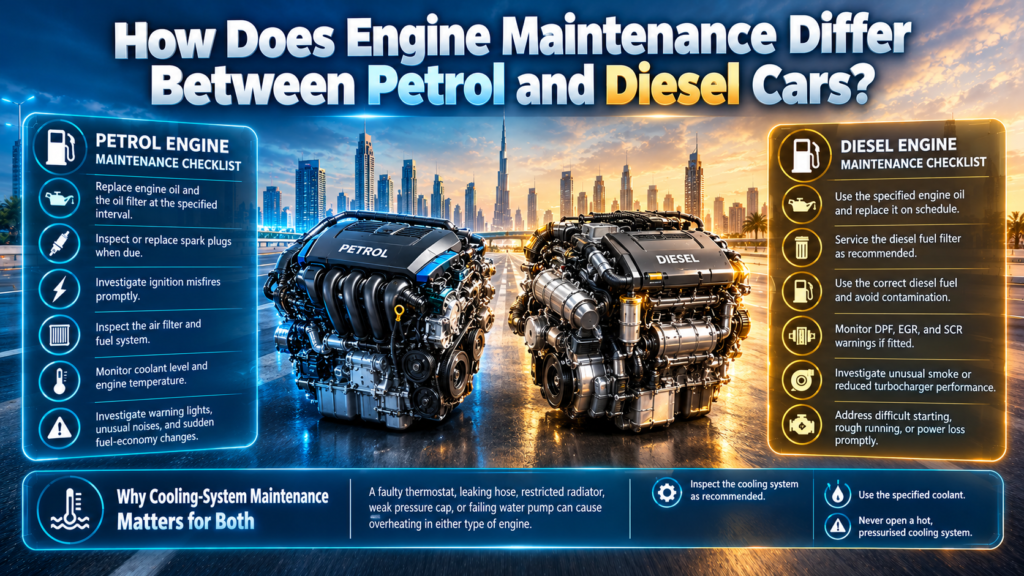
Both engines require regular servicing, but their ignition systems, fuel systems, and emissions equipment create different maintenance needs. The manufacturer’s maintenance schedule is the most reliable starting point.
Petrol engine maintenance checklist
- Replace engine oil and the oil filter at the specified interval.
- Inspect or replace spark plugs when due.
- Investigate ignition misfires promptly.
- Inspect the air filter and fuel system.
- Monitor coolant level and engine temperature.
- Investigate warning lights, unusual noises, and sudden fuel-economy changes.
Diesel engine maintenance checklist
- Use the specified engine oil and replace it on schedule.
- Service the diesel fuel filter as recommended.
- Use the correct diesel fuel and avoid contamination.
- Monitor DPF, EGR, and SCR warnings if fitted.
- Investigate unusual smoke or reduced turbocharger performance.
- Address difficult starting, rough running, or power loss promptly.
Why cooling-system maintenance matters for both
A faulty thermostat, leaking hose, restricted radiator, weak pressure cap, or failing water pump can cause overheating in either type of engine.
Inspect the cooling system as recommended, use the specified coolant, and never open a hot, pressurised cooling system.
14. Common Mistakes When Comparing Petrol and Diesel Engines
A poor engine choice often results from focusing on one benefit while ignoring the wider ownership picture.
Mistake 1: Choosing diesel only because it uses less fuel
Why it happens: Diesel has a reputation for better fuel economy.
Why it is harmful: Higher purchase costs, maintenance expenses, or low annual mileage can reduce the financial benefit.
How to avoid it: Calculate annual fuel expenditure and compare servicing, repairs, insurance, and depreciation.
Mistake 2: Assuming petrol engines are always cheaper to maintain
Why it happens: Conventional petrol engines often have simpler ignition systems.
Why it is harmful: Turbochargers, direct injection, and hybrid components can make petrol vehicles expensive to repair.
How to avoid it: Check the exact engine model, service history, warranty, and parts costs.
Mistake 3: Ignoring driving patterns
Why it happens: Buyers compare published fuel-consumption figures without considering their own journeys.
Why it is harmful: A diesel that performs well on highways may be less suitable for repeated short trips if its emissions system cannot complete regeneration.
How to avoid it: Assess journey length, traffic conditions, annual mileage, and manufacturer guidance.
Mistake 4: Ignoring warning signs
Why it happens: Drivers may consider rough running or smoke normal for a particular fuel type.
Why it is harmful: Delayed diagnosis can increase repair costs.
How to avoid it: Investigate persistent smoke, overheating, difficult starting, warning lights, and unusual engine sounds.
Mistake 5: Using the wrong fuel or maintenance products
Why it happens: Drivers may confuse fuel types or assume that similar-looking fluids are interchangeable.
Why it is harmful: Misfuelling can damage sensitive fuel-system components, while unsuitable oil or coolant can affect engine protection.
How to avoid it: Confirm the required fuel on the fuel flap or owner’s manual and follow the specified fluid requirements.
Mistake 6: Buying a used vehicle without an inspection
Why it happens: A clean exterior and short test drive can make a vehicle appear mechanically sound.
Why it is harmful: Hidden injector problems, cooling-system leaks, previous overheating, and emissions faults may not be immediately obvious.
How to avoid it: Arrange an independent inspection, review maintenance records, and request appropriate diagnostic checks before buying.
15. Expert Advice: How to Choose the Right Engine
A sound buying decision starts with your driving requirements and then considers the exact models available.
Step 1: Calculate your annual mileage
Estimate how many kilometres you drive each year. Someone driving 8,000 km annually may need a different vehicle from a delivery driver covering 40,000 km.
Higher mileage gives fuel savings more opportunity to offset other costs, although the result depends on the vehicles being compared.
Step 2: Compare equivalent vehicles
Compare vehicles with similar size, weight, performance, and equipment. Comparing a small petrol hatchback with a large diesel SUV won’t reveal the effect of fuel type alone.
Check official fuel-consumption figures and reliable real-world data for the conditions in which you expect to drive.
Step 3: Investigate service history
For a used vehicle, review maintenance records, cold-start behaviour, diagnostic reports, oil leaks, and cooling-system condition.
For a diesel, check the condition of its emissions equipment where applicable. For a petrol vehicle, investigate ignition performance and model-specific concerns.
Step 4: Compare likely repair costs
Ask a qualified workshop about common issues, service intervals, and parts availability for the exact model.
Avoid replacing injectors, sensors, filters, or other components based on assumptions. Proper diagnosis should identify the cause before repairs are authorised.
Step 5: Calculate total ownership costs
Include purchase price, fuel, insurance, servicing, repairs, resale value, and the length of time you expect to own the vehicle.
Professional recommendation: Start by comparing petrol and petrol-hybrid vehicles if you mainly drive short urban journeys. Include diesel models if you frequently travel long distances, cover high annual mileage, or need strong pulling power. Make the final decision based on total ownership cost and vehicle condition.
Which Is Better: Petrol or Diesel Engine for Daily Driving?
A petrol engine is often a practical choice for daily driving, particularly if your routine involves short journeys, school runs, shopping, office commutes, and frequent traffic stops. Petrol vehicles generally offer quieter operation, smooth acceleration, and straightforward everyday usability. However, a diesel engine can be a better option for drivers who cover long distances regularly or need strong pulling power.
The right choice depends on how you use your vehicle rather than simply which fuel is cheaper. For example, someone driving short distances around Dubai may benefit from a petrol car or petrol hybrid, while a driver travelling between cities every day may find a diesel vehicle more economical.
Important factors to consider:
Daily distance: Low annual mileage often favours petrol, while high mileage can make diesel worth considering.
Driving conditions: Frequent short trips may be less suitable for some modern diesel engines equipped with particulate filters.
Comfort: Petrol engines are generally quieter, although modern diesel vehicles can also provide excellent cabin comfort.
Which Engine Gives Better Mileage: Petrol or Diesel?
Diesel engines generally deliver better fuel economy than comparable conventional petrol engines. Diesel fuel contains more energy per litre, and diesel engines typically convert a larger proportion of that energy into useful work. Consequently, many diesel vehicles can travel farther on the same volume of fuel.
However, actual mileage varies according to engine size, vehicle weight, transmission, traffic, driving speed, and maintenance condition. A small petrol car or petrol hybrid may use less fuel than a larger diesel SUV, especially during urban driving.
For a meaningful comparison, examine the real-world fuel consumption of the exact vehicles you are considering rather than relying only on general claims about petrol and diesel.
How to compare fuel economy accurately:
Check consumption figures: Compare litres per 100 kilometres (L/100 km) under similar driving conditions.
Calculate monthly usage: Multiply your monthly distance by the vehicle’s consumption figure and divide by 100.
Consider local fuel prices: Lower fuel consumption does not automatically mean lower expenditure if the fuel costs more.
Include ownership expenses: Add servicing and likely repairs to determine whether the fuel savings provide a genuine financial benefit.
Is a Diesel Engine More Expensive to Maintain Than a Petrol Engine?
A diesel engine can be more expensive to maintain when its specialised fuel-injection or emissions-control components require repairs. Modern diesel vehicles may use high-pressure injectors, turbochargers, diesel particulate filters (DPFs), exhaust gas recirculation (EGR), and selective catalytic reduction (SCR) systems. These components can increase repair costs when faults develop.
Petrol engines often have simpler maintenance requirements in conventional designs, but modern turbocharged and direct-injection petrol engines can also be expensive to repair. Therefore, the maintenance difference depends on the particular engine, vehicle age, servicing history, and availability of replacement parts.
Regular maintenance is important for both types of engines, particularly in hot climates where cooling-system condition and correct engine oil specifications matter.
Maintenance expenses to compare:
Routine servicing: Engine oil, oil filters, air filters, and other scheduled replacements.
Fuel-system repairs: Diesel injectors and high-pressure pumps can be costly; petrol fuel systems can also require specialised repairs.
Emissions equipment: Check whether the diesel has a DPF, EGR, or SCR system and whether these components have known model-specific issues.
Long-term reliability: A well-maintained vehicle with a documented service history may be a better purchase than a neglected vehicle with lower theoretical running costs.
Which Engine Is Better for Long-Distance Driving and Highway Use?
Diesel engines are often well suited to long-distance driving because they generally provide good fuel economy and strong torque at relatively low engine speeds. These characteristics can make them attractive for drivers who regularly travel between cities, drive on highways, or cover high annual mileage.
Petrol engines are also capable of efficient highway performance, particularly when they have modern engine technology and suitable gearing. The difference depends on the vehicles being compared, their speeds, aerodynamics, engine size, and load.
For drivers in the UAE, the decision should also account for the frequency of long journeys, the amount of city driving, and the maintenance requirements of the specific vehicle.
Before choosing an engine for highway use:
Compare real-world economy: Check consumption at the speeds you normally travel.
Evaluate comfort: Consider engine noise, cabin insulation, seating, and ride quality.
Review maintenance needs: Check cooling-system condition, oil requirements, and relevant emissions equipment.
Calculate annual costs: Higher mileage can increase the value of fuel savings, but repairs and purchase costs still matter.
Which Engine Is Better for Dubai’s Hot Weather: Petrol or Diesel?
Both petrol and diesel engines can perform reliably in Dubai’s hot weather when they are correctly maintained. Neither fuel type automatically provides better heat resistance in every vehicle. Engine design, cooling-system capacity, maintenance history, operating load, and the condition of components are more important than fuel type alone.
High temperatures, prolonged traffic congestion, air-conditioning use, and sustained highway driving can increase the demands placed on an engine’s cooling system. Drivers should pay attention to coolant leaks, radiator condition, cooling-fan operation, and any unusual rise in engine temperature.
A diesel vehicle may be attractive for frequent long-distance journeys, while a petrol vehicle may suit regular short urban trips. The best option depends on the driving pattern and the specific vehicle’s engineering.
Practical advice for hot-weather driving:
Check the cooling system: Follow the manufacturer’s inspection schedule and investigate coolant loss promptly.
Use the correct fluids: Follow the specified engine-oil and coolant requirements.
Monitor warning signs: Stop safely if the engine overheats; never open a hot, pressurised cooling system.
Maintain air filters: Dust can restrict airflow and affect engine performance.
Choose based on usage: Consider journey length, annual mileage, repair costs, and vehicle condition before deciding between petrol and diesel.
Conclusion: Choosing Between Petrol and Diesel Engines
Choosing between a petrol and diesel engine depends on your driving habits, budget, vehicle requirements, and long-term ownership plans. Petrol engines are generally a practical choice for daily commuting, short trips, city driving, and drivers who prefer quieter operation with a smoother driving experience. Diesel engines are often better suited to long-distance travel, frequent highway driving, heavy loads, and situations where strong low-speed torque and fuel efficiency are important.
In Dubai, traffic congestion, high temperatures, frequent air-conditioning use, and driving distances can all influence engine performance and running costs. However, neither engine type is automatically the best option for every driver. The right decision requires comparing the vehicle’s purchase price, real-world fuel consumption, maintenance requirements, emissions equipment, and expected annual mileage.
Before making a final choice, consider the following points:
- For city driving: A petrol engine may be more suitable if most journeys are short and involve frequent stops.
- For regular highway travel: A diesel engine may offer better fuel economy and useful torque, particularly over longer distances.
- For maintenance planning: Follow the manufacturer’s service schedule and use the correct engine oil, filters, and approved fluids.
- For long-term value: Compare total ownership costs rather than judging a vehicle by fuel economy alone.
- For Dubai’s driving conditions: Keep the engine properly maintained and address warning lights, unusual noises, overheating, or changes in fuel consumption promptly.
Whichever engine you choose, consistent maintenance and sensible driving habits can help support reliability, efficiency, and long-term performance. For additional guidance on vehicle care, explore our Engine Maintenance Guide. For more information about fuel-related services and support in Dubai, visit Fuel Delivery Dubai.
Ultimately, the best engine is the one that matches your everyday driving needs, fits your budget, and delivers dependable performance throughout its ownership life.
Leave a Reply