
Introduction
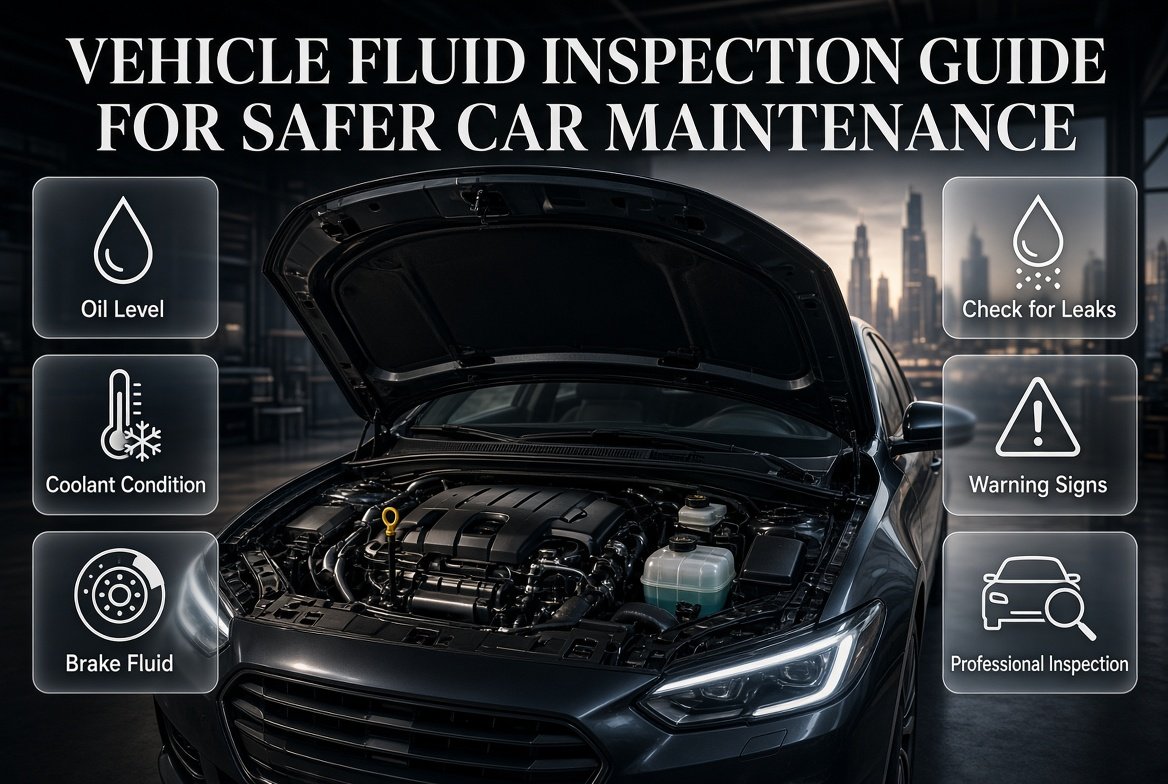
Vehicle Fluid Inspection | A car can look completely normal while a fluid problem is quietly developing under the bonnet. The engine may still start, the brakes may still work, and the vehicle may feel fine during a short drive. But low engine oil, declining coolant, contaminated brake fluid, or a developing fluid leak can eventually turn into a much bigger mechanical problem.
That’s why vehicle fluid inspection should be part of regular car care rather than something you only think about when a warning light appears.
At Fuel Delivery Dubai, understanding the condition of your vehicle is especially important for drivers dealing with Dubai’s heat, traffic, long highway journeys, frequent idling, and heavy air-conditioning use. Fluid checks can help identify problems early and give you a clearer idea of when your vehicle needs professional attention.
This guide explains what to inspect, how to inspect it safely, what different warning signs can mean, which fluids you can check yourself, when professional inspection is necessary, and how to build vehicle fluid inspection into a practical maintenance routine.
What Is Vehicle Fluid Inspection?
Vehicle fluid inspection is the process of checking a vehicle’s essential fluids for correct level, visible condition, contamination, leakage, and signs of deterioration.
The inspection can include:
- Engine oil
- Engine coolant
- Brake fluid
- Transmission fluid
- Power steering fluid, if applicable
- Windshield washer fluid
- Differential fluid
- Transfer-case fluid on applicable vehicles
- Other manufacturer-specified fluids
However, a proper inspection isn’t simply a matter of looking at whether a reservoir is full.
A useful inspection asks several questions:
- Is the fluid level within the correct range?
- Does the fluid look normal for its type?
- Is there evidence of contamination?
- Is fluid leaking from the vehicle?
- Has the level changed since the previous inspection?
- Is the correct fluid specification being used?
- Is there an unusual smell?
- Are there warning lights or mechanical symptoms?
- Does the service history indicate that maintenance is due?
This distinction matters because a fluid can be at the correct level and still require attention.
For example, brake fluid may be at an acceptable level but overdue for scheduled service. Similarly, transmission fluid may not be visibly low while the transmission itself is showing symptoms that require professional diagnosis.
Why Is Vehicle Fluid Inspection Important?
Vehicle fluids perform different jobs throughout the car.
Engine oil lubricates moving engine components and helps manage heat and contaminants. Coolant carries heat away from the engine and helps protect the cooling system. Brake fluid transfers hydraulic pressure through the braking system. Transmission fluid supports lubrication and transmission operation.
When a fluid becomes too low, contaminated, degraded, or incorrectly specified, the system may not operate as intended.
Regular inspection can help identify problems before they develop into major repairs.
According to AAA automotive guidance, incorrect fluid levels can contribute to serious vehicle problems, while routine checks can help identify issues between scheduled service visits.
The main benefits of regular fluid inspection include:
- Detecting leaks early
- Identifying low fluid levels
- Supporting proper lubrication
- Helping prevent overheating
- Monitoring brake-system condition
- Protecting transmission components
- Identifying unusual fluid contamination
- Supporting vehicle reliability
- Reducing the chance of avoidable breakdowns
- Giving technicians useful information when diagnosing problems
The important point is that inspection doesn’t necessarily mean replacement.
You may inspect a fluid regularly without needing to change it every time.
Which Car Fluids Need Regular Inspection?
The exact fluids depend on your vehicle.
Modern vehicles don’t all use the same systems. Some have electric power steering rather than hydraulic steering. Some automatic transmissions don’t have traditional dipsticks. Some differentials or transfer cases require specialised inspection procedures.
The owner’s manual should therefore remain the primary reference for your particular vehicle.
Still, most drivers should understand the purpose of the major fluids.
| Vehicle Fluid | Main Function | What You Should Watch For |
|---|---|---|
| Engine oil | Lubricates and helps cool engine components | Low level, leaks, abnormal condition |
| Engine coolant | Controls engine temperature | Low level, leaks, overheating |
| Brake fluid | Transfers hydraulic braking pressure | Low level, contamination, leaks |
| Transmission fluid | Lubricates and supports transmission operation | Leaks, shifting problems, abnormal condition |
| Power steering fluid | Provides hydraulic steering assistance | Low level, leaks, steering noise |
| Washer fluid | Cleans the windshield | Low or empty reservoir |
| Differential fluid | Lubricates differential gears | Leaks, unusual noises |
| Transfer-case fluid | Lubricates 4WD/AWD transfer components | Leaks, service requirements |
Not every vehicle has every fluid listed here.
That’s why you should never open a reservoir simply because you’ve seen one in another car.
How Do You Prepare for a Vehicle Fluid Inspection?
Before checking fluids, preparation matters.
Park the vehicle on a reasonably level surface and make sure it is secure. Switch off the engine where the manufacturer’s procedure requires it.
Keep a clean cloth or paper towel available for checking dipsticks.
You should also know which fluids your vehicle uses before opening any reservoir.
Before starting, check:
- Owner’s manual
- Recommended fluid specifications
- Correct engine-oil grade
- Correct coolant specification
- Brake-fluid specification
- Transmission-fluid requirements
- Whether the vehicle has a power-steering fluid reservoir
- Whether any system requires a special inspection procedure
AAA also recommends parking on level ground, avoiding overfilling, using fluids that meet the automaker’s specifications, and cleaning around dipsticks and reservoir caps before opening them.
⚠ Common Mistake: Never assume that a fluid labelled “universal” is automatically appropriate for your vehicle. Compatibility should be confirmed against the manufacturer’s requirements.
Step-by-Step Vehicle Fluid Inspection
A systematic approach makes the inspection easier and reduces the chance of overlooking something.
Step 1: Park Safely and Identify the Vehicle’s Fluid Systems
Start with the vehicle on level ground.
Make sure the parking brake is applied and the vehicle is stable.
Open the bonnet only when it is safe to do so.
Don’t start removing caps immediately.
First identify:
- Engine-oil dipstick or electronic oil-level system
- Coolant reservoir
- Brake-fluid reservoir
- Power-steering reservoir, if fitted
- Washer-fluid reservoir
- Transmission-fluid inspection point, if accessible
If you don’t recognise a reservoir, check the owner’s manual rather than guessing.
Step 2: Inspect for Visible Leaks
Before checking individual fluid levels, look around the engine compartment and underneath the vehicle.
A fluid inspection is more useful when you look for the reason a fluid might be low.
Look for:
- Wet patches
- Fresh drips
- Fluid residue
- Staining
- Cracked hoses
- Damaged reservoirs
- Loose connections
- Damp areas around seals
Also look underneath the vehicle after it has been parked.
A recurring spot is more significant than a single unexplained mark.
However, don’t identify a fluid solely by its location on the ground. Fluids can travel across components before dripping.
Step 3: Check Engine Oil
Engine oil is one of the most familiar vehicle fluids, but it still needs to be checked correctly.
Many vehicles have a physical dipstick, while some newer vehicles provide an electronic oil-level reading.
For vehicles with a dipstick, the general process is:
- Park on level ground.
- Turn the engine off.
- Follow the manufacturer’s recommended waiting period.
- Remove the dipstick.
- Wipe it clean.
- Reinsert it fully.
- Remove it again.
- Check the oil level against the markings.
The level should remain within the manufacturer’s specified range.
Don’t automatically fill it to the maximum mark without understanding the measurement system.
If the level is low, use the correct engine oil specification.
What should you look for?
During an oil inspection, pay attention to:
- Low oil level
- Repeatedly falling oil level
- Oil around the engine
- Strong burnt smell
- Unusual deposits
- Metallic particles
- Unusual milky appearance
- Oil-pressure warning light
Oil colour by itself isn’t a complete diagnosis.
Engine oil naturally becomes darker as it circulates through the engine and collects contaminants.
For a more detailed maintenance routine, readers can follow the Engine Oil Maintenance in Dubai guide.
💡 Pro Tip: If you repeatedly need to add engine oil between services, don’t treat topping up as the complete solution. Find out why the level is falling.
Step 4: Inspect Engine Coolant
Coolant is essential for controlling engine temperature and protecting the cooling system.
This is particularly important in hot climates.
Always follow the manufacturer’s instructions for checking coolant. In many vehicles, the coolant reservoir can be visually checked when the engine is cold.
The reservoir normally has minimum and maximum markings.
The level should sit within the specified range when the vehicle is at the appropriate temperature for the inspection.
AAA specifically advises checking coolant with the engine cold and warns against removing a hot radiator cap because the cooling system can be pressurised.
Look for:
- Low coolant level
- Repeated coolant loss
- Wet areas
- Dried coolant residue
- Cracked hoses
- Damaged reservoir
- Corrosion
- Overheating
- Temperature warning lights
A cooling system that repeatedly loses coolant needs investigation.
Adding coolant again and again without finding the cause isn’t proper maintenance.
For a deeper explanation, see the Coolant Fluid Maintenance in Dubai guide.
📌 Quick Tip: Never open a hot radiator cap simply to “see how much coolant is inside.” Allow the system to cool and follow the manufacturer’s safety procedure.
Why Is Coolant Inspection Particularly Important in Dubai?
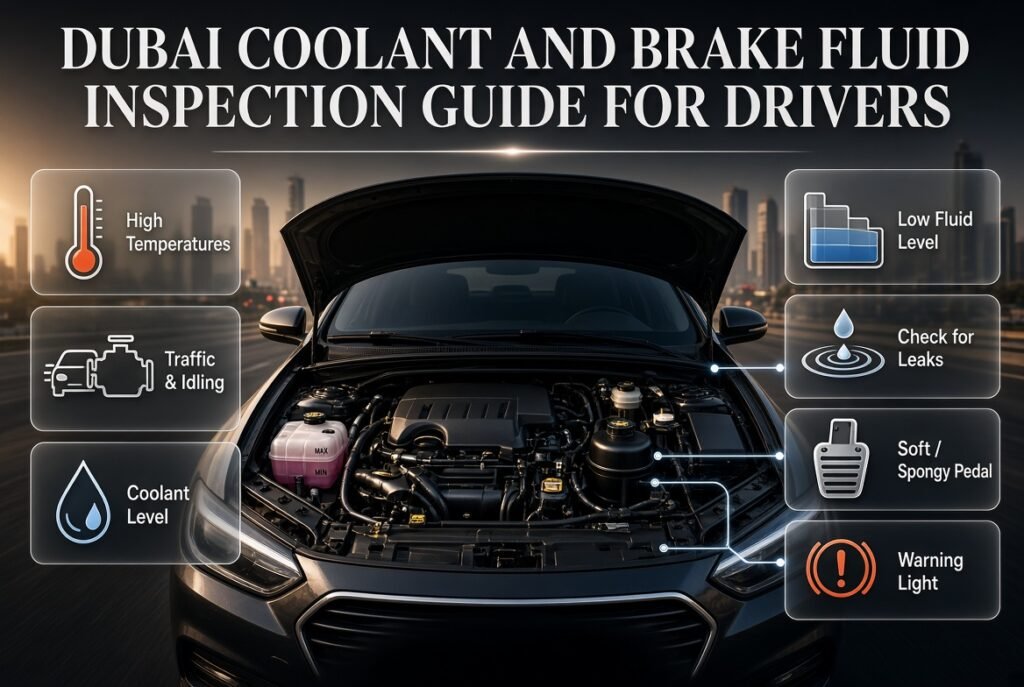
Dubai’s climate creates conditions in which cooling-system problems can become especially noticeable.
A vehicle may spend extended periods exposed to high ambient temperatures while also dealing with:
- Heavy traffic
- Long periods of idling
- Frequent air-conditioning use
- Highway driving
- Stop-and-go movement
- High engine operating temperatures
This doesn’t mean you should automatically shorten every manufacturer’s service interval.
Instead, it means you should take visible warning signs seriously.
If coolant levels repeatedly fall or the temperature gauge behaves abnormally, the issue deserves attention before the vehicle is used for a long journey.
Step 5: Inspect Brake Fluid
Brake fluid is one of the most important fluids because it helps transmit hydraulic pressure through the braking system.
The brake-fluid reservoir is generally located near the brake master cylinder.
Inspect the fluid level against the reservoir markings.
If the level is low, don’t automatically assume that adding more fluid is the answer.
A low brake-fluid level can be associated with brake-system wear or leakage.
Look for:
- Low fluid level
- Wet areas
- Reservoir leakage
- Brake warning lights
- Soft brake pedal
- Spongy pedal
- Longer stopping distance
- Changes in braking behaviour
AAA recommends having the brake system inspected if the brake-fluid level is near or below the lower mark, rather than treating the situation as a simple refill.
For detailed guidance, see the Brake Fluid Maintenance guide.
⭐ Expert Tip: A sudden change in brake-pedal feel is more important than the appearance of the brake fluid. If the pedal becomes unusually soft or spongy, have the braking system assessed promptly.
Step 6: Inspect Transmission Fluid Carefully
Transmission-fluid inspection is more complicated because manufacturers use different systems and procedures.
Some older or conventional automatic transmissions may have dipsticks.
Other vehicles use sealed or specialised transmissions where checking the fluid requires specific equipment, temperature conditions, or workshop procedures.
AAA notes that some modern vehicles have sealed transmissions requiring special procedures to check fluid levels.
Never assume the engine-oil dipstick procedure applies to transmission fluid.
Signs that may indicate a transmission problem include:
- Delayed gear engagement
- Harsh shifting
- Slipping
- Unusual noises
- Burning smell
- Fluid leakage
- Unexpected transmission warning lights
If your transmission is behaving differently, don’t simply add fluid unless you know the correct specification and inspection procedure.
Step 7: Check Power Steering Fluid if Applicable
Not every vehicle uses hydraulic power steering.
Many modern vehicles use electric power steering and therefore don’t have a conventional power-steering fluid reservoir.
If your vehicle does use hydraulic power steering, inspect the fluid according to the manufacturer’s instructions.
Watch for:
- Low fluid
- Visible leakage
- Whining during steering
- Difficulty turning
- Foaming or unusual appearance
If the vehicle uses electric power steering, look for electronic warning lights or steering symptoms instead of searching for a fluid reservoir that doesn’t exist.
Step 8: Check Windshield Washer Fluid
Washer fluid isn’t usually considered as mechanically critical as engine oil or brake fluid, but it plays an important visibility role.
A dirty windshield can significantly reduce visibility, especially when driving at night or in dusty conditions.
Check the washer reservoir regularly and keep it filled with an appropriate washer fluid.
Avoid using unsuitable household liquids if the vehicle manufacturer recommends a specific washer product.
What Does Fluid Colour Tell You?
Fluid appearance can provide clues, but colour alone should never be treated as a definitive diagnosis.
Different manufacturers and fluid formulations can have different colours.
Instead, consider:
- Colour
- Clarity
- Consistency
- Smell
- Level
- Service age
- Vehicle symptoms
- Signs of contamination
For example, a fluid that looks different from what you expected isn’t automatically bad.
The owner’s manual and service documentation are more reliable than generic colour charts.
How Can You Identify a Possible Fluid Leak?
A leak often becomes noticeable through one of several signs.
Common warning signs include:
- Fluid spots underneath the vehicle
- Wet components
- Falling fluid levels
- Strong unusual smells
- Steam or smoke
- Overheating
- Warning lights
- Steering changes
- Brake changes
- Transmission problems
The location of the puddle can provide a clue, but it doesn’t always identify the source.
A leak may travel along a component before reaching the ground.
What should you do?
- Park safely.
- Observe the location of the fluid.
- Don’t touch an unknown fluid unnecessarily.
- Check accessible fluid levels safely.
- Look for warning lights.
- Don’t continue driving if there are serious symptoms.
- Arrange professional inspection if the leak involves a critical system.
⚠ Common Mistake: Cleaning up a puddle without investigating why it appeared.
Can You Check Vehicle Fluids Yourself?
Yes, some basic checks are suitable for vehicle owners.
However, DIY inspection has limits.
Usually easier to check yourself:
- Engine oil level
- Coolant reservoir level when cold
- Brake-fluid reservoir level
- Washer fluid
- Visible leaks
Often better handled professionally:
- Sealed automatic transmissions
- Differential fluid
- Transfer-case fluid
- Hydraulic leaks
- Cooling-system pressure testing
- Internal transmission problems
- Fluid contamination diagnosis
- Brake-system leakage
- Complex electronic fluid-level systems
The important principle is knowing where DIY inspection ends.
You don’t need to become a mechanic to perform basic checks.
You do need to recognise when the vehicle requires proper diagnosis.
How Often Should You Perform a Vehicle Fluid Inspection?
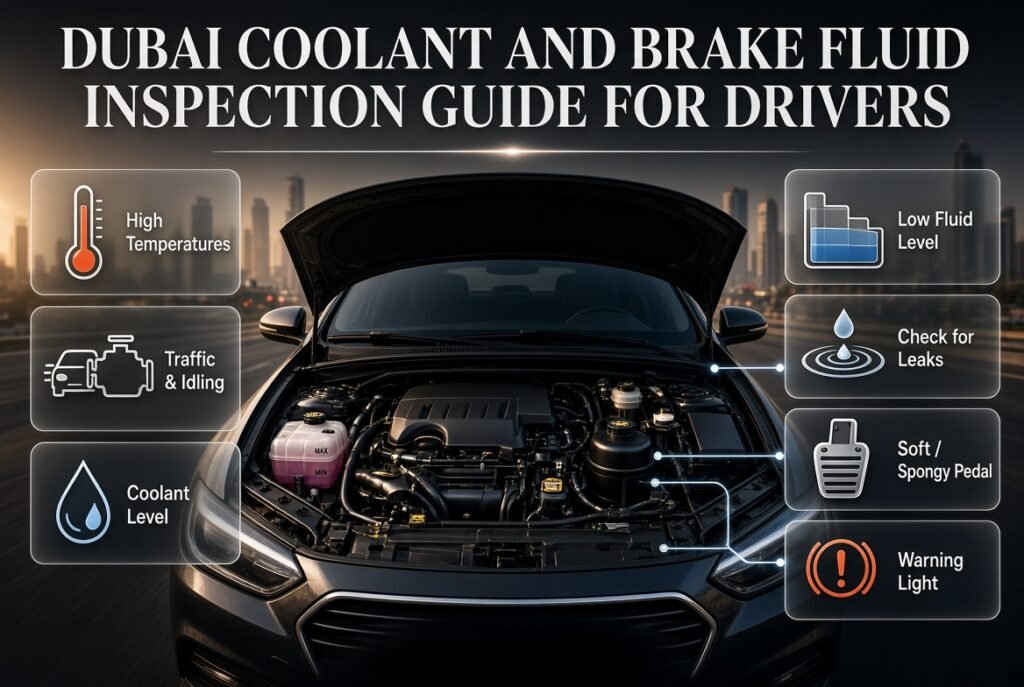
There isn’t one universal inspection schedule for every car.
Modern vehicles have different maintenance requirements, and manufacturers may specify different service intervals.
AAA also notes that maintenance intervals vary by vehicle and recommends using the owner’s manual for the vehicle-specific requirements.
A practical routine can include:
Regular quick checks
Look for:
- Visible leaks
- Warning lights
- Low washer fluid
- Obvious coolant issues
- Oil-level concerns
Periodic inspection
Check accessible fluid levels and inspect the engine compartment more thoroughly.
Scheduled maintenance
Follow the manufacturer’s service schedule for fluid replacement, transmission service, coolant service, brake-fluid service, and other maintenance requirements.
Before long journeys
Perform a broader vehicle check before travelling long distances.
This is especially sensible if the vehicle has:
- High mileage
- Known fluid consumption
- A history of leaks
- Recent repairs
- An upcoming highway journey
Should Fluids Be Replaced Just Because They Look Dirty?
Not necessarily.
Fluid appearance can be useful, but replacement decisions should consider the manufacturer’s service requirements, fluid specification, vehicle age, operating conditions, and diagnostic evidence.
Modern fluids and vehicle systems can have long service intervals, and there is no universal replacement interval that applies to every vehicle.
AAA’s current guidance similarly emphasises that service requirements for coolant, brake fluid and transmission fluid vary by vehicle and should be determined using the manufacturer’s specifications.
This is important because unnecessary fluid replacement isn’t the same thing as good maintenance.
Good maintenance means doing the right service at the right time.
What Are the Most Common Vehicle Fluid Inspection Mistakes?
1. Checking everything when the engine is hot
This is especially risky around the cooling system.
Why it happens: The driver arrives home and wants to inspect the car immediately.
Why it’s a problem: Hot cooling systems can be pressurised.
Better approach: Follow the manufacturer’s procedure and allow the vehicle to cool where required.
2. Using the wrong fluid
A vehicle doesn’t simply need “oil” or “coolant.”
It needs a fluid meeting a particular specification.
Better approach: Check the owner’s manual or manufacturer documentation.
3. Mixing incompatible fluids
Don’t assume two fluids can be mixed because they have similar names.
Brake fluid is a particularly important example because different specifications aren’t automatically interchangeable. AAA advises using only the brake fluid specified for the particular vehicle.
4. Overfilling
Drivers sometimes believe that if low fluid is bad, extra fluid must be better.
It isn’t.
Too much fluid can also create problems.
5. Ignoring repeated top-ups
If you’re constantly adding fluid, ask why.
Repeated top-ups can indicate:
- Leakage
- Consumption
- Component wear
- Cooling-system problems
- Incorrect previous servicing
6. Treating the dashboard as the only inspection tool
Warning lights are important, but they don’t replace physical inspection.
A vehicle can have a developing leak before the dashboard gives you a warning.
7. Assuming every car has the same systems
One vehicle may have a power-steering reservoir.
Another may use electric steering.
One transmission may have a dipstick.
Another may require workshop equipment.
Always inspect according to the vehicle’s design.
What Fluid Problems Should You Never Ignore?
Some symptoms deserve immediate attention.
Engine oil warning
An oil-pressure warning light is not the same thing as a routine reminder to change oil.
If a serious oil-pressure warning appears, continuing to drive can cause severe engine damage.
Coolant loss or overheating
If the temperature gauge rises abnormally, coolant is disappearing rapidly, or the vehicle is overheating, stop driving when it is safe to do so and allow the vehicle to cool.
Brake-fluid loss
A low brake-fluid level combined with a soft pedal, warning light, or visible leakage should be treated seriously.
Major transmission leak
A substantial transmission-fluid leak combined with shifting problems can leave the vehicle unable to operate correctly.
Strong burning smell
A burning smell can have several causes. It shouldn’t automatically be blamed on one fluid.
If it is accompanied by smoke, warning lights, overheating, or unusual mechanical behaviour, stop and investigate safely.
Vehicle Fluid Inspection Before a Long Journey
Long journeys deserve more attention because a minor issue can become inconvenient—or dangerous—far from home.
Before leaving, check:
Under the bonnet
- Engine oil
- Coolant
- Brake fluid
- Washer fluid
- Power steering fluid if applicable
- Visible hoses
- Visible leaks
Around the vehicle
- Tyre condition
- Tyre pressure
- Lights
- Wipers
- Visible fluid spots
- Signs of leakage
Inside the vehicle
- Warning lights
- Temperature gauge
- Oil-pressure warnings
- Brake warnings
- Transmission warnings
Also consider
- Fuel level
- Emergency equipment
- Spare tyre or tyre-repair equipment
- Recent maintenance history
A long trip is not the time to discover that your coolant has been slowly disappearing for several weeks.
How Does Vehicle Fluid Inspection Fit Into Preventive Maintenance?
Fluid inspection shouldn’t be treated as a separate activity that exists on its own.
It’s one part of preventive vehicle maintenance.
A complete maintenance approach also includes:
- Tyre inspection
- Brake inspection
- Battery checks
- Filter replacement
- Belt inspection
- Hose inspection
- Suspension checks
- Steering inspection
- Light checks
- Wiper maintenance
- Scheduled servicing
This is why drivers who want a more organised maintenance routine should think in terms of the whole vehicle rather than individual fluids.
The Vehicle Maintenance Guides section provides a useful starting point for understanding the wider maintenance picture.
What Do Professionals Look for During Fluid Inspection?
A professional inspection is different from simply checking a reservoir.
A technician may compare current conditions with the vehicle’s service history and look for relationships between different symptoms.
For example:
Low brake fluid + worn brake components
may require more than simply adding fluid.
Low coolant + repeated overheating
may require cooling-system diagnosis.
Transmission leak + harsh shifting
may indicate a problem that needs more detailed assessment.
Low engine oil + repeated top-ups
may require investigation for leaks or oil consumption.
This is why the most useful question isn’t always:
“Which fluid should I add?”
Sometimes the better question is:
“Why has the fluid level changed?”
That change in thinking can prevent temporary fixes from hiding developing mechanical problems.
A Simple Vehicle Fluid Inspection Checklist

Use this checklist as a practical reminder.
Engine oil
- Correct level
- No obvious leak
- No unusual smell
- No oil-pressure warning
- Service interval checked
Coolant
- Level checked according to manufacturer’s procedure
- No visible leak
- No overheating
- Reservoir intact
- Correct coolant specification
Brake fluid
- Level within specified range
- No visible leakage
- No brake warning light
- Brake pedal feels normal
- Service requirements reviewed
Transmission
- Correct inspection procedure known
- No visible leak
- No abnormal shifting
- No burning smell
- Service schedule checked
Steering
- Fluid checked if hydraulic system is fitted
- No visible leak
- No unusual steering noise
- No unexpected steering difficulty
Washer fluid
- Reservoir adequately filled
- Washers operate correctly
- Wipers clean the glass effectively
General
- No recurring fluid spots
- No warning lights
- No smoke
- No unusual smell
- No unexplained fluid loss
When Should You Stop Driving Because of a Fluid Problem?
Not every fluid issue means the vehicle must immediately be parked.
But certain combinations of symptoms are serious.
Stop driving when safe and seek appropriate assistance if you experience:
- Engine overheating
- Oil-pressure warning
- Major brake-fluid loss
- Sudden brake-pedal changes
- Significant coolant leak
- Smoke from the engine bay
- Major transmission-fluid leak
- Sudden steering difficulty
- Multiple warning lights
- Severe mechanical noise
The key factor is not simply the fluid itself.
It’s the effect the fluid problem is having on vehicle safety and mechanical operation.
How Can Dubai Drivers Make Fluid Inspection Part of Their Routine?
A complicated maintenance system isn’t necessary.
A simple routine is easier to follow.
Once a week or during regular vehicle use
Look for:
- Warning lights
- Obvious leaks
- Low washer fluid
- Overheating symptoms
- Changes in vehicle behaviour
During routine maintenance
Review:
- Engine oil
- Coolant
- Brake fluid
- Transmission-related service
- Power steering if applicable
- Other manufacturer-specified fluids
Before long highway trips
Perform a more complete inspection.
After repairs
Pay particular attention to:
- Fluid levels
- Leaks
- Warning lights
- New noises
- New smells
- Changes in vehicle performance
This approach doesn’t require you to become obsessed with the bonnet.
It simply turns fluid inspection into a normal part of responsible vehicle ownership.
Is Vehicle Fluid Inspection Different for Older Cars?
Older vehicles may deserve closer observation because seals, hoses, reservoirs, gaskets, and other components can deteriorate with age.
The fluid itself may not be the only concern.
An older vehicle may have:
- Aging hoses
- Brittle plastic components
- Old seals
- Previous repairs
- Corrosion
- Unknown service history
- Higher oil consumption
- Older cooling-system components
This doesn’t mean every older vehicle needs unnecessary fluid replacement.
Instead, inspection becomes more useful because it can reveal changes before they become major failures.
Can Fluid Inspection Help Prevent Breakdowns?
It can help identify certain problems before they become breakdown situations, although no inspection can guarantee that a vehicle won’t fail.
A low coolant level, visible leak, declining oil level, or transmission leak can provide an early warning.
The earlier the cause is identified, the more opportunity there may be to address the issue before it becomes a roadside problem.
This is particularly valuable for drivers who regularly travel long distances or use major highways.
What If the Vehicle Runs Out of Fuel During a Fluid Inspection Routine?
Fuel isn’t technically a maintenance fluid in the same way as engine oil, coolant, or brake fluid, but fuel level is still an important part of vehicle readiness.
A driver may perform a complete fluid inspection and still face a roadside problem simply because the fuel level was ignored.
Before a long journey, check:
- Current fuel level
- Estimated remaining range
- Planned refuelling points
- Traffic conditions
- Route length
If the vehicle unexpectedly runs out of fuel, move to a safe location where possible and prioritise traffic and passenger safety before dealing with the fuel problem.
How Often Should You Perform a Vehicle Fluid Inspection?
A vehicle fluid inspection should be part of your regular maintenance routine, but the exact frequency depends on the vehicle, its age, mileage, driving conditions, and manufacturer’s maintenance schedule. A quick visual check can be done regularly, while more detailed fluid checks and fluid replacement should follow the vehicle manufacturer’s recommendations.
Drivers who regularly deal with Dubai heat, heavy traffic, frequent idling, or long-distance highway driving should pay closer attention to fluid levels and signs of leakage. You should also inspect the vehicle before a long journey or whenever its behaviour changes.
Important points to remember:
Check accessible fluid levels according to the manufacturer’s instructions.
Look for visible leaks around the engine bay and underneath the vehicle.
Follow the recommended service interval for fluid replacement.
Inspect more carefully if your vehicle has high mileage or a known fluid issue.
Don’t wait for a dashboard warning before paying attention to obvious fluid problems.
The purpose of regular inspection isn’t to replace fluids unnecessarily. It’s to identify changes early so that a small issue doesn’t develop into a more expensive mechanical problem.
What Fluids Should Be Checked During a Vehicle Fluid Inspection?
A proper vehicle fluid inspection should cover the fluids relevant to your specific vehicle, rather than simply checking whichever reservoirs are easiest to access. The most commonly inspected fluids include engine oil, coolant, brake fluid, transmission fluid, power-steering fluid where applicable, and windshield washer fluid.
Some vehicles also require inspection or scheduled servicing of differential and transfer-case fluids. Modern vehicles can have different designs, so not every car will have every fluid or an accessible way to check it manually.
During an inspection, pay attention to:
Engine-oil level and condition
Coolant level and visible leaks
Brake-fluid level and brake-system symptoms
Transmission-fluid requirements and leaks
Power-steering fluid if the vehicle uses hydraulic steering
Windshield washer-fluid level
Differential or transfer-case service requirements
Fluid leaks underneath the vehicle
The most important point is that fluid level isn’t the only thing that matters. Fluid condition, leakage, correct specification, service history, and vehicle symptoms should also be considered.
What Are the Warning Signs That a Vehicle Has a Fluid Problem?
A fluid problem doesn’t always begin with a dashboard warning. One of the earliest signs may be a fluid level that keeps dropping, a small puddle underneath the vehicle, an unusual smell, or a change in how the car operates.
For example, repeated coolant loss may indicate a cooling-system leak, while low brake fluid combined with a soft brake pedal requires much more attention than simply adding fluid. Similarly, repeatedly adding engine oil may indicate leakage or oil consumption that needs investigation.
Watch for these warning signs:
Repeatedly low engine oil
Falling coolant level
Visible fluid spots underneath the car
Brake-fluid loss
Soft or spongy brake pedal
Engine overheating
Oil-pressure warning
Transmission slipping or harsh shifting
Unusual burning or chemical smells
Smoke from the engine compartment
Sudden steering changes
Multiple dashboard warning lights
A single symptom doesn’t always identify the exact cause. The useful approach is to treat the symptom as a reason for further inspection, rather than guessing which fluid needs to be added.
Can You Inspect Car Fluids Yourself, or Should You Use a Professional?
Many basic fluid checks can be performed by a vehicle owner, provided the correct procedure is followed. Engine-oil level, coolant reservoir level when the system is safely cool, brake-fluid level, washer fluid, and visible leaks are examples of checks that may be straightforward on many vehicles.
However, not every fluid system is designed for DIY inspection. Some modern automatic transmissions require a specific fluid temperature, procedure, or workshop equipment. Differential and transfer-case fluids may also require specialised access.
A professional inspection is particularly useful when:
The fluid level keeps falling.
You cannot identify the correct fluid specification.
The vehicle has a sealed transmission.
There is a significant leak.
The engine is overheating.
The brake pedal feels abnormal.
The transmission is shifting incorrectly.
You notice smoke or a strong burning smell.
A warning light appears alongside a fluid-related symptom.
The best approach is to perform simple checks yourself when appropriate, but don’t turn an unfamiliar system into a DIY experiment. The owner’s manual should always be your first reference for the correct inspection procedure.
What Should You Do If You Find a Fluid Leak During an Inspection?
Finding a fluid leak should be treated as a diagnostic clue, not simply as a reason to top up the reservoir. The correct response depends on which fluid is leaking, how quickly it is being lost, and whether the vehicle is showing other symptoms.
Start by parking the vehicle safely and observing where the leak appears. Don’t assume that the location of a puddle automatically identifies the source because fluid can travel along components before reaching the ground.
If you discover a possible leak:
Check whether the leak is recurring.
Look at the affected fluid level if it can be checked safely.
Note the location of the fluid spot.
Look for warning lights.
Pay attention to overheating or unusual smells.
Check for changes in braking, steering, or transmission operation.
Avoid driving if there is major fluid loss or a serious safety-related symptom.
Have the vehicle professionally inspected when the source isn’t obvious.
A small leak can sometimes develop gradually, but a major leak involving engine oil, coolant, brake fluid, or transmission fluid can become a serious problem quickly. Repeatedly adding fluid without repairing the underlying cause only masks the symptom.
The professional rule is simple: don’t ask only “What fluid should I add?” Ask “Why is the vehicle losing this fluid in the first place?”
Conclusion
A vehicle fluid inspection is one of the simplest ways to identify developing maintenance problems before they become expensive or disruptive. Engine oil, coolant, brake fluid, transmission fluid, power steering fluid, and washer fluid all play different roles, but each contributes to the vehicle’s reliability, safety, and everyday performance.
Regular inspection is especially important in demanding conditions such as Dubai’s extreme heat, heavy traffic, frequent air-conditioning use, dusty environments, and long highway journeys. Checking fluid levels, condition, leaks, warning signs, and service history can help you recognize problems early and arrange the correct maintenance before a minor issue becomes a major repair.
A professional vehicle fluid inspection should be part of your wider maintenance routine, not something you only consider when a warning light appears. Make fluid checks a regular habit, follow the manufacturer’s recommended service intervals, and investigate unusual fluid loss, contamination, overheating, warning lights, or changes in vehicle performance promptly.
The goal is not simply to keep fluid levels topped up. Proper fluid inspection helps you understand your vehicle’s condition, protect important mechanical components, maintain safe operation, and reduce the risk of unexpected breakdowns. Combined with routine servicing and regular vehicle inspections, it provides a practical foundation for keeping your car dependable on Dubai roads.
Leave a Reply