

Introduction
Coolant Fluid Maintenance | A car can start, drive normally, and show no obvious warning signs while its cooling system is slowly developing a problem. Then, during heavy traffic or a long drive on a hot day, the temperature gauge suddenly begins to rise. What looked like a small maintenance issue can quickly become an expensive repair.
This is why coolant fluid maintenance deserves more attention than simply checking whether there is liquid in the reservoir. For drivers who rely on their vehicle every day, including those using FuelDeliveryDubai.com for roadside fuel-related assistance, understanding the cooling system can help prevent avoidable breakdowns and engine damage.
Engine coolant helps control temperature, protect cooling-system components, and reduce corrosion inside the system. But using the wrong coolant, ignoring a leak, checking the reservoir incorrectly, or continuing to drive an overheating vehicle can create serious problems.
This guide explains how coolant works, how to check it safely, how to identify warning signs, when coolant needs replacement, how coolant differs from plain water, what happens when coolant is low, and how to maintain the entire cooling system properly.
What Is Engine Coolant?
Engine coolant is a specially formulated fluid that circulates through the engine and cooling system to help control operating temperature. It carries heat away from hot engine components and transfers that heat to the radiator, where it can be released into the surrounding air.
Coolant also does more than move heat.
Depending on its formulation, it helps provide protection against corrosion, deposits, freezing, and excessive boiling. It also supports the proper operation and durability of components such as the radiator, water pump, thermostat, hoses, and other cooling-system parts.
In most vehicles, coolant is based on a mixture involving water and antifreeze, along with additives designed for the particular cooling system.
The exact formulation and concentration vary by vehicle and coolant product.
That is why coolant shouldn’t be treated as simply “colored water.”
Why does coolant matter so much?
The engine produces a large amount of heat during normal operation. Some of that heat leaves through the exhaust system, but a significant amount must be managed by the cooling system.
The basic process looks like this:
Engine generates heat → Coolant absorbs heat → Water pump circulates coolant → Radiator releases heat → Cooled coolant returns to engine
If this cycle isn’t working properly, engine temperature can rise beyond the intended operating range.
Severe overheating can damage components that are far more expensive to repair than a coolant leak or cooling-system service.
Why Is Coolant Fluid Maintenance Important?
Regular coolant maintenance helps keep the engine operating within its intended temperature range while protecting the components that make temperature control possible.
A cooling system doesn’t depend on coolant alone. It works as a complete system.
It includes:
- Engine coolant
- Radiator
- Water pump
- Thermostat
- Cooling fans
- Expansion or overflow reservoir
- Radiator or pressure cap
- Coolant hoses
- Hose connections
- Temperature sensors
- Heater circuit
- Related seals and components
If one part develops a problem, the rest of the system may have to work harder.
For example, a small coolant leak can gradually reduce the fluid level. A low coolant level can reduce the system’s ability to transfer heat. Continued operation under those conditions may eventually result in overheating.
This is why topping up coolant isn’t always the complete solution.
If the level keeps falling, the important question isn’t only:
“How much coolant should I add?”
It’s:
“Why is the coolant level falling?”
That difference is at the heart of proper preventive maintenance.
How Does a Car Cooling System Work?
Understanding the cooling system makes coolant maintenance much easier.
The engine
Combustion produces intense heat inside the engine. The cooling system carries away excess heat so engine components can remain within their designed operating range.
The coolant
Coolant flows through internal passages around hot engine components. It absorbs heat and transports it away.
The water pump
The water pump circulates coolant through the system.
If coolant isn’t circulating correctly, the radiator can’t effectively remove heat from the engine.
The thermostat
The thermostat helps regulate coolant flow based on engine temperature.
When the engine is cold, the thermostat helps the engine reach its normal operating temperature. As temperature rises, coolant flow is adjusted to help maintain the appropriate range.
The radiator
The radiator transfers heat from the coolant to the surrounding air.
Airflow may come naturally from vehicle movement and can also be assisted by cooling fans.
Cooling fans
Cooling fans become particularly important when airflow through the radiator is limited, such as when the vehicle is stopped or moving slowly in traffic.
Expansion reservoir
The reservoir provides space for coolant to expand and contract as temperature changes.
This is often the component drivers use when checking coolant level.
Hoses
Hoses transport coolant between different components.
A cracked, swollen, hardened, or leaking hose can compromise the entire cooling system.
How Often Should You Check Your Coolant?
There isn’t one universal inspection interval that applies to every vehicle.
The correct schedule depends on the vehicle manufacturer, coolant type, vehicle age, driving conditions, and maintenance history.
However, checking the coolant level periodically is a sensible part of routine vehicle care.
You should pay particular attention to the coolant before:
- Long-distance journeys
- Extended highway driving
- Periods of very hot weather
- Heavy daily driving
- Road trips
- Towing or carrying heavy loads
- After cooling-system repairs
- When the vehicle has shown temperature changes
You don’t need to open the cooling system every time.
In many vehicles, a quick inspection of the expansion reservoir is enough for a routine level check.
The important part is knowing what the normal level looks like when the engine is cold.
What should you look for?
Check whether:
- The level is between the manufacturer’s marked limits
- The coolant looks reasonably clean
- There are visible leaks
- Hoses appear damaged
- Connections look wet
- There are unusual deposits around joints
- The engine temperature behaves normally
- The vehicle has recently needed coolant
A sudden change is often more useful than a single isolated observation.
If the coolant level was stable for months and suddenly drops, investigate it.
How Do You Check Coolant Level Safely?

Checking coolant isn’t difficult, but it needs to be done safely.
Step 1: Park on a suitable surface
Park the vehicle safely on a level surface.
Turn the engine off.
Step 2: Let the engine cool
Wait until the engine and cooling system have cooled sufficiently.
This is extremely important.
A cooling system can become pressurized when hot. Opening a hot radiator or coolant reservoir can release hot coolant or steam and cause serious burns.
Step 3: Locate the coolant reservoir
Look for the coolant expansion or overflow tank.
It usually has markings such as:
MIN
and
MAX
The exact design varies by vehicle.
Step 4: Check the level
When the engine is cold, compare the coolant level with the manufacturer’s markings.
Don’t judge the level based on how much fluid you think the vehicle should contain.
Use the markings.
Step 5: Inspect for leaks
Look around:
- Reservoir
- Hoses
- Hose connections
- Radiator area
- Water pump area
- Engine bay
Look for wetness, stains, deposits, or other signs of coolant escaping.
Step 6: Use the correct coolant
If the level is low, use the coolant specified for your vehicle.
Don’t automatically use whatever coolant is closest on a shop shelf.
Step 7: Secure the cap
If you add coolant, make sure the cap is correctly secured according to the vehicle’s instructions.
A loose or incorrectly fitted cap can affect cooling-system operation.
What Happens If Coolant Is Low?
Low coolant means the system has less fluid available to carry heat away from the engine.
The consequences depend on how low the level is and why it became low.
Possible symptoms include:
- Higher engine temperature
- Temperature warning
- Overheating
- Reduced heating performance inside the cabin
- Coolant smell
- Visible leakage
- Steam
- Engine performance problems associated with excessive heat
A low coolant level doesn’t always mean the engine will overheat immediately.
That’s part of what makes the problem easy to ignore.
The vehicle may continue operating normally for some time.
But if coolant continues to disappear, the underlying issue can become progressively worse.
Why shouldn’t you simply keep topping it up?
Because coolant isn’t normally something that should continuously disappear.
If the level keeps dropping, there may be:
- An external leak
- A damaged hose
- A radiator leak
- A reservoir problem
- A pressure-cap problem
- A water-pump leak
- A heater-core issue
- Another cooling-system fault
- In some cases, an internal engine problem
The correct solution is to identify the cause.
For a practical step-by-step overview of oil checks, correct oil selection, warning signs, service intervals, and common maintenance mistakes, read our complete Engine Oil Maintenance Guide before your next oil service.
What Are the Signs of a Coolant Leak?
Coolant leaks don’t always appear as a large puddle.
A small leak may only occur when the system becomes hot and pressurized.
That’s why you should pay attention to several warning signs.
Common signs include:
- Coolant level repeatedly dropping
- Wet areas around hoses
- Colored residue near connections
- A coolant smell around the engine
- Steam
- Overheating
- Fluid underneath the vehicle
- Deposits around the radiator
- Reservoir level changing unexpectedly
- Frequent coolant top-ups
The exact appearance of coolant varies according to the product.
Don’t rely solely on fluid color to identify it.
If you see an unknown fluid under the vehicle, it’s better to determine what it is rather than assuming.
Why Does Coolant Keep Disappearing?
A coolant system is designed to circulate fluid rather than continuously consume it.
So if you repeatedly add coolant, there is usually a reason.
External leak
A hose, radiator, reservoir, connection, seal, or other component may be leaking.
Water-pump problem
A failing water pump can sometimes leak coolant or stop circulating it correctly.
Radiator problem
Radiator damage, corrosion, or a faulty connection can result in coolant loss.
Pressure-cap problem
A damaged pressure cap may prevent the system from maintaining the intended pressure.
Heater-core problem
A leak inside the heater circuit may sometimes produce coolant smell or moisture inside the cabin.
Internal engine problem
In more serious cases, coolant can enter areas where it shouldn’t.
This requires professional diagnosis.
⚠ Common Mistake: Repeatedly filling the reservoir without diagnosing the cause can make a developing cooling-system problem harder to identify and may leave the vehicle vulnerable to overheating.
Can You Use Water Instead of Coolant?
Plain water can absorb engine heat effectively, which is why it may seem like an obvious replacement.
But water alone doesn’t provide all the protection expected from properly formulated engine coolant.
A suitable coolant provides additional protection against corrosion and helps establish the thermal and chemical characteristics required by the cooling system.
Plain water can also present problems related to:
- Corrosion
- Mineral deposits
- Boiling protection
- Freeze protection
- Cooling-system durability
For normal operation, follow the vehicle manufacturer’s coolant recommendation.
What about an emergency?
Emergency situations are different from routine maintenance.
If a vehicle is critically low on coolant and professional assistance isn’t immediately available, the safest temporary action depends on the vehicle, climate, condition of the engine, and what fluid is available.
The important point is that an emergency measure shouldn’t become the permanent maintenance method.
Once the vehicle is safe, the cooling system should be checked and restored to the correct specification.
What Is the Difference Between Coolant and Antifreeze?
The terms are often used interchangeably, but they aren’t exactly identical in every context.
Antifreeze is generally the concentrated fluid used as part of the cooling mixture. Coolant refers to the fluid circulating through the cooling system, commonly involving antifreeze and water at the required concentration.
The important thing for drivers isn’t getting stuck on terminology.
The practical question is:
What fluid and concentration does my vehicle require?
Different vehicles can require different formulations.
Always follow the manufacturer’s recommendation.
How Do You Choose the Correct Coolant?
Choosing coolant should start with the vehicle manufacturer’s specification.
Not the color.
Not the cheapest bottle.
Not the most expensive bottle.
Not what worked in your friend’s car.
Check these sources first:
- Owner’s manual
- Manufacturer service documentation
- Coolant specification printed in vehicle documentation
- Existing maintenance records
- Qualified technician
- Authorized service information
What about coolant color?
Coolant colors can be useful for identification, but color alone isn’t a dependable compatibility standard.
A red coolant isn’t automatically better than green.
A blue coolant isn’t automatically suitable for every Japanese vehicle.
An orange coolant isn’t automatically appropriate for every modern engine.
The specification is more important than the dye.
Can Different Coolants Be Mixed?
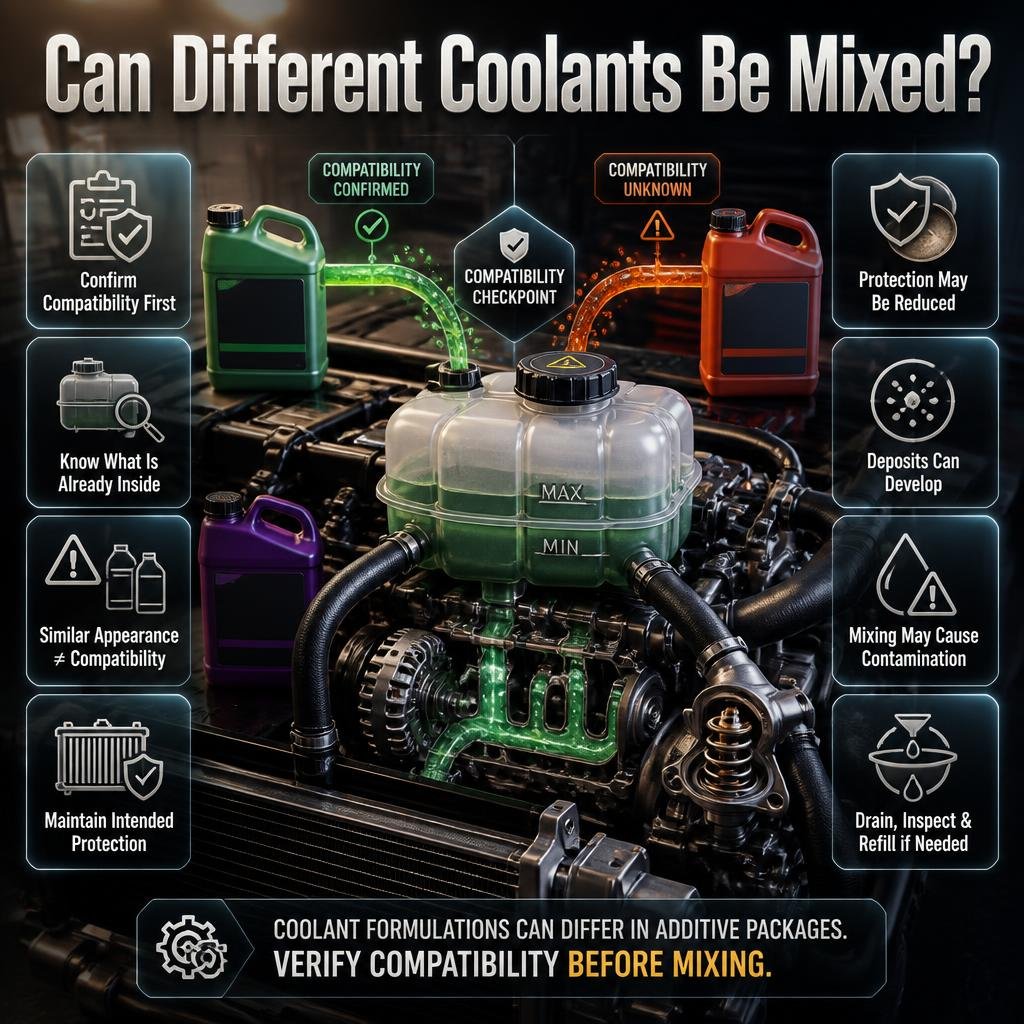
This is one of the most common coolant questions.
The answer is: don’t assume different coolants are compatible simply because they look similar or are marketed for multiple vehicles.
Different coolant formulations can use different additive packages.
If incompatible products are mixed, the resulting fluid may not provide the intended level of protection.
Potential concerns can include:
- Reduced corrosion protection
- Deposits
- Contamination
- Shortened service life
- Cooling-system problems
If you don’t know what coolant is already in the vehicle, it’s better to identify it before adding another product.
If compatibility cannot be confirmed, a proper drain, inspection, and refill may be more appropriate than experimenting with different products.
Does Coolant Color Matter?
Color can help distinguish products, but it should never be your main method of selecting coolant.
Think of color as an identification feature, not a technical specification.
Two products with similar colors may have different formulations.
Two products with different colors may potentially meet similar requirements.
This is why professional coolant selection starts with the vehicle’s required specification.
📌 Quick Tip: When buying coolant, take a photo of the information in your owner’s manual or existing coolant bottle. It can help you compare specifications instead of relying on color.
When Should Engine Coolant Be Changed?
Coolant replacement intervals vary significantly between vehicles.
Some vehicles require relatively frequent replacement.
Others use long-life coolant designed for much longer service intervals.
Therefore, there is no responsible single number of years or kilometers that can be applied to every car.
The correct interval depends on:
- Vehicle make
- Model
- Engine
- Coolant specification
- Coolant technology
- Manufacturer maintenance schedule
- Driving conditions
- Previous maintenance
- Cooling-system condition
Your owner’s manual should be the starting point.
Should you change coolant early?
Sometimes an early replacement can make sense, but it shouldn’t be done simply because someone says every vehicle needs a flush at the same interval.
Early service may be appropriate when:
- The coolant is contaminated
- The wrong coolant was installed
- The cooling system has been repaired
- The system has been opened for major work
- The manufacturer recommends it
- The coolant condition is poor
- A qualified inspection identifies a problem
What Is a Coolant Flush?
A coolant flush is more than simply adding fresh fluid.
The exact procedure depends on the vehicle.
A service may involve draining the old coolant, flushing or cleaning the system according to the manufacturer’s procedure, inspecting components, and refilling with the correct coolant mixture.
Some vehicles also require specific bleeding procedures to remove trapped air.
Why does trapped air matter?
Air pockets can interfere with proper coolant circulation and temperature control.
They may also produce unusual noises or inconsistent cabin heating.
That’s why cooling-system work should be performed using the appropriate procedure for the vehicle.
Should You Flush Coolant Every Year?
Not necessarily.
A yearly flush isn’t automatically required for every vehicle.
The correct maintenance schedule depends on the manufacturer’s instructions and coolant type.
However, annual inspection can still be valuable.
There’s an important difference between:
Inspecting the coolant
and
Replacing the coolant.
You may inspect something regularly without replacing it every time.
For example, if the coolant level is stable, the system is clean, there are no leaks, and the manufacturer’s replacement interval hasn’t arrived, replacement may not be necessary.
What Does Bad Coolant Look Like?
Coolant condition can provide useful clues about the cooling system.
Healthy coolant should generally look consistent with the product’s intended appearance.
Warning signs can include:
- Rust-like appearance
- Muddy fluid
- Excessive debris
- Oily contamination
- Sludge
- Unusual particles
- Significant discoloration
- Strong contamination
However, appearance alone doesn’t provide a complete diagnosis.
A coolant may look acceptable while its protective properties have deteriorated.
Similarly, unusual appearance may indicate a larger cooling-system problem rather than simply old coolant.
A professional inspection can provide a more reliable assessment when condition is uncertain.
Why Is Coolant Maintenance Important in Hot Weather?
High ambient temperatures can increase the demand placed on a vehicle’s cooling system.
This is particularly relevant in places such as Dubai, where vehicles can experience very high temperatures, heavy traffic, frequent air-conditioning use, and long periods of slow movement.
A healthy cooling system should be capable of handling normal operating conditions.
However, heat can expose an existing weakness.
For example, a vehicle with:
- Low coolant
- A weak cooling fan
- A restricted radiator
- A damaged hose
- A faulty thermostat
- A failing water pump
may develop temperature problems during demanding conditions.
The lesson isn’t that hot weather automatically causes overheating.
The lesson is that a vehicle with a cooling-system weakness may have less margin when operating under high thermal demand.
How Does Traffic Affect Cooling-System Performance?
Traffic creates a different cooling environment from highway driving.
At highway speed, the vehicle naturally moves through a large amount of air.
In slow traffic, natural airflow through the radiator is reduced.
This is where cooling fans become especially important.
If the cooling fan isn’t operating properly, the vehicle may remain normal at higher road speeds but begin showing temperature problems in slow traffic.
This pattern can be an important diagnostic clue.
For example:
Normal temperature on highway + overheating in traffic
may point toward a cooling-system airflow problem, although other causes are possible.
Don’t attempt to diagnose the exact cause solely from this symptom. Use it as useful information when explaining the problem to a technician.
What Should You Do If Your Car Starts Overheating?
Overheating should be treated seriously.
The longer an engine operates at an excessive temperature, the greater the potential for damage.
Step 1: Stay calm
Don’t make sudden movements.
Look for a safe place to stop.
Step 2: Reduce the load
If you are still moving and it is safe to do so, reduce unnecessary engine load while preparing to stop.
Step 3: Pull over safely
Move away from moving traffic whenever possible.
Passenger safety comes first.
Step 4: Turn the engine off when appropriate
If the vehicle is clearly overheating, stopping the engine can prevent additional heat buildup.
Step 5: Don’t immediately open the radiator cap
This is critical.
A hot cooling system can be pressurized.
Hot coolant or steam can escape violently if the system is opened.
Step 6: Let the vehicle cool
Allow adequate time for the system to cool before inspection.
Step 7: Look for obvious signs
Once it is safe, look for:
- Coolant leaks
- Steam
- Broken hoses
- Damaged components
- Empty reservoir
- Other obvious problems
Step 8: Get professional assistance
If the vehicle overheats again or the cause isn’t obvious, arrange professional assistance rather than continuing to drive.
Why Should You Never Open a Hot Coolant System?

This deserves its own section because it’s one of the most dangerous coolant maintenance mistakes.
When the cooling system is hot, pressure can build inside it.
If the cap is removed suddenly, pressurized coolant and steam can escape.
That can cause severe burns.
The safe approach is to allow the system to cool and follow the manufacturer’s instructions before opening any cooling-system component.
Do not rely on:
- “It has been five minutes.”
- “The engine is switched off.”
- “The temperature gauge has dropped slightly.”
- “I only need to loosen it a little.”
The cooling system may still contain dangerous heat and pressure.
⭐ Expert Tip: A stopped engine isn’t automatically a cool engine. Always treat a recently overheated cooling system as potentially pressurized.
What Are the Most Common Coolant Maintenance Mistakes?
Mistake 1: Waiting for the Temperature Warning
Some drivers never check coolant until the temperature warning appears.
By then, the system may already have a serious problem.
Better approach: Include coolant level and leak checks in regular maintenance.
Mistake 2: Choosing Coolant by Color
Color isn’t a reliable technical specification.
Better approach: Match the coolant to the manufacturer’s required specification.
Mistake 3: Using Tap Water as Routine Coolant
Plain tap water can introduce minerals and doesn’t provide the complete protection of the correct coolant mixture.
Better approach: Follow the coolant manufacturer’s water and mixing requirements or use the correct premixed product.
Mistake 4: Repeatedly Topping Up
If coolant keeps disappearing, something may be wrong.
Better approach: Find the source of the coolant loss.
Mistake 5: Opening the Cap While Hot
This can expose you to pressurized hot coolant and steam.
Better approach: Allow the system to cool completely.
Mistake 6: Mixing Unknown Coolants
Different formulations aren’t automatically compatible.
Better approach: Confirm compatibility before mixing.
Mistake 7: Ignoring Small Leaks
A small leak can become a major leak.
Better approach: Investigate even gradual coolant loss.
Mistake 8: Assuming Normal Engine Operation Means the Coolant Is Fine
A vehicle can operate normally while coolant condition or level is gradually deteriorating.
Better approach: Monitor coolant as part of preventive maintenance.
Mistake 9: Using Straight Concentrate Incorrectly
Coolant concentrate often needs to be mixed according to product instructions.
Too much concentrate isn’t automatically better.
Better approach: Follow the manufacturer’s recommended concentration.
Mistake 10: Forgetting the Cooling Fan
Some drivers focus only on coolant level.
But the cooling fan is an important part of the complete system.
Better approach: If temperature problems occur mainly in traffic, have the cooling system inspected rather than assuming more coolant is the answer.
What Should a Professional Cooling-System Inspection Include?
A proper inspection should look beyond the coolant reservoir.
Depending on the vehicle and symptoms, a technician may inspect:
Coolant level
Is the level appropriate when cold?
Coolant condition
Does the fluid show signs of contamination or deterioration?
Hoses
Are they cracked, swollen, soft, hard, or leaking?
Radiator
Is there evidence of damage, blockage, corrosion, or leakage?
Water pump
Is coolant circulating correctly?
Are there signs of leakage or mechanical failure?
Thermostat
Is it regulating coolant flow correctly?
Cooling fan
Does the fan operate when required?
Pressure cap
Can the system maintain the correct pressure?
Temperature sensor
Is the vehicle receiving accurate temperature information?
Pressure testing
When a leak isn’t obvious, pressure testing can help identify certain cooling-system leaks.
Air in the system
If the cooling system was recently opened, trapped air may need to be addressed using the correct procedure.
A professional diagnosis is particularly important when the vehicle repeatedly overheats or loses coolant.
How Can You Prevent Coolant Problems?
Preventive maintenance doesn’t have to be complicated.
The goal is consistency.
Create a simple routine
Check coolant level periodically.
Look for leaks.
Pay attention to temperature changes.
Follow the manufacturer’s replacement schedule.
Record major cooling-system work.
Investigate repeated coolant loss.
This can be summarized as:
Check → Monitor → Maintain → Investigate → Repair
Each step has a purpose.
Check: Find visible issues.
Monitor: Notice changes from normal behavior.
Maintain: Follow scheduled service requirements.
Investigate: Identify the reason behind unusual symptoms.
Repair: Correct the actual problem instead of repeatedly treating the symptom.
What Should You Check Before a Long Road Trip?
A long trip isn’t the best time to discover that your cooling system has a problem.
Before traveling, check:
- Coolant level
- Visible coolant leaks
- Engine temperature behavior
- Radiator condition
- Accessible hoses
- Cooling fan behavior
- Maintenance history
- Recent warning lights
- Recent overheating symptoms
Also check other important vehicle systems.
A useful vehicle inspection should include tyres, brakes, battery, fluids, lights, belts, and other components relevant to your vehicle.
If you’re building a broader maintenance routine, your vehicle maintenance guides can be used alongside the coolant-specific checks in this article.
How Should You Maintain Coolant in an Older Vehicle?

Older vehicles deserve closer attention because cooling-system components can deteriorate with age.
The coolant itself isn’t necessarily the only concern.
Older cars may have:
- Aging radiator hoses
- Old clamps
- Corrosion
- Weakened radiators
- Aging water pumps
- Older thermostats
- Brittle plastic reservoirs
- Previous repairs
- Unknown coolant history
If you own an older vehicle and don’t know when the coolant was last replaced, checking the maintenance history is a good starting point.
Don’t automatically flush everything without understanding the vehicle’s condition.
A technician should assess the cooling system and follow the correct procedure.
Can a Car Overheat Even With Enough Coolant?
Yes.
Having enough coolant doesn’t guarantee that the cooling system is functioning correctly.
The system also depends on circulation and heat transfer.
Possible causes of overheating despite an apparently normal coolant level include:
- Thermostat failure
- Cooling fan failure
- Water-pump problem
- Radiator restriction
- Pressure problem
- Sensor issue
- Air trapped in the system
- Other mechanical faults
This is why adding more coolant isn’t a universal cure for overheating.
If the level is correct but the engine is overheating, the cooling system needs diagnosis.
What Does a Coolant Warning Light Mean?
The exact warning symbol varies between vehicles.
Depending on the vehicle, a warning may indicate low coolant level, excessive engine temperature, or another cooling-system issue.
Don’t assume every coolant-related warning means exactly the same thing.
When a warning appears:
- Check the vehicle’s owner’s manual.
- Monitor the temperature.
- Stop safely if overheating is indicated.
- Avoid opening a hot cooling system.
- Get assistance if the warning persists.
A warning light is useful because it gives you an opportunity to respond before a problem becomes more severe.
Why Is Preventive Coolant Maintenance Better Than Emergency Repairs?
Preventive maintenance gives you the opportunity to identify problems while they’re still manageable.
For example, consider two situations.
Situation A: Small coolant leak
You notice the reservoir is gradually dropping.
You inspect the vehicle.
A damaged hose is found and replaced.
Situation B: Ignored coolant leak
The same leak continues unnoticed.
The coolant level falls further.
The engine overheats during traffic.
The vehicle has to stop unexpectedly.
Now the problem may involve additional components.
The exact outcome varies from vehicle to vehicle, but the principle is clear:
Finding the cause early is generally better than waiting for the cooling system to fail.
Coolant Maintenance Checklist
Use this checklist as a simple reference.
Regular checks
- Check coolant level when the engine is cold.
- Look for visible leaks.
- Inspect accessible hoses.
- Check around the reservoir.
- Watch the temperature gauge.
- Pay attention to warning lights.
- Notice unusual coolant smells.
- Monitor repeated coolant loss.
Before long trips
- Confirm coolant level.
- Look for leaks.
- Review maintenance history.
- Check recent temperature behavior.
- Make sure recent cooling-system repairs were completed correctly.
- Check other important vehicle fluids and safety components.
When topping up
- Use the correct coolant specification.
- Confirm whether the product is premixed or concentrate.
- Follow the correct mixing instructions.
- Avoid random coolant combinations.
- Secure the cap correctly.
When overheating occurs
- Stop safely.
- Protect passengers from traffic.
- Switch off the engine when appropriate.
- Do not open the hot cooling system.
- Allow the vehicle to cool.
- Arrange professional assistance if necessary.
Quick Decision Guide: What Should You Do?
| Situation | Recommended Response |
|---|---|
| Coolant level is normal and stable | Continue normal scheduled maintenance |
| Coolant is slightly low | Check manufacturer instructions and top up with the correct coolant if appropriate |
| Coolant repeatedly drops | Investigate the cause of the loss |
| Visible coolant leak | Avoid ignoring it; arrange inspection |
| Temperature rises above normal | Reduce driving demand and investigate |
| Temperature reaches danger zone | Stop safely and avoid continued driving |
| Steam is visible | Stop and allow the vehicle to cool |
| Coolant type is unknown | Confirm compatibility before adding another product |
| Engine recently overheated | Have the cooling system inspected |
| Coolant looks contaminated | Arrange professional inspection |
How Often Should You Check and Change Engine Coolant?
Engine coolant should be checked regularly, particularly before long trips, during periods of high heat, or whenever you notice a change in engine temperature. The coolant replacement interval is different for every vehicle because manufacturers use different coolant formulations and service schedules. Instead of following a generic two-year or five-year rule, check your owner’s manual for the recommended replacement interval for your specific vehicle.
A visual coolant-level check is much simpler than a coolant change and can be performed more frequently. When the engine is cold, check the expansion reservoir and make sure the level is within the manufacturer’s marked range. If the level repeatedly drops, don’t treat topping up as routine maintenance. It can indicate a leak or another cooling-system problem.
Important points to remember:
Check coolant when the engine is cold.
Follow the manufacturer’s replacement schedule.
Inspect the system before long-distance journeys.
Investigate repeated coolant loss.
Don’t replace coolant solely because of its color or appearance.
What Are the Signs That Your Car Is Low on Coolant?
Low coolant can show up in several ways, and the symptoms aren’t always obvious at first. A reservoir level below the recommended mark is one of the clearest signs, but drivers may also notice a rising temperature gauge, a coolant warning light, unusual coolant smell, reduced cabin heating, visible leakage, or steam from the engine compartment.
One important warning sign is having to add coolant repeatedly. A cooling system isn’t normally supposed to consume coolant during everyday operation. If the level keeps falling, there may be a leaking hose, radiator, water pump, reservoir, connection, or another cooling-system fault.
Watch for these warning signs:
Coolant level repeatedly falling
Engine temperature higher than normal
Coolant or sweet chemical smell
Visible fluid underneath the vehicle
Steam around the engine compartment
Temperature warning light
Unusual changes in cabin heater performance
If the temperature rises significantly or the vehicle begins overheating, don’t continue driving simply because the engine is still running. Stop somewhere safe and allow the cooling system to cool before further inspection.
Can You Use Water Instead of Engine Coolant?
Water can temporarily help remove heat from an engine, but it isn’t a proper long-term replacement for the coolant specified by the vehicle manufacturer. Engine coolant contains additives that provide corrosion protection and other properties needed for reliable cooling-system operation. Plain water doesn’t provide the same level of protection, particularly when used continuously.
In an emergency, the appropriate temporary solution depends on the vehicle, the amount of coolant lost, the surrounding conditions, and what is safely available. Once the immediate situation is under control, the cooling system should be inspected and restored to the correct coolant specification and mixture.
For normal maintenance:
Use the coolant specified by the vehicle manufacturer.
Follow the correct coolant-to-water ratio when using concentrate.
Don’t rely on ordinary water as a permanent solution.
Avoid using unknown fluids in the cooling system.
Have the system inspected if coolant has been lost significantly.
The goal isn’t simply to put liquid back into the reservoir. The cooling system needs the correct fluid, correct concentration, and proper circulation to work as intended.
Why Does My Car Keep Losing Coolant but Not Overheating?
A vehicle can lose coolant gradually without immediately overheating. A small leak may allow coolant to escape only when the engine is hot or the cooling system is pressurized, so there may be no obvious puddle underneath the car. This can make the problem easy to overlook until the coolant level becomes significantly lower.
Possible sources include deteriorated hoses, radiator connections, the expansion reservoir, pressure cap, water pump, thermostat housing, or other cooling-system components. In some cases, coolant loss can also require investigation for an internal engine-related problem.
Repeatedly topping up the coolant without identifying the cause isn’t a reliable maintenance strategy.
If coolant keeps disappearing, check for:
Wet or stained areas around hoses and connections
Dried coolant deposits
Radiator leakage
Reservoir or cap problems
Water-pump leakage
Changes in engine temperature
Unusual coolant smell
Persistent need for coolant top-ups
If the cause isn’t visible, a professional cooling-system inspection or pressure test may be needed. Finding the source early can prevent a small leak from developing into an overheating problem.
What Should You Do If Your Car Overheats Because of a Coolant Problem?
If your vehicle starts overheating, the priority should be protecting passengers, moving away from traffic safely, and preventing further engine damage. Don’t treat overheating as a minor warning that can be ignored until you reach your destination. Continued driving while the engine is excessively hot can turn a cooling-system fault into a much more expensive engine repair.
If it is safe to do so, pull over and switch off the engine. Most importantly, never immediately open the radiator cap or another pressurized part of the cooling system while the engine is hot. Hot coolant and steam can escape under pressure and cause serious burns. Allow the vehicle to cool before any inspection.
When an overheating problem occurs:
Move to a safe location away from traffic.
Switch off the engine when appropriate.
Do not open a hot radiator cap.
Allow the cooling system to cool sufficiently.
Look for obvious leaks only when it is safe.
Don’t continue driving if the temperature rises again.
Arrange professional assistance if the cause isn’t clear.
An overheating incident should also be investigated after the vehicle has cooled. Simply adding coolant may not solve the problem if the underlying cause is a failed thermostat, cooling fan, radiator, water pump, hose, or another component.
Conclusion
Coolant fluid maintenance is one of the simplest ways to protect your engine from overheating, corrosion, and avoidable cooling-system damage. Regularly checking the coolant level, using the correct manufacturer-recommended coolant, inspecting for leaks, and following the recommended service interval can help keep the cooling system working reliably in both everyday driving and demanding conditions.
A healthy coolant system does more than control engine temperature. It helps protect important components such as the radiator, water pump, thermostat, hoses, and engine passages from excessive heat and corrosion. Small warning signs, such as a dropping coolant level, visible leaks, an unusual coolant smell, temperature fluctuations, or repeated overheating, should not be ignored because they can indicate a developing cooling-system problem.
For better vehicle reliability, make coolant checks part of your regular maintenance routine rather than waiting until the temperature warning appears. Always check coolant when the engine is cool, avoid opening a pressurized cooling system when it is hot, and use the correct coolant specification for your vehicle.
If your vehicle has already experienced coolant loss or overheating, finding and fixing the underlying cause is more important than simply adding more coolant. Proper maintenance and timely inspection can help prevent a minor cooling-system issue from becoming a costly engine repair.
Leave a Reply